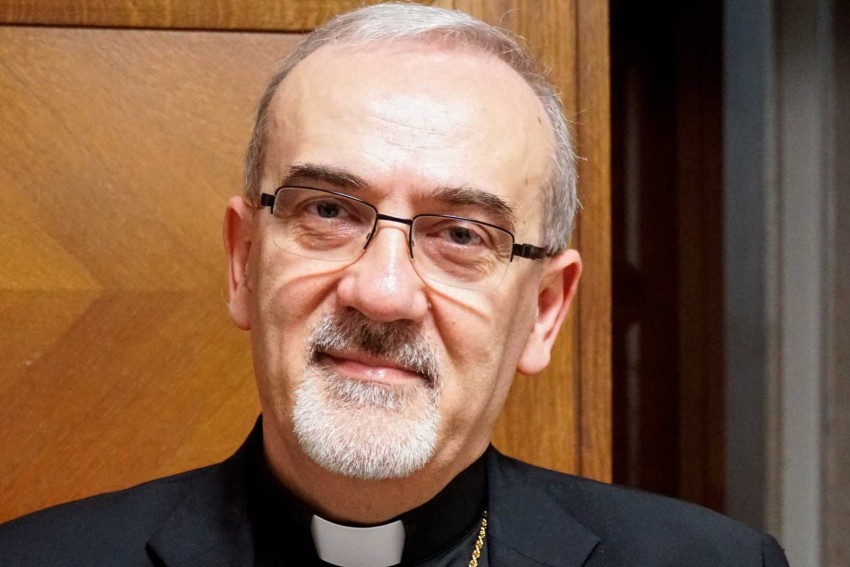

Bishop Eric Varden of Trondheim, Norway, was chosen to lead the Spiritual Exercises for the Roman Curia this Lent of 2026

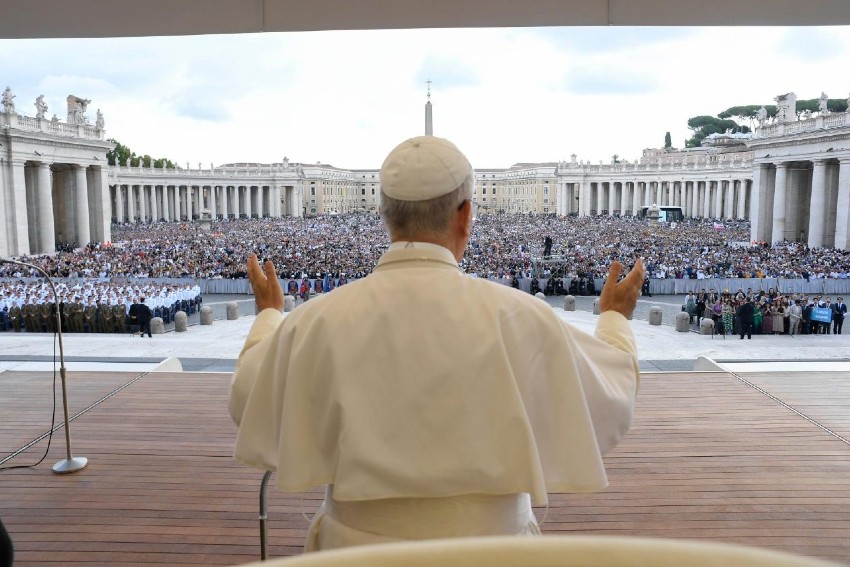
An image from the Lenten Retreat of the Vatican Curia, in the Pauline Chapel, with Bishop Eric Varden preaching. Pope Leo is sitting in the front row
Letter #14, 2026, Thursday, February 26: Bishop Varden
Bishop Eric Varden has this week been preaching the Spiritual Exercises for the Roman Curia.
The Vatican News agency has been giving summaries of his teaching (link).
Here below are high points from the Exercises this week in Rome.
* Bishop Erik Varden, Bishop of Trondheim, Norway, was asked to preach the 2026 Spiritual Exercises for Pope Leo XIV, Cardinals residing in Rome, and the heads of Dicasteries of the Roman Curia, which runs from Sunday, February 22, to Friday, February 27. Here is the link to his website.
—RM
‘Illuminated by a Hidden Glory’: Theme of Lenten Spiritual Exercises (link)
The Lenten Spiritual Exercises for Pope Leo XIV, Cardinals residing in Rome, and head of Dicasteries will be preached by Trappist Bishop Erik Varden, scheduled for February 22-27.
Vatican News
The start of the Spiritual Exercises for Lent is set for Sunday, February 22, at 5:00 p.m. in the Pauline Chapel, in the presence of Pope Leo XIV, Cardinals residing in Rome, and heads of Dicasteries.
The annual Lenten Exercises will be preached by Bishop Erik Varden, on the theme “Illuminated by a Hidden Glory.”
The Cistercians of the Strict Observance (Trappists) has served as Bishop of Trondheim in Norway since 2019.
Twice-daily meditations
From Monday, February 23, until its conclusion on February 27, Bishop Varden will preach two meditations each day, one at 9:00 a.m., preceded by Mid-Morning Prayer, and at 5:00 p.m., followed by Eucharistic Adoration and Vespers.
After the first reflection on the theme “Entering Lent” on Sunday, February 22, two meditations on Saint Bernard are scheduled: “Saint Bernard, the Idealist” and “Saint Bernard, the Realist,” scheduled for the afternoon of February 26.
Other themes include: God’s help; Becoming free; The splendor of truth; A thousand will fall; “I will glorify Him”; The angels of God; On consideration; concluding with the final meditation focused on “Communicating hope.”
From Norway to Vatican Radio
Bishop Erik Varden was born on May 13, 1974 in Sarpsborg, Norway (Diocese of Oslo).
He completed philosophical and theological studies at Cambridge, where he obtained a doctorate in theology, and at the Pontifical Oriental Institute in Rome, receiving a licentiate in Eastern ecclesiastical sciences.
He entered the Order of Cistercians of the Strict Observance in 2002, making his solemn profession at Mount St. Bernard Abbey in Leicestershire on October 6, 2007.
He was ordained a priest on July 16, 2011. He later taught at the Pontifical Atheneum of St. Anselm in Rome, while at the same time working for Vatican Radio’s Scandinavian section.
He then returned to Mount St. Bernard Abbey, taking on the role of Superior ad nutum (from 2013). In 2015, he was elected Abbot of Mount St. Bernard.
In 2019, he was appointed by Pope Francis as Bishop Prelate of Trondheim in Norway, and he was ordained Bishop in 2020.
Since 2023, he has also held the office of Apostolic Administrator of the Prelature of Tromsø; since 2024, he has been President of the Scandinavian Bishops’ Conference.
In 2025, Pope Leo XIV appointed him a Member of the Dicastery for the Clergy.
Lenten Retreat Preacher opens Spiritual Exercises in the Vatican (link)
The Lenten Spiritual Exercises for Pope Leo XIV, Cardinals residing in Rome, and heads of Dicasteries open on Sunday afternoon with the first reflection of Trappist Bishop Erik Varden on the theme of “Entering Lent.”
By Deborah Castellano Lubov
The Spiritual Exercises for Lent in the Vatican began Sunday, February 22, at 5 p.m. in the Pauline Chapel, in the presence of Pope Leo XIV, Cardinals residing in Rome, and heads of Dicasteries.
(…)
In his remarks at the beginning of the Spiritual Exercises on Sunday, Bishop Varden stresses that Lent confronts us with essentials: “it takes us, materially and symbolically, into a space stripped of superfluities.”
He notes that things apt to distract us, even things wholesome in themselves, are removed for a season, and reiterates how we are to embrace an abstinence of the senses.
In particular, the Preacher underscores that Christians are to battle against vices and harmful passions, but to pursue and be people of peace.
Before concluding, Bishop Varden cites St Bernard of Clairvaux as a model, who understood “what it means to live by grace as we fight evil, foster good, uphold truth, and follow the exodus path from unfreedom towards the land of promise…”
“He summons us,” the Preacher concludes, “to loving and clear-headed discipleship.”
====================
Bishop Varden at Lenten Retreat: St. Bernard, the Idealist (link)
Bishop Erik Varden delivers his second reflection at the Spiritual Exercises in the Vatican for Pope Leo XIV, Cardinals residing in Rome, and heads of Dicasteries, focusing on the theme: “Bernard, the Idealist.” Here is a summary of his reflection.
By Bishop Erik Varden, OCSO
What sort of man was St Bernard? Where did he come from? He towers over the twelfth-century Cistercian movement: such were his charisma and industriousness.
Many people, including some who should know better, suppose he got the order going. He did not, of course; though he did make a splash when he turned up in 1113, aged 23, with a band of thirty companions.
The monastery he joined, Cîteaux, was a project as much of innovation as of reform. The founders, who set it up in 1098, called their house novum monasterium. They were doing something new, not primarily reacting against anything, which is just as well, since projects of reaction sooner or later run into the sand.
On the face of it, the Cistercian project was conservative. Yet its protagonists introduced novelties. This dialectic was fruitful.
Bernard’s confidence in his own judgement could make him flexible in the observance of conventional procedures he otherwise claimed to uphold. His view of the Church’s needs drove him sometimes to adopt rigid positions that involved fierce partisanship.
But he was no hypocrite.
He was a genuinely humble man, fully given to God, capable of tender kindness, a firm friend—indeed, able to befriend former enemies—and a compelling witness to God’s love. He was, and remains, fascinating.
Dom James Fox, entrepreneurial abbot of Gethsemani from 1948 to 67, once wrote in exasperation about his confrère Thomas Merton: ‘His mind is so electrical!’ Merton wound Fox up with his ideas, intuitions, and insistence. Yet Fox knew him to be genuine. He respected him, enjoyed his company (when they were not in the middle of some epic quarrel), and went to Merton for confession for most of his abbacy.
It would be daft to compare Thomas Merton to Bernard of Clairvaux, yet there is temperamental similarity. While Bernard never knew about electricity, his was a quicksilver nature containing and having to equilibrate massive tensions.
Bernard’s teaching on conversion is born of a Biblical culture second to none and of well-pondered notions of theology. It is also, and increasingly so with the passage of time, born of personal struggle as he learns not to take it for granted that his course is always the right course, taught by experience, hurts, and provocations to consider his self-righteousness and marvel before God’s merciful justice.
Bernard is a good, wise companion for anyone setting out on a Lenten exodus from selfishness and pride, wishing to pursue authenticity with eyes set on the all-illumining love of God.
Lenten Retreat: Bishop Varden reflects on ‘God’s help’ (link)
Bishop Erik Varden delivers his third reflection at the Spiritual Exercises in the Vatican for Pope Leo XIV, Cardinals residing in Rome, and heads of Dicasteries, focusing on the theme: “God’s Help.” The following is a summary of his reflection.
By Bishop Erik Varden, OCSO*
Mary Ward, that great Christian educator of the 17th century, used to tell her sisters: ‘Do your best and God will help’.
The notion that God can and will help us in our predicaments is axiomatic to Biblical faith. It sets the God of Abraham, Isaac, and Jacob, the God made compassionate flesh in Christ Jesus, apart from the Unmoved Mover of philosophy.
Psalm 90 begins with the verse: ‘He who dwells within the help of the Most High’. God’s help, says Bernard, may indeed be called a habitat in as much as it forms a sustaining reality within which we can live, move, and have our being. God’s help is not occasional to us; it is not an emergency service we call out now and then, when a house is burning or someone has been hit by a car, the way we might dial 999.
But what about occasions when God-fearing people cry out to heaven but get no perceptible response, hearing only the desolate echo of their own voice?
The Scriptural type of such plight is Job, whose majestic book can be approached as a symphony in three movements, going from a visceral Lament through an exposition of Menace to a wholly surprising experience of Grace.
Job refuses to accept his friends’ rationalisations. He refuses to posit that God is just working out sums in his life as if it were a balance sheet. Unhelped, he is determined to find God present in his affliction, calling out heroically: ‘If it is not he, who then is it?’
As believers we may at some level regard our religion as an insurance policy. Certain of subsisting within God’s help, we may think we are out of harm’s way. A world can seem to collapse if — when — harm strikes. How do I face trials which cause my carefully assembled, customised protective fencing to fall? Is my relationship with God one of barter, disposing me to follow, when things are hard, the counsel of Job’s hard-headed wife to ‘curse God and die’? Or do I live at greater depth?
God can enable a new world to emerge after he has pulled down walls we thought were the world, walls within which we actually suffocated.
To live within God’s help as St Bernard would have us do is not to peddle securities. It is to pass through Lament and Menace in order to live graciously at a deeper level.
Lenten Retreat: Bishop Varden reflects on ‘becoming free’ (link)
Bishop Erik Varden delivers his fourth reflection at the Spiritual Exercises in the Vatican for Pope Leo XIV, Cardinals residing in Rome, and heads of Dicasteries, focusing on the theme: “Becoming Free.” The following is a summary of his reflection.
By Bishop Erik Varden, OCSO*
The notion of ‘freedom’ has become contentious in public discourse. Freedom is a good to which we all aspire; we rise up against anything which threatens to curtail or confine our freedom. As a result, the vocabulary of freedom is an effective rhetorical tool.
Suggestions that the freedom of a particular group is at risk will call forth instant responses of outrage on the internet. It may even rally people into the piazza.
A variety of political causes in Europe now harness the jargon of freedom. Tensions result. What one segment of society perceives as ‘liberating’ is found oppressive by others. Opposing fronts are raised, with the banner of ‘freedom’ held high on all sides. Bitter conflicts arise from incompatible agendas of purported liberation.
This state of affairs poses a challenge for Christians. It is essential to qualify what we mean when, in the context of faith, we speak of becoming free. That is what Bernard does when he comments on the verse: ‘For He has freed me from the snare of the hunters and from the bitter word.’
For Bernard it is evident that true freedom is not ‘natural’ to fallen man. What seems natural to us is to have things our way, to satisfy our desires and realise our plans without interference, to flaunt and be vaunted for our own brilliant lights. Bernard, addressing man in this state of delusion, is deliciously sarcastic: ‘What do you fancy yourself as, you smatterer?! You have become a beast for which captors’ snares are laid.’
The fact that we are so easily tripped up, that we keep falling into the same old snares, though we know so well where they lie, is to him proof good enough that we are unfree, unable on our own to make steady progress towards our life’s true goal, delivered instead to all sorts of obstructions and distractions.
Rooting his understanding of freedom in the Son’s Yes! to the Father’s will, Bernard works a revolution in our grasp of what it means to be free. Christian freedom is not about seizing the world with force; it is about loving the world with a crucified love magnanimous enough to make us freely wish, one with Christ, to give our lives for it, that it may be set free.
Caution is called for when freedom, held hostage by force, is manipulated as a means to legitimate the doings of impersonal subjects like ‘the Party’, ‘the Economy’, or even ‘History’. In a Christian way of thinking, no oppressive policy can be redeemed by invocations of ideological ‘freedom’. The only meaningful freedom is personal; and one person’s freedom cannot cancel another’s.
To subscribe to a Christian idea of freedom is to consent to pain. When Christ tells us: ‘Resist not evil’, He does not ask us to countenance injustice. He lets us see that justice’s cause is sometimes best served by suffering for it, refusing to meet force with force.
Our emblem of freedom remains the Son of God who ‘emptied Himself’.
Lenten Retreat: Bishop Varden reflects on the splendour of truth (link)
Bishop Erik Varden delivers his fifth reflection at the Spiritual Exercises in the Vatican for Pope Leo XIV, Cardinals residing in Rome, and heads of Dicasteries, focusing on the theme: “ The Splendour of Truth”. The following is a summary of his reflection.
By Bishop Erik Varden, OCSO*
Bernard keeps us on our toes. He states: ‘I would have you warned: no one lives on earth without temptation; if one is relieved of one, let him surely expect another’. We must nurture the correct balance between assurance in God’s help and distrust of our frailty, dreading temptations while we accept their inevitability, remembering that God submits us to them because they are useful.
Useful in what sense?
As we resist arrows launched by the Father of Lies, our commitment to the truth will be strengthened. We shall be fit, having turned away from weakening falsehood, to strengthen our brethren.
Ambition represents a particular form of capitulation to untruth. Ambition is a not very subtly sublimated form of cupidity. Describing it Bernard, always eloquent, surpasses himself. Ambition, he says, is ‘a subtle ill, a secret virus, an occult pest, an artisan of deceit; it is the mother of hypocrisy, the parent of envy, the origin of vices; it is kindling for crimes, causing virtues to rust, holiness to rot, hearts to be blinded. Remedies it turns into illnesses. From medicine it extracts apathy’. Ambition springs from an ‘alienation of the mind’. It is a madness that comes about when truth is forgotten. The fact that ambition is a form of insanity makes it ridiculous in any instantiation, but especially so when it occurs in persons given to a state of selfless service. Not for nothing does the figure of the ambitious clergyman haunt literature and cinema as a comic, but not very funny, trope — from the fawning parsons in Jane Austen to the tart courtier priest in Patrice Leconte’s notable film Ridicule.
‘What is truth?’
People of our time ask this question earnestly, often with remarkable good will, notwithstanding their confusion, fear, and the rush they are always in. We cannot let it go unanswered. We have no energy to waste on the silly temptations of fear, vainglory, and ambition. We need our best resources to uphold substantial, essential, freeing truth against more or less plausibly shining, more or less fiendish substitutes.
In our predicament, rich in opportunity, it is imperative to see and articulate the world in Christ’s light. Christ, who is truth, not only shields us; he renews us, impatient to reveal himself through us to a creation increasingly aware of being subject to futility.
It is tempting to think we must keep up with the world’s fashions. It is, I’d say, a dubious procedure. The Church, a slow-moving body, will always run the risk of looking and sounding last-season. But if she speaks her own language well, that of the Scriptures and liturgy, of her past and present fathers, mothers, poets, and saints, she will be original and fresh, ready to express ancient truths in new ways, standing a chance, as she has done before, of orienting culture.
This work has an important intellectual dimension. It also has an existential dimension. As Cardinal Schuster said on his deathbed: ‘It seems that people no longer let themselves be convinced by our preaching, but in the presence of holiness, they still believe, they still kneel and pray.’
Was not the universal call to holiness, the call, that is, to embody truth, the strongest note struck by the Second Vatican Council? It resounded splendidly like a gong throughout its deliberations. The Christian claim to truth becomes compelling when its splendour is made personally evident with sacrificial love in sanctity, cleansed of temptations to temporise.
Lenten Retreat: Bishop Varden on ‘the fall of thousands’ (link)
Bishop Erik Varden delivers his sixth reflection at the Spiritual Exercises in the Vatican for Pope Leo XIV, Cardinals residing in Rome, and heads of Dicasteries, focusing on the theme: “The Fall of Thousands.” The following is a summary of his reflection.
By Bishop Erik Varden, OCSO*
Falls can humble us when we are puffed up, showing God’s power to save. They can become milestones on a personal journey of salvation, to be recalled gratefully.
Yet we cannot afford to be gullible. Not every fall ends in exhilaration. There are falls that reek hellishly, bringing destruction to the guilty and carrying ruin in their wake. That wake is often broad and long, pulling in many innocents. We shall need fortitude to approach, with Bernard, the verse of Psalm 90 which begins: ‘A thousand shall fall at your side, ten thousand at your right.’
Nothing has done the Church more tragic harm, and compromised our witness more, than corruption arisen within our own house. The worst crisis of the Church has been brought on, not by secular opposition, but by ecclesiastical corruption. The wounds inflicted will take time to heal. They call out for justice and for tears.
It is tempting, face to face with corruption, especially when we confront abuse, to look for a diseased root. We expect to find early warning signs that were ignored: some failure in screening, an original pattern of deviancy. Sometimes these trails exist and we are right to blame ourselves for not having spotted them in time. We do not, however, find them always.
We can recognise the great and joyful good often manifest in the beginnings of communities now linked with scandal. We cannot presuppose that there was structural hypocrisy from the start, that founders set out as white-washed sepulchres. Sometimes we do find signs of inspiration, even traces of holiness. How can we simultaneously account for these and for warped developments?
A secular mindset will simplify: when it meets calamity, it designates monsters and victims.
Happily the Church possesses, when she remembers to use them, more delicate and more effective tools.
Bernard reminds us that where people pursue noble endeavours, enemy attacks will be fierce. He notes ‘that the spiritual men of the Church are attacked much more terribly than those who are carnal’. He thinks this is what the Psalm Qui habitat intends with its language of ‘left’ and ‘right’: the left stands for our carnal, the right for our spiritual nature. Casualties are more numerous on the right for that is where, on the spiritual battlefield, the most lethal weapons are used.
While he took the demonic realm seriously, this is not to say that he ascribes all spiritual disease to villains with horns and pitchforks. He holds men and women responsible for the way in which they use their sovereign freedom. His point is that human nature is one. If we begin to go deep into our spiritual nature, other depths are perforce laid bare. We shall face existential hunger, vulnerability, a yearning for comfort. Such experiences may arise by way of assault.
Progress in the spiritual life requires a configuring of our physical and affective self attuned to contemplative maturing, else there is danger that spiritual exposure will seek physical or affective release; and that such instances of release are rationalised as if they were, somehow, ‘spiritual’ themselves, more elevated than the misdemeanours of ordinary mortals. The integrity of a spiritual teacher will be attested by his conversation, but not only; it will be evidenced as much by his online habits, his comportment at table or at the bar, his freedom with regard to others’ adulation.
The spiritual life is not adjunct to the remainder of existence. It is its soul. We must beware of all dualism, always remembering that the Word became flesh so that our flesh might be imbued with Logos. We must keep a look-out both to the left and to the right while taking care, Bernard insists on this point, not to mistake the left for the right or the right for the left. We must learn to be equally at ease in our carnal and spiritual nature so that Christ our Master may govern peacefully in both.
Lenten Retreat: Bishop Varden reflects on ‘Glory’ (link)
Bishop Erik Varden delivers his seventh reflection at the Spiritual Exercises in the Vatican for Pope Leo XIV, Cardinals residing in Rome, and heads of Dicasteries, focusing on the theme of ‘Glory’. The following is a summary of his reflection.
By Bishop Erik Varden, OCSO*
When Jesus spelled out what it means to remain with him, to enter the Kingdom towards which he was pointing, ‘many of his disciples drew back and no longer went about with him’. They would not put up with his discourses about sacramental realism, the indissolubility of marriage, the necessity of the Cross. When Christ was crucified on Calvary, the synodos that had walked with him six days before was no more. Two followers only remained: his Mother and John, the Beloved Disciple. John gives a stark account of Jesus’s kenosis. It plays out at two levels: that of divine, compassionate love crushed in the wine-press of the Cross; and that of the betrayal of human loyalties. Yet John insists that this scene of dereliction manifests Christ’s glory.
‘Glorification’, says Bernard, ‘happens in the presence of God’s face’ when, our earthly voyage done, we shall at last behold what in this life we have firmly hoped for, putting our trust in Jesus’s name. ‘Spes in nomine, res in facie est’. There is no way of rendering this terse formula except by way of turgid circumscription: ‘Our hope is in the name of the Lord; the reality hoped for will be revealed face to face.’
Yet a ‘hidden glory’ is perceptible even now. Augustine liked to say that we carry the image of glory in an ‘obscure form’. Once we have passed through this life, the form will reveal itself explicit and ‘luminous’. It will be apt to stand before God. Any deformities inflicted by ill-used liberty will be reformed then, so that the form will appear in its intended beauty: as ‘forma formosa’.
Augustine, at once so profoundly humane and trenchantly lucid, stresses that the glory of the image can never be lost; it is imprinted on our being. It can, though, be buried under accumulating layers of darkness, which must be removed.
The Church reminds women and men of the glory secretly alive in them. She shows us that present mediocrity and despair, not least my despair at my own persistent failures, need not be final; that God’s plan for us is infinitely lovely; and that God, through Christ’s Mystical Body, will give us grace and strength, if only we ask.
The Church manifests the radiance of ‘hidden glory’ in her saints. They stand as proofs that even illness and degradation may be means providence uses to realise a glorious purpose, bestowing strength on the feeble and making them radiant. The Church channels ‘hidden glory’ in her sacraments. Any Catholic knows what light can break forth in the confessional, in an anointing, at an ordination or a wedding. Most splendid, and in some ways most veiled, is the glory of the Holy Eucharist. What priest, after offering Mass, has not felt what a great musician once said about an instrument in a bright communication of beauty, healing, and truth: ‘death would really be no tragedy: [for] the best of that which is at the centre of human life has been seen and lived through’, his heart on fire with glorious wonder?
Lenten Retreat: Bishop Varden reflects on ‘God’s Angels’ (link)
Bishop Erik Varden delivers his eighth reflection at the Spiritual Exercises in the Vatican for Pope Leo XIV, Cardinals residing in Rome, and heads of Dicasteries, focusing on the theme of ‘God’s Angels’. The following is a summary of his reflection.
By Bishop Erik Varden, OCSO*
During Christ’s forty-day sojourn in the desert Satan came to him citing Psalm 90, specifically two verses about the angels. ‘The devil’, we read in St Matthew, ‘took him to the holy city and placed him on the pinnacle of the temple.’ He challenged Christ to prove himself Son of God by throwing himself down, ‘for it is written: “He will command his angels concerning you” and “On their hands they will bear you up, so that you will not dash your foot against a stone”’.
God alone may invite us to jump from a pinnacle. His call, however, will be, ‘Jump into my arms’, not, ‘Throw yourself down’.
Angelic interventions are not always reassuring. The angels are not there to humour us in our caprices. In a popular prayer traceable to Bernard’s contemporary Reginald of Canterbury we ask our guardian angel to ‘enlighten, keep, govern, and guide’ us. These are hefty verbs. An angel is a guardian of holiness.
The monastic life was early understood and advertised as angelic on account of its finality of praise; but also in so far as the monk is called to be aflame with God’s love and to be an emissary who brings that love to others.
Christ’s one ‘canticle of praise’ of which Sacrosanctum Concilium speaks in a beautiful paragraph, resounds from the ends of the earth to heaven’s heights through a pulsating chain of mediation. The angels are essential to that chain, as we affirm in the final section of each preface within the canon of the Mass.
Bernard stresses the angels’ role as mediators of God’s providence. Mediation is not always called for. God can touch us immediately, but he delights in letting his creatures be channels of grace to one another.
He admonishes us to look at what an angel does and do likewise: ‘Descend, and show mercy to your neighbour; next, in a second movement, letting the same angel elevate your desires, use all the cupiditas of your soul to rise towards the most high and eternal truth’. Cupid is rarely referred to, these days, in the same breath as ‘most high and eternal truth’. Bernard’s choice of vocabulary is telling. It tells us that all natural human yearnings, including those that are embodied, are drawn towards fulfilment in God, so must be guided towards it.
The angels’ last, most decisive act of charity will happen when, at the hour of our death, they will bear us through this world’s veil into eternity. They will show their characteristics then: ‘They cannot be vanquished or seduced, even less can they seduce’. All pretence will fall in that hour. Rhetoric will fail. Only truth will stand and sound, attuned to mercy.
Bernard preached cautiously about these things in 1139. 726 years later a man of very different temperament but similar intelligence would make his intuitions explicit in an exquisite poem about dying.
John Henry Newman thought a lot about angels. He envisaged the priest’s ministry as angelic. The priest is at home in this world, unafraid to go into dark woods in search of the lost. At the same time he keeps his mind’s eyes raised towards the Father’s face, letting its radiance illumine all present reality. Illumination is ever a twofold process: intellectual and essential, sacramental and pedagogical.
Newman, now a Doctor of the Church, invites us to rediscover the teacher, too, as angelic enlightener. It is a prophetic challenge, given how much so-called ‘education’ is now farmed out to digital, artificial media, while young people yearn to meet teachers who are worthy of trust, who can impart not only skills but wisdom.
An angelic encounter is always personal. It cannot be replaced by a download or a chatbot.
Lenten Retreat: Bishop Varden reflects on ‘Bernard the Realist’ (link)
Bishop Erik Varden delivers his ninth reflection at the Spiritual Exercises in the Vatican for Pope Leo XIV, Cardinals residing in Rome, and heads of Dicasteries, focusing on the theme of ‘Bernard the Realist’. The following is a summary of his reflection.
By Bishop Erik Varden, OCSO*
February 26, 2026
The identity of the Cistercian movement is forged in the interface between the ideal and the concrete, the poetic and the pragmatic. Its protagonists are tested and purified by tensions that result.
I have spoken of Bernard’s high ideals, of his liking for working out a course of action in his mind, then following it a little ruthlessly. Riding a high horse came naturally to him. This fierce, intransigent aspect never left him. But it was sweetened over time. Of this process we must now speak. It turned the idealist into a realist.
The psychoanalyst Jacques Lacan said that ‘the real’ is what we butt against. The range of Bernard’s endeavours in Realpolitik made for a great deal of butting. But he became a realist not merely in the sense of accepting things as they are. He learnt above all that the deepest reality of all human affairs is a cry for mercy.
The more he recognised this cry in human hearts, in bitter tears, in worldly conflicts, in madcap campaigns against decency and truth, and in the whisper of the trees of the forest, the more he was conscious of God’s gracious response. He heard it in the holy name of Jesus, which became unspeakably dear to him. In Jesus God reveals his saving purpose, pouring it forth upon mankind as fragrant, healing, cleansing oil.
‘Every food of the mind’, Bernard told his monks, ‘is dry if it is not dipped in that oil; it is tasteless if not seasoned by that salt. Write what you will, I shall not relish it unless it tells of Jesus. Talk or argue about what you will, I shall not relish it if you exclude the name of Jesus. Jesus to me is honey in the mouth, music in the ear, a song in the heart.’
Bernard knew what wonders God’s mercy in Jesus can work. This gave his devotion affective depth. The term affectus is central to him. It has a broad remit, showing that grace moves us as sensate beings. But Bernard considered Jesus, the incarnation of truth, no less a hermeneutic principle. He read situations, persons, and relationships resolutely in Jesus’s light. This outlook has earned him firm admirers from well beyond the Catholic fold, from Martin Luther to John Wesley.
Only when supernaturally illumined will our nature reveal its perfect form, its forma formosa. Only then will the delightfulness of which earthly life is capable be apparent. Only then will the glory hidden within us and about us shine in substantial flashes, teaching us what we, and others, can become, providing a paradigm for a world renewed.
Such is the realism towards which Bernard matured. It enabled him to become not just a high-minded reformer, a matchless rhetorician, a chieftain of the Church. Knowledge of the utter reality of Christ’s love, and of its power to change everything, made Bernard a doctor and saint. And that is why we love and honour him.
‘He was’, the Vita Prima tells us, ‘at freedom with himself’. That is what life had taught him. A man or woman truly free is glorious to behold.
[End, summaries of the 2026 Spiritual Exercises of Bishop Eric Varden]
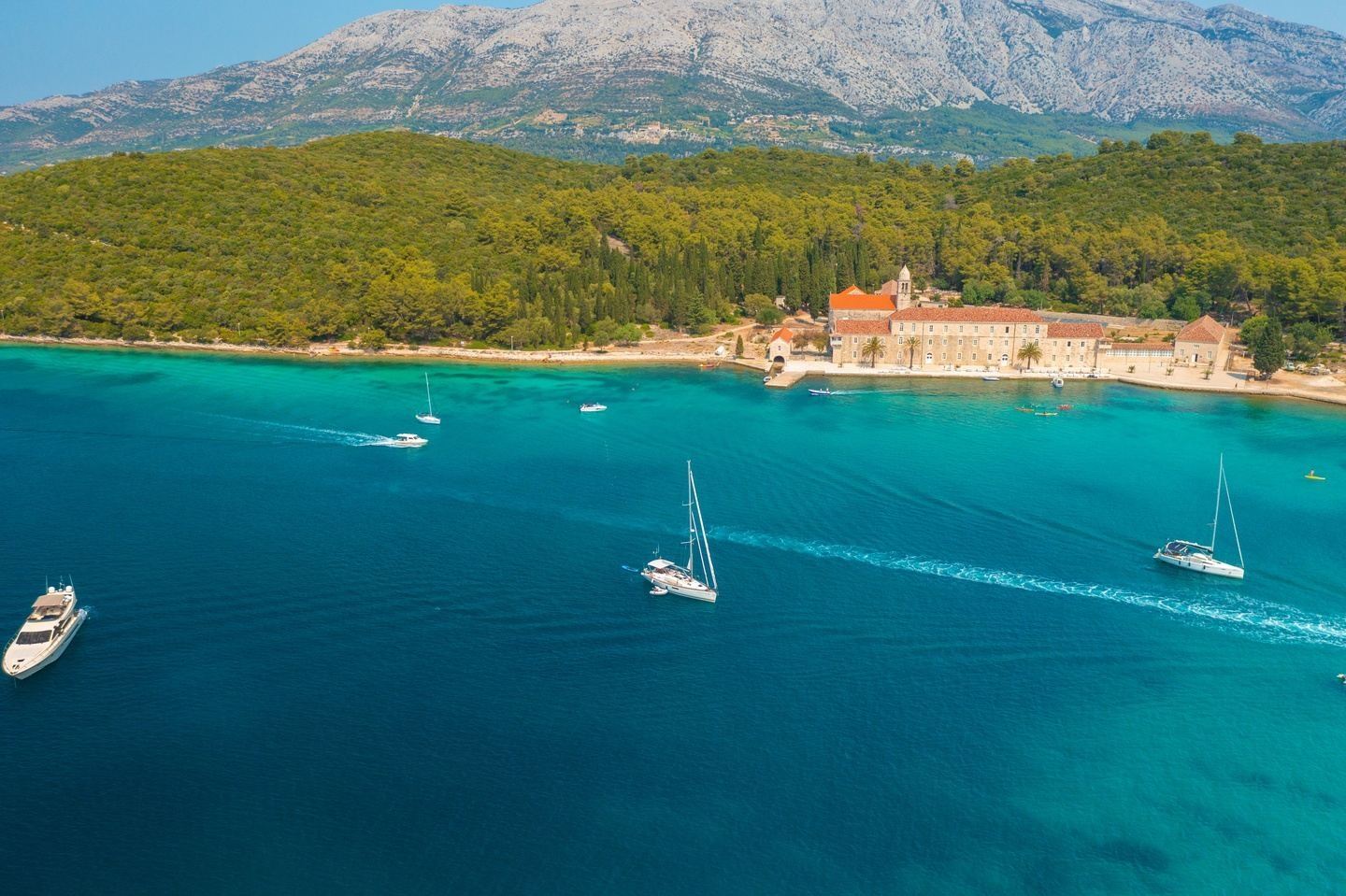
Rooted in Hope: Private Island Retreat with Bishop Athanasius Schneider
June 15 – June 21, 2026
Inside the Vatican Pilgrimages invites you to join a special Pilgrimage and Retreat with Bishop Athanasius Schneider, June 15-21, 2026.
Highlights of our Croatia Retreat with Bishop Schneider, June 2026
- Five-day private island retreat with Bishop Schneider at an ancient, recently restored monastery
- Daily Mass celebrated in the Traditional Latin Rite
- Free time to pray, explore the island, swim in the blue Adriatic waters, walk with other pilgrims along the island path, and travel to nearby islands in a private boat
- One night in Split with time to explore the city on your own