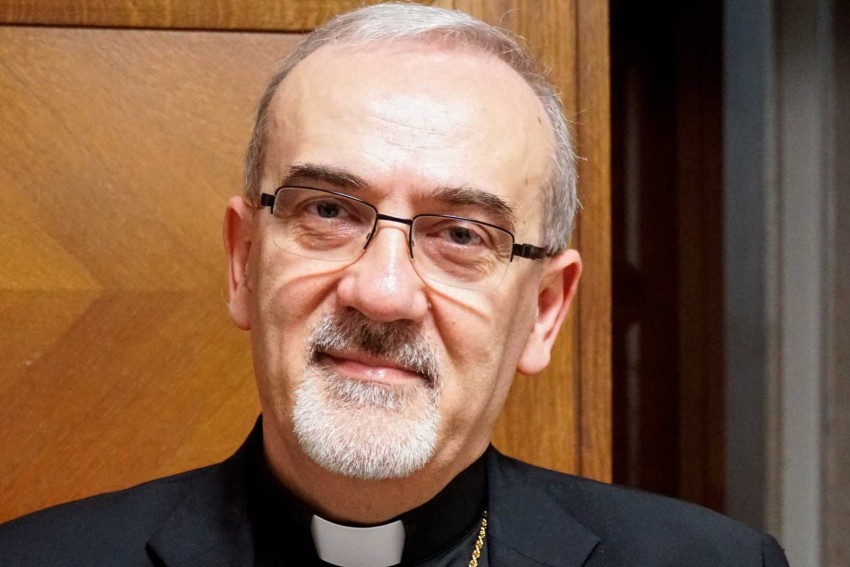
Cardinal Pierbattista Pizzaballa, 60, the Latin-rite Patriarch of Jerusalem — along with Father Francesco Ielpo, OFM, the Franciscan Custos (“Guardian”) of the Holy Land — was, “for the first time in centuries,” stopped, by Israeli police, and prevented from celebrating Mass today, Palm Sunday, in the Church of the Holy Sepulchre in Jerusalem (link). Full story below
“Greater love than this no man hath, that a man lay down his life for his friends.” —John 15:13. In these words in John’s Gospel, Jesus makes clear that the highest form of love is to give one’s life for others
Letter #18, 2026, Sunday, March 29: Jerusalem
I write from Rome on Palm Sunday, a week before Easter.
I just received this news from Jerusalem, which I now share with you.
It comes from the Latin Patriarchate of Jerusalem.
The message is from the Cardinal Patriarch, Pierbattista Pizzaballa, an Italian Franciscan, a good and holy man. I have met him, and have long admired him for his courage and faith.
He was the man who offered himself to become a hostage of Hamas in place of the Israelis taken hostage on October 7, 2023, in order to save the lives of the hostages, especially children, even at the cost of his own life. Jesus said: “Greater love than this no man hath, that a man lays down his life for his friends.”
On October 16, 2023, the Catholic Church’s highest ranking prelate in the Holy Land offered his “absolute availability” to be exchanged for Israeli children taken hostage by Hamas.
Cardinal Pizzaballa, the Latin patriarch of Jerusalem, told reporters during an online meeting October 16 that he was willing to do “anything” to “bring to freedom and bring home the children” taken into Gaza during Hamas’ October 7 attack on Israel, in which more than 1,300 Israelis were killed. (link)
The Israeli military said that day that some 200 people, including children and elderly persons, were being held hostage.
Returning the hostages held in Gaza is “absolutely necessary” to stopping the ongoing violence between Israel and Hamas, the cardinal said.
He expressed the Vatican’s willingness to assist in de-escalation and mediation efforts but said they had not been able to speak with Hamas.
In other words, Pizzaballa was willing to give his own life — because it was possible that, becoming a hostage, he might have lost his life — to bring peace in the struggle between Israel and the Palestinians in Gaza… a struggle that has continued to this day, and is part of the present struggle between Israel the US and Iran.
Pizzaballa was willing to give his life in order to stop the spiral of violence which has continued to this day, and each day threatens to grow even more intense and deadly.
May God grant that men such as Pizzaballa may play some role in bringing a peace to the Middle East which now, daily, seems ever more distant, yet ever more necessary… a peace for all in the Middle East, and for all mankind — as Pope Leo has rightly been praying for publicly, day after day, since he became Pope almost one year ago.
Below is the full text of the Press Release the Patriarchate released just a few hours ago.
—RM
Joint Press Release
The Latin Patriarchate of Jerusalem and the Custody of the Holy Land
Holy City of Jerusalem
Palm Sunday, 29 March 2026
This morning, the Israeli Police prevented the Latin Patriarch of Jerusalem, His Beatitude Cardinal Pierbattista Pizzaballa, Head of the Catholic Church in the Holy Land, together with the Custos of the Holy Land, the Most Reverend Fr. Francesco Ielpo, OFM, the official Guardian of the Church of the Holy Sepulchre, from entering the Church of the Holy Sepulchre in Jerusalem, as they made their way to celebrate the Palm Sunday Mass.
The two were stopped en route, while proceeding privately and without any characteristics of a procession or ceremonial act, and were compelled to turn back. As a result, and for the first time in centuries, the Heads of the Church were prevented from celebrating the Palm Sunday Mass at the Church of the Holy Sepulchre.
This incident is a grave precedent, and disregard the sensibilities of billions of people around the world who, during this week, look to Jerusalem.
The Heads of the Churches have acted with full responsibility and, since the outset of the war, have complied with all imposed restrictions: public gatherings were cancelled, attendance was prohibited, and arrangements were made to broadcast the celebrations to hundreds of millions of faithful worldwide, who, during these days of Easter, turn their eyes to Jerusalem and to the Church of the Holy Sepulchre.
Preventing the entry of the Cardinal and the Custos, who bear the highest ecclesiastical responsibility for the Catholic Church and the Holy Places, constitutes a manifestly unreasonable and grossly disproportionate measure.
This hasty and fundamentally flawed decision, tainted by improper considerations, represents an extreme departure from basic principles of reasonableness, freedom of worship, and respect for the Status Quo.
The Latin Patriarchate of Jerusalem and the Custody of the Holy Land express their profound sorrow to the Christian faithful in the Holy Land and throughout the world that prayer on one of the most sacred days of the Christian calendar has thus been prevented.
An old letter from 2013
Now I again offer an excerpt from a Moynihan Letter I wrote 13 years ago, on February 18, 2013, Letter #15, Benedict’s Vision.
I wrote the letter just 5 days after Pope Benedict resigned, but I think it is still relevant today, perhaps even more relevant than 13 years ago.
Here is the text of that letter (link):
***
Pope Benedict’s Vision for the Future
By Robert Moynihan
February 18, 2013
A vision for the future of the Church set forth in 1969, 44 years ago, by the relatively young theologian Joseph Ratzinger, then 42 — so at almost the exact midpoint of his life from his birth in 1927 until now — was recalled today by Italian writer Marco Bardazzi on the Vatican Insider website.
It was a vision of a Church with “far fewer members” and with “little influence over political decisions,” to the point of being almost “socially irrelevant” and forced to “start over.”
But it was also a vision of a Church that would find herself again and be reborn a “simpler and more spiritual” entity following “enormous confusion.”
The vision was set forth is a series of five radio homilies by Ratzinger in 1969, and was published in book form just two years ago by Ignatius Press as Faith and the Future.
Ratzinger said he was convinced the modern Church was going through a dramatic era similar to the Enlightenment and the French Revolution.
“We are at a huge turning point in the evolution of mankind,” he said. “This moment makes the move from medieval to modern times seem insignificant.”
From the crisis “will emerge a Church that has lost a great deal,” he warned. “It will become small and will have to start pretty much all over again. It will no longer have use of the structures it built in its years of prosperity… It will be a more spiritual Church, and will not claim a political mandate flirting with the Right one minute and the Left the next. It will be poor and will become the Church of the destitute.”
The process outlined by Ratzinger was a “long” one “but when all the suffering is past, a great power will emerge from a more spiritual and simple Church.”
Then, and only then, Ratzinger concluded, would Catholics begin to see “that small flock of faithful as something completely new… as a source of hope for themselves, the answer they had always secretly been searching for.”
The Destruction of the Church’s Mission through Worldliness
Has Benedict’s vision for the Church’s future changed over the past 44 years?
An exceptional talk he gave on the matter a year and a half ago offers insight into the Pope’s mind on this question. His talk is worth recalling now, in light of his announcement of his resignation on February 11, to take effect on February 28.
On his September 22-25, 2011 apostolic journey to Germany, Benedict went into his vision for the Church’s future in some detail in an address to Catholic workers in Freiburg im Breisgau on the final day of the trip, on Sunday, September 25.
“For some decades now we have been experiencing a decline in religious practice and we have been seeing substantial numbers of the baptized drifting away from Church life,” Benedict began.
So, in a sense, he was saying that the vision he had set forth in 1969 had, by 2011, come to pass.
He then posed the question this situation inevitably calls forth: should the Church not change?
“This prompts the question: should the Church not change? Must she not adapt her offices and structures to the present day, in order to reach the searching and doubting people of today?”
His answer?
“Yes, there are grounds for change,” he said. “There is a need for change. Every Christian and the whole community of the faithful are called to constant change.”
But, what type of change?
His answer: that the Church must “set herself apart from her surroundings, become in a certain sense ‘unworldly.’”
This is an arduous way of changing, a counter-cultural way.
And this is why the Church’s relationship to the world must always be nuanced.
Yes, the Church must change, and make herself “up-to-date.”
But she must not conform to the modern or progressive world; rather, she must “set herself apart from her surroundings” and “become in a certain sense ‘unworldly.’”
And the reason for this is that the Church’s mission is to point men and women beyond themselves, beyond whatever “present” they inhabit, beyond whatever “modern world” they live in, to what is eternal, that is, to God.
Benedict said (the italics are my own addition for emphasis):
“The Church’s mission has its origins in the mystery of the triune God, in the mystery of his creative love. And love is not just somehow within God, it is God, He Himself is love by nature.
“And divine love does not want to exist only for itself, by nature it wants to pour itself out. It has come down to humanity, to us, in a particular way through the incarnation and self-offering of God’s Son: by virtue of the fact that Christ, the Son of God, as it were stepped outside the framework of his divinity, took flesh and became man, not merely to confirm the world in its worldliness and to be its companion, leaving it to carry on just as it is, but in order to change it.”
Benedict then set forth a vision of an “economy” that is not an exchange of goods and services between men, but an exchange between men and God.
“The Christ event includes the inconceivable fact of what the Church Fathers call a sacrum commercium, an exchange between God and man,” Benedict said.
“The Fathers explain it in this way: we have nothing to give God, we have only our sin to place before him. And this he receives and makes his own, while in return he gives us himself and his glory: a truly unequal exchange, which is brought to completion in the life and passion of Christ.
“He becomes, as it were, a ‘sinner,’ he takes sin upon himself, takes what is ours and gives us what is his…
“The Church owes her whole being to this unequal exchange. She has nothing of her own to offer to him who founded her, such that she might say: here is something wonderful that we did! Her raison d’être consists in being a tool of redemption, in letting herself be saturated by God’s word and in bringing the world into loving unity with God.
“The Church is immersed in the Redeemer’s outreach to men. When she is truly herself, she is always on the move, she constantly has to place herself at the service of the mission that she has received from the Lord. And therefore she must always open up afresh to the cares of the world, to which she herself belongs, and give herself over to them, in order to make present and continue the holy exchange that began with the Incarnation.”
But this mission, to be a “tool of redemption,” to bring the world into loving unity with God, can be frustrated.
“In the concrete history of the Church, however, a contrary tendency is also manifested, namely that the Church becomes self-satisfied, settles down in this world, becomes self-sufficient and adapts herself to the standards of the world,” Benedict said.
“Not infrequently, she gives greater weight to organization and institutionalization than to her vocation to openness towards God, her vocation to opening up the world towards the other.”
And here Benedict spoke about the mission of the Church, and of each member of the Church, using words which may shed light on his decision to resign the papacy.
“In order to accomplish her true task adequately,” Benedict said a year and a half ago, “the Church must constantly renew the effort to detach herself from her tendency towards worldliness and once again to become open towards God. In this she follows the words of Jesus: “They are not of the world, even as I am not of the world” (Jn 17:16), and in precisely this way he gives himself to the world.”
Benedict’s decision to “leave the world” and, as it were, become “hidden” in a small convent inside the Vatican walls, may be seen as his attempt to try to accomplish his true task, which is “to open up the world towards the other.”
He added, provocatively:
“One could almost say that history comes to the aid of the Church here through the various periods of secularization, which have contributed significantly to her purification and inner reform.”
He is saying that those periods in which the Church has seemingly been diminished by secular forces, by the powers of this world, are actually periods which are needed to bring about the Church’s “purification and inner reform.”
And this is the vision that Benedict has for our future.
That we will lose many privileges, and many glories, from a human perspective. Cathedrals may close. Schools and universities may be abandoned or lost. Religious orders may die out. Secular laws may put great pressure on the Church.
But all of this can be freeing.
And of this can be a way of liberating the Church from a facade of holiness, and bringing about true holiness.
“Secularizing trends – whether by expropriation of Church goods, or elimination of privileges or the like – have always meant a profound liberation of the Church from forms of worldliness, for in the process she, as it were, sets aside her worldly wealth and once again completely embraces her worldly poverty,” Benedict said.
The destiny of the tribe of Levi…
“In this she shares the destiny of the tribe of Levi, which, according to the Old Testament account, was the only tribe in Israel with no ancestral land of its own, taking as its portion only God himself, his word and his signs,” he said.
“At those moments in history, the Church shared with that tribe the demands of a poverty that was open to the world, in order to be released from her material ties: and in this way her missionary activity regained credibility.”
And this is the key phrase: “in this way her missionary activity regained credibility.”
For that is what Benedict is after, in the end.
As a theologian, as a bishop, as a Pope, he wants the message of Christ to be seen for what it is, something life-giving, something liberating.
And if that message is losing credibility, the whole mission of the Church is in jeopardy.
If scandals, if corruption, if hypocrisy, if cover-ups, have made the message of the Church a message no one can hear without a sneer, then something must be done to free the message once again.
Something dramatic.
For the sake of the message.
Something like taking an action not taken in centuries.
Something like resigning the papacy and devoting one’s life to prayer.
“History has shown that, when the Church becomes less worldly, her missionary witness shines more brightly,” Benedict said.
“Once liberated from material and political burdens and privileges, the Church can reach out more effectively and in a truly Christian way to the whole world, she can be truly open to the world…
“The Church opens herself to the world not in order to win men for an institution with its own claims to power, but in order to lead them to themselves by leading them to him of whom each person can say with Saint Augustine: he is closer to me than I am to myself (cf. Confessions, III,6,11). He who is infinitely above me is yet so deeply within me that he is my true interiority.
“This form of openness to the world on the Church’s part also serves to indicate how the individual Christian can be open to the world in effective and appropriate ways.”
It is in these lines that one may find Benedict’s true interpretation of the Second Vatican Council, and the Council’s search to “open up” the Church so that her message could be better heard by the world. The entire point of the “opening up” was not to become worldly, but to be able to preach to the worldly.
“It is not a question here of finding a new strategy to relaunch the Church,” Benedict said. “Rather, it is a question of setting aside mere strategy and seeking total transparency, not bracketing or ignoring anything from the truth of our present situation, but living the faith fully here and now in the utterly sober light of day, appropriating it completely, and stripping away from it anything that only seems to belong to faith, but in truth is mere convention or habit.
“To put it another way: for people of every era, and not just our own, the Christian faith is a scandal,” Benedict said. “That the eternal God should know us and care about us, that the intangible should at a particular moment have become tangible, that he who is immortal should have suffered and died on the Cross, that we who are mortal should be given the promise of resurrection and eternal life – for people of any era, to believe all this is a bold claim.
“This scandal, which cannot be eliminated unless one were to eliminate Christianity itself, has unfortunately been overshadowed in recent times by other painful scandals on the part of the preachers of the faith,” he continued.
“A dangerous situation arises when these scandals take the place of the primary skandalon of the Cross and in so doing they put it beyond reach, concealing the true demands of the Christian Gospel behind the unworthiness of those who proclaim it.”
One senses in these words the terrible consequences of the priestly abuse of children for the Church, but not so much for the Church as institution as for the Church as the source of a message of healing and holiness.
The scandals have rendered the Church almost incapable of preaching her essential message.
This, too, helps explain why Benedict decided to resign.
“All the more, then, it is time once again to discover the right form of detachment from the world, to move resolutely away from the Church’s worldliness,” Benedict said.
The Pope then summed up his argument to the German Catholics he was speaking to:
“Openness to the concerns of the world means, then, for the Church that is detached from worldliness, bearing witness to the primacy of God’s love according to the Gospel through word and deed, here and now, a task which at the same time points beyond the present world because this present life is also bound up with eternal life.
“As individuals and as the community of the Church, let us live the simplicity of a great love, which is both the simplest and hardest thing on earth, because it demands no more and no less than the gift of oneself.”
Those lines are worth repeating. They seem to describe the choice that Benedict has made:
“As individuals and as the community of the Church, let us live the simplicity of a great love, which is both the simplest and hardest thing on earth, because it demands no more and no less than the gift of oneself.”
[End excerpt from Moynihan Letter #15 of February 18, 2013]