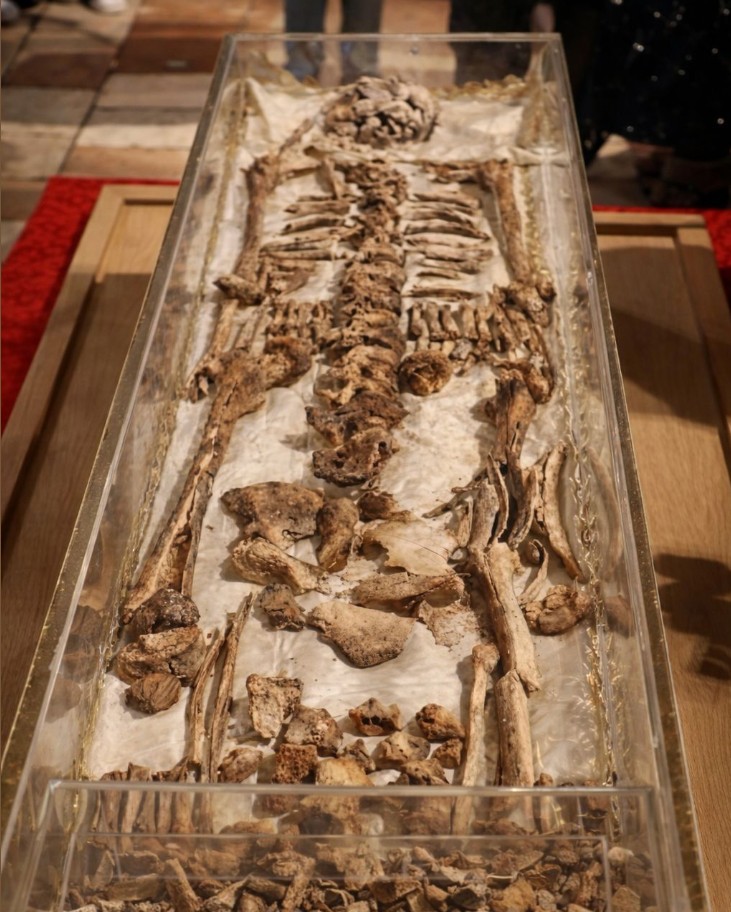
In commemoration of the 800th anniversary of his death, the relics of St. Francis of Assisi have been temporarily moved from their crypt to the foot of the papal altar in the Lower Basilica of St Francis in Assisi, Italy. This public veneration has been open from February 22 and will end in two days, on March 22, 2026. St. Francis of Assisi, pray for us
Letter #16, 2026, Thursday, March 19: The Chronicle of Archbishop Viganò’s Effort to Meet with Pope Leo XVI
I am in Rome, and staying in the Domus Santa Marta guesthouse, inside Vatican City, where Pope Francis lived until his death almost one year ago.
This guesthouse is where the cardinals stayed during the past conclave.
Today, March 19, the Feast of St. Joseph, marks the 13th anniversary of the inauguration of Pope Francis’s pontificate at the Inaugural Mass on March 13, 2013.
I have just been in Assisi, with a group of pilgrims, to venerate the bones of St. Francis of Assisi, who died 800 years ago this year, in 1226.
After a Mass in the Basilica of St Francis, as I gazed for some moments upon the bones of the saint, spread out in a glass case — skull and shoulder bones and ribs and arm bones and pelvis and leg bones and feet and wrist and hand and finger bones — I thought: “He was so small.”
The bones were those of a small man, it seemed to me.
“Yet,” I thought, “in his flesh, in his life, in his time, he was also so great, so large of soul, and of mind, and of longing for God, that his name, St. Francis, San Francesco, has gone out to the ends of the earth as one of the greatest of Christ’s disciples — and for both his greatness, and his smallness, we come to draw near to him, to learn from him, and to venerate him as someone who sought to become holy, and, in his humility, became a great saint.”
And meditating on the smallness of all human lives, and yet also on the potential for greatness in all human lives, I touched the glass case, bowed my head, and asked St. Francis to intercede for me, and all of you, as we make our way toward our own hour of death, and set out on our own final journey toward the face of God, and asked him to help us find peace in our world, and unity, in truth, in our Church.
I then left Assisi and came, via Foligno and Spoleto, to Rome.
***
And tonight, after having joined hundreds of Roman Catholics in a beautiful afternoon procession — the parishioners of the parish of the church of San Giuseppe (St. Joseph) carried a statue of St Joseph through the streets of Prati, a part of Rome on the Vatican Museums side of the Vatican, praying five decades of the rosary and singing hymns while traffic waited, and asking for rthe intercession of St. Joseph, for peace, and for unity, in truth — I was just about to fall asleep when…
I decided to click on my computer, just to check and see if an old friend, with whom I have not been in touch for some time, had written anything in recent days.
I typed in “Archbishop Viganò”… (The archbishop is now 85 years old.)
And, lo and behold, I came immediately to the web site of Aldo Maria Valli, also an old friend, an Italian journalist, and found that Valli, just a few minutes ago(!) — precisely this evening, Feast of St Joseph — had posted an extraordinary account written by Archbishop Viganò, and dated earlier today, about his efforts over the past year to have a meeting with Pope Leo XIV, which I did not know about.
And reading the account, I said to myself, “I have to send this out.”
“This made the condemned an outlaw”
Viganò does not give a full explanation of precisely why he has desired to meet with Pope Leo, but he does set his wish for the meeting in the context of the decree of excommunication for schism ordered by Pope Francis on July 4, 2024, just a few months before Pope Francis died. (link)
Viganò says he does not accept this “excommunication,” judging it “an unjust and evil action,” but still… still, he notes that, for those who impose the excommunication, the excommunication is a very severe punishment.
He writes that, for the Romans, excommunication was “the penalty in ancient Roman law equivalent to a form of perpetual exile, which required the condemned person to abandon Roman territory, with a prohibition against anyone providing him with water, fire, or any form of assistance, including hospitality or shelter, under penalty of severe punishment. In practice, this made the condemned an outlaw, depriving him of the essentials of survival and isolating him from society.”
And, indeed, this is true: the text of the 2024 excommunication judgment does ask all Catholics — and that means, also people like me — not to give any help to Viganò until the excommunication is lifted, under the threat of severe penalties.
Viganò reveals that he half expected that Pope Leo might have “reached out” to him as to a “lost sheep,” after Leo’s election to the papal throne last May 8, but he says “this did not happen.”
And then he describes how, from his side, he tried to arrange a meeting.
Here is the text by the archbishop that I read this evening:

March 19
Aures habent et non audiunt [“They have ears and do not hear”] (link)
“I listen to everyone!”
By Archbishop Carlo Maria Viganò
I would have expected Leo, following the example of the Good Shepherd, to come looking for the lost sheep and bring it back to the fold from which his predecessor had expelled it. This did not happen.
Although I am convinced that my “excommunication” is an unjust and evil action that for this reason had not actual juridical effect, I cannot help but point out that it constitutes, for those who inflicted it on me, a sort of aquae et ignis interdictio, the penalty in ancient Roman law equivalent to a form of perpetual exile, which required the condemned person to abandon Roman territory, with a prohibition against anyone providing him with water, fire, or any form of assistance, including hospitality or shelter, under penalty of severe punishment. In practice, this made the condemned an outlaw, depriving him of the essentials of survival and isolating him from society.
And so, in defiance of the fine words about welcome and inclusiveness, I see myself condemned to a “spiritual death penalty,” deprived of the Sacraments and supposedly destined for eternal damnation. For Bergoglio and Prevost, capital punishment, which kills only the body, would be inadmissible, but excommunication, which kills the soul and condemns it to eternal death, is permissible.
For this reason, wanting to leave no stone unturned, I felt it my duty to write to Leo and request an audience. Here is the chronology of the entire affair:
– On June 4, 2025, I sent a personal letter of extremely sensitive content via the Vatican Post, in which I also requested an audience.
– On August 28, 2025, having received no response to my previous letter, I resubmitted my request to be received in a private audience with Leo, through the Prefecture of the Pontifical Household, by sending an email to the Regent, Msgr. Leonardo Sapienza.
– On September 20, 2025, I received a reply from Msgr. Sapienza, confirming that the audience had been granted, and that it was scheduled for December 11, 2025, at 10:00 a.m. at the Library of the Apostolic Palace.
– On December 9, 2025, at 8:08 a.m., two days before the meeting, Msgr. Sapienza informed me by an email that the audience had been canceled.
– However, less than two hours later, at 9:53 a.m., the Secretariat of the Prefecture of the Pontifical Household forwarded me the ticket for the audience.
– Shortly thereafter, at 10:14 a.m., the same Secretariat informed me that the audience had been canceled.
– Following these contradictory communications, I called Msgr. Sapienza to understand the reason for the cancellation. Ostensibly embarrassed, he offered unbelievable excuses but assured me that he would communicate a new date as soon as possible, quoting Leo’s words: “We have to reschedule the audience: I listen to everyone!”
– Having received no communication from the Prefecture, on January 12, 2026, I wrote again to Msgr. Sapienza, receiving no response to my email.
– Since the path to the Prefecture was now closed to me, on the following January 21, I decided to telephone the Dean of the College of Cardinals, Card. Giovanni Battista Re, with whom I had collaborated for decades—in the Secretariat of State and in my subsequent functions—asking him to make every effort to secure an audience with Leo. I received an immediate enthusiastic response from the Cardinal, the transcript of which is provided below: “I am so happy, but very… I was very keen to hear your voice and I would also be happy to meet you wherever you want… I would be very happy to meet you…” Then the Cardinal added: “The essential problem is that it would be the Pope himself to receive you with all that has happened. In my opinion, the Pope is having difficulty receiving you: it’s not a problem of time or appointments. The Pope has some doubts about being the one to receive you… without there being any sign of change on your part. In any case, I will take care and I will happily let you know… Because we must be children of the Church and as children of the Church we must be united with the Pope and follow the Pope’s directives. What we must care about is the salvation of the soul, but to save the soul we must remain within the Church. Within the Church, therefore, remain in union with the Pope. In any case, know that from a personal point of view I am close to you, always available to help you, if I can help in any way, so that we can serve the Church together… We must also know how to forget the past and also know how to forgive…”
– On January 27, 2026, I met with the Cardinal Dean at the Nunciature in Italy. The conversation lasted over an hour. Despite his good-natured demeanor and displays of affection, the Cardinal proved incapable of listening to my arguments, so much so that he even refused to receive a letter I had to deliver to Leo and other sensitive documents I wanted to inform the Cardinal of. As I took my leave, he repeated: “We must obey the Pope even if the Pope does not obey the Lord.”
– On January 28, 2026, I sent this letter of mine to Leo via Vatican Post, addressing it to his personal secretary. This letter—the content of which I will soon disclose—also remains unanswered.
+ Carlo Maria Viganò, Archbishop
Viterbo, 19 March MMXXVI
Joseph Sponsi B.M.V. Confessoris [Feast of St. Joseph, Spouse of the Blessed Virgin Mary, Confessor]
—RM
(Note: Archbishop Viganò is currently living outside of Viterbo, a small city an hour or so north of Rome.)