
Pope Leo XIV today spoke with journalists aboard the papal plane bound for Beirut, Lebanon, following more than three days in Turkey. On the flight, he spoke of the Vatican’s view that a Palestinian state in the Holy Land is needed to bring peace to the region
***
Letter #94, 2025, Sunday, Nov 30, Feast of St. Andrew, brother of St. Peter: Day #4 of Pope Leo’s 1st foreign trip as Pope marked by mention of support for a Palestinian state during the papal flight press conference
Pope Leo said today that the only solution in the decades-long conflict between Israel and the Palestinian people must include a Palestinian state, reaffirming the Vatican’s long-held position.
“We all know that at this time Israel still does not accept that solution, but we see it as the only solution,” Leo, the first US pope, told journalists on a flight from Turkey to Lebanon, as he held his first in-flight press conference as Pope. (full text of the press conference below)
Leo quickly added: “We are also friends of Israel, and we try with the two sides to be a mediating voice that can help draw closer to a solution with justice for all.”
And Leo also emphasized something that he first mentioned yesterday: that he hopes to visit Jerusalem in the Holy Land, along with other Christian leaders, on the 2,000th anniversary of the Crucifixion and Resurrection of Christ in 2033 A.D.
***
Most political figures in Israel — including Prime Minister Benjamin Netanyahu — are vehemently opposed to the creation of a Palestinian state.
Leo’s eight-minute press conference was brief and focused primarily on his visit to Turkey, which he visited from Thursday to Sunday on his first overseas trip since he was elected in May.
But still, the press conference did touch on the difficult situation in Lebanon, where the papal plane was about to land, and in neighboring Israel, where a bloody war between Israel and the Palestinians in Gaza, and to a lesser degree in the West Bank, has been fought since October 7, 2023, more than two years ago, leaving tens of thousands dead.
And so, the most important “takeaway” from the press conference was what Leo said about Palestine: that the Vatican has supported, and still does support, the idea of a separate state for the Palestinian people as “the only solution” viable to bring peace to the region.
Papal Press Conference, in which Palestine was mentioned
Here is the full transcript of Pope Leo’s Press Conference with the world’s press, traveling with him on the papal plane (link to the English text; link to the text the Vatican released, with both English and Italian)today:
Pope Leo: Turkey has important role for peace in Middle East and Ukraine
Sunday, November 30, 2025
Aboard the papal plane flying from Istanbul to Beirut, Pope Leo XIV thanks Turkey’s authorities for their welcome and answers a pair of questions from reporters, expressing his hopes for peace in Ukraine and Gaza and confirming the desire to celebrate the 2033 Jubilee of Redemption in Jerusalem.
By Vatican News
As the papal plane flew Pope Leo XIV from Türkiye to Lebanon on Sunday afternoon, he took a moment to answer questions from reporters traveling with him on his first Apostolic Journey.
The Pope began by expressing his appreciation for his visit to Türkiye, especially the work of the Turkish government.
Here follows a working English transcription and translation of the press conference:
Pope Leo XIV (in English): Good afternoon to you all. I’ll speak English to start; I think most of you understand. I’m happy to greet you. I hope you all had as good a time in Türkiye as I did. I think it was a wonderful experience.
As you know, the primary reason for coming to Türkiye was the 1,700th anniversary of the Council of Nicaea.
We had that magnificent celebration, very simple and yet very profound, on the site of one of the ancient basilicas of Nicaea to commemorate the great event of the agreement of the whole Christian community and the profession of faith, the Nicene-Constantinopolitan Creed.
Besides that, of course, there were many other events that we celebrated.
I personally want to express to all of you my gratitude for all the work that went into planning the visit, beginning with the Nuncio, the staff, the whole team from Rome, of course, that did all the organization, but in a very special way the government of Türkiye, President Erdogan and so many people that he put at our disposition in order to make sure that the trip would be a total success, his personal helicopter, many means of transportation, organization, etc, the presence of the ministers in various moments along the visit, so it was, I think, a great success.
I was very happy to have the different moments we had with the different Churches, with the different Christian communities, with the Orthodox Churches, culminating this morning with the Divine Liturgy with Patriarch Bartholomew.
So, it was a wonderful celebration, and I hope that all of you shared that same experience, so thank you.
I don’t know if there are any questions or comments, just a couple because they are waiting for me for more photos.
Q: Baris Seçkin (Anadolu Ajansi): Thank you very much. At the beginning of your papal trip you made reference to world and regional peace. In this regard, what is your comment on Türkiye’s role in achieving and maintaining world and regional peace, and what were your discussions with President Erdogan on this matter?
To have come to Türkiye, and of course now to Lebanon, on this trip there was of course a special theme of, if you will, being a messenger of peace, of wanting to promote peace throughout the region.
Türkiye has a number of, if you will, qualities about it; it is a country with the vast majority being Muslims, and yet the presence of numerous Christian communities there, although a very small minority, and yet people of different religions are able to live in peace. And that is one example, I would say, of what I think we all would be looking for throughout the world.
To say that in spite of religious differences, in spite of ethnic differences, in spite of many other differences, people can indeed live in peace.
Türkiye itself has had, of course, in its history various moments when it was not always the case, and yet to have experienced that and to have been able to speak also with President Erdogan about peace, I think, was an important element, a worthwhile element of my visit.
Q: Seyda Canepa (NTV, in Italian): Your Holiness, with President Erdogan, other than the official declarations, did you speak about the situation in Gaza since the Vatican and Türkiye have the same point of view on the solution of two people, two states? On Ukraine, the Vatican has underlined more than once the role of Türkiye, starting from the opening of the grain corridor at the beginning of the conflict. So, do you see hope for a ceasefire in Ukraine and for a faster peace process in Gaza in this moment?
(In Italian): Certainly, we spoke about both situations.
The Holy See for several years has publicly supported the proposal of a two-state solution.
We all know that in this moment Israel still does not accept this solution, but we see it as the only solution that could offer—let us say—a solution to the conflict that they continuously live.
We are also friends of Israel, and we try with the two sides to be a mediating voice that can help draw closer to a solution with justice for all.
I spoke about this with President Erdogan; he is certainly in agreement with this proposal.
Türkiye has an important role that it could play in all of this.
The same with Ukraine.
Already some months ago, with the possibility of dialogue between Ukraine and Russia, the President helped a lot in convoking the two sides.
We still have, unfortunately, not seen a solution, but today again there are concrete proposals for peace.
And let us hope that President Erdogan, with his relationship with the Presidents of Ukraine, Russia, and the United States, may help in this sense to promote dialogue, a ceasefire, and to see how to resolve this conflict, this war in Ukraine.
He suggests (Matteo Bruni, ed.) that I say a word after the important ecumenical meeting in Nicaea, and then, yesterday morning, we spoke about possible future meetings.
One would be in 2033, 2,000 years since the Redemption, the Resurrection of Jesus Christ; that obviously is an event that all Christians want to celebrate.
The idea was welcomed; we still haven’t sent the invitation, but the possibility exists to celebrate, perhaps in Jerusalem in 2033, this great event of the Resurrection. There are still years to prepare it.
However, it was a very beautiful encounter, because Christians of different traditions were present and were able to participate in this time.
Thank you all.
[End, today’s papal flight press conference]
From Turkey to Lebanon
Today was a day of transition, and of some polemics, for Pope Leo.
Leo spent the morning of his 4th day in Turkey wrapping up his historic visit to Turkey — after on Friday visiting the site of the Council of Nicaea, held 1,700 years ago in 325 A.D., and on Saturday visiting the “Blue Mosque” in Istanbul, respectfully, but without an expected moment of silence for prayer, and then signing a declaration on behalf of peace with the leader of the world’s Orthodox Christians, Greek Orthodox Ecumenical Patriarch Bartholomew.
So today Leo:
—visited the cathedral of the Armenian Apostolic Church for common prayer
—celebrated Sunday Mass in the eastern rite (Divine Liturgy) in the Patriarchal Church of St. George together with Greek Orthodox Ecumenical Patriarch Bartholomew
—had lunch with Patriarch Bartholomew
—carried out all of the protocol ceremonies to take leave of Turkey
—lifted off in his jet from the airport in Istanbul, headed for Lebanon
—held a brief press conference during his flight from Istanbul to Beirut, during which the question of a Palestinian state was mentioned
—carried out all of the ceremonies of arrival at Beirut airport in Lebanon, then
— made a courtesy visit to the President of Lebanon, then
— held a meeting with the President of the National Assembly, then
— held a meeting with Lebanon’s Prime Minister, and then
— held a meeting with other political and civil authorities, and with the diplomatic corps in Lebanon (see this video)
— answered journalists questions as night was falling (see this video)
In Lebanon, despite heavy rain (see this video), thousands turned out to meet the Pope. A large number of “welcome” signs had been placed on many roads throughout the country, in order to greet the Roman pontiff with affection.
This made a favorable impression on all who viewed the outpouring of affection and support, even in the Muslim sections of Beirut, for Pope Leo XIV.
Below is a report on today’s events from Inside the Vatican correspondent Anna Artymiak, a Polish journalist based in Rome.
—RM
Note: If you would like to subscribe to this letter, or add a friend as a subscriber, you may do so here.
If you wish to donate to this letter, click here.
Pope Leo’s day started with a visit to the Armenian Orthodox Patriarch of Constantinople, who greeted him with a gift of “:salt and bread.”
In Armenian tradition, bread symbolizes life and God’s generous blessing, while salt represents purity, loyalty, incorruptibility, and faithful relationships.
To “eat salt and bread together” means to seal a bond of lasting trust and peace.
In Armenian spirituality, this call to hospitality is rooted in Abraham welcoming the three angels…


After leaving the Armenian Patriarch, Leo attended divine liturgy with the Greek Orthodox Patriarch, Bartholomew (photos below)

A view at the start of the divine liturgy this morning in St. George’s Church in the Phanar in Istanbul. The Vatican delegation with Pope Leo is on the right, the Greek Orthodox hosts on the left, including Ecumenical Patriarch Bartholomew, who is slightly obscured in this photo. The video highlights of this long liturgy may be seen here

The embrace between the Catholic and Orthodox leaders

Patriarch Bartholomew beside Pope Leo as Leo venerates a holy icon

Patriarch Bartholomew delivers his homily

Pope Leo reads his remarks on the significance of this occasion (see below for the full text)

Pope Leo and Patriarch Bartholomew give their blessing together

Leo’s arrival in Lebanon. Despite heavy rain, crowds came out to greet the new Pope…

Leo, now in Lebanon, walks toward his final meeting of the day…

Leo enters the room of the government and civil leaders and the diplomatic corps in Lebanon, his final meeting of the day

Leo, after a 14-hour day that began in Turkey, continued on the plane to Lebanon, and involved many meetings in Beirut, continues to answer journalists’ questions after his final meeting of the day. Leo emphasized that every human person has dignity and that children must be well-educated and well-formed to provide a hopeful future for every country

Trip of Pope Leo XIV, Day #4
From Istanbul to Beirut: The Papal Flight…
By Anna Artymiak
Day #4, Nov 30th
Today Pope Leo XIV concluded his visit to Turkey during his first Apostolic Journey to Turkey and Lebanon on the occasion of the 1700th anniversary of the first Council of Nicaea to celebrate the Nicene Creed.
It is the only Apostolic Journey that Leo XIV is making this year which the Catholic Church lives as an Ordinary Jubilee Year dedicated to hope.
The 4th and last day of Leo’s Apostolic trip to Turkey started with the visit to the Armenian Apostolic Cathedral. Before the Cathedral the Pope was welcomed by His Beatitude Sahak II Mashalian, the Armenian Patriarch of Constantinople with a gift of bread (see link).
EWTN reported: “In a candid moment, Pope Leo blessed the traditional Armenian offering of bread and salt—and, after asking the Armenian Patriarch Sahak II if he should eat the piece, he did. This was the first event of his fourth and final day in Turkey: a prayer visit to the Armenian Apostolic Cathedral, where he was welcomed with the customary gift of bread and salt. In Armenian tradition, bread symbolizes life and God’s generous blessing, while salt represents purity, loyalty, incorruptibility, and faithful relationships. To ‘eat salt and bread together’ means to seal a bond of lasting trust and peace. In Armenian spirituality, this call to hospitality is rooted in Abraham welcoming the three angels, the Gospel invitation to receive Christ in every stranger, and the monastic tradition of caring for pilgrims.”
At the beginning of the prayer meeting, the Holy Father blessed gathered the faithful together with the Patriarch. Leo was also invited to say a prayer in English.
Sahak II Mashalian pronounced his address in English. He said that the First Council of Nicaea “was a spiritual turning point in Christian history, reminding us that unity is essential, that truth must be spoken with courage, and that our shared faith in Christ transcends nation, ethnicity, and time.”
He thanked the Popes for being the moral voice and defender of people. “The Papacy has long served as a moral compass, defending the dignity of every human being, championing peace, and giving voice to those who have none,” he said.
“The Armenian people do not forget the Popes who raised their voice in our times of suffering, who stood with Christian communities in danger, and who upheld truth when the world hesitated,” he added.
The Patriarch underlined that the “unity becomes essential” in the times where Christian presence in the Middle East “faces hardship, migration and declining numbers.”
He spoke of the suffering of many Christians: “Unfortunately, in these days of hot conflict, we are witnesses to the suffering people have had to endure. We are especially mindful of the continuing agony experienced by Christians across the Middle East, who bear a great share of persecution.”
And he expressed his hope that “the immense moral voice and influence of the papacy” contributed “for the safety of these vulnerable Christian communities, especially in the very region to which you will travel later today.”
Leo XIV thanked the Patriarch “for the courageous Christian witness of the Armenian people throughout history, often amid tragic circumstances.”
He recalled significant moments of recent relations between both Churches: the May 1967 exchange of the kiss of peace between His Holiness Catholicos Khoren I and the bishop of Rome, and the first joint declaration between Paul VI and Catholicos Vasken I in May 1970 “inviting their faithful to rediscover themselves as brothers and sisters in Christ with a view to fostering unity” what led also to the “dialogue of charity” between the Churches.
Speaking of the commemoration of 1700th anniversary of Nicaea, Leo spoke about unity and restoring full communion.
“We must draw from this shared apostolic faith in order to recover the unity that existed in the early centuries between the Church of Rome and the ancient Oriental Churches,” Leo said. “We must also take inspiration from the experience of the early Church in order to restore full communion, a communion which does not imply absorption or domination, but rather an exchange of the gifts received by our Churches from the Holy Spirit for the glory of God the Father and the edification of the body of Christ (cf. Eph 4:12).”
In this context, Leo spoke about saints of the Armenian tradition including 12th-century Catholicos and poet Berses IV Shnorhali.
Leo XIV expressed his hope that “the Joint International Commission for Theological Dialogue between the Catholic Church and the Oriental Orthodox Churches will be able to resume its fruitful work promptly, seeking a model of full communion “together, of course,” as Pope John Paul II wished in his 1995 Encyclical Ut unum sint (no. 95).”
The Holy Father at the end of the meeting received from the Patriarch a chalice and exchanged his own gift, a mosaic picture of the Greek Cross created by the Vatican Mosaic Studio.
The prayer meeting concluded with the Pope’s blessing.
Then the Patriarch with the Holy Father inaugurated a commemorative plaque.
The mosaic picture Pope Leo gave the Patriarch is inspired by Byzantine-style crosses, known as “Greek” crosses because they feature four arms of equal length. The Greek letters Ι (iota) and Χ (chi) are abbreviations which stand for the words “Iesus” and “Xristos” (Jesus Christ), while Μ (mi) and Θ (theta) abbreviate “Mḗtēr Theoû,” meaning Mother of God. The colors used have a specific symbolic meaning: green alludes to the Holy Spirit, red to the divine, and blue to the earthly element.
The Arminian Christians are the largest Christian community in Turkey.
The Armenian Church is not Orthodox, but Oriental.
The Armenian Patriarchate of Constantinople is an autonomous seat of the Armenian Apostolic Church.
The seat of the Armenian Patriarch of Constantinople, also known as the Armenian Patriarch of Istanbul, is the patriarchal church Surp Asdvadzadzin (Patriarchal Church of the Holy Mother of God), in the Kumkapı district.
The Armenian Patriarchate of Constantinople recognizes the primacy of the Catholicos of All Armenians, in the spiritual and administrative seat of the Armenian Church, Etchmiadzin (Armenia), in matters concerning the worldwide Armenian Apostolic Church.
In local matters, the patriarchal seat is autonomous.
Here is Leo’s full text addressed to the Armenian Patriarch:
APOSTOLIC JOURNEY OF HIS HOLINESS POPE LEO XIV
WITH A PILGRIMAGE TO IZNIK (TÜRKIYE)
ON THE OCCASION OF THE 1700th ANNIVERSARY OF THE FIRST ECUMENICAL COUNCIL OF NICAEA
(27 November – 2 December 2025)
GREETING OF HIS HOLINESS POPE LEO XIV
TO ARMENIAN PATRIARCH SAHAK II
Armenian Apostolic Cathedral (Istanbul)
Sunday, 30 November 2025
____________________________________
Dear Brother in Christ,
It is a great joy for me to visit Your Beatitude, especially in the very place where the late Patriarchs Shenork I and Mesrob II, of happy memory, welcomed my predecessors.
As I greet you, I would also like to extend my fraternal regards to His Holiness Karekin II, Supreme Patriarch and Catholicos of All Armenians, who recently honored me with a visit, as well as to the bishops, clergy and the entire Armenian Apostolic community in Istanbul and Türkiye.
This visit provides me with the opportunity to thank God for the courageous Christian witness of the Armenian people throughout history, often amid tragic circumstances.
I would also like to express my deep gratitude to the Lord for the ever-closer fraternal bonds uniting the Armenian Apostolic Church and the Catholic Church.
Shortly after the Second Vatican Council, in May 1967, His Holiness Catholicos Khoren I became the first primate of an Oriental Orthodox Church to visit and exchange the kiss of peace with the Bishop of Rome. I also recall that in May 1970, His Holiness Catholicos Vasken I signed with Pope Paul VI the first joint declaration between a Pope and an Oriental Orthodox Patriarch, inviting their faithful to rediscover themselves as brothers and sisters in Christ with a view to fostering unity. Since then, by God’s grace, the “dialogue of charity” between our Churches has flourished.
On this 1700th anniversary of the first ecumenical Council, my visit offers an opportunity to celebrate the Nicene Creed. We must draw from this shared apostolic faith in order to recover the unity that existed in the early centuries between the Church of Rome and the ancient Oriental Churches.
We must also take inspiration from the experience of the early Church in order to restore full communion, a communion which does not imply absorption or domination, but rather an exchange of the gifts received by our Churches from the Holy Spirit for the glory of God the Father and the edification of the body of Christ (cf. Eph 4:12).
It is my hope that the Joint International Commission for Theological Dialogue between the Catholic Church and the Oriental Orthodox Churches will be able to resume promptly its fruitful work, seeking a model of full communion “together, of course,” as Pope John Paul II wished in his Encyclical Ut unum sint (no. 95).
On this journey towards unity, we are preceded and surrounded by “a great cloud of witnesses” (Heb 12:1). Among the saints of the Armenian tradition, I would like to remember the great 12th-century Catholicos and poet Nerses IV Shnorhali, whose 850th anniversary of death we recently commemorated, and who worked tirelessly to reconcile the churches in order to fulfil Christ’s prayer that “they may all be one” (Jn 17:21). May the example of Saint Nerses inspire us and his prayer strengthen us on the path to full communion!
In thanking Your Beatitude for your warm welcome, I assure you of my wholehearted dedication to the holy cause of Christian unity. May we receive this gift from above with open hearts so that we may be ever more convincing witnesses to the truth of the Gospel and better servants of the mission of the one Church of Christ.
Copyright © Dicastery for Communication – Libreria Editrice Vaticana
The Divine Liturgy
For the fourth time in history, the Ecumenical Patriarchate had the Holy Father for the celebration of St. Andrew liturgical solemnity.
It is a tradition that the Catholic and the Orthodox Churches exchange delegations for the respectful feast of St. Peter and St. Paul (June 29, when the Orthodox visit Rome) and of St. Andrew (when the Catholics visit Constantinople).
Leo XIV arrived to the Patriarchal Church of Saint George amid Orthodox chants. He lit a candle and entered the Patriarchal Church to participate in the Divine Liturgy. He was wearing richly calligraphed and gemmed stole adorned with eleven crosses he received day before from the Ecumenical Patriarch as a gift.
St. Andrew, as the Pope recalled, according to ancient tradition brought the Gospel to this city. “His faith is the same as our faith, namely that which was defined by the Ecumenical Councils and is professed by the Church today.”
In his speech pronounced in English, the Holy Father spoke about the dialogue of reconciliation between the Catholic and the Orthodox Churches and the need of them to be peacemakers in today’s world.
“In the past, there have been many misunderstandings and even conflicts between Christians of different Churches, and there are still obstacles preventing us from achieving full communion,” Pope Leo said.
“Nevertheless, we must not relent in striving towards unity,” he continued. “We must continue to consider each other as brothers and sisters in Christ and to love one another accordingly.”
Leo XIV recalled the historic meeting in 1964 between Paul VI and Patriarch Athenagoras when the mutually removed the excommunications of 1054.
“At this time of bloodstained conflict and violence in places both near and far, Catholics and Orthodox are called to be peacemakers,” Leo said. “This certainly means taking action, making choices and adopting gestures that build peace, while also acknowledging that peace is not merely the fruit of human effort, but is a gift from God. Peace, therefore, must be sought through prayer, penance, contemplation and nurturing a living relationship with the Lord, who helps us to discern what words, gestures and actions to undertake so that we can genuinely be at the service of peace.”
The Holy Father stressed then two other further challenges of our times: “the threatening ecological crisis” and “the use of new technologies, especially in the filed of communications.” He called Catholics and Orthodox to “cooperate in promoting their responsible use.”
“Indeed, these technologies must be placed at the service of integral human development, and be universally accessible, so as to ensure that their benefits are not reserved to a small number of people or the interests of a privileged few,” the Holy Father said.
Here is the full text of what Pope Leo said:
APOSTOLIC JOURNEY OF HIS HOLINESS POPE LEO XIV
TO TÜRKIYE AND LEBANON
WITH A PILGRIMAGE TO IZNIK (TÜRKIYE)
ON THE OCCASION OF THE 1700th ANNIVERSARY OF THE FIRST ECUMENICAL COUNCIL OF NICAEA
(27 November – 2 December 2025)
ADDRESS OF THE HOLY FATHER
AT THE CONCLUSION OF THE DIVINE LITURGY
Patriarchal Church of Saint George (Istanbul)
Sunday, 30 November 2025
____________________________________
Your All Holiness, beloved brother in Christ,
Your Beatitudes,
Dear brothers in the Episcopate,
Members of the Holy Synod of the Ecumenical Patriarchate,
Dear brothers and sisters!
Our pilgrimage to the places where the First Ecumenical Council in the history of the Church was held draws to a close with this solemn Divine Liturgy, in which we have commemorated the Apostle Andrew.
According to ancient tradition, he brought the Gospel to this city.
His faith is the same as our faith, namely that which was defined by the Ecumenical Councils and is professed by the Church today.
During this ecumenical prayer, together with the Heads of Churches and Representatives of Christian World Communities, we have recalled that the faith professed in the Nicene-Constantinopolitan Creed unites us in real communion and allows us to recognize each other as brothers and sisters.
In the past, there have been many misunderstandings and even conflicts between Christians of different Churches, and there are still obstacles preventing us from achieving full communion.
Nevertheless, we must not relent in striving towards unity.
We must continue to consider each other as brothers and sisters in Christ and to love one another accordingly.
Inspired by this awareness, sixty years ago Pope Paul VI and Patriarch Athenagoras solemnly declared that the unfortunate decisions and sad events that led to the mutual excommunications of 1054 should be removed from the Church’s memory.
That historic gesture by our venerable predecessors inaugurated a path of reconciliation, peace and growing communion between Catholics and Orthodox, which has been fostered through frequent contact, fraternal meetings and promising theological dialogue.
In light of the advances already made, significant steps have been taken at ecclesiological and canonical levels, and today we are called even more to commit ourselves to the restoration of full communion.
In this regard, I wish to express my deep gratitude to His All Holiness and the Ecumenical Patriarchate for their ongoing support for the Joint International Commission for Theological Dialogue between the Catholic Church and the Orthodox Church.
I also hope that every effort will be made to ensure that all the autocephalous Orthodox Churches return to take an active part in this endeavor.
For my part, in continuity with the teaching of the Second Vatican Council and my predecessors, I wish to confirm that, while respecting legitimate differences, the pursuit of full communion among all those baptized in the name of the Father, and of the Son and of the Holy Spirit, is one of the priorities of the Catholic Church.
In particular, it is one of the priorities of my ministry as Bishop of Rome, whose specific role in the universal Church is to be at the service of all, building and safeguarding communion and unity.
In order to remain faithful to the Lord’s desire for us to care not only for our brothers and sisters in faith, but also for all of humanity and the whole of creation, our Churches must respond together to the promptings of the Holy Spirit today.
First of all, at this time of bloodstained conflict and violence in places both near and far, Catholics and Orthodox are called to be peacemakers.
This certainly means taking action, making choices and adopting gestures that build peace, while also acknowledging that peace is not merely the fruit of human effort, but is a gift from God.
Peace, therefore, must be sought through prayer, penance, contemplation and nurturing a living relationship with the Lord, who helps us to discern what words, gestures and actions to undertake so that we can genuinely be at the service of peace.
A further challenge facing our Churches is the threatening ecological crisis, which His All Holiness has often said requires of us a spiritual, personal and communal conversion for changing direction and safeguarding creation. Catholics and Orthodox alike are called to work together in promoting a new mindset so that everyone acknowledges responsibility for caring for the creation that God has entrusted to us.
The third challenge that I would like to mention is the use of new technologies, especially in the field of communications.
Aware of the enormous advantages that they can offer humanity, Catholics and Orthodox must cooperate in promoting their responsible use. Indeed, these technologies must be placed at the service of integral human development, and be universally accessible, so as to ensure that their benefits are not reserved to a small number of people or the interests of a privileged few.
In addressing these challenges, I am confident that all Christians, the members of other religious traditions, and all men and women of good will can cooperate harmoniously in working together for the common good.
Your All Holiness, with these heartfelt thoughts, I offer you and your brothers and sisters my most fervent wishes for good health and serenity as you celebrate the Feast of your patron saint. I would like to express my sincere gratitude for the warm and fraternal welcome you have extended to me during these days.
I entrust all of you, therefore, to the intercession of the Apostle Andrew and his brother Saint Peter, Saint George the Great Martyr to whom this Church is dedicated, the Holy Fathers of the First Council of Nicaea and the many Holy Pastors of this ancient and glorious Church of Constantinople.
And I ask God, the Father of mercies, abundantly to bless all those present.
Hrònia Pollà! Ad multos annos!
Copyright © Dicastery for Communication – Libreria Editrice Vaticana
[End, text of what Leo said at the end of the Mass today]
At the end of solemn 2-hour Divine Liturgy both Leo XIV and Bartholomew I imparted together traditional joint ecumenical blessing from the balcony of the Patriarchate as did his predecessors. The gesture was received with applause by those gathered in front of the Patriarchate.
Then, the Patriarch received the Holy Father for lunch.
After that, Leo XIV was to leave Turkey and begin his Apostolic visit to Lebanon, second country he chose for his first international journey.
Leo XIV had also met, in the Vatican, the Ecumenical Patriarch, Bartholomew, after his inauguration Mass in May, and again in Rome in September.
***
In the afternoon, Leo XVI continued his first Apostolic Journey with a scheduled 3-day visit to Lebanon, biblical Land of Cedars.
Also Pope Francis wished to visit this country.
Leo XIV is the fourth Pope to visit the country after Paul VI who had only a short layover in 1964, John Paul II in 1997 and Benedict XVI in 2012, making his last Apostolic Journey before his resignation in February, 2013.
The central theme of Leo’s journey are the words: “Blessed are the peacemakers!” (Mt 5:9).
At Beirut International Airport the pontiff was welcomed by the President of Republic, Joseph Aoun. A couple of children welcomed the Pope with the flowers, and again with bread and salt. (Leo XIV had a bite.)
Lebanon welcomed Leo XIV with great enthusiasm.
The Pope was warmly welcomed by people who gathered numerously long the streets, screaming: Viva il Papa!, dancing and music with joy apart from the rain. Ships exhibited water salvo of honor and 21-gun salute. The last part of the route in Beirut, Leo XVI made in his popemobile.
On the way to the Presidential Palace there started a heavy rain.
At the Presidential Palace Leo XIV had a private meeting with the President and after with the Prime Minister.
Afterwards, the Holy Father planted a “cedar of friendship.”
***
As his last meeting of a long Sunday, Leo XIV had a meeting with the Authorities, Civil Society and the Diplomatic Corps.
In his first speech, pronounced in English, Leo XIV called Lebanon a “land where ‘peace’ is much more than just a word,” but “is a desire and a vocation” and “a gift and a work in progress.”
The Pope praised the beauty of Lebanese nature and rich culture and appreciated the Lebanese nation. “You are a people – ha said – who do not give up, but in the face of trials, always know how to rise again with courage. Your resilience is an essential characteristic of authentic peacemakers, for the work of peace is indeed a continuous starting anew. Moreover, the commitment and love for peace know no fear in the face of apparent defeat, are not daunted by disappointment, but look ahead, welcoming and embracing all situations with hope. It takes tenacity to build peace; it takes perseverance to protect and nurture life.” A people who use “the language of hope, which has always enabled you to start again.”
“You have suffered greatly – he continued – from the consequences of an economy that kills (cf. Apostolic Exhortation Evangelii Gaudium, 53), from global instability that has devastating repercussions also in the Levant, and from the radicalization of identities and conflicts. But you have always wanted, and known how, to start again.”
Leo XIV appreciated also Lebanese people as “a vibrant, well-educated civil society, rich in young people capable of expressing the dreams and hopes of an entire nation” and encouraged them “never to separate yourselves from your people, and to place yourselves with commitment and dedication at the service of your people, who are so rich in variety”.
He invited them to use “the language of hope,” “to live and grow in unity as a people” and in “deep bonds of affection that tie.”
Also he stressed the need of reconciliation.
“Indeed, there are personal and collective wounds that take many years, sometimes entire generations, to heal. If they are not treated, if we do not work, for example, to heal memories, to bring together those who have suffered wrongs and injustice, it is difficult to journey towards peace.”
The Pope expressed the need for reconciliation and the culture of reconciliation. “The truth, on the other hand, can only be honored through encountering one another. Each of us sees a part of the truth, knowing one aspect of it, but we cannot negate what only the other knows, what only the other sees. Truth and reconciliation only ever grow together, whether in a family, between different communities and the various people of a country, or between nations.”
“It takes real courage and foresight to stay or return to one’s own country, and to consider even somewhat difficult situations worthy of love and dedication. We know that here, as in other parts of the world, uncertainty, violence, poverty and many other threats are leading to an exodus of young people and families seeking a future elsewhere, even though it is very painful to leave one’s homeland.”
Continuing the Pope asked “what can be done to ensure that young people in particular do not feel compelled to leave their homeland and emigrate? How can we encourage them not to seek peace elsewhere, but to find guarantees of peace and become protagonists in their own native land?”
“In this regard, Christians and Muslims together, and all religious and civil components of Lebanese society, are called to play their part, and to commit themselves to raising awareness of this issue within the international community.”
The Pope, emphasizing the role of the women “in the arduous and patient endeavor to preserve and build peace,” said: “Let us not forget that women have a special capacity for peace-making, because they know how to cherish and strengthen the profound bonds with life, people and places. Their participation in social and political life, as well as in their own religious communities, represents a factor of true renewal throughout the world, as does the energy that comes from young people.”
At the end Leo XIV appreciated the love for music of the Lebanese people, which he himself experienced at his arrival.
“This aspect of your culture helps us to understand that peace is not only the result of human effort, however necessary. Indeed, peace is a gift that comes from God and which, above all, dwells in our hearts. It is like an interior motion pushing outwards, enabling us to let ourselves be guided by a melody greater than ourselves, namely that of divine love. Those who dance move lightly, without trampling on the earth, harmonizing their steps with those of others. So it is with peace, which is a journey inspired by the Spirit, and causes our hearts to listen, making them more attentive and respectful towards others.”
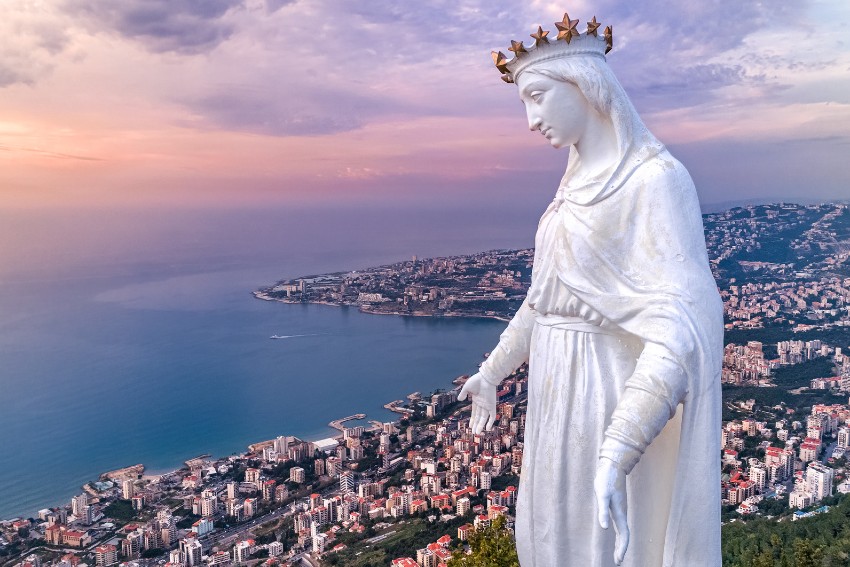
The Holy Father gave a cast of the commemorative medal. In the center are depicted the Maronite Saint, Charbel Makhlouf, and Saint Andrew the Apostle. Next to them are some images of the places visited during the Apostolic Journey, from the left: Our Lady of Harissa, a cedar of Lebanon, and the Sultan Ahmed Mosque, with the minarets depicted next to the Christian bell tower, emphasizing the dialogue between the religions. At the top is the inscription of the journey in Latin TVRCIAM ET LIBANVM VISIT and, below, the anniversary MDCC ANNIV. CONC. NICAENI, together with the date and year of the Apostolic Journey: XXVII NOVEMBRIS – II DECEMBRIS MMXXV.
Here is the full text of what Pope Leo said in his address to the Civil and Religious Authorities, and the Diplomatic Corps in the country, after meeting with the President and Prime Minister of Lebanon:
MEETING WITH THE AUTHORITIES, REPRESENTATIVES OF CIVIL SOCIETY
AND THE DIPLOMATIC CORPS
ADDRESS OF THE HOLY FATHER
Presidential Palace (Beirut)
Sunday, 30 November 2025
____________________________________
Mr President,
Distinguished Civil and Religious Authorities,
Members of the Diplomatic Corps,
Ladies and Gentlemen,
Blessed are the peacemakers!
It is a great joy for me to meet with you, and to visit this land where “peace” is much more than just a word, for here peace is a desire and a vocation; it is a gift and a work in progress.
You are invested with authority in this country, each in your own area and with specific roles.
It is in light of this authority that I wish to address to you the words of Jesus that have been chosen as the central theme of my journey: “Blessed are the peacemakers!” (Mt 5:9).
Certainly, there are millions of Lebanese, here and throughout the world, who serve peace silently, day after day.
Yet you, who have important institutional tasks within this nation, are destined for a special beatitude if you can say that you have put the goal of peace above all else.
In this meeting, I would like to reflect with you a little on what it means to be peacemakers in circumstances that are highly complex, conflictual and uncertain.
In addition to Lebanon’s natural beauty and cultural riches, which have been praised by those of my predecessors who visited your country, there is a shining quality that distinguishes the Lebanese: you are a people who do not give up, but in the face of trials, always know how to rise again with courage.
Your resilience is an essential characteristic of authentic peacemakers, for the work of peace is indeed a continuous starting anew.
Moreover, the commitment and love for peace know no fear in the face of apparent defeat, are not daunted by disappointment, but look ahead, welcoming and embracing all situations with hope.
It takes tenacity to build peace; it takes perseverance to protect and nurture life.
Examine your history, and ask yourselves: from where comes that formidable energy that has never left your people downtrodden or without hope.
You are a diverse country, a community of communities, united by a common language.
I am not simply referring to the Levantine Arabic, by which your great past has left inestimable treasures.
Above all, I am referring to the language of hope, which has always enabled you to start again.
Almost everywhere in the world around us, a kind of pessimism and sense of powerlessness seem to have taken hold, where people are no longer able to ask themselves what they can do to change the course of history.
Major decisions appear to be taken by a select few, often to the detriment of the common good, as if this were an inevitable destiny.
You have suffered greatly from the consequences of an economy that kills (cf. Apostolic Exhortation Evangelii Gaudium, 53), from global instability that has devastating repercussions also in the Levant, and from the radicalization of identities and conflicts.
But you have always wanted, and known how, to start again.
Lebanon can boast a vibrant, well-educated civil society, rich in young people capable of expressing the dreams and hopes of an entire nation.
I encourage you, therefore, never to separate yourselves from your people, and to place yourselves with commitment and dedication at the service of your people, who are so rich in variety.
May you speak just one language, namely the language of hope that, by always starting afresh, draws everyone together.
May the desire to live and grow in unity as a people create a polyphonic voice out of each group.
May you also be helped by those deep bonds of affection that tie so many Lebanese throughout the world to their country.
They love their origins and pray for the people of which they still feel a part.
They also support them through the many experiences and skills that make them so appreciated everywhere.
This brings us to a second characteristic of peacemakers.
Not only do they know how to start over, but they do so first and foremost along the arduous path of reconciliation.
Indeed, there are personal and collective wounds that take many years, sometimes entire generations, to heal.
If they are not treated, if we do not work, for example, to heal memories, to bring together those who have suffered wrongs and injustice, it is difficult to journey towards peace.
We would remain stuck, each imprisoned by our own pain and our own way of thinking.
The truth, on the other hand, can only be honored through encountering one another.
Each of us sees a part of the truth, knowing one aspect of it, but we cannot negate what only the other knows, what only the other sees.
Truth and reconciliation only ever grow together, whether in a family, between different communities and the various people of a country, or between nations.
At the same time, there can be no lasting reconciliation without a common goal, or without openness towards a future in which good prevails over the evils that have been suffered or inflicted in the past or the present.
A culture of reconciliation, therefore, does not arise only from below, from the willingness and courage of a few.
It also needs authorities and institutions that recognize the common good as superior to the particular.
The common good is more than the sum of many interests, for it draws together everyone’s goals as closely as possible, directing them in such a way that everyone will have more than if they were to move forward by themselves.
Indeed, peace is much more than a mere balance – which is always precarious – among those who live separately while under the same roof.
Peace is knowing how to live together, in communion, as reconciled people.
A reconciliation that, in addition to enabling us to live together, will teach us to work together for a shared future side by side.
Thus, peace becomes that abundance which will surprise us when our horizons have expanded beyond every wall and barrier.
Sometimes we think that, before taking a further step, we need to clarify and resolve everything.
Instead, mutual dialogue, even amid misunderstandings, is the path that leads to reconciliation.
The greatest truth is that we find ourselves together as part of a plan that God has prepared so that we may become a family.
Finally, I would like to outline a third characteristic of those who strive for peace.
Even when it requires sacrifice, peacemakers dare to persevere.
There are times when it is easier to flee, or simply more convenient to move elsewhere.
It takes real courage and foresight to stay or return to one’s own country, and to consider even somewhat difficult situations worthy of love and dedication.
We know that here, as in other parts of the world, uncertainty, violence, poverty and many other threats are leading to an exodus of young people and families seeking a future elsewhere, even though it is very painful to leave one’s homeland.
It is certainly necessary to recognize that much good can come to all of you from having Lebanese people spread throughout the world.
However, we must not forget that remaining in our homeland and working day by day to develop a civilization of love and peace remains something very valuable.
Indeed, the Church is not only concerned about the dignity of those who move away from their own countries.
She does not want anyone to be forced to leave their country.
Moreover, the Church wants those who wish to return home to be able to do so safely.
While human mobility represents an immense opportunity for encounter and mutual enrichment, it does not erase the special ties that unite each person to certain places, to which they owe their identity in a very special way.
Moroever, peace always grows in a concrete living context, made up of geographical, historical and spiritual bonds.
We need to encourage those who foster and nurture them, without giving in to sectionalism or nationalism.
In his encyclical Fratelli Tutti, Pope Francis indicated the way forward: “We need to have a global outlook to save ourselves from petty provincialism. When our house stops being a home and starts to become an enclosure, a cell, then the global comes to our rescue, like a ‘final cause’ that draws us towards our fulfilment. At the same time, though, the local has to be eagerly embraced, for it possesses something that the global does not: it is capable of being a leaven, of bringing enrichment, of sparking mechanisms of subsidiarity. Universal fraternity and social friendship are thus two inseparable and equally vital poles in every society” (n. 142).
A challenge, not only for Lebanon but for the entire Levant, is what can be done to ensure that young people in particular do not feel compelled to leave their homeland and emigrate?
How can we encourage them not to seek peace elsewhere, but to find guarantees of peace and become protagonists in their own native land?
In this regard, Christians and Muslims together, and all religious and civil components of Lebanese society, are called to play their part, and to commit themselves to raising awareness of this issue within the international community.
In this context, I would like to emphasize the essential role of women in the arduous and patient endeavour to preserve and build peace.
Let us not forget that women have a special capacity for peace-making, because they know how to cherish and strengthen the profound bonds with life, people and places.
Their participation in social and political life, as well as in their own religious communities, represents a factor of true renewal throughout the world, as does the energy that comes from young people.
Blessed, therefore, are the peacemakers, and blessed are the young people who remain or who return in order that Lebanon may once again be a land full of life.
I conclude by drawing inspiration from another precious feature of your tradition, which stretches back thousands of years.
You are a people who love music.
On feast days, this becomes a dance, a language of joy and communion.
This aspect of your culture helps us to understand that peace is not only the result of human effort, however necessary.
Indeed, peace is a gift that comes from God and which, above all, dwells in our hearts.
It is like an interior motion pushing outwards, enabling us to let ourselves be guided by a melody greater than ourselves, namely that of divine love.
Those who dance move lightly, without trampling on the earth, harmonizing their steps with those of others.
So it is with peace, which is a journey inspired by the Spirit, and causes our hearts to listen, making them more attentive and respectful towards others.
May this desire for peace, which comes from God, grow among you; for even today, peace can transform the way you look at others and the way you live together in this land, a land that God deeply loves and continues to bless.
Mr President, Distinguished Authorities, I thank you once again for your welcome.
Please be assured of my prayers, and those of the whole Church, for your delicate service to the common good.
Copyright © Dicastery for Communication – Libreria Editrice Vaticana
[End, report by Anna Artymiak on Pope Leo’s 4th day in Turkey and 1st day in Lebanon]