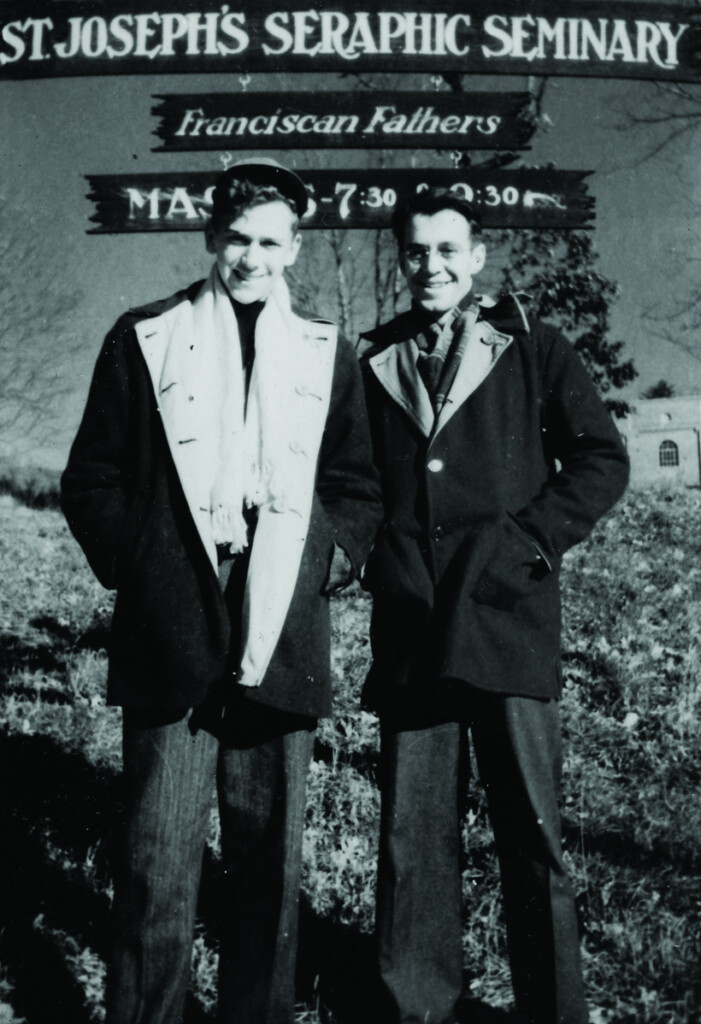
Two young American Catholic seminarians in 1943, standing in front of the entrance sign to St. Joseph’s Seraphic Seminary in Callicoon, New York, USA.
The young man on the left, then 17, is my father, William Moynihan, who died in 2020 at the age of 93.
He entered the seminary in September, 1943, at age 17, and left the seminary two years later, in 1945, at the age of 19, entering the United States Marine Corps, where he remained for four years.
I have wished to understand why my father entered the seminary, and why he left, a decision which in a roundabout way led to my own coming into the world.
This letter attempts to go back to those beginnings.
It is based on my father’s seminary journal from 1943, which my sister recently sent to me.
St Joseph’s seminary is now permanently closed.
***
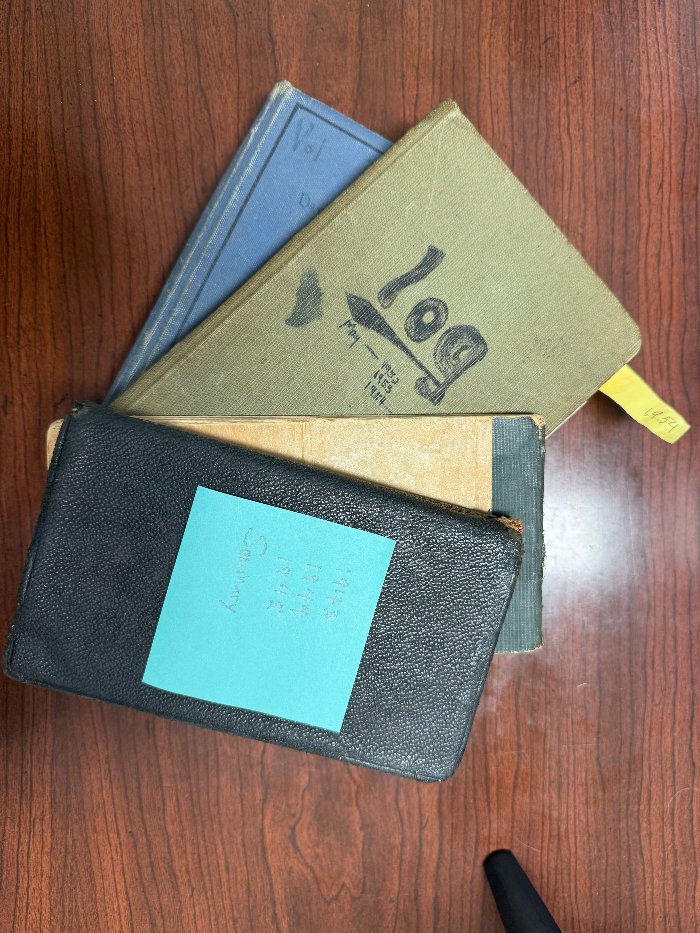
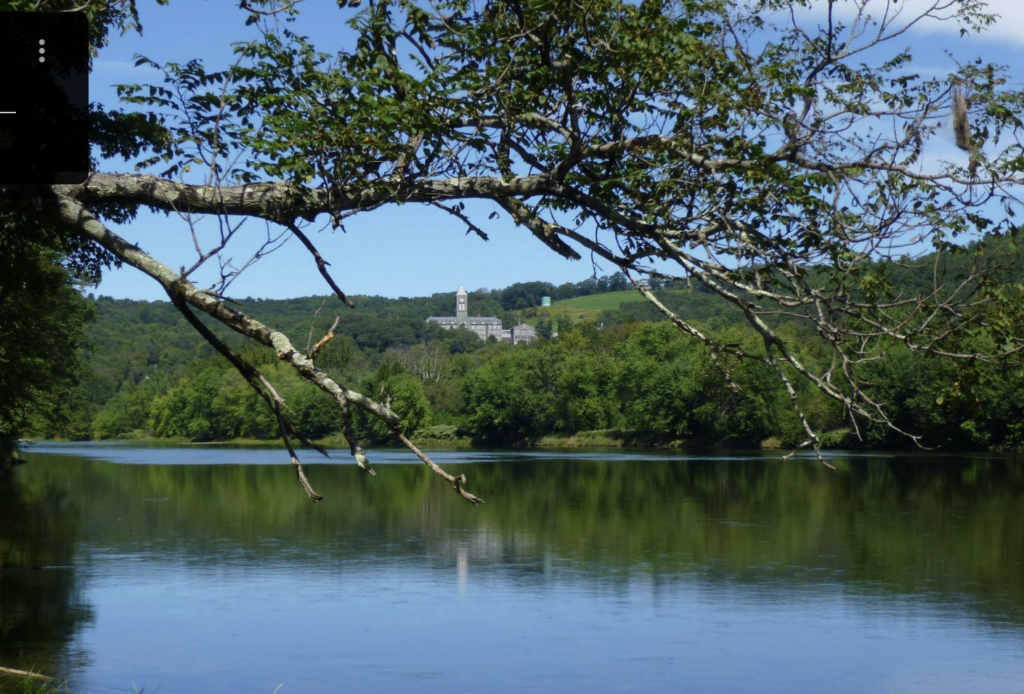
Below, a photo of the seminary, and a map showing its location in the eastern United States, as well as a photo of four of my father’s journals, containing the page which recounts his arrival at the seminary on September 8, 1943…
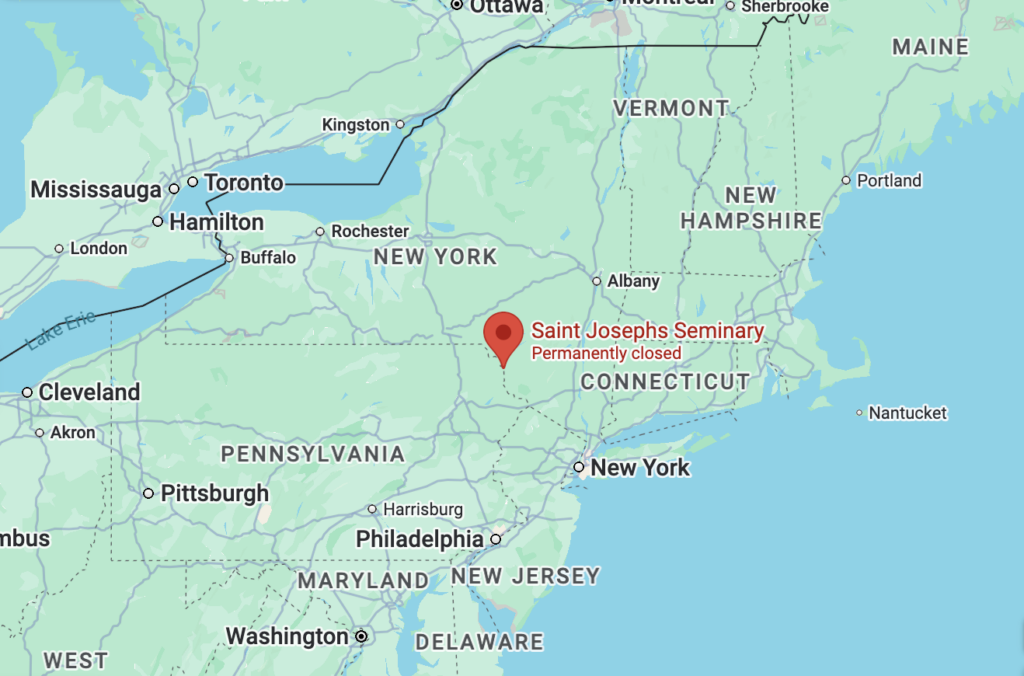
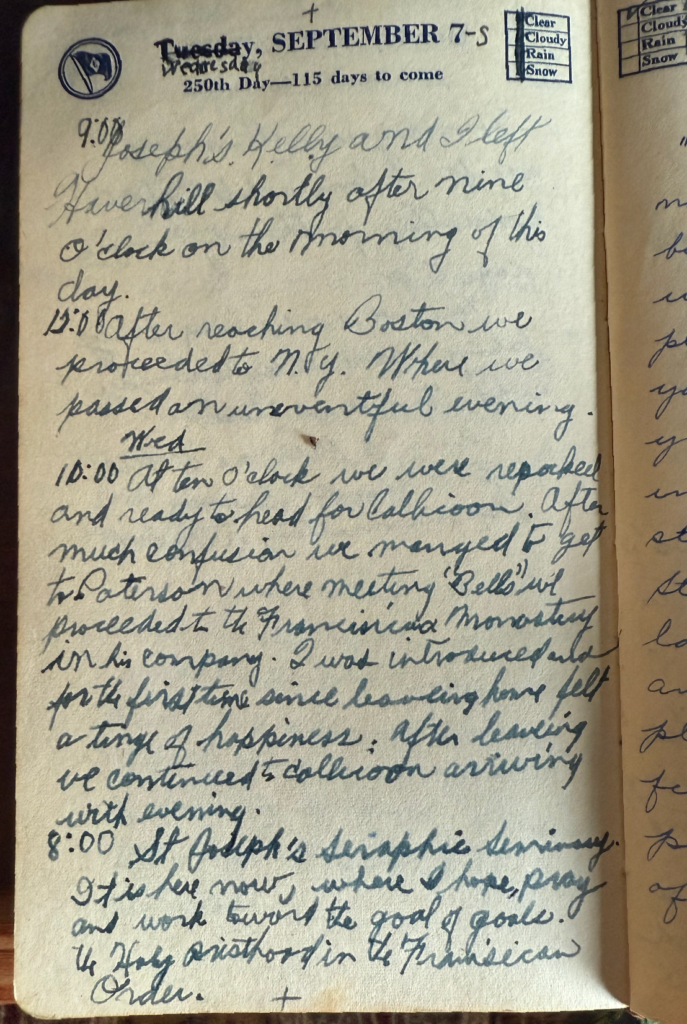
“It is here now, where I hope, pray and work toward the goal of goals: the Holy Priesthood in the Franciscan Order.” —William T. Moynihan (1926-2020; he was my father), in his journal from September 8, 1943, when he entered the Franciscan seminary in Callicoon, New York, to begin studies for the priesthood
“The glory of God is man alive, but the life of man is the vision of God.” —St. Ireneaus of Lyons, in about 180 A.D. (link)
Letter #19, 2026, Tuesday, May 26
Feast of St. Philip Neri (link)
Beginnings
The following passage is taken from my father’s diary, recounting his journey from New York City to Callicoon, New York (the photo of this page of the diary is above):
By William T. Moynihan
Tuesday, September 7, 1943
9:00 Joseph Kelly and I left Haverhill [Massachusetts] shortly after nine o-clock on the morning of the day.
12:00 (midnight): After reaching Boston, we proceeded to N.Y. [New York] Where we passed an uneventful evening.
Wednesday, September 8, 1943
10:00 At ten o’clock we were repacked and ready to head for Callicoon. After much confusion, we managed to get to Paterson, where meeting “Bells” we proceeded to the Franciscan Monastery in his company. I was introduced and, for the first time since leaving home, felt a tinge of happiness. After leaving, we continued to Callicoon, arriving with evening.
8:00 St. Joseph’s Seraphic Seminary. It is here now, where I hope, pray and work toward the goal of goals: the Holy Priesthood in the Franciscan Order.
***
“The goal of goals”
“The goal of goals: the Holy Priesthood in the Franciscan Order.”
And so in 1943 my father entered a Franciscan seminary in New York state, and if he had remained there, I would not have been born, and would not now be preparing to send this letter to you about his entrance into that seminary.
***
“A ring of fire…”
Today, May 26 of 2026, is the day after the presentation of the first encyclical of Pope Leo XIV, a magnificent effort on his part entitled Magnifica humanitas (“Magnificent humanity”), on “safeguarding” (or protecting) “the human person in the time” (or “the age”) “of artificial intelligence.”
(Here is a link to the entire text: link).
Today is also the feast day of St. Philip Neri (1515-1585).
St. Philip Neri died on May 26 in 1585, at the age of 80.
And I just received a copy of The Pillar email, by JD Flynn, which contains an account of St. Philip Neri’s life.
It includes several lines I have not read before, and these lines relate to the question of the mind and soul and person of St. Philip Neri — and the protection of the human soul and person is the chief subject of Pope Leo’s new encyclical.
So, I send you those lines to you here, as an attempt to raise a question which I think needs to be raised, and answered.
(Note: the italicized lines below are my own emphasis; I felt them to be the important lines to consider):
By JD Flynn, The Pillar (link)
St. Philip Neri was born in 1515 to a noble family. After his mother died, Philip was raised by his grandmother in Florence, as a basically pious boy under the tutelage of local Dominicans.
At 18, he moved in with an uncle, and around that time, he had a deep spiritual conversion.
Plans for a merchant’s career were put aside, as Philip felt a call to Rome…
He lived in a small attic room, ate cheap bread, tutored kids to pay the bills, and visited the tombs of the apostles and Roman martyrs, counting on the Lord to make clear why he was there.
Rome itself was in bad shape. The city had been sacked in 1527 by the Holy Roman Emperor — with the pope himself barely escaping capture. More than 1,000 people were executed. (…)
The city’s population dropped to just 10,000 people, from more than 50,000 prior. The remaining Romans were despondent and depressed. And for many, faith was lost entirely.
That was the Rome to which the Lord called Philip. It wasn’t a glorious place, it was a bombed out filthy city barely beginning to rebuild.
(…)
At the Augustinianum, he studied theology and philosophy.
And then — praying before a large crucifix — he had a deeper conversion still.
He quit school, and became a kind of apostolic hermit.
He started visiting hospitals, poor neighborhoods, and prostitutes — sitting down to talk with people, and inviting them to Christ.
All of that was backed by prayer — he started praying in the catacombs, often spending the entire night there.
(…)
When he was almost 30, Philip had a mystical experience.
It was close to Pentecost.
As he knelt in a catacomb, Philip experienced a ring of fire descend, and then enter his mouth, and then settle around his heart.
He recalled that he was filled then with an extraordinary and intense love for God, which eventually was so intense he fell to the ground.
He rose after a few minutes of catching his breath, just absolutely full of joy.
And the accounts say that his heart was literally swollen — that he had then an observable swelling in his chest, and that an autopsy later confirmed such an enlarged heart that two ribs were broken and reformed in a kind of arch to accommodate it.
Anyway, Philip’s life changed. He began forming young men as companions — inviting them to serve the sick with him, while teaching them to pray. Eventually they formed a little association.
Six years later, Philip was ordained a priest, and became a very busy confessor. He continued forming young men, and soon after founded the Congregation of the Oratory — the movement of clerical common life which eventually included St. John Henry Newman.
For all of that, he is remembered as the “third Apostle of Rome.”
(…)
AI and the Mystical
And so the question arises:
Can Artificial Intelligence (AI) account for the descent of what St. Philip Neri experienced as a “ring of fire,” a mystical reality which entered his chest, and surrounded his heart, when he was about 30 years old?
Again:
Can AI account for that reality which touches men and women after long prayer, enlightening them as to their identity and path in life, and, sometimes, inducing unutterable joy, and even the ecstasy of union with the divine?
And again:
Can AI account for… the Holy Spirit?
***
These are some questions which come to my mind on May 26, 2026, after two months of not writing a word, prompted by the new encyclical of Pope Leo, and by the words of the tireless JD Flynn on the spiritual life of the “third apostle” of Rome, St. Philip Neri — a saint who felt a “ring of fire” descend upon his heart, filling him with an extraordinary and intense love of God.
***
Once again I cite the words of St. Ireneaus:
“The glory of God is man alive, but the life of man is the vision of God.”
The vision of God, the glimpse of that Being who truly “is,” who is before us, above us, within us, who is the source of our own being… this vision — a seeing of what is most real — brings light to our nature, enabling it to shine forth with a glory it receives “from above,” or “from within.”
This descent of the spirit brings life, and joy.
We must ask whether AI can account for this Holy Spirit.
Thank you.
Ex Toto Corde
—RM
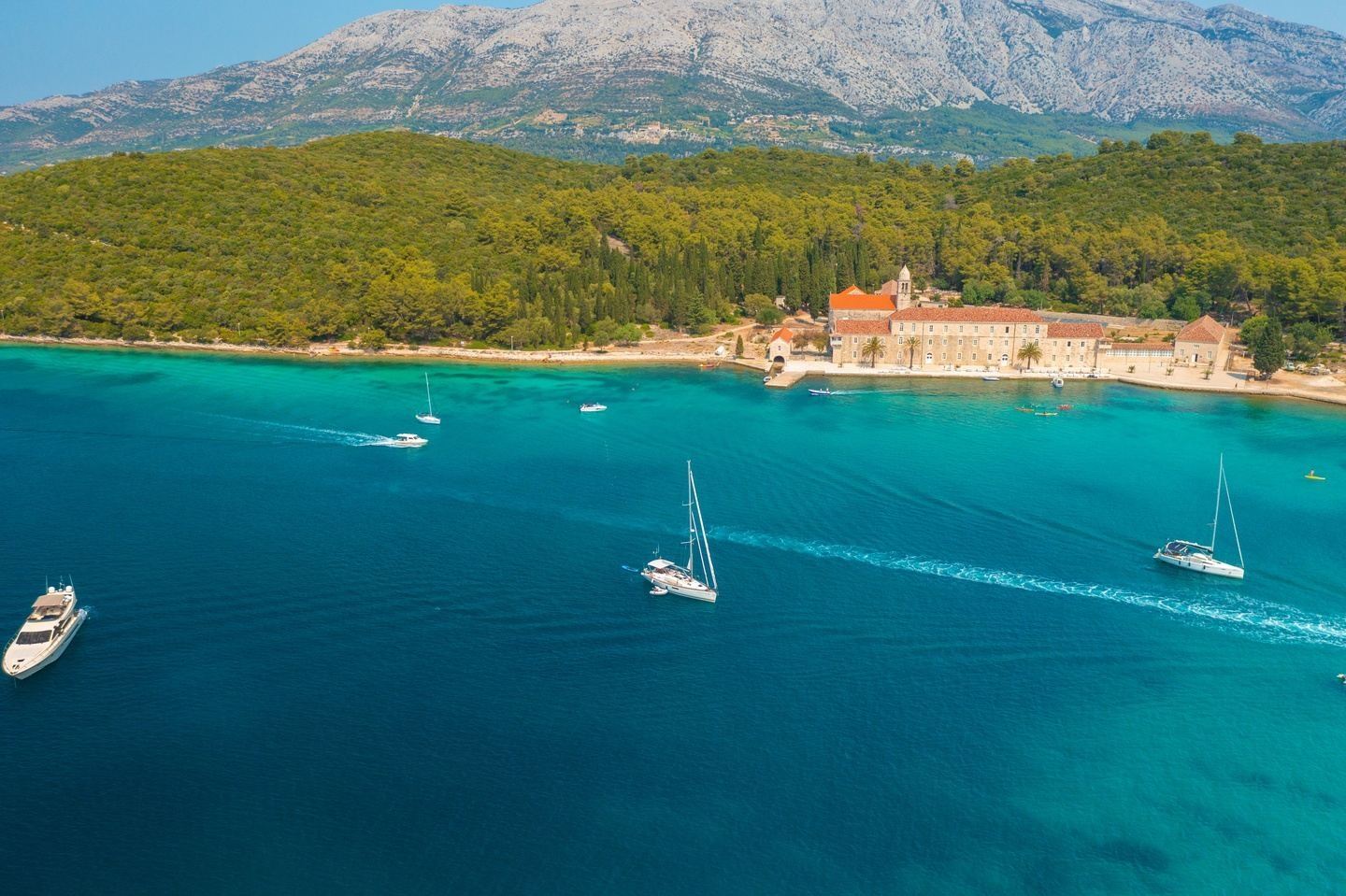
Rooted in Hope: Private Island Retreat with Bishop Athanasius Schneider
June 15 – June 21, 2026
Inside the Vatican Pilgrimages invites you to join a special Pilgrimage and Retreat with Bishop Athanasius Schneider, June 15-21, 2026.
Highlights of our Croatia Retreat with Bishop Schneider, June 2026
- Five-day private island retreat with Bishop Schneider at an ancient, recently restored monastery
- Daily Mass celebrated in the Traditional Latin Rite
- Free time to pray, explore the island, swim in the blue Adriatic waters, walk with other pilgrims along the island path, and travel to nearby islands in a private boat
- One night in Split with time to explore the city on your own