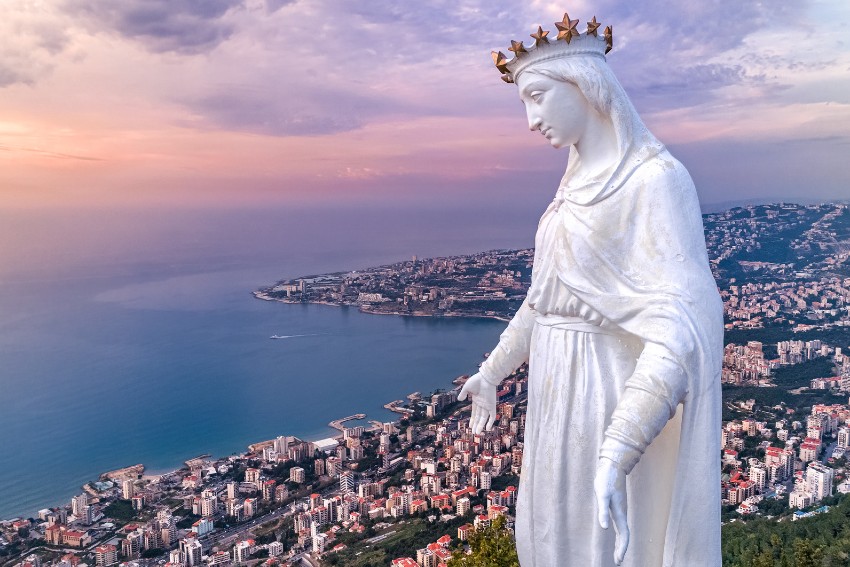
“Mary offers a hermeneutical key for engaging herself with Truth Himself that is both fully free and personal, as well as irrevocable and objective. She combines and surpasses both how we understand objective truth as well as subjectively true love.” –-The central thesis of a new essay by a Dutch theologian, by Dr. Michaël Bauwens of the University of Antwerp, “SSPX and Rome — Toward a Marian Hermeneutic for Modernity (and Vatican II) to Preserve Church Unity” (link): that we should place Mary at the center of our thought in this moment of crisis. Dr. Bauwens offers a “Marian hope” or a “Marian path” in facing and overcoming the current crisis of the Church, on the eve of the four episcopal consecrations on July 1 by the Society of St. Pius X without the necessary permission of Pope Leo XIV.
Here below is the entire essay.
It is offered in the hope that this path may, even at this late moment, be of help to the Church.
(I note that there are passages of the essay I might not fully agree with; still, the “Mary-centric” thrust of the essay seems to me possibly a helpful way to move beyond the present impasse. —RM)
“The glory of God is man alive, but the life of man is the vision of God.” —St. Ireneaus of Lyons, in about 180 A.D. (link)
Letter #22, 2026, Saturday, June 27: Mary
I write from Rome.
Almost all the cardinals in the Church are here as June draws to a close for a consistory called by Pope Leo — 168 cardinals (link), with three prominent cardinals missing due to ill health:
–Peter Erdö of Esztergom-Budapest, 74, Primate of Hungary since 2003
–Joseph Zen, 94, bishop of Hong Kong from 2002 to 2009, and
–Willem Eijk, 73, Metropolitan Archbishop of Utrecht since 2007 and the Primate of the Netherlands (link).
Looming in four days time: a schism in the Church. (link)
***
Cardinal Gerhard Müller (link) brought the matter up yesterday during the first session of the cardinals’ two-day consistory.
Diane Montagna, citing Italian journalist Nico Spuntoni, reports today:
“Cardinal Gerhard Ludwig Müller has urged the Holy See to issue a formal response to the Society of St. Pius X’s latest challenge to Rome and proposed establishing a new Ecclesia Dei structure to receive members expected to leave the Society following its planned episcopal consecrations on 1 July.
“The former prefect of the Congregation for the Doctrine of the Faith made the proposal during an intervention on the opening day of the extraordinary Consistory of Cardinals underway at the Vatican.” (link)
Müller, though a conservative in doctrine, has been critical of the SSPX. On March 19, in an interview with Jan-Heiner Tück entitled “A Graded Assent to the Council is not an Option: Cardinal Müller on the Conflict with the Society of Saint Pius X,” Müller said: “The Society of St. Pius X regards the Second Vatican Council as a break with previous doctrine. This break does not exist; there is no justification for the planned episcopal ordinations.” (link)
Müller said in that interview:
“The real problem does not lie in the liturgy – that is, in the classical (post-Tridentine) and renewed (post-Vatican II) ritual form, but in the doctrine of the faith, which they believe to be compromised in the renewed liturgy.
“Certain formulations of the Second Vatican Council are subject to dubious interpretations, such as the idea that Muslims, like Christians and Jews in the tradition of Abraham, recognize the Creator and adore the one God along with us.
“In this, they see a form of history-of-religions-based relativism that posits a common religion of humanity beyond God’s self-revelation in Jesus Christ.
“What is overlooked here is the classical Catholic teaching that human reason is, in principle, capable of recognizing the existence and unity of God, while the mysteries of the Trinity and the Incarnation are revealed only in supernatural faith (Thomas Aquinas, Summa contra Gentiles I, 2 and 6; Vatican I, Dogmatic Constitution Dei Filius, Canon I, 1: DH 3026).
“In recognition of the sincere pursuit of God’s truth, all can attain to salvation, who through no fault of their own do not know the Gospel of Christ or His Church, but allow themselves to be guided by the grace of God and strive to do what is good and true, which is always a preparation for the Gospel (cf. Lumen Gentium, Art. 16).
“When the statements of the Second Vatican Council – which the Society of St. Pius X criticizes – are read in the context of the Church’s entire tradition, a relativist interpretation becomes untenable.”
***
So, Müller thinks the ambiguous passages of the Council can be read and understood in an orthodox way.
He does not deny the ambiguities — he admits that there are passages which can be interpreted in an unorthodox way.
But, he believes they can also be understood in a fully orthodox way.
So, the issue is how to come to agreement on these passages.
And that is the contribution that Dutch theologian Dr. Michaël Bauwens of the University of Antwerp offers: we can find a way to come to this agreement if we place Mary at the center of our thought in this moment of crisis.
***
The schism looms.
The Society of St. Pius X said on February 2 (link) that it planned to consecrate four new bishops on July 1 without the approval of Pope Leo, and on May 26 (link) gave the names of the four:
Fr. Pascal Schreiber (Switzerland)
Fr. Michael Goldade (United States)
Fr. Michel Poinsinet de Sivry (France)
Fr. Marc Hanappier (France)
And Pope Leo‘s doctrinal chief, Cardinal Victor Fernandez, 63, Prefect of the Dicastery for the Doctrine of the Faith since July 1, 2023, three years ago, said on February 12 that, if the consecrations went forward, the four men and the society as a whole would be automatically excommunicated as openly disobedient to the Pope. (link)
Still, the SSPX head, Fr. Davide Pagliarani, insisted in a February 18 letter to Fernandez that the SSPX would go ahead with the unapproved consecrations (link).
So this crisis has been announced since February.
***
That has led to many different statements and initiatives during these 5 months to “re-start” a dialogue to reach a compromise.
Italian theologian Nicola Bux, who was close to Pope Benedict XVI, weighed in on June 24: “Fr Nicola Bux to Pope Leo XIV: Do All Possible to Bridge Differences With SSPX” (link).
American Catholic commentator George Weigel weighed in, criticizing the SSPX, on June 17: “The SSPX Leadership Against Scripture and Tradition” (link).
Dr. Roberto de Mattei weighed in three days ago, on June 24 (link). He ends by saying: “The last word, in this dramatic horizon, belongs to him who holds the divine mandate to guide the Church and whom the Society of Saint Pius X itself acknowledges as the legitimate Vicar of Christ — the reigning Pope, Leo XIV. No solution to the grave problems afflicting the Mystical Body of Christ will be found outside of him or against him.”
Bishop Athanasius Schneider has made a number of statements calling on Pope Leo to permit the consecrations. He has said that the entire debate is marked by defects of reason and good will: “The discussion has been fueled by emotion—often quite literally cum ira et studio—and is frequently conducted by individuals who lack direct familiarity with the relevant documents or personal experience of the SSPX. In many cases, their knowledge is superficial and shaped by preconceived judgments. As a result, the debate often resembles a dialogue of the deaf, in which the same arguments are endlessly repeated without any meaningful progress.” (link)
Schneider’s essential point is that this matter should be handled in a different way, not leading to schism — which could harden into a split for decades or centuries — but his solution would require a type of engagement between the parties different from what has been shown up until now — a difference which can only come about if Pope Leo himself steps into the debate and brings it onto a new level.
Schneider writes: “If, this year, the Pope were to pronounce an excommunication, a new anathema, upon the consecrating and consecrated bishops, it would go down in Church history as an error of excessive pastoral severity. Future generations and future Popes would come to regret it. Why should the Pope do today what future generations may lament tomorrow? Should we not learn from history? Is not the Pope, as the Supreme Pontiff, called above all to be a builder of bridges?” (link)
Here is Schneider explaining his position in a podcast discussion we had back in February (link).
In this context, it seems useful to present the proposal of Dr. Bauwens: that we should place Mary at the center of our thought in this moment of crisis.
–-RM
SSPX and Rome – Toward a Marian Hermeneutic for Modernity (and Vatican II) to Preserve Church Unity (link)
A guest article by Dr. Michaël Bauwens, University of Antwerp. As usual, we share this essay for the benefit of wider and deeper conversation, not as an official Rorate editorial position. ~Peter Kwasniewski
The rising tensions concerning the scheduled episcopal consecrations by the SSPX and the announced ensuing excommunications by the Vatican have provoked a range of reactions – from pleas for ecclesial unity, obedience, leniency and pragmatism, to the intricacies of canon law, all the way to ideologically hardened hearts. These are pressing and legitimate ecclesial worries indeed, but the current situation shows that the roots of the problem are really doctrinal and theological, and are still far from being resolved.
It is therefore sad to note that both sides seem disheartened about the prospects of a genuine dialogue to overcome the roots of this situation.
The Vatican, normally eager to dialogue with everyone, accompanied its offer to dialogue with the SSPX with a condition and a warning.
The SSPX, normally eager to convince and convert the entire world, responded that they would never come to an agreement about Vatican II anyhow.
Although the repeated doctrinal dialogues that have taken place over the course of the past decades have indeed failed to bring about a result, and fatigue or even scepticism from both sides is understandable, it is not permissible given the demands of faith, hope and charity towards Church unity.
Otherwise all the calls for dialogue, world peace and christian unity, or efforts towards massive conversions and faith in God’s grace and Mary’s mediation for doing so, can sound eerily hollow if not every effort is put into overcoming and healing even this little rift in the mystical Body of Christ.
Since focusing on specific bones of contention in the conciliar texts and the postconciliar magisterium has failed to deliver any results, let us take a step back and look at the way we have been looking at the issue.
That is, what is the proper interpretative framework, i.e. the proper hermeneutic, for interpreting the Council?
This is actually more a philosophical than a theological issue.
In his 2005 Christmas Address for the Roman Curia, Benedict XVI famously defended a hermeneutic of reform for reading the conciliar texts, which is a ‘combination of continuity and discontinuity at different levels’.
But the crucial question is thereby left unanswered – namely, where to draw the line between these different levels?
The common thread running through all of the conciliar texts was ‘modern man’ – and Benedict’s Christmas Address reiterated that what was at stake at the Council was the Church’s relation to the modern world.
The question who or what this ‘modern man’ or ‘modern world’ is, therefore determines one’s overall attitude towards the conciliar texts.
The modern era marks a tectonic shift from a vertical, hierarchic cosmic order, to a horizontal, autonomous and interpersonal order – threatening our fundamental orientation towards transcendence.
In that light, the imminent SSPX consecrations and announced excommunications are a kind of canonical volcanic eruption given the tectonic shifts and tensions arising in the modern era.
The decades-long tensions between the SSPX and Rome are a miniature version of the centuries-long tensions between the Church and the modern world.
It is history happening right before our eyes.
Instead of scandal and emotion, we need sober and charitable reflection – and a tiny bit of enthusiasm to take on the intellectual challenge.
In the past, doctrinal problems have always propelled the Church to bring greater clarity and richness to her own doctrine, why would it be any different this time?
The final seismic rumbling coming from the SSPX before the announced episcopal consecrations, concerned the Vatican document Mater populi fidelis on Mary’s title as co-redemptrix.
There is no shortage of pious and zealous declaration when it comes to the Blessed Virgin, but whether we invoke her as co-redemptrix, ‘untangler of all knots’, or ‘conqueror of all heresies’, it is worth noting that it is she who has guided the growth and development of the Church and her doctrine from the very beginning.
So it is useful to take a long, sober, charitable and reflective look at her in this dire situation.
More particularly, what if we try to approach the modern world in general, and the conciliar texts in particular, with a Marian hermeneutic?
It would be the same hermeneutic that God used when speaking his one Word in spatiotemporal flesh – Mary of Nazareth.
With such a hermeneutic, ‘modern man’ is not some vague sociological snapshot of the 1960’s, but a specific human person who received two major dogmatic declarations late in the modern era – her Immaculate Conception in 1854 and her Assumption in 1950, with further dogmatic inroads seemingly just around the corner.
Such a Marian hermeneutic would enable both a fundamentally charitable as well as a critically purifying reading of the modern world – and the conciliar texts.
The fundamental autonomy for the secular realm need not be a threat, but can then be understood in light of the distinction between Mary as a created person on the one hand, and the three divine persons on the other hand.
As daughter, bride and mother, Mary has a thoroughly interpersonal relationship with the three divine persons which does not exhaustively fit within a pre-modern, hierarchical scheme.
Yet Mary’s relation to the triune God is fully respectful of, dependent upon and open to God – a God who in turn fully respects Mary’s creaturely freedom, integrity and autonomy.
This provides a dynamic and nuanced hermeneutical key to reopen the deadlocked theological trenches and hardened hearts.
Moreover, her unique relationship with God began with a very precise question: how shall this be done?
Let us therefore do so likewise.
Benedict XVI recognised that the crucial confrontation with the modern era took place in two small Council documents, Dignitatis Humanae (on religious liberty) and Nostra Aaetate (on interreligious dialogue) – two key documents indeed in the discussions with the SSPX.
So if Mary can reopen the deadlocked theological trenches, how shall this be done?
If our relationship towards God is fundamentally oriented by a hierarchical scheme of truth and falsity, religious liberty indeed opens the floodgates of religious indifferentism as claimed by the SSPX and supported by many preconciliar magisterial teaching.
It would be akin to ‘mathematical liberty’ granting everyone a constitutional right to freely adopt whatever rules of arithmetic one prefers.
But if our relationship towards God is fundamentally oriented by an interpersonal relationship of love – much like the freedom to get married, or not, with whomever one ‘truly’ loves – religious liberty is indeed a conditio sine qua non, as it is for contracting a valid marriage.
Beyond being a mere issue of Church-state policy, it is indeed a key anthropological and theological issue for both sides, a rejection of which is seen as a fundamental betrayal or misunderstanding of the faith.
But Mary offers a hermeneutical key for engaging herself with Truth Himself that is both fully free and personal, as well as irrevocable and objective.
She combines and surpasses both how we understand objective truth as well as subjectively true love.
For the premodern perspective, Mary’s ‘yes’ was not a merely passive acquiescence to an objective truth, and it is this freedom which ‘religious liberty’ seeks to preserve.
For the modern perspective, Mary’s ‘yes’ became a definitively new and irrevocable reality, worthy of the full protection of the law, and it is this freedom to fully entrust oneself to this new reality that does require legal protection.
The state should not be in the business of deciding who marries who, or indeed what marriage is, but it should be able to protect the promises and new realities people freely entrust themselves to.
Moving on to the topic of interreligious (and ecumenical) dialogue, a premodern perspective sees the recognition of elements of truth and salvation outside of the Church as abandoning the extra Ecclesiam nulla salus (‘no salvation outside of the Church’) doctrine, as grounded on the exclusive fullness of truth in the Catholic Church.
Instead of the unique ark of salvation, the Church merely becomes the highway or ‘privileged path’ to heaven, with countless other paths towards the same unfathomable divine mystery.
But from a modern perspective, it is about taking the perspective seriously of these persons outside of the Church, attached and holding on to these elements of truth.
Rejecting that would ultimately amount to turning a blind eye to these other persons – as well as to the many shortcomings within the human aspect of the Church.
But what if the uniqueness and exclusivity of the Church is primordially grounded on the exclusivity of the nuptial covenant with Mary of Nazareth, predestined as God’s Immaculate Spouse from the very beginning?
Instead of the exclusivity of the Church being grounded on her fullness of truth, her fullness of truth in Christ would be grounded on the exclusivity of the nuptial covenant with God’s Immaculate Spouse.
It would take the personalist orientation of the modern era seriously, while putting this traditional doctrine in a new and stronger light.
For, recognising elements of truth and salvation outside of the Church and therefore engaging in repeated interreligious dialogues, would amount to recognising elements of beauty and fertility in other women and therefore engaging in repeated conversations with them.
But in general, the opposition between premodern ‘convincing’ versus modern ‘dialoguing’, becomes a challenge of ‘wooing’ souls for the one and only Bridegroom.
More specifically on the issue of the Old Covenant, the SSPX declaration of faith strongly stated that Christ had “rendered the Old Covenant definitively null and void” – a point against which George Weigel at CWR reacted by saying that “the Old and New Testaments form a unity, as the Church has consistently affirmed for two millennia”.
It is a tangled question indeed, but especially here Mary offers a hermeneutic to overcome the tension between the two extremes of supersessionism on the one hand and a dual covenant theology on the other hand.
For, at the time of the Annunciation, Mary – daughter Sion – was espoused.
What is a betrothal?
It would be odd to say that the marriage ‘renders the betrothal definitively null and void’, because in that sense “the gifts and the call of God are irrevocable” indeed (Romans 11:29).
On the other hand, the betrothal no longer ‘exists’ after the marriage, and saying that ‘the Old and New Testaments form a unity’ as if they are two distinct entities tends towards the risk of a dual covenant theology.
In that sense, the requirement of a chaperone is indeed ‘definitively null and void’ after the wedding.
A covenant expresses a relationship, which is a notoriously tricky thing for a substance metaphysics, but in this case the metaphysical status of that relationship is the very ‘substance’ of the problem.
Thirdly, on what is arguably the most visible issue, that of the liturgy, it is again worth going to the theological depths of the issue.
At the risk of rushing in like a fool where angels fear to tread, one way of painting the opposition with broad brushes seems to be the following.
On the one hand, the Mass is seen as an expiatory sacrifice, atoning for the infinite sins committed against God in his transcendent majesty.
On the other hand, the Mass is seen as an interpersonal, convivial and community-building meal of thanksgiving, drawing people into the mystery and joy of what is ultimately the interpersonal Trinitarian community.
Here again, what if Mary as bride of the Holy Spirit is indeed the primordial and Immaculate ‘form’ of our spousal communion with God?
It would fully recognise the primordiality of this interpersonal dimension, while recognising that this initial and Immaculate form took on an irrevocably sacrificial shape on Calvary, when God’s spousal offer was extended to all of us sinners.
Although the wedding supper of the lamb is the primordial and indeed interpersonal form, which grounds the expiatory sacrifice, it is only through this expiatory sacrifice that we can approach and participate in this Trinitarian communion.
The ‘active participation’ of ‘modern man’ in the liturgy would then not amount to gathering as much laity as possible around the altar, but to see the laity in a truly distinct yet truly active and Marian form standing beneath the cross – perhaps even as co-redemptrix…
These are all but the briefest outlines of an immense work.
But what is needed first and foremost, is hope that dialogue can be fruitful – and is urgently necessary.
There again, this gives us every reason to turn to Mary as the mother of hope.
It is she who generated the Church as the one mystical body while the body of her Son was being ripped apart.
It is she who stood firm under the cross while almost all the men had fled.
[End, essay by Dr. Bauwens]