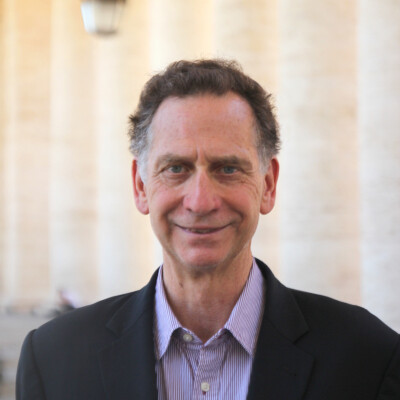
“Hope calls us – as St. Augustine would say – to be upset with things that are wrong and to find the courage to change them.” —Pope Francis, Christmas Eve, December 24, 2024, Opening the Jubilee Year of Hope
By Dr. Robert Moynihan
Monday, December 30, 2024, Rome — In Rome on Christmas Eve, as the “Jubilee of Hope” began — it was an absolutely frigid evening in St. Peter’s Square — I had three great hopes:
(1) for the coming of peace in Ukraine and in the Middle East;
(2) for the coming of peace in families everywhere;
(3) for the restoration of peace and unity in the Church, the mystical body of Christ.
As I listened to the words of Pope Francis, 88, after he opened the Holy Door in St. Peter’s Basilica, I heard him express similar hopes in a Christocentric way. “Sisters and brothers, this is our hope,” he began. “God is Emmanuel, God-with-us. The infinitely great has made himself tiny; divine light has shone amid the darkness of our world; the glory of heaven has appeared on earth. And how? As a little child. If God can visit us, even when our hearts seem like a lowly manger, we can truly say: Hope is not dead; hope is alive and it embraces our lives forever.”
So hope has come into our world. Hope for peace, not war. Hope for families to be united, not divided. Hope for the Church to be healed by mutual forgiveness.
“This is our task,” Francis said. “To bring hope into the different situations of life… Hope calls us to become pilgrims in search of truth, dreamers who never tire, women and men open to being challenged by God’s dream, which is of a new world where peace and justice reign.” Francis continued: “Sisters and brothers, this is the Jubilee… All of us have received the gift and task of bringing hope wherever hope has been lost, lives broken, promises unkept, dreams shattered and hearts overwhelmed by adversity.”
The next day — Christmas Day — speaking from the central loggia of St. Peter’s Basilica, the Pope continued in the same vein. “Brothers and sisters, the door of God’s heart is always open; let us return to Him! Let us be reconciled with Him!… I wish everyone a serene and blessed Christmas.”
That same day, the excommunicated Archbishop Carlo Maria Viganò, 83 (84 as of January 16), issued his own Christmas sermon, “Sicut in coelo et in terra” (“On earth as it is in heaven”).
Viganò also spoke in a Christocentric way. He began: “‘Dixit Dom inus Domino meo: ‘Sede a dextris meis; donec ponam inimicos tuos scabellum peduum tuorum’” (Ps 109:1). The Church repeats this Psalm at Vespers on every Sunday and feast day: ‘The Lord said to my Lord: Sit at my right hand, until I make your enemies your footstool.’ The Eternal Father, in the eternity of time, addresses the Eternal Incarnate Word, sanctioning His Eternal Lordship — ‘Sit at my right hand’ — and His definitive victory over Satan and his servants…”
Viganò then speaks about the entrance of evil into the world, about the fall of man and of the angels: “In the eternity of time, according to some of the Church Fathers, the Angels were put to the test by showing them the Mystery of the Incarnation, decreed by the Holy Trinity to repair the temptation to which our Progenitors would succumb when tempted by the Serpent. It was before this prodigy of infinite and divine Charity and Mercy, before the Word who becomes flesh and assumes our human nature, that the pride of Satan and the apostate angels refused to bow to the will of God, and launched their cry ‘Non serviam’ [“I will not serve”] in response to the ‘Ecce, venio’ [“Behold, I come”] of Incarnate Wisdom, to the ‘Fiat mihi secundum verbum tuum’ [“Let it be done to me according to they word”] of the Mother of God, to the ‘Quis ut Deus?’ [“Who is like God?”] of the Archangel Michael and the faithful Angels. Obedience and disobedience. Humility and pride. Adoring gratitude and arrogant rebellion.”
Viganò then focuses even more completely on Christ: “The cosmos is Christocentric,” he writes. “Omnia per ipsum facta sunt, et sine ipso factum est nihil, quod factum est (Jn 1:3). Everything was made through Him. Per ipsum, cum ipso, et in ipso. Through him, with him and in him… And the Holy Church, which is the Mystical Body of Christ the Head, is the new Jerusalem, the new Israel, the people of the eternal Covenant that guards on its altars Emmanuel, God-With-Us, in the Most Holy Sacrament, until the end of time… Everything refers to Christ; everything announces His coming, His Incarnation, His Birth, His Preaching, His Passion and Death, His Resurrection…”
Viganò then denounces “the hatred of the enemies of Christ” which, he stresses, “is born of pride, that Luciferian pride which refuses to recognize in the Man-God He… to Whom the Divine Order necessarily imposes one to bow and kneel, because it cannot be otherwise, and because by not recognizing Christ as Lord one ends up erecting the creature as an idol, as a simulacrum, in that blasphemous subversion of the κόσμος [“cosmos”] which is the χάος [“chaos”] that is, the Revolution, the infernal soul of the rebellion against God.”
And Viganò speaks of the “ontological and indefectible necessity” of exalting the name of Christ above every name, a necessity which finds its reason “in the obedience and humility of Christ”, factus oboediens usque ad mortem, mortem autem crucis [“having been made obedient unto death, even unto the death of the cross”] (Phil 2:8), and in the evangelical precept: Si quis vult venire post me, abneget semetipsum et tollat crucem suam quotidie, et sequatur me [“If anyone wishes to follow me, let him deny himself and take up his cross daily, and follow me”] (Lk 9:22). He adds: “And Christ was the first, both in the eternity of time as the Word of the Father and in history as the God-Man, to give the example of this self-denial, this obedience, this humility.”
And he concludes: “Let us follow the example of the Shepherds and the Magi, dear brothers and sisters: let us kneel in adoration before the Infant King.”
And I found myself agreeing with the archbishop, who calls on us to kneel in adoration before the Infant King.
And I found myself agreeing also with Francis, who calls upon us to “bring hope wherever hope has been lost, lives broken, promises unkept, dreams shattered…”
And as I passed through the Holy Door, I prayed that these two men might find a way to forgive each other, and give a sign to the world and the Church that would astonish all, restoring what has been lost: the unity of faith in Christ the Lord.