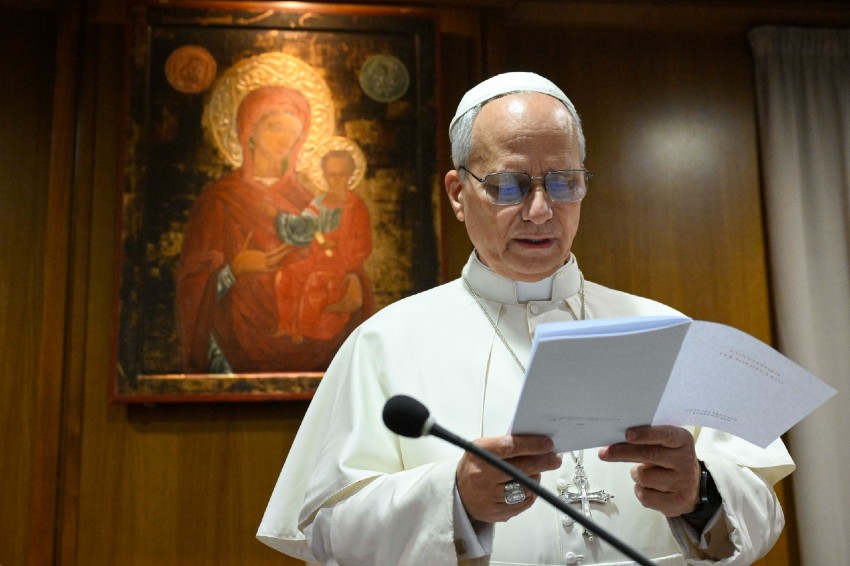
Pope Leo, 70, reads a text to open the Extraordinary Consistory of cardinals that began in Rome yesterday and concludes today. The Pope, eight months after his election on May 8, 2025, has asked the cardinals to advise him on how to face some of the pressing issues facing the Church and society.
Note: If you would like to subscribe to this letter, or add a friend as a subscriber, you may do so here. If you would like to make a donation to the work of this letter, and of the magazine Inside the Vatican, founded in 1993, you may do so here. It would be much appreciated. —RM
Letter #1, 2026, Thursday, January 8: Cardinals meet
Pope Leo has been meeting yesterday and today with about 170 of the Church’s cardinals.
Leo announced just a month ago that he wanted the cardinals to come to Rome in person, if possible (obviously a few have had health problems or other reasons for not attending).
What is it all about?
Some have been wondering whether the Pope may not announce some decisions — for example, about the liturgy, perhaps making some changes to the policies of Pope Francis — but it seems more a meeting to seek a leadership consensus, to help keep Church leaders together amid the myriad challenges the Church faces in this troubled world, than a meeting to take specific decisions.
British convert Gavin Ashenden, a former Anglican priest and chaplain to Queen Elizabeth II, who has a thoughtful Substack page, sums it up nicely in a piece he published yesterday, here below (link).
(Note: Ashenden will also be guiding a retreat for Inside the Vatican Pilgrimages held in an isolated 14th century monastery on a pleasant island in the Mediterranean sea in the month of June; more details soon.)
–RM
“A consultation… to help Leo shape a coherent mind for the Church”
From an essay by Gavin Ashenden
“What is taking place is a consultation,” Ashenden wrote (link), “not between equals, but between the Pope and the senior colleagues on whom he depends to help him shape a coherent mind for the Church at a moment of inherited division and instability.
“Ever since Leo was elected, and given the fact that the open wounds his predecessor left behind him have been continuously bleeding, we have been waiting to see how the new Pope would approach the division and turmoil he inherited,” Ashenden continued. “There was a great deal of pressure on him to rescind different aspects of Francis’ legacy. But for one pope to overrule another by fiat would simply have taken what Francis had done in departing from the Magisterium and made it worse. There had to be another way.
“And here we have it,” Ashenden continued.
“From the beginning, it was obvious to many of us that Cardinal Robert Prevost (as he was then) was a careful, thoughtful, and considered administrator — someone who would not allow himself to be rushed or pressured, and who understood the complexities of the office that had been imposed upon him by the will of his fellow Cardinals and the gift of the Holy Spirit,” Ashenden wrote.
“He knew that the depth of discontent in the Catholic Church had created fissures of resentment and misunderstanding between different theologies, different cultures, and different interest groups.
“It was predicted by many of us that the way he would approach this would be to draw the Cardinals around him and, collectively, carefully, and prayerfully, find their way to a common mind — one by which they could take the Church forward and undo what had been done provocatively, carelessly, or improperly. \
“This would allow him to avoid the very anti-Catholic dramatic act of simply reversing his predecessor. He was going to act collectively and not arbitrarily.
“He was going to act only after a period of time had allowed him to work out the politics of the different fault lines that lay before him in one of the most complicated and complex organisations that has ever existed.”
[End, remarks by Gavin Ashenden]
Texts during the Consistory
Here below:
#1, Pope Leo’s opening address on the 1st day
#2, Opening reflections by Cardinal Timothy Radcliffe, 80, who was chosen to speak to the cardinals at the start of the consistory
#3, Pope Leo’s closing remarks on the 1st day
#4, Pope Leo’s homily at Mass this morning
==============
#1: Leo’s opening address
Yesterday, the cardinals decided to focus on two of four proposed themes, as the Pope requested due to time constraints. The cardinals voted to make the themes of “Synod and synodality” and “Evangelization and mission in the Church in the light of Evangelii gaudium,” the main focus of their meeting. They voted to leave aside two other proposed themes: liturgy, and the service and structure of the Holy See. But Pope Leo said those two themes could and would also come up in their discussions.
Here is what Pope Leo said to open the gathering of the cardinals of the Church on Wednesday, January 7 (yesterday).
About 170 cardinals were present. (link)
***
Dear Brothers,
I am very pleased to welcome all of you. Thank you for your presence! May the Holy Spirit, whom we have invoked, guide us during these two days of reflection and dialogue.
I consider it highly significant that we have gathered in Consistory on the day after the Solemnity of the Epiphany of the Lord, and I would like to introduce our work by proposing something drawn precisely from this mystery.
The liturgy echoed the ever-moving appeal of the prophet Isaiah: “Arise, shine; for your light has come, and the glory of the Lord has risen upon you. For darkness shall cover the earth, and thick darkness the peoples; but the Lord will arise upon you, and his glory will appear over you. Nations shall come to your light, and kings to the brightness of your dawn” (Is60:1-3).
These words call to mind the beginning of the Second Vatican Council’s Constitution on the Church. I will read the first paragraph in its entirety: “Christ is the light of the nations and consequently this holy Synod, gathered together in the Holy Spirit, ardently desires to bring all humanity that light of Christ which is resplendent on the face of the Church, by proclaiming his Gospel to every creature (cf.Mk16:15). Since the Church, in Christ, is a sacrament — a sign and instrument, that is, of communion with God and of the unity of the entire human race — it here proposes, for the benefit of the faithful and of the entire world, to describe more clearly, and in the tradition laid down by earlier councils, its own nature and universal mission. The present situation lends greater urgency to this duty of the Church, so that all people, who nowadays are drawn ever more closely together by social, technical and cultural bonds, may achieve full unity in Christ” (Lumen Gentium, 1).
While centuries apart, we can say that the Holy Spirit inspired the same vision in the prophet and in the Council Fathers, namely the vision of the light of the Lord illuminating the holy city — first Jerusalem, then the Church. The guidance of this light enables all peoples to walk in the midst of the darkness of the world. What Isaiah announced figuratively, the Council recognizes in the fully revealed reality of Christ, the light of the nations.
We can understand the overall pontificates of Saint Paul VI and Saint John Paul II within this conciliar perspective, which sees the mystery of the Church as entirely held within the mystery of Christ, and thus understands the evangelizing mission as a radiation of the inexhaustible energy released by the central event of salvation history.
Popes Benedict XVI and Francis, in turn, summarized this vision in one word: “attraction.” Pope Benedict referred to this in his homily for the opening of the Aparecida Conference in 2007, when he said: “The Church does not engage in proselytism.
Instead, she grows by ‘attraction’: just as Christ ‘draws all to himself’ by the power of his love, culminating in the sacrifice of the Cross, so the Church fulfils her mission to the extent that, in union with Christ, she accomplishes every one of her works in spiritual and practical imitation of the love of her Lord.” Pope Francis was in perfect agreement with this, and repeated it several times in different contexts.
Today, I joyfully revisit this theme and share it with you. I invite us to pay close attention to what Pope Benedict signaled as the “power” that drives this movement of attraction. Indeed, this power is Charis, it is Agape, it is the love of God that became incarnate in Jesus Christ and that, in the Holy Spirit, is given to the Church, sanctifying all her actions. Furthermore, it is not the Church that attracts, but Christ; and if a Christian or an ecclesial community attracts, it is because through that “channel” flows the lifeblood of Charity that cascades from the Heart of the Savior. Moreover, it is significant that Pope Francis began with Evangelii Gaudium “on the proclamation of the Gospel in today’s world,” and concluded with Dilexit Nos“on the human and divine love of the Heart of Jesus Christ.”
Saint Paul writes, “the love of Christ urges us on” (2 Cor 5:14). The verb sunechei signifies that the love of Christ urges us on because it possesses us, envelops us and captivates us. This is the power that attracts everyone to Christ, as he himself foretold: “And I, when I am lifted up from the earth, will draw all people to myself” (Jn12:32). To the extent that we love one anotheras Christ has loved us, we belong to him, we are his community, and he can continue to draw others to himself through us. In fact, only love is credible; only love is trustworthy.[1]
While unity attracts, division scatters. It seems to me that physics also confirms this, both on the microscopic and macroscopic levels. Therefore, in order to be a truly missionary Church, one that is capable of witnessing to the attractive power of Christ’s love, we must first of all put into practice his commandment, the only one he gave us after washing his disciples’ feet: “Just as I have loved you, you also should love one another.” He then adds: “By this everyone will know that you are my disciples, if you have love for one another” (Jn 13:34-35). Saint Augustine observes: “This is why he loved us, so that we too might love one another. By loving us, he gave us the help we need to bind ourselves together in mutual love, and, bound together by such a pleasing bond, we are the body of such a mighty Head” (Homily 65 on the Gospel of John,2).
Dear Brothers, I would like to begin here, with these words of the Lord, for our first Consistory and especially for the collegial journey that, with God’s grace, we are called to undertake.
We are a very diverse group, enriched by a wide range of backgrounds, cultures, ecclesial and social traditions, formative and academic paths, pastoral experiences, not to mention personal characteristics and traits.
We are called first to get to know one another and to dialogue, so that we may work together in serving the Church. I hope that we can grow in communion and thus offer a model of collegiality.
Today, in a certain sense, we will continue that memorable meeting, which I was able to share with many of you immediately after the Conclave, in “a moment of communion and fraternity, of reflection and sharing, aimed at supporting and advising the Pope in the demanding responsibility of governing the universal Church” (Letter Convoking the Extraordinary Consistory, 12 December 2025).
In the coming days, we will have the opportunity to engage in a communal reflection on four themes: Evangelii Gaudium, that is, the mission of the Church in today’s world; Praedicate Evangelium, namely the service of the Holy See, especially to the particular Churches; the Synod and synodality as both an instrument and a style of cooperation; and the liturgy, the source and summit of the Christian life. Due to time constraints, and in order to encourage a genuinely in-depth analysis, only two of them will be discussed specifically.
While each of the twenty-one groups will contribute to the choice that we will make, the groups that will be reporting will be those nine coming from the local Churches, since it is naturally easier for me to seek counsel from those who work in the Curia and live in Rome.
I am here to listen. As we learned during the two Assemblies of the Synod of Bishops of 2023 and 2024, the synodal dynamic implies a listening par excellance. Every moment of this kind is an opportunity to deepen our shared appreciation for synodality. “The world in which we live, and which we are called to love and serve, even with its contradictions, demands that the Church strengthen cooperation in all areas of her mission. It is precisely this path of synodality which God expects of the Church of the third millennium” (Francis, Address on the Fiftieth Anniversary of the Institution of the Synod of Bishops, 17 October 2015).
This day and a half together will point the way for our path ahead. We must not arrive at a text, but continue a conversation that will help me in serving the mission of the entire Church.
Tomorrow, we will discuss the two chosen themes, with the following question as a guide:
Looking at the path of the next one or two years, what considerations and priorities could guide the action of the Holy Father and of the Curia regarding each theme?
This will be our way of proceeding: being attentive to the heart, mind and spirit of each; listening to one other; expressing only the main point and in a succinct manner, so that all can speak.
The ancient Romans in their wisdom used to say: Non multa sed multum!
In future, this way of listening to each other, seeking the guidance of the Holy Spirit and walking together, will continue to be a great help for the Petrine ministry entrusted to me.
Even the way in which we learn to work together, with fraternity and sincere friendship, can give rise to something new, something that brings both the present and the future into focus.
May the Holy Spirit always guide us, and may the Virgin Mary, Mother of the Church, assist us.
–Pope Leo XIV
______________
[1] Cf. H.U. Von Balthasar,Glaubhaft ist nur Liebe, Johannes Verlag, Einsiedeln 1963.
#2: Cardinal Radcliffe’s Meditation (link)
“Peter (The Pope) must not be unaccompanied”:
Here the meditation given by British Dominican Cardinal Timothy Radcliffe, 80, on the afternoon of Wednesday, January 7, to the cardinals participating in the Consistory
by Cardinal Timothy Radcliffe, O.P.
A reading from the Holy Gospel according to Saint Mark (6:45–52) “After the five thousand had eaten and were satisfied, Jesus made his disciples get into the boat and precede him to the other side toward Bethsaida, while he dismissed the crowd. And when he had taken leave of them, he went off to the mountain to pray. When it was evening, the boat was far out on the sea and he was alone on shore. Then he saw that they were tossed about while rowing, for the wind was against them. About the fourth watch of the night, he came toward them walking on the sea. He meant to pass by them. But when they saw him walking on the sea, they thought it was a ghost and cried out. They had all seen him and were terrified. But at once he spoke with them, “Take courage, it is I, do not be afraid!” He got into the boat with them and the wind died down. They were completely astounded. They had not understood the incident of the loaves. On the contrary, their hearts were hardened.”
We are gathered in this Consistory to be of help to the Holy Father in the exercise of his ministry to the Universal Church. How are we to do that?
Tomorrow Pope Leo will preach on the Gospel of the day, the feeding of the five thousand in St. Mark. It was suggested that the text which follows, Jesus walking on the water, gives us some clues as to our task.
Jesus commanded the disciples to get into the boat and go before him.
Peter must not go into the storm alone.
This is our first obedience, to be in the barque of Peter, with his successor, as he faces the storms of our times.
We cannot remain on the beach saying ‘Myself, I would not go sailing today.’ Or ‘I would choose a different boat’.
Jesus is alone on the mountain but Peter must not be unaccompanied.
John writes that: ‘if we love one another, God abides in us and his love is perfected in us.’
If the boat of Peter is filled with disciples who quarrel, we shall be of no use to the Holy Father.
If we are peace with each other in love, even when we disagree, God will indeed be present even when he seems to be absent.
In the storm, Jesus is a long way off on the mountain but, the gospel says, ‘he saw that they were making headway painfully.’
His eye is always on them.
It is as if Jesus wishes them to experience his apparent absence.
He takes his time.
He waits until they are almost exhausted.
This experience of absence prepares them for an intimacy they could never have imagined.
He gets into the boat with them.
Sometimes we too shall feel alone, burnt out exhausted.
But Jesus is watching and will come closer to us than ever before.
So we need not be afraid.
We live in a time of terrible storms too, of growing violence, from knife crime to war.
The chasm between the rich and the poor is every wider.
The world order which came into being after the last world war is breaking down.
We have no idea of what Artificial Intelligence will yield.
If we are not nervous, we ought to be.
The Church herself is shaken by her own storms, of sexual abuse and ideological division.
The Lord commands us to sail out into these storms, and face them truthfully, not timidly waiting on the beach.
If we do so in this Consistory, we shall see him coming to us.
If we hide on the beach we shall not encounter him.
Mark gives us a strange detail: ‘he meant to pass by them.’
The Greek word for ‘passing by’ is connected with dying, as it is in English when we talk of someone ‘passing away’.
We see the pattern of Holy Week. A shared meal, the feeding of the 5000; the absence of Jesus, and his sudden appearance.
Already on the Sea of Galilee the disciples are living in anticipation the death and resurrection of the Lord.
It will be repeated after the feeding of the four thousand.
In Mark, the Resurrection is both utterly new and to be relived again and again, as we do so in the Liturgical Year.
In Evangelii Gaudium we read of how the Christian life is sustained by memory and by God’s inexhaustible newness.
Augustine says that God is always younger than we are!
In the Consistory some of us will be champions of memory, cherishing the tradition.
Others will delight more in God’s surprising newness, but memory and newness are inseparable in the dynamic of Christian life.
So our discussions will come alive if we are both rooted in our memory of the great things the Lord has done and open to his ever fresh newness.
There is no competition.
The disciples were ‘utterly astounded for they did not understand about the loaves for their hearts were hardened.’
In the Bible, the heart is the seat of thinking rather than emotions which were in the bowels. As one of my brethren said, everything happens 50 centimetres lower in the Bible.
The disciples had fed the five thousand but they were stuck in the old logic of calculation.
All that they had been able to produce was five loaves and a few fish.
They had to discover that in the logic of the Kingdom.
Their small offerings were more than enough for thousands.
The Lord of the harvest works miracles with what they offer.
We may feel that, faced with the vast challenges of our world and Church, we have so little offer.
What can we say and do that will make a difference?
But with God’s grace, our little will be more than enough.
So let us not harden our hearts but be open to the incalculable gifts of God, who bestows upon us grace without measure if we open our hands and our ears to Him and to each other.
[End, Cardinal Radcliffe’s reflections]
#3: Pope Leo’s closing remarks at the end of the first day
The Pope made these remarks in Italian, extemporaneously.
Below are the words that the Holy Father Leo XIV addressed extemporaneously to the College of Cardinals yesterday, at the end of the first session of the Extraordinary Consistory (January 7, 2026):
Words of the Holy Father
Good evening again, and thank you very much for all the work already done in this first session.
I would like to begin by simply repeating the words of one of the secretaries, the first who spoke, who suggested that the journey was as important as the conclusion of the work at the table. I would like to start from there to first of all say thank you for being here!
I think that the participation of all of you in this experience as the College of Cardinals of the Church is very important, offering not only to us – it is not for us – but to the Church and the world a certain testimony of the will, the desire, recognizing the value of being together, of making the sacrifice of a journey – for some of you a very long one – to come together and be able to seek together what the Holy Spirit wants for the Church today and tomorrow.
So for this, I truly think it is important, even if it is a very short time, but it is a very important time for me too, because I feel, I experience the need to be able to count on you: it is you who called this servant to this mission! So, I would like to say, I think it is important that we work together, that we discern together, that we seek what the Spirit asks of us.
If you will allow me, I will repeat some words from yesterday’s homily on the Feast of the Epiphany. Many of you were present, but I will say it again. “Let us ask ourselves: is there life in our Church?”
I am convinced that there is, certainly.
These months, if I hadn’t experienced it before, I certainly have had many beautiful experiences of the life of the Church.
But the question is there: is there life in our Church? Is there room for what is being born? Do we love and proclaim a God who sets us back on the path?
We cannot close ourselves off and say: “Everything is already done, finished, do as we have always done.”
There truly is a path, and with the work of these days, we are walking it together.
In the story, Herod fears for his throne; he is agitated by what he feels is beyond his control, he tries to take advantage of the Magi’s desire and seeks to bend their search to his own advantage. Herod “is ready to lie, he is willing to do anything. Fear, in fact, blinds.
The joy of the Gospel, however, liberates. It makes us prudent, yes, but also bold, attentive and creative; it suggests paths different from those already traveled.
This [meeting] for me is one of the many expressions in which we can truly experience the newness of the Church. The Holy Spirit is alive and present among us.
How wonderful it is to be together in the boat!
That image that Cardinal Radcliffe offered us in his reflection this afternoon, as if to say: we are together.
There may be something that frightens us; there is doubt: but where are we going? how will it end?
But if we place our trust in the Lord, in his presence, we can accomplish so much.
Thank you for your choices. The choice of all the tables, by a large majority, is quite clear, I think. And it seems very important to me, from the other comments made, that one theme cannot be separated from another. In fact, there is much that we can see together. But we want to be a Church that does not only look at itself, that is missionary, that looks beyond, to others.
The reason for the Church’s existence is not for the cardinals, nor for the bishops, nor for the clergy. The reason for its existence is to proclaim the Gospel.
And therefore these two themes: Synod and synodality, as an expression of seeking how to be a missionary Church in today’s world, and Evangelii Gaudium, proclaiming the kerygma, the Gospel with Christ at the center.
This is our mission.
And so I thank you. This will help us organize ourselves for tomorrow’s work in the two sessions.
The other themes are not lost. There are very concrete, specific issues that we still need to address.
I hope that each of you feels truly free to communicate with me or with others, and we will continue this process of dialogue and discernment.
So, nothing more. Thank you for this service. I don’t know if I exceeded the three minutes. The moderator was very kind! Good evening and see you tomorrow morning.
[Original text: Italian]
#4: Pope Leo’s Homily at Mass this morning. (link)
Here is what Pope Leo said at his homily at the 7:30 a.m. Mass he celebrated this morning in St. Peter’s Basilica with his cardinals from around the world. The Mass began Day 2 of the Extraordinary Consistory that he called for January 7 and 8 in Rome. Some 170 of the 245 living cardinals were in attendance.
***
EXTRAORDINARY CONSISTORY
HOMILY OF POPE LEO XIV
St Peter’s Basilica
Thursday, 8 January 2026
_________________________________
“Beloved, let us love one another, because love is from God” (1 Jn 4:7).
The liturgy sets this exhortation before us as we celebrate the Extraordinary Consistory, a moment of grace wherein our unity in the service of the Church finds its expression.
As we know, the word Consistory (Consistorium, or “assembly”) can be understood through the root of the verb consistere, meaning “to stand still.”
Indeed, all of us have “paused” in order to be here.
We have set aside our activities for a time, and even cancelled important commitments, so as to discern together what the Lord is asking of us for the good of his people.
This itself is already a highly significant and prophetic gesture, particularly in the context of the frenetic society in which we live.
It reminds us of the importance, in every aspect of life, of stopping to pray, listen and reflect.
In doing so, we refocus our attention ever more clearly on our goal, directing every effort and resource towards it, lest we risk running blindly or “beating the air” in vain, as the Apostle Paul warns (cf. 1 Cor 9:26).
We gather not to promote personal or group “agendas,” but to entrust our plans and inspirations to a discernment that transcends us – “as the heavens are higher than the earth” (Is 55:9) – and which comes only from the Lord.
For this reason, it is important that during this Eucharist, we place each of our hopes and ideas upon the altar.
Together with the gift of our lives, we offer them to the Father in union with the Sacrifice of Christ, so that we may receive them back purified, enlightened, united and transformed by grace into one Bread.
Indeed, only in this way will we truly know how to listen to his voice, and to welcome it through the gift that we are to one another – which is the very reason we have gathered.
Our College, while rich in many skills and remarkable gifts, is not called primarily to be a mere group of experts, but a community of faith. Only when the gifts that each person brings are offered to the Lord and returned by him, will they bear the greatest fruit according to his providence.
Moreover, God’s love, of which we are disciples and apostles, is a “Trinitarian” and “relational” love. It is the very source of that spirituality of communion, by which the Bride of Christ lives and desires to be a home and a school (cf. Apostolic Letter Novo Millennio Ineunte, 6 January 2001, 43).
Expressing the hope that this spirituality would flourish at the dawn of the third millennium, Saint John Paul II described it as “the heart’s contemplation of the mystery of the Trinity dwelling in us, and whose light we must also be able to see shining on the face of the brothers and sisters around us” (ibid.).
Our “pausing,” then, is first and foremost a profound act of love for God, for the Church and for the men and women of the whole world. Through this, we allow ourselves to be formed by the Spirit: primarily in prayer and silence, but also by facing one another and listening to one another.
In our sharing, we become a voice for all those whom the Lord has entrusted to our pastoral care in many different parts of the world. We must live this act with humble and generous hearts, aware that it is by grace that we are here.
Moreover, we bring nothing that we have not first received as a gift or talent, which are not to be squandered, but invested with prudence and courage (cf. Mt 25:14–30).
Saint Leo the Great taught that “it is a great and very precious thing in the sight of the Lord when the whole people of Christ apply themselves together to the same duties, and all ranks and orders… cooperate with one and the same Spirit.”
In this way, “the hungry are fed, the naked clothed, the sick visited, and no one seeks his or her own interests, but those of others” (Sermon 88, 4).
This is the spirit in which we wish to work together: the spirit of those who desire that every member of the Mystical Body of Christ will cooperate in an orderly way for the good of all (cf. Eph 4:11–13).
May we fully carry out our ministry with dignity under the guidance of the Holy Spirit, happy to offer our own labor and to see it its fruits mature. May we likewise welcome the labors of others and rejoice in seeing them flourish (cf. Saint Leo the Great, Sermon 88, 5).
For two millennia, the Church has embodied this mystery in its multifaceted beauty (cf. Francis, Encyclical Letter Fratelli Tutti, 280). This very assembly bears witness to it through the variety of our origins and ages, and in the unity of grace and faith that gathers us together and makes us brothers.
Certainly, we stand before a “great crowd” of humanity hungry for goodness and peace.
In a world where satisfaction and hunger, abundance and suffering, and the struggle for survival together with a desperate existential emptiness continue to divide and wound individuals, communities and nations, we may feel inadequate.
Faced with the words of the Master, “You give them something to eat” (Mk 6:37), we too might feel, like the disciples, that we lack the necessary means.
Yet Jesus repeats to us once more, “How many loaves have you? Go and see” (Mk 6:38).
This is something we can do together. We may not always find immediate solutions to the problems we face, yet in every place and circumstance, we will be able to help one another – and in particular, to help the Pope – to find the “five loaves and two fish” that providence never fails to provide wherever his children ask for help. When we welcome these gifts, hand them over, receive and distribute them, they are enriched by God’s blessing and by the faith and love of all, ensuring that no one lacks what is necessary (cf. Mk 6:42).
Beloved brothers, what you offer to the Church through your service, at every level, is something profound and very personal, unique to each of you and precious to all.
The responsibility you share with the Successor of Peter is indeed weighty and demanding.
For this reason, I offer you my heartfelt thanks, and I wish to conclude by entrusting our work and our mission to the Lord with the words of Saint Augustine: “You give us many things when we pray, and whatever good we received before we prayed for it, we have received from you. We have also received from you the grace that later we came to realize this… Remember, Lord ‘that we are but dust.’ You have made man of the dust” (Confessions, 10, xxxi, 45). Therefore, we say to you: “Grant what you command, and command what you will” (ibid.).