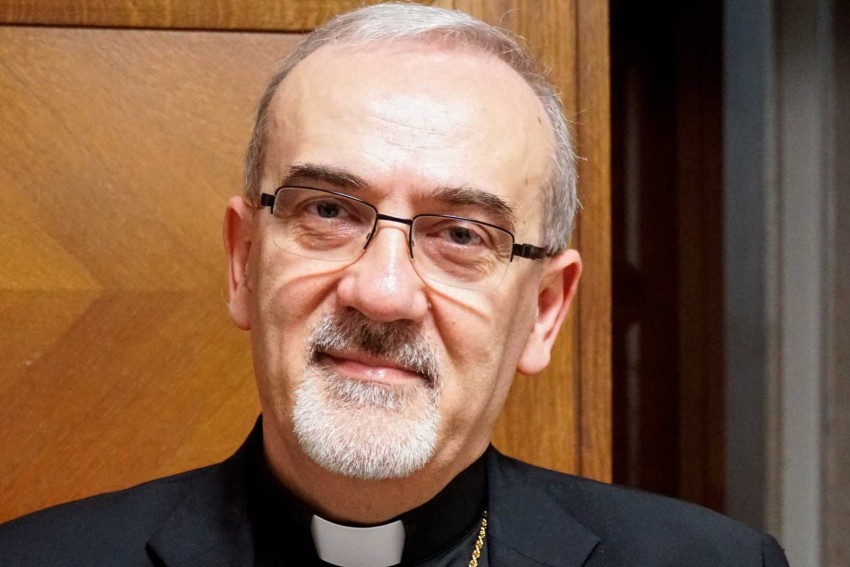

Pope Leo XIV met today with the participants in the Conference “Artificial Intelligence and Care of Our Common Home” (@VATICAN MEDIA).
He delivered an address to the conference which outlines his deep concern over the possible negative consequences, or even evil misuse, of artificial intelligence (AI) (full text below)
“Artificial intelligence has certainly opened up new horizons for creativity, but it also raises serious concerns about its possible repercussions on humanity’s openness to truth and beauty, and capacity for wonder and contemplation.” —Pope Leo XIV, today in Rome, in an address on artificial intelligence to a conference convened to discuss “Artificial Intelligence and Care of Our Common Home
Letter #100, 2025, Friday, December 5: Leo on AI
Pope Leo asked an important question today in an address to a Vatican-convened conference on the modern phenomenon of “artificial intelligence” — a phenomenon that clearly is one of the chief interests of this new Pope, as it is the question that he has returned to repeatedly in his talks in the seven months since he became Pope on May 8.
Leo’s question today was: “What does it mean to be human in this moment of history?”(!)
***
Even to begin to deal with this question is challenging.
Leo has been saying over and over again that the development of AI —a technology which gathers information and seems to “think” about it “intelligently” — poses a challenge to mankind.
But what type of challenge?
Why is AI different than previous technologies, like the printing press, the telegraph, the computer, the internet?
In the talk Leo gave today (full text below), Leo said:
“The advent of artificial intelligence is accompanied by rapid and profound changes in society, which affects essential dimensions of the human person, such as critical thinking, discernment, learning and interpersonal relationships.”
And then he asked:
“How can we ensure that the development of artificial intelligence truly serves the common good, and is not just used to accumulate wealth and power in the hands of a few?”
So we may understand that Leo sees a certain danger that this new technology be used, not “for the common good,” but “to accumulate wealth and power in the hands of the few.”
From this it would seem that Leo’s concern may be socio-political: that he is worried that this technology can be used to control and oppress the poor (or perhaps not just the poor, but almost everyone).
But this would be an over-simplification of Leo’s position.
For Leo then goes on to make some remarks which suggest that his concern is not simply socio-political, but actually ontological — that is, that he is concerned about the very nature and reality of man, of what it means to be a human being.
Ontology is the study of being. Ontology tries to understand what things truly are. In this case, “what does it mean to be human.”
Now, in the past, we in the West would have defined a human being, as Catholic theology did, by saying something like this:
“A human being is a unique creation made in the image and likeness of God possessing inherent dignity, an immortal soul, a physical body, intellect, free will, and a capacity for love, reason, and relationship with God and others, called to holiness, happiness, and communion with their Creator.”
And this was rooted in a scriptural passage, Genesis 1:27: “So God created man in his own image, in the image of God he created him; male and female he created them.”
Now, why go back to that old definition?
Because Leo himself is speaking of the AI technology as being capable, in some way, and perhaps quite soon, of interfering with that image that is in man, that is his nature, of harming or distorting that image and its way of being and relating to others.
And the words Leo uses are both poetic and profound, in such a way that they touch the heart.
Leo is speaking here about something he believes in, very deeply.
He says:
“Human beings are called to be co-workers in the work of creation, not merely passive consumers of content generated by artificial technology.
“Our dignity lies in our ability to reflect, choose freely, love unconditionally and enter into authentic relationships with others.
“Artificial intelligence has certainly opened up new horizons for creativity, but it also raises serious concerns about its possible repercussions on humanity’s openness to truth and beauty, and capacity for wonder and contemplation.”
Here Leo is not speaking about socio-political oppression by big tech companies — though he is concerned about that too, obviously, because he says he is — but about what we might call the “marring of the soul,” the transformation of humans from “co-workers with God” to “passive consumers of content generated by artificial technology.”
The transformation of human nature.
The loss of our dignity.
This dignity “lies in our ability to reflect, choose freely, love unconditionally, and enter into authentic relationships with others.”
But why would artificial intelligence be any risk to this dignity? What is the danger Leo sees?
Leo says: “Artificial intelligence has certainly opened up new horizons for creativity, but it also raises serious concerns about its possible repercussions on humanity’s openness to truth and beauty, and capacity for wonder and contemplation.”
Here I have to pause and say I need to know and reflect more, because I am not quite sure where the danger, precisely, enters in.
Leo says there is a danger: “it also raises serious concerns about its possible repercussions on humanity’s openness to truth and beauty, and capacity for wonder and contemplation.”
But what is the mechanism that makes this technology a threat to “humanity’s openness to truth and beauty” and “capacity for wonder and contemplation”?
Leo does not tell us specifically what he thinks this mechanism is.
This is what he says:
“Recognizing and safeguarding what characterizes the human person and guarantees his or her balanced growth is essential for establishing an adequate framework for managing the consequences of artificial intelligence.”
What does Leo mean, precisely, by the words “what characterizes the human person” and “guarantees his or her balanced growth” — the recognizing and safeguarding of which is “essential” for “establishing an adequate framework” for “managing the consequences” of artificial intelligence?
Well, he has already told us: “Human beings are called to be co-workers in the work of creation.”
That, it would seem, is “what characterizes the human person.”
That human collaborate in working in this world toward…. toward what?
Here we again come up against the question: what is the work of creation? And how should we collaborate with that work?
The Christian answer is that the work of creation is intended to build a “peaceable kingdom,” otherwise known as “the kingdom of heaven” — a realm comprised of persons who have been inwardly “conformed” to the sanctity and selfless love of Jesus Christ, who has saved them from a life of meaninglessness and frustration.
What is the answer AI gives, or will give?
What does AI say the work of creation is?
***
To recapitulate…
Our time is marked by the explosive development of artificial intelligence (AI).
But “intelligence” has traditionally been considered one of the distinctive characteristics, not of machines made by humans, but of human beings themselves, exclusively. (Homo sapiens is, after all, the name for the human species, and it means “man knowing” or “man being intelligent”).
So the question arises: what is the relation between “Homo sapiens” (man being intelligent, using intelligence, reasoning) and “artificial intelligence”?
What does the word “artificial” in the term “artificial intelligence” really mean?
That “artificial intelligence” is not genuine intelligence? Not real? Is it actually “fake” intelligence? Why do we call it “artificial”?
And how does it relate to human intelligence?
Is ordinary, “not artificial” human intelligence… genuine intelligence?
***
Men and women in the past has used their intelligence to do much work more effectively in this world, on the many and varying projects that they have chosen to work on: building St. Peter’s Basilica, building the Great Wall of China, building the Titanic, planting and cultivating a garden, irrigating a desert, operating on a cancerous tumor and removing it, making a better mouse trap.
But men like Francis of Assisi and St. Charbel of Lebanon, and women like St. Catherine of Siena and St. Edith Stein, have used their intelligence to seek mystical communion with God through a lifetime of faith, hope and charity, and prayer, and penance.
So the question is: “What does it mean to be human?”
And that question may receive a different answer today than in the past.
***
AI and Holiness…
Pope Leo seems to be saying that the danger of AI is the danger of losing our human freedom.
Our human freedom of judgment.
The danger of losing that freedom, perhaps at first almost imperceptibly, very slowly, in little, partial ways, but eventually, over time, in ways that are increasingly intrusive, and finally risk handing over individual freedom to “the experts” whose collective wisdom will be said to have been gathered in the astonishing memory banks and logical rigor of the artificial intelligence machines.
A month ago, Preston Fore wrote an article for Fortune entitled “Pope Leo warns Gen Z and Gen Alpha that using AI too much could stunt their personal and career growth: ‘Don’t ask it to do your homework’” (link).
In the article, he reported on a November 21 speech (two weeks ago) that Leo made virtually to thousands of American teenagers at the National Catholic Youth Conference.
Leo said to the young people that AI is becoming a “defining feature” of our time, but he urged them to approach it with caution.
“AI can process information quickly, but it cannot replace human intelligence,” Leo said. “And don’t ask it to do your homework for you. It cannot offer real wisdom. It misses a very important human element.”
Fore wrote: “The Pope’s message comes as young people are increasingly turning to AI for writing, problem solving, and even relationship building—raising new questions about what technology can enhance and what capabilities might quickly erode.
“AI lacks a level of ‘right and wrong’ judgment, according to the Pope, and he urged young people to think deeply on how AI can support personal development—not replace effort or reflection.”
The Pope’s advice for using AI effectively
“The Pope stopped short of telling young people to reject AI altogether,” Fore continued. “Instead, he urged them to use AI in ways that help them grow without compromising their humanity.
“‘Using AI responsibly means using it in ways that help you grow—never in ways that distract you from your dignity or your call to holiness,’ he said. [Emphasis added]
“Relying too heavily on the technology could quietly chip away at the abilities young people need, the Pope warned.
“‘Be prudent, be wise, be careful that your use of AI does not limit your true human growth. Use it in such a way that if it disappeared tomorrow, you would still know how to think, how to create, how to act on your own, how to form authentic friendships.'”
Fore continued:
“In June, during an address at the second annual Rome Conference on AI, he struck a similar tone—praising the technology’s potential to advance health care and scientific discovery, but questioned the ‘repercussions on humanity’s openness to truth and beauty, on our distinctive ability to grasp and process reality.’
“‘Acknowledging and respecting what is uniquely characteristic of the human person is essential to the discussion of any adequate ethical framework for the governance of AI,’ he told attendees, which included representatives from Google, IBM, Meta, OpenAI, Anthropic, and Palantir.
“The Pope also echoed his concern for young people in particular and the risks technology poses on their intellectual and neurological development.
“‘No generation has ever had such quick access to the amount of information now available through AI,’ Pope Leo said. ‘But again, access to data—however extensive—must not be confused with intelligence.'”
So, Pope Leo is issuing a warning call to the world to be aware that AI may not be without dangers, and this letter is a small attempt to bring that call to more ears.
—RM
Anna Artymiak, the Polish journalist who has been collaborating with Inside the Vatican, sent me the following summary on the Pope’s day, just two days after his return from his first Apostolic Journey.
Pope Leo’s December 5, 2025
By Anna Artymiak
Another busy morning for Pope Leo.
The Holy See Press Office at noon daily bulletin informed us that the Holy Father this morning received in audience:
– His Eminence Cardinal Luis Antonio G. Tagle, pro-prefect of the Dicastery for Evangelization (Section for First Evangelization and the New Particular Churches);
– Participants in the Conference “Artificial Intelligence and Care of Our Common Home”;
– His Excellency Mr. Andrej Plenković, President of the Government of the Republic of Croatia, with his wife and entourage;
– A delegation from the “Paris Course on Revascularization”;
– Members of the Presidency of the Canadian Conference of Catholic Bishops;
– Organizers and artists of the Concert with the Poor.
***
Leo XIV started his day with First Advent Meditation given by the Preacher of the Papal Household, Fr. Roberto Pasolini, OFM Cap.
The Pope delivered three speeches, two in English and one in Italian.
The first one addressed to the Participants in the Conference “Artificial Intelligence and Care of Our Common Home.”
It was especially interesting because the Holy Father has shown he is very concerned about this issue, artificial intelligence, since the very beginning of his pontificate. The conference is promoted by the Centesimus Annus Pro Pontifice Foundation and the Strategic Alliance of Catholic Research Universities.
“The advent of artificial intelligence is accompanied by rapid and profound changes in society, which affects essential dimensions of the human person, such as critical thinking, discernment, learning and interpersonal relationships,” the Pope began
He then posed an “urgent question”: how to “ensure that the development of artificial intelligence truly serves the common good, and is not just used to accumulate wealth and power in the hands of a few.”
He also recalled that “human beings are called to be co-workers in the work of creation” and “not merely passive consumers of content generated by artificial technology.”
“Our dignity,” he continued, “lies in our ability to reflect, choose freely, love unconditionally and enter into authentic relationships with others.”
Therefore, we must “teach young people to use these tools with their own intelligence, ensuring that they open themselves to the search for truth, a spiritual and fraternal life, broadening their dreams and the horizons of their decision making” and “support their desire to be different and better.”
“In order to build a future together with our young people that achieves the common good and harnesses the potential of artificial intelligence, it is necessary to restore and strengthen their confidence in the human ability to guide the development of these technologies,” he continued.
It must be common commitment of “coordinated and concerted action involving politics, institutions, businesses, finance, education, communication, citizens and religious communities.”
The Pope underlined that “this commitment comes before any partisan interest or profit, which is increasingly concentrated in the hands of a few.”
[End, report by Anna Artymiak]
Here is the complete text of the Pope’s address today on AI (link):
ADDRESS OF HIS HOLINESS POPE LEO XIV
TO PARTICIPANTS IN THE CONFERENCE
“ARTIFICIAL INTELLIGENCE AND CARE OF OUR COMMON HOME”
ORGANIZED BY
THE CENTESIMUS ANNUS PRO PONTIFICE FOUNDATION
AND THE STRATEGIC ALLIANCE OF CATHOLIC RESEARCH UNIVERSITIES
Consistory Hall
Friday, 5 December 2025
____________________________________
Dear brothers and sisters, welcome!
I am pleased to greet all of you, members of the Centesimus Annus Pro Pontifice Foundation and the Strategic Alliance of Catholic Research Universities.
We are meeting on the occasion of the publication of your research on a very important topic.
The advent of artificial intelligence is accompanied by rapid and profound changes in society, which affects essential dimensions of the human person, such as critical thinking, discernment, learning and interpersonal relationships.
How can we ensure that the development of artificial intelligence truly serves the common good, and is not just used to accumulate wealth and power in the hands of a few?
This is an urgent question, because this technology is already having a real impact on the lives of millions of people, every day and in every part of the world.
As the Social Doctrine of the Church reminds us, and as is clear from the interdisciplinary work you are doing, addressing this challenge requires asking an even more fundamental question: What does it mean to be human in this moment of history?
Human beings are called to be co-workers in the work of creation, not merely passive consumers of content generated by artificial technology.
Our dignity lies in our ability to reflect, choose freely, love unconditionally and enter into authentic relationships with others.
Artificial intelligence has certainly opened up new horizons for creativity, but it also raises serious concerns about its possible repercussions on humanity’s openness to truth and beauty, and capacity for wonder and contemplation.
Recognizing and safeguarding what characterizes the human person and guarantees his or her balanced growth is essential for establishing an adequate framework for managing the consequences of artificial intelligence.
In this regard, we must pause and reflect with particular care upon the freedom and inner life of our children and young people, and the possible impact of technology on their intellectual and neurological development.
The new generations must be helped, not hindered, on their path to maturity and responsibility.
The well-being of society depends on their ability to develop their talents and respond to the demands of the times and the needs of others, with generosity and freedom of mind.
The ability to access vast amounts of data and information should not be confused with the ability to derive meaning and value from it.
The latter requires a willingness to confront the mystery and core questions of our existence, even when these realities are often marginalized or ridiculed by the prevailing cultural and economic models.
It will therefore be essential to teach young people to use these tools with their own intelligence, ensuring that they open themselves to the search for truth, a spiritual and fraternal life, broadening their dreams and the horizons of their decision making.
We support their desire to be different and better, because never before has it been so clear that a profound reversal of direction is needed in our idea of maturing.
In order to build a future together with our young people that achieves the common good and harnesses the potential of artificial intelligence, it is necessary to restore and strengthen their confidence in the human ability to guide the development of these technologies.
It is a confidence that today is increasingly eroded by the paralyzing idea that its development follows an inevitable path.
This requires coordinated and concerted action involving politics, institutions, businesses, finance, education, communication, citizens and religious communities.
Actors from these areas are called upon to undertake a common commitment by assuming this joint responsibility.
This commitment comes before any partisan interest or profit, which is increasingly concentrated in the hands of a few.
Only through widespread participation that gives everyone the opportunity to be heard with respect, even the most humble, will it be possible to achieve these ambitious goals.
In this context, the research carried out by Centesimus-SACRU represents a truly valuable contribution.
Thank you, dear friends, and I encourage you to continue your work with creativity, guided by Sacred Scripture and the Church’s Magisterium.
May the intercession of the Blessed Virgin Mary accompany you, and I impart my Apostolic
Blessing upon all of you.
Copyright © Dicastery for Communication – Libreria Editrice Vaticana