
Letter #11, 2026, Tuesday, February 24: A Statement by Cardinal Robert Sarah
[Note: Please consider joining me Thursday morning, February 26, at 10 am US Eastern time (4 pm Rome time) in a live podcast with Bishop Athanasius Schneider, on our YouTube channel at this link.]
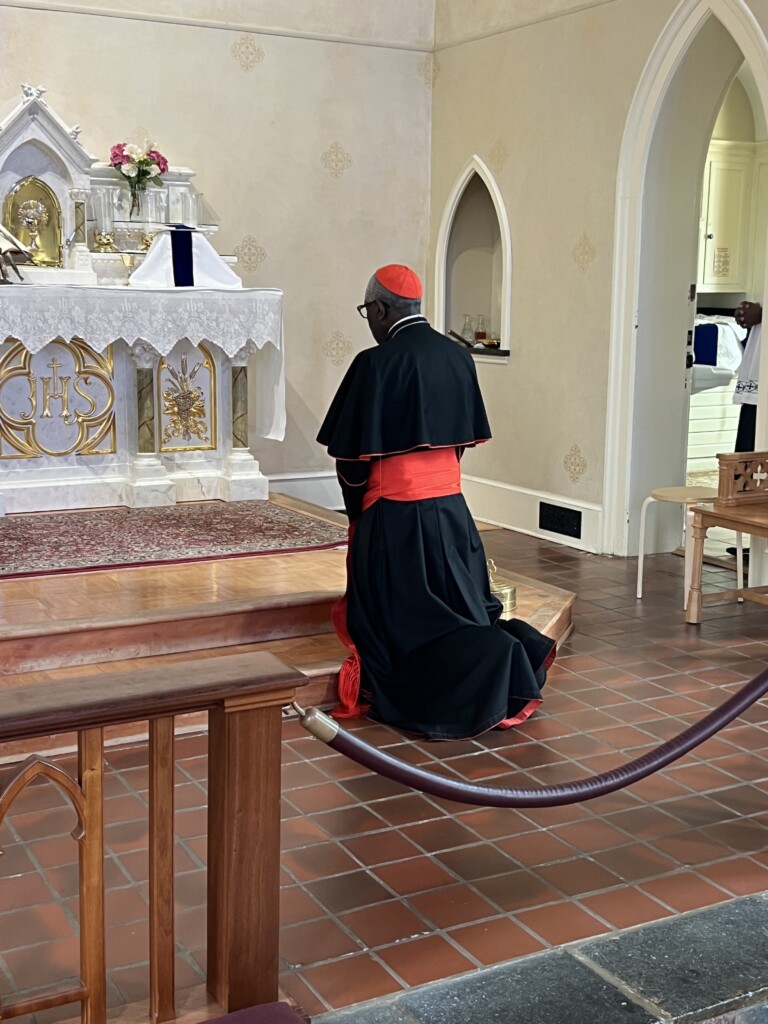
Below, an image from almost 2 years ago of Cardinal Robert Sarah, on the morning his 79th birthday, kneeling in an adoration chapel in Front Royal, Virginia, USA, on June 15, 2024, after celebrating Mass.
***
Cardinal Sarah, two days ago, on February 22, released a text, published partially in French, on the dispute between the SSPX and Rome. The complete text, translated into English, was published on February 23 by Diane Montagna on her Substack at this link.
Here is a central part of Cardinal Sarah’s text:
“I wish to express my grave concern and my profound sorrow upon learning of the announcement by the Priestly Fraternity of Saint Pius X, founded by Archbishop Lefebvre, of its intention to proceed with episcopal ordinations without pontifical mandate.
“We are told that this decision to disobey the law of the Church is motivated by the supreme law of the salvation of souls: suprema lex, salus animarum. But salvation is Christ, and He gives Himself only within the Church.
“How can one claim to lead souls to salvation by paths other than those He Himself has indicated to us?
“Is it truly to will the salvation of souls to rend the Mystical Body of Christ in a perhaps irreversible way?
“How many souls risk being lost because of this new tear in the seamless garment of the Church?”
I discussed this text on a YouTube video yesterday, at this link.
Below is the full text.
—RM
Breaking:
Here below is the text by Cardinal Robert Sarah, published on Diane Montagna‘s Substack at this link.
***
EXCLUSIVE: Full English Text of Cardinal Robert Sarah’s Appeal for Unity
Published in French in abbreviated form on Feb. 22, the full English text responding to the recent SSPX decision is presented here.
February 23, 2026
ROME, 23 February 2026 — Cardinal Robert Sarah has expressed his “grave concern” following the Society of Saint Pius X’s announcement that they intend to proceed with episcopal ordinations on July 1 without a pontifical mandate.
In an appeal published in the prominent French weekly Le Journal du Dimanche on Feb. 22, Cardinal Sarah urged the SSPX to reconsider its decision and called for unity in the Church through obedience to the Vicar Christ.
Previously published in French only in an abbreviated form, the full English translation of Cardinal Sarah’s appeal is presented below for the first time, with His Eminence’s kind permission.
***
Before It Is Too Late!
A Call to Unity by Cardinal Robert Sarah
Full text
February 23, 2026
“’You are the Christ, the Son of the living God’ (Mt 16:16). By these words, Peter, questioned along with the other disciples by the Master about the faith he professes in Him, expresses in summary the patrimony that the Church, through apostolic succession, has safeguarded, deepened, and handed down for two thousand years. Jesus is the Christ, the Son of the living God—that is to say, the one and only Savior.”
These words, so clear and so powerful, spoken by Pope Leo XIV on the faith of Peter the day after his election, still resound in my soul.
The Holy Father thus sums up the mystery of faith which bishops, as successors of the Apostles, must never cease to proclaim and recall. Christ is not only our sole Savior; He is our sole salvation. His Name is the only one by which we can be saved.
But where can we find Jesus Christ, the one Redeemer?
Saint Augustine answers us with clarity: “Where the Church is, there is Christ.”
We know that there is no salvation outside the Church. That is why our concern for the salvation of souls is expressed in our constant solicitude to lead them to the one source: Christ, who gives Himself in and through the Church.
The Church is therefore the place of faith, the place where the faith is handed on, and the place where, through Baptism, one is plunged into the Paschal mystery of the Passion, Death, and Resurrection of Christ. This mystery frees us from the prison of sin and from all our divisions, and brings us into the communion of the Triune God.
In the one Church there exists a center, a necessary point of reference: the Church of Rome, governed by the Successor of Peter, “the first of the Twelve.”
The Second Vatican Council, in its Dogmatic Constitution on the Church, Lumen Gentium, declares:
“By preaching the Gospel everywhere (cf. Mk 16:20), welcomed by those who hear it through the action of the Holy Spirit, the Apostles gather together the universal Church, which the Lord founded upon the Apostles and built upon blessed Peter, their head, Christ Jesus Himself being the supreme cornerstone (cf. Rev 21:14; Mt 16:18; Eph 2:20)” (LG 19).
This formulation directly renders the thought of Jesus, as it were engraved in the very names themselves of “Kephas” and of the Twelve, given the depth of their biblical resonances.
Simon Peter, who already occupies in the Gospel a preeminent position among the Twelve, brings to the Risen One the fish of his net. Jesus then solemnly entrusts to him the charge of shepherding His flock.
The Church is one.
She is the Church that Christ entrusted to Peter and to the Twelve. Indeed, the Church is, fundamentally, according to the expression of Mark and Luke, “Peter and those who are with him” (Mk 1:36; Lk 9:32).
Primacy is therefore given to Peter, and thus one can see one single Church and one single Chair… Can one who abandons the Chair of Peter still claim to be within the Church of Christ?
For this reason, I wish to express my grave concern and my profound sorrow upon learning of the announcement by the Priestly Fraternity of Saint Pius X, founded by Archbishop Lefebvre, of its intention to proceed with episcopal ordinations without pontifical mandate.
We are told that this decision to disobey the law of the Church is motivated by the supreme law of the salvation of souls: suprema lex, salus animarum. But salvation is Christ, and He gives Himself only within the Church.
How can one claim to lead souls to salvation by paths other than those He Himself has indicated to us?
Is it truly to will the salvation of souls to rend the Mystical Body of Christ in a perhaps irreversible way?
How many souls risk being lost because of this new tear in the seamless garment of the Church?
We are told that this act is intended as a defense of Tradition and of the integrity of the Deposit of Faith. I know only too well how the Deposit of Faith is sometimes scorned even by those who have the mission to defend it. Certainly, today we ought to have a more vivid awareness that there exists an unbroken continuity in the life of the Church—in the proclamation of God, in the celebration of the sacraments—which reaches down to us and which we call Tradition. It gives us the guarantee that what we believe is the original message of Christ preached by the Apostles.
The core of the original proclamation is the event of the Passion, Death, and Resurrection of the Lord Jesus, from which flows the entire patrimony of the faith.
In this way, while Sacred Scripture contains the Word of God, the Church’s Tradition preserves and faithfully and integrally transmits it, so that men and women of every age may have access to its immense riches and be enriched by its treasures.
Thus, the Church “perpetuates and transmits to every generation, in her doctrine, her life, and her worship, all that she herself is, all that she believes.”
But I also know, and firmly believe, that at the heart of the Catholic faith lies our mission to follow Christ, who became obedient unto death—even death on a Cross.
Can one truly dispense with following Christ in His humility, even unto the Cross? Is it not a betrayal of Tradition to take refuge in merely human means in order to preserve our works, even if they be good?
Our supernatural faith in the indefectibility of the Church may lead us to say with Christ, “My soul is sorrowful even unto death” (Mt 26:38), when we see the betrayals and cowardice of an ever-increasing number of high-ranking prelates teaching not the Deposit of Faith, but their own opinions and their personal vision in matters of doctrine and morals.
But it can never lead us to renounce obedience to the Church.
Saint Catherine of Siena, who did not hesitate to rebuke cardinals and even the Pope, declares: “Always obey the shepherd of the Church, for he is the guide whom Christ has established to lead souls to Himself.” The good of souls can never be served by deliberate disobedience, for the good of souls is a supernatural reality. Let us not reduce salvation to a worldly game of media pressure.
Who will give us the certainty of truly being in contact with the source of salvation? Who will guarantee that we have not taken our own opinion for the truth? Who will protect us against subjectivism? Who will assure us that we are still being nourished by the one Tradition that comes to us from Christ? Who will guarantee that we are not running ahead of Providence, but following it, allowing ourselves to be guided by its promptings?
To these anguished questions, there is but one answer—the answer given by Christ to the Apostles: “He who hears you hears Me. Whose sins you forgive are forgiven them, and whose sins you retain are retained” (Lk 10:16; Jn 20:23).
How can one take upon oneself the responsibility of distancing oneself from this one certainty? We are told that this is done in fidelity to the previous Magisterium—but who can guarantee this to us except the Successor of Peter himself?
Here there is a question of faith. It arises for all those who contest dogma and morality in the name of fashionable ideologies. It also arises for those who claim to defend Tradition.
“He who obeys the Pope, the representative of Christ on earth, will not be separated from the Blood of the Son of God,” said Saint Catherine of Siena. It is not a matter of worldly or ideological fidelity to a man and to his personal ideas.
It is not a matter of being partisans of a man. It is not a matter of papolatry or of a cult of personality surrounding the Pope. It is not a matter of obeying the Pope insofar as he expresses his personal ideas, opinions, or ideological positions on grave doctrinal and moral questions. It is a matter of obeying the Pope who says, like Jesus: “My doctrine is not Mine, but His who sent Me” (Jn 7:16).
It is a matter of a supernatural understanding of canonical obedience, which guarantees our bond with Christ Himself. This is the sole guarantee that our struggle for the faith, Catholic morality, and the liturgical tradition does not stray into ideology. Christ has given us no other certain sign.
To leave the Barque of Peter and to organize oneself autonomously, in a closed circle like a sect, is to deliver oneself to the waves of the storm.
I know well that often, even within the Church herself, there are wolves disguised as lambs.
Did not Christ Himself warn us of this?
But the surest protection against error and heresy remains our supernatural and canonical attachment to the Successor of Peter. “If certain pastors or leaders are wicked, do not reject the Church: she is the one that Christ founded, and He will never allow her to perish. It is Christ Himself who wills that we remain in unity, and that even when wounded by the scandals of evil pastors, we do not abandon the Church,” says Saint Augustine.
I would like to conclude by recalling the suffering of Christ in the Garden of Olives and His cry of thirst upon the Cross. How can one remain insensitive to the anguished prayer of Jesus: “Father, that they may be one, even as We are one” (Jn 17:22)?
How can one fail to be moved by this cry of Jesus, who desires our unity, and yet continue to tear apart His Body under the pretext of saving souls?
Is it not He—Jesus—who saves?
Is it we and our structures who save souls?
Is it not through our unity that the world will believe and be saved?
This unity is first that of the Catholic faith; it is also that of charity; and finally, it is that of obedience.
I would like to recall that Saint Pio of Pietrelcina was unjustly condemned in his lifetime by men of the Church. For twelve years, he was forbidden to hear confessions. Even though God had given him a special grace to help the souls of sinners, he was forbidden to hear confessions!
What did he do?
Did he disobey in the name of the salvation of souls?
Did he rebel in the name of fidelity to God?
No—he remained silent.
He embraced crucifying obedience, certain that his humility would be more fruitful than rebellion.
He wrote: “The good God has made me understand that obedience is the only thing that pleases Him, and for me the only means to hope for salvation and to sing of victory.”
Thus, we too can affirm that the best way to defend the faith,
Tradition, and the authentic liturgy will always be to follow the obedient Christ.
Christ will never command us to break the unity of the Church.
As Saint John Chrysostom says: “The unity of the Church, preserved by the Holy Spirit, is more precious than all the riches of this world.”
[End, text by Cardinal Sarah, “Before it’s too late”]
=============================
One interesting reader’s comment
American Catholic scholar of liturgy Peter Kwasniewski (link) commented on Sarah’s text on Montagna’s Substack:
Peter Kwasniewski: As a wise friend wrote after reading this:
“Bishops who agree with the basic critique of the Vatican (as Sarah does!) should get together and say, Holy Father, we call upon you to prevent this rupture by taking these steps to circumvent the felt necessity to ordain bishops without a mandate — and then outline a way forward that allows sympathetic prelates to ordain for the SSPX (Sarah, Müller, et al can offer their services) and regularizes the Society; at least insert the language of +Schneider on the Abu Dhabi statement; soften or repeal TC; and establish a study group to correct AL [Amoris Laetitia]
“Or something similar.
“The way of stating things Sarah goes with just widens the gap. But presenting the matter as something the authority has the responsibility to fix changes the narrative, not least because if the Pope doesn’t take the suggestion, once overtly made, he looks like he’s admitting that the charges are correct — that he really does want to lead the church into Anglicanism (a good line there in Müller’s statement, much better than hiding behind synodality).
“It’s really Rome’s move.”
[End, Comment by Peter Kwasniewski, citing a friend]