Dear Friends,
For more than two decades, I’ve been sending The Moynihan Letters without charge, and I intend to keep them freely available. As the new year begins, I am faced once again with the annual costs of producing and sending the letters to all my readers — about $5,000 in total. If you enjoy the letters and would like to help support their continuation, I’d be very grateful for your contribution. Thank you, as always, for reading and for being part of this community.
— Dr. Robert Moynihan


Cardinal Joseph Zen walks in Rome in front of the Holy Office, assisted by his secretary, Fr. Carlos Ceung. The Vatican, where the Consistory was held, is in the background. The photo taken by Edward Pentin (link)

Above, left, Cardinal Joseph Zen Ze-kiun, 93, with Pope Leo XIV and Zen’s assistant Fr. Carlos Cheung at the Vatican, January 7, 2026.
Note: Zen turns 94 tomorrow, January 13(!)… so tomorrow is his birthday.
Letter #3, 2026, Monday, January 12: Zen… and Ashenden
Cardinal Joseph Zen has done it again.
He has spoken truth to power, courageously.
But this time, Zen was speaking, not, as so often in the past, to the Communist governing authorities of his native China, but… to his fellow Catholic cardinals, at a special Consistory summoned to gather in Rome last week by Pope Leo XIV.
Zen delivered a powerful address to the College of Cardinals, which has now gone viral. The talk was given in the presence of Pope Leo and of about 170 members of the College of Cardinals during the Extraordinary Consistory held on January 7 and 8 in Rome (full text below)
***
Cardinal Zen is known worldwide as a courageous Chinese Catholic leader. Zen served as Bishop of Hong Kong from 2002 to 2009. He is a member of the Salesian Order of Don Bosco. Zen was made a cardinal by Pope Benedict XVI in 2006, 20 years ago. So Zen has served at the highest level of global Church government for two decades now.
Zen is known in China and around the world for speaking out on issues of human rights, political freedom, and religious liberty.
Now he will also be known throughout the Church as a man willing to speak about the true needs of the Church in this time of crisis.
***
A fiery talk to remember: “Put Christ first!”
In this sense, if one remembers one thing about this Consistory, one should remember that a 93-year-old cardinal from Communist China came to Rome and had to courage to tell the assembled cardinals that they must put Christ first, above every other consideration of diplomacy and convenience.
The full text of his remarks is below, along with a discussion of the text written by British journalist Edward Pentin, an old friend, who was the first to publish the text.
(It has not been made clear how or who leaked the text; the rule for this Consistory was that the proceedings would remain reserved.)
In addition to Zen’s text, I include below a second text: a thoughtful analysis of Zen’s address by Gavin Ashenden, 71, a British Catholic convert from Anglicanism who served for some time as the Anglican chaplain to Queen Elizabeth II.
Below that, still another fascinating text: a moving essay by Ashenden, explaining his conversion story, and, the story of… why he is not a Catholic priest, despite the fact that he wished to be ordained as a Catholic priest, after having served as an Anglican priest for many years.
The reason: Catholic authorities told Ashenden he would have to agree to give up his very effective and powerful media and podcast ministry of evangelization to the modern world if he were to be ordained to the Catholic priesthood.
***
“Everyone in his life has the moment when he is open to Divine Grace”
Ashenden decided to continue the evangelizing ministry he felt God had entrusted to him, a ministry of writing, in the long line of British Catholic converts which includes great convert writers like Graham Greene, Evelyn Waugh and Muriel Spark.
Evelyn Waugh once said of his own Catholic belief: “I believe that everyone in his life has the moment when he is open to Divine Grace. It’s there, of course, for the asking all the time, but human lives are so planned that usually there’s a particular time, sometimes on the deathbed, when all resistance is down and Grace can come flooding in.”
***
Below, the moment of Ashenden’s reception into the Church on December 19, 2019, in Shrewsbury, England.
His wife, Helen, became a Catholic about two years ago in the Diocese of Shrewsbury.
“Having come to believe that the claims and expression of the Catholic faith are the most profound and potent expression of apostolic and patristic belief, and to accept the primacy of the Petrine tradition, I am grateful to the Bishop of Shrewsbury and the Catholic community in his diocese for the opportunity to mend 500 years of fractured history and be reconciled to the Church that gave birth to my earlier tradition,” Ashenden has said.
“I am especially grateful for the example and the prayers of St John Henry Newman. He did his best to remain a faithful Anglican and renew his mother Church with the vigour and integrity of the Catholic tradition,” he added. “Now, as then, however, his experience informs ours that the Church of England is inclined to be rooted in secularised culture rather than the integrity and insight of biblical, apostolic and patristic values.”
Ashenden added that St. John Henry Newman‘s experience “also inspires ours, and charts the way to our proper ecclesial home which is the rock that is the Petrine charism of faith and witness in our struggle for salvation and heaven.”
—RM
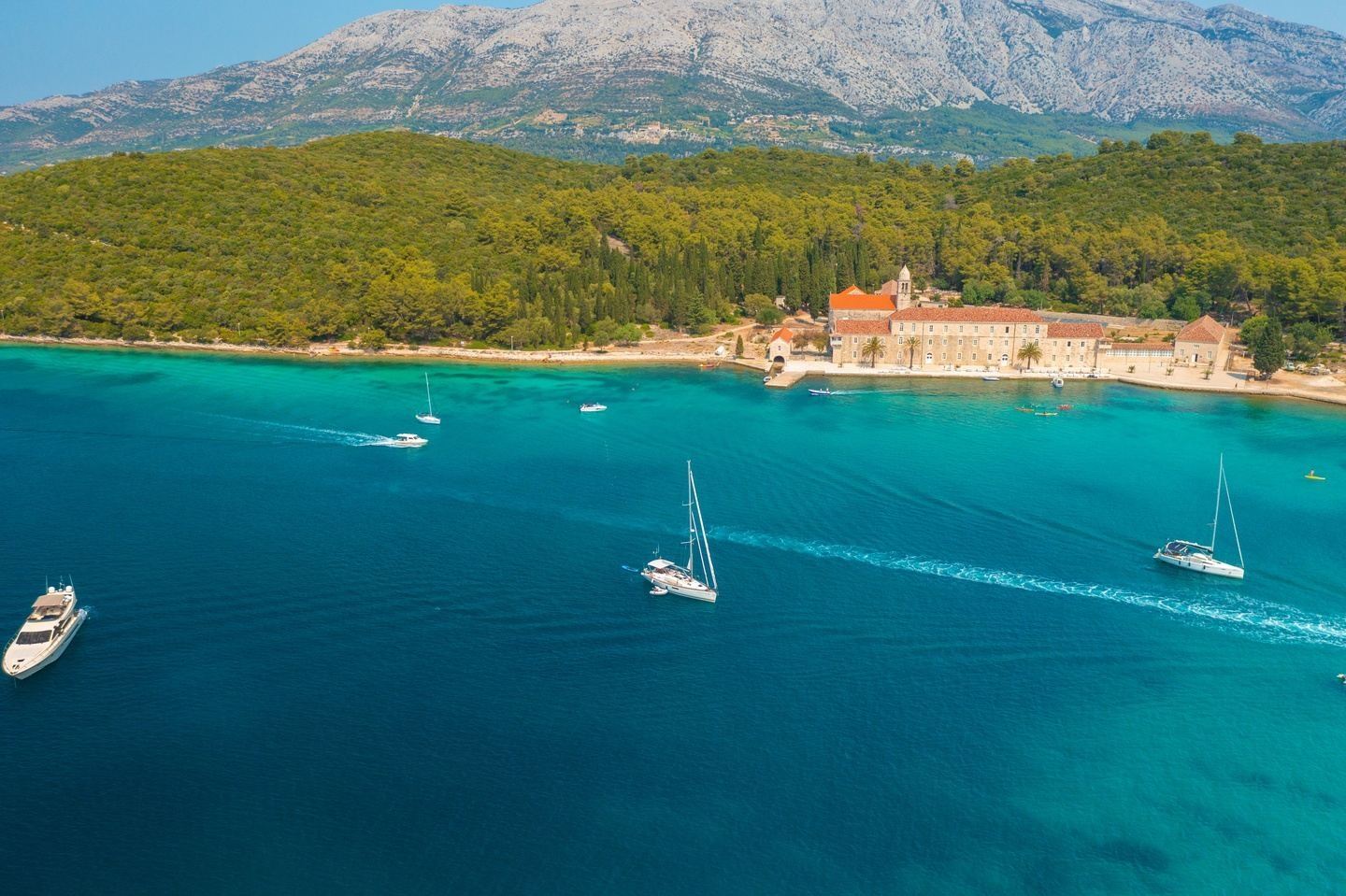
Rooted in Hope: Private Island Retreat & Medjugorje with Gavin Ashenden
May 29 – June 7, 2026
Inside the Vatican Pilgrimages invites you to join a special Pilgrimage and Retreat with Dr. Gavin Ashenden, May 29 – June 7, 2026.
Highlights of our Pilgrimage:
- Five-night private island retreat at a historic Franciscan monastery on the Island of Badija
- Three nights of pilgrimage and prayer in Medjugorje
- One night in Split
- Afternoon in Dubrovnik
- Morning retreat conferences led by Gavin Ashenden
- Daily Mass and spiritual reflections celebrated by Father Jacob Jose
- Time set aside for personal prayer, silence, and reflection
- Participation in the evening prayer program at St. James Church in Medjugorje
- Visits to key Medjugorje pilgrimage sites, including Apparition Hill, Cross Mountain, and the Blue Cross
- Catholic guides in Medjugorje providing daily guidance and schedules
- Travel by private coach and boat to and from the Island of Badija
- All breakfasts and most lunches (except 2) and dinners (except 1), are included
- A peaceful, unhurried retreat-style pilgrimage centered on Christ and Marian devotion
Cardinal Zen Received in a Private Audience by the Pope (link)
January 10, 2026
Source: FSSPX News
On the occasion of the extraordinary consistory of January 7 and 8, 2026, Cardinal Joseph Zen Ze-kiun was received by Pope Leo XIV, in contrast to the previous Pope’s refusal to meet with him during the last years of his pontificate, undoubtedly due to the cardinal’s sharp, and indeed justified, criticism of the agreement between the Vatican and the People’s Republic of China.
Quite unexpectedly, the 93-year-old Archbishop Emeritus of Hong Kong received permission from the Hong Kong authorities to travel to Rome for the extraordinary consistory, even though he is currently out on bail after his conviction three years ago for failing to register an association assisting pro-democracy protesters, and his passport had been confiscated.
The hearing for the appeal filed by the Chinese cardinal took place on December 3 and 4. His friend, Jimmy Lai, on the other hand, was sentenced for “sedition” and “collusion with foreign forces” on December 15, two offenses each punishable by life imprisonment.
In 2025, Cardinal Zen had been authorized to travel to Rome for the funeral of Pope Francis and to attend the pre-conclave, during which he sharply criticized the Synod on Synodality, which, according to him, is an attempt to “dismantle the ecclesiastical hierarchy” and introduce a “democratic structure into the Church,” a true change to the divine constitution of the Church.
He strongly criticized Fiducia supplicans, a document authorizing blessings for same-sex couples, and signed the dubia requesting clarification on issues related to doctrinal development, the blessing of homosexual unions, the authority of the Synod on Synodality, the ordination of women, and sacramental absolution, along with four other cardinals. He even wondered aloud whether Cardinal Fernández should be replaced…
A Persistent Refusal from Francis
During the previous pontificate, Cardinal Zen repeatedly requested an audience with Pope Francis, without success. He even published articles on his blog about it: “I’m not sure my letters are reaching him, so I’m publishing what I have to say on my blog, hoping that he will have the opportunity to read it someday through someone,” he stated.
The main reason for this refusal is undoubtedly the cardinal’s persistent criticism of the agreement signed with the Chinese authorities, which gave the Communist Party effective control over the appointment of Catholic bishops in China, de facto validating the Chinese Patriotic Catholic Association, subservient to the Party, and abandoning the underground Catholics persecuted for their loyalty to the Pope.
Cardinal Zen notably declared that they were “delivering the flock into the jaws of the wolves” and that it was an “incredible betrayal.”
Pope Francis behaved similarly with several bishops, whom he also refused to receive. For example, Bishop Rogelio Livieres, who was removed from his position as diocesan bishop of Ciudad del Este, and whom the Pope did not deign to receive before dismissing him, even though Bishop Livieres had traveled to Rome for that purpose.
It is undeniable that the practice followed by Francis regarding access to the Vicar of Christ was anything but normal.
This is why the meeting between Cardinal Zen and Pope Leo XIV shows a return to normalcy in the relations between the Supreme Pontiff and the hierarchy, cardinals and bishops.
Cardinal Zen’s 3-Minute Intervention at the Consistory (link)
Here below is the full text of Cardinal Joseph Zen’s intervention at the Extraordinary Consistory of Cardinals, held on January 7 and 8, published with the kind permission of His Eminence.
By Cardinal Joseph Zen
On the Accompanying Note by the Holy Father Francis
The Pope says that, with the Final Document, he gives back to the Church what has developed over these years (2021–2024) through “listening” (to the People of God) and “discernment” (by the Episcopate?).
I ask:
- Has the Pope been able to listen to the entire People of God?
- Do the lay people present represent the People of God?
- Have the Bishops elected by the Episcopate been able to carry out a work of discernment, which must surely consist in “disputation” and “judgment”?
- The ironclad manipulation of the process is an insult to the dignity of the Bishops, and the continual reference to the Holy Spirit is ridiculous and almost blasphemous (they expect surprises from the Holy Spirit; what surprises? That He should repudiate what He inspired in the Church’s two-thousand-year Tradition?).
The Pope, “bypassing the Episcopal College, listens directly to the People of God,” and he calls this “the appropriate interpretative framework for understanding hierarchical ministry”?
The Pope says that the Document is magisterium, “it commits the Churches to make choices consistent with what is stated in it.”
But he also says “it is not strictly normative …. Its application will need various mediations”;“the Churches are called upon to implement in their different contexts, the authoritative proposals contained in the document”; “unity of teaching and practice is certainly necessary in the Church, but this does not preclude various ways of interpreting some aspects of that teaching”; “each country or region can seek solutions better suited to its culture and sensitive to its tradition and needs.”
I ask:
- Does the Holy Spirit guarantee that contradictory interpretations will not arise (especially given the many ambiguous and tendentious expressions in the document)?
- Are the results of this “experimenting and testing,” e.g. (of the “creative activation of new forms of ministeriality”), to be submitted to the judgment of the Secretariat of the Synod and of the Roman Curia? Will these be more competent than the Bishops to judge the different contexts of their Churches?
- If the Bishops believe themselves to be more competent, do the differing interpretations and choices not lead our Church to the same division (fracture) found in the Anglican Communion?
Perspectives on Ecumenism
- Given the dramatic rupture of Anglican communion, will we unite ourselves with the Archbishop of Canterbury (who remains with only about 10% of the global Anglican community), or with the Global Anglican Future Conference (which retains about 80%)?
- And with the Orthodox? Their Bishops will never accept Bergoglian synodality; for them, synodality is “the importance of the Synod of Bishops.” Pope Bergoglio has exploited the word Synod, but has made the Synod of Bishops—an institution established by Paul VI—disappear.
Read more about Cardinal Joseph Zen here, at The College of Cardinals Report.
Gavin Ashenden on Cardinal Zen’s Intervention (link)
Here is the full text of Gavin Ashenden’s intervention on the intervention by Cardinal Zen.
Cardinal Zen was given three minutes to change history.
JAN 11
Cardinal Zen’s role during the recent consistory should, in principle, have been hidden by the confidentiality intended to preserve privacy. The fact that his three-minute speech was leaked and published is itself a sign of the effect and leverage it must have had within the consistory. I want to explore why that is, and why I believe it is the harbinger of real change and hope under our new pope.
Not all of my readers will know the role that this extraordinary 93-year-old cardinal has played over the decades, but particularly over the last few years. So let me provide a brief biography. Before doing so, however, we need to remind ourselves of the wider context—the cycle of hope and despair the Church has been enduring in recent years.
Truth v. Relativism
The broader struggle in which the Catholic Church is engaged is its claim to represent objective truth against relativism.
We claim to defend the sanctity of the human person against the tyranny of collectivism on the Left.
We claim to defend free speech against censorship, because the Church is committed both to Truth—and to those who speak it—and to human dignity, the value of human beings as truth-tellers. For this reason, the Church has always been committed to freedom of speech.
As we know, we are facing a deepening crisis in which relativism, collectivism, and censorship press in from all sides.
It is not an act of tribalism or partisanship to say that only the Catholic Church is fighting this battle on all fronts—and that only the Catholic Church has the intellectual, moral, and spiritual resources capable of winning and defending the human heart.
This Substack has made that claim since its beginning and continues to articulate and argue for it. Cardinal Zen exemplifies precisely this witness, which is why I want to draw attention to what he has achieved this week.
But first, a brief biography for those who may not know what an inspirational priest and bishop he has been.
Cardinal Zen: A Brief History
Cardinal Joseph Zen Ze-kiun is a Chinese Catholic bishop, Salesian priest, philosopher, and moral witness whose life has been shaped by exile and persecution. He has been a courageous, unyielding voice in some of the most politically dangerous circumstances imaginable, always insisting that truth must never be bartered for political convenience or comfort.
He is 93.
Born in Shanghai in 1932, Zen fled with his family to Hong Kong after the Communist victory in China. He entered the Salesians, studied philosophy and theology in China and Italy, and was ordained in 1961.
His early academic work was in philosophy, and he has always demonstrated a sharp intellect marked by clarity and precision. His integrity, intelligence, and courage have made him a formidable servant of the Church.
He was appointed Bishop of Hong Kong in 2002 and created a cardinal by Pope Benedict XVI in 2006.
Zen quickly became the Church’s most prominent defender of religious freedom in China. He emerged as a fierce critic of the Chinese Communist Party’s control over the Church, particularly through the state-run Patriotic Catholic Association, which demands loyalty to the Party over communion with Rome.
Where others spoke the language of “dialogue” and “gradual progress,” Zen represented the language of conscience. He warned repeatedly that accommodation without truth would lead not to evangelisation but to betrayal—especially of China’s underground Catholics, many of whom had suffered imprisonment, labour camps, and martyrdom for fidelity to Rome.
After his retirement in 2009, Zen’s voice only sharpened. He became the most vocal critic of the Vatican–China agreement, arguing that it sacrificed the suffering faithful for the illusion of diplomatic success.
In Hong Kong, he stood publicly with pro-democracy demonstrators, insisting that the Church must never confuse prudence with silence, or realism with surrender.
Now in his nineties, his slight stature hiding his formidable moral authority, Cardinal Zen occupies a role rare in modern ecclesial life: a bishop who reminds the Church that compromise with falsehood corrodes the soul, and that obedience is only Christian when ordered to truth.
Arrest, Surveillance, and Constraint
Zen was arrested in May 2022 by Hong Kong’s National Security Police over his involvement with the 612 Humanitarian Relief Fund, a charity supporting people affected by the 2019 pro-democracy protests. His passport was confiscated, and although the main conviction was for a minor administrative offence, he continues to live under legal constraint.
For several years after his arrest, he required special court permission to travel. In 2025 he was temporarily granted his passport to attend Pope Francis’ funeral in Rome, before returning to Hong Kong.
As a retired cardinal, he lives there as a private citizen under bail conditions, with ongoing legal sensitivities and constant surveillance.
The Vatican–China Agreement
In September 2018, the Holy See and the People’s Republic of China signed a Provisional Agreement on the appointment of Catholic bishops. It has never been made public.
Under its terms, state-controlled Church bodies propose episcopal candidates, while the Pope retains formal authority to approve or veto them. Several bishops previously appointed without papal mandate were recognised, in the hope of healing division and securing a stable future.
Cardinal Zen sharply criticised the agreement, warning that it subordinated the Church to an atheistic state and betrayed the underground Catholics who had endured persecution in fidelity to Rome. He argued that the agreement replaced martyrial witness with administrative accommodation, mistaking diplomatic access for genuine religious freedom.
He was ignored.
IGNORED BY THE POPE
In January 2020, at the age of 88, Zen travelled to Rome and formally requested an audience with Pope Francis in order to warn him personally that the underground Church was being abandoned. Pope Francis declined to receive him.
Instead, Zen was briefly seen by Cardinal Pietro Parolin, the chief architect of the China policy Zen was opposing. Zen later made public that he had been refused a papal audience—not as a personal grievance, but as a symbolic repudiation of the message he carried. He did not conceal the pain or gravity of what he believed had happened.
Many Catholics found the refusal profoundly troubling. The agreement itself remained secret, renewed without transparent assessment, and shielded from theological scrutiny.
The offence was deepened when Pope Francis instead received Cardinal Battista Re, who publicly praised the China policy in a consistory address, marginalising dissent and defending the bureaucratic machinery of accommodation over the witness of the suffering faithful.
A Declaration of Interest
Some readers will know that in the early 1980s I undertook clandestine missions smuggling Catholic texts into Czechoslovakia for underground seminarians. The Marxist government had outlawed ordinations in an attempt to starve the Church of priests. Formation had to be secret, or the Church would die.
I met underground Church leaders in Prague under conditions of extreme risk. None of us knew each other’s real names. I was myself interrogated. I know something of the courage and cost of Catholic witness under Marxist totalitarianism.
The dynamics in China today are not dissimilar. I remain deeply suspicious of the 2018 agreement, and I have long held a profound admiration for Cardinal Zen.
Have the Claims Held?
The agreement was justified on three grounds:
- Healing the split between “official” and “underground” Catholics
- Protecting the Church by cooperation rather than confrontation
- Securing a more normal episcopal life over time
These claims are now testable.
Since 2018 there has been no persuasive evidence that the policy has protected Catholics or softened the regime. On the contrary, repression has intensified, episcopal freedom has not materialised, and Rome’s prophetic voice has grown muted. The underground Church has been morally disarmed and exposed.
Cardinal Zen has been proved right.
The Consistory and the Turning Tide
Cardinal Zen’s return to Pope Leo’s first consistory was therefore of serious significance. He came reminding the Vatican that nothing he had warned about has been disproved—and that the legacy of Pope Francis must be held to account.
Although he said nothing about China, he delivered a devastating critique of the Bergoglian implementation of synodality.
What followed was an excoriating analysis of a process that bypassed bishops, politicised consultation, and substituted managerial control for episcopal discernment.
When Pope Leo announced that he intended to draw the cardinals together in an exercise of synodality, many of those who were critical of the Synodal process were overcome with anxiety. They assumed there was only one expression of synodality. But of course, in reality it refers simply to the process of consultation.
And Pope Leo did two things that were wholly different from his predecessor. Firstly, unlike Pope Francis he actually consulted. Francis talked about the Synodal process and implemented a highly politicised version of it extending it way past the office of bishops, but in fact he seldom if ever consulted the cardinals.
One of Pope Leo’s first public acts was to draw the cardinals together in this consistory, and then to ask them, – to consult them, on what synodality ought to consist of.
It is greatly to Pope Leo’s credit that Cardinal Zen was given the opportunity to address both the pope and his fellow cardinals.
His words were leaked because not only because they resonated and because of their profound analytical significance.
Cardinal Zen’s Speech
What follows is a summary, with direct quotations, of Cardinal Zen’s intervention at the consistory, as reported on 9 January by The College of Cardinals Report, based on sources present at the closed-door meeting.
The bishop emeritus criticised Pope Francis for bypassing the College of Bishops in the synodal processes he implemented. He questioned Francis’ assumption that the process he initiated was an appropriate means for “understanding the hierarchical ministry.”
The cardinal refuted the assumption that any pope had the ability to “listen to the entire People of God.” In fact, he questioned whether, or to what extent, the laity themselves actually represented the People of God. He asked whether the bishops elected to take part in the synodal process had in fact been in a position to carry out a work of any real discernment.
Cardinal Zen clearly thought not. His speech was an excoriating indictment of the synodal process.
He made a series of accusations:
“The ironclad manipulation of the process is an insult to the dignity of the bishops, and the continual reference to the Holy Spirit is ridiculous and almost blasphemous.”
“They expect surprises from the Holy Spirit. What surprises? That he should repudiate what he inspired in the Church’s two-thousand-year tradition?”
He also pointed out the obvious inconsistencies in the synod’s final document:
- it was declared to be part of the magisterium, yet said it established no norms;
- it stressed unity of teaching and practice, but contradicted itself by claiming these could be applied according to “different contexts”;
- it reinforced this contradiction by claiming that each country or region “can seek solutions better suited to its culture and sensitive to its tradition and needs.”
The cardinal exposed the document’s “many ambiguous and tendentious expressions,” and asked whether the Holy Spirit guarantees that “contradictory interpretations will not arise.”
Zen then challenged the role of the Synod Secretariat in effectively replacing the role of bishops in the process.
He asked whether the results of what the document calls “experimenting and testing” of these “new forms of ministeriality” were to be submitted to the Synod Secretariat and, if so, whether that body would be “more competent than the bishops to judge different contexts” in the Church across countries and regions.
Like so many others, he saw the whole trajectory as offering a forced replay of the incoherent progressivism under which the Anglican Communion collapsed.
He asked:
“If the bishops believe themselves to be more competent, do the differing interpretations and choices not lead our Church to the same division (fracture) found in the Anglican Communion?”
He also raised the ecumenical implications of the Bergoglian plan with respect to the Orthodox Churches.
Zen pointed out that their bishops “will never accept” what he called “Bergoglian synodality,” because for them synodality means precisely the authority of the Synod of Bishops.
He accused Pope Francis of “exploiting the word synod, but [having] made the Synod of Bishops — an institution established by Paul VI — disappear.”
(He was referring to Francis’ reshaping of the institution by giving non-bishops a formal role, thereby transforming it from an episcopal advisory body into something else entirely.)
We should remember that the consistory was a closed-door meeting to which no media were admitted, and cardinals were asked to keep the proceedings confidential. But clearly, there was sufficient sympathy and support for his excoriating analysis that his speech was recorded and leaked to the world, which is why we have it.
The Vatican press office and cardinals chosen to speak to the press tried to put the lid back on. They made no mention of Zen’s remarks during the consistory.
A number of press statements made the claim there was no criticism of Pope Francis during the two-day meeting. This was obviously an attempt to impose some diplomatic oil on the troubled waters of frank analysis. Cardinal Stephen Brislin made an attempt to acknowledge what had taken place with an elegant understatement, referring to a “divergence” of opinion, acknowledging that “some cardinals wanted the concept of synodality to be further clarified.”
What will come of Cardinal Zen’s intervention?
We already know that Bishop Barron has gone public with his own pointed critique of the Bergoglian strategy.
“Synods are good and useful tools for the determination of practical pastoral strategies, but they oughtn’t to be forums for debate regarding doctrine. When settled teaching becomes a subject for synodal determination, the Church devolves into relativism and self-doubt—as is clearly evident in the misconceived “Synodal Way” in Germany………
So, if we must continue with synodality, let it be dedicated to the consideration of practical means by which the Church can more effectively do its work of worshipping God, evangelizing, and serving the poor. And let it not be a defining and permanent feature of the Church’s life, lest we lose our verve and focus.”
Conclusion
Between the prophetic clarity of Cardinal Zen and the measured warnings of younger bishops such as Bishop Barron, the College of Cardinals has been confronted with the theological and political consequences of the last decade of Vatican policy.
Pope Leo and the cardinals now have the opportunity to reconstitute an integrated episcopal mind, to heal divisions, and to put aside the ambiguities that have damaged both papal authority and episcopal confidence.
With the clarion voice of one of the Church’s most respected confessors sounding once more, we can say with confidence:
The tide has turned.
Zen’s interventions—past and present—are not those of a rebel, but of a revered confessor: a man formed by persecution, having proven his courage, paid the price, and making a formidable speech to remind the Church of the ultimate issues it faces, and calling it back to truth.
Formed by persecution rather than diplomacy, he spoke as a bishop who knows the cost of truth when power demands accommodation and heterodoxy challenges orthodoxy. The fact that his words were heard, recorded, and released tells its own story.
With Pope Leo’s decision to consult the cardinals in earnest, and with voices of moral authority now both being given a platform and being heard, something has shifted.
The Church has been reminded that synodality is a means, not a process to a manufactured end; that politicised manipulative consultation cannot replace episcopal responsibility; and that unity cannot be built on ambiguity.
Accompanied by the clarity of one of the Church’s oldest and most respected confessors, the tide has turned, by truth reasserting its rightful place both at the centre of the Church and at the heart of the episcopate.
We owe our pope a debt of gratitude for making this consistory possible and Cardinal Zen a debt for his courage, integrity and perseverance. The tide has turned.
[End, piece by Gavin Ashenden]

Gavin Ashenden, a former Anglican bishop, is blessed by Bishop Mark Davies of Shrewsbury, England, during Ashenden’s reception into the Catholic faith on December 19, 2019. (CNS photo/Simon Caldwell)
Why I am not a Catholic Priest (link)
Deus le Vult (“God wills it”)
By Gavin Ashenden
I have been asked to write a little about why, unlike many of my more estimable Anglican former colleagues, I have not been ordained as a priest in the Catholic Church, but remain a layman

Ordination as an Anglican priest
It is June 1980. I am standing in my bare feet, in a black cassock, in what long before had been the Priory Church of St Mary Overie, on the Feast of St Peter. I trained at university to be a lawyer.
I am now waiting instead to be ordained as an Anglican, and start work in a parishe by Dockhead in Bermondsey, just east of Tower Bridge.
I had come wearing a pair of carefully polished black shoes. But I had seen Catholic ordinations and was lamenting that in our own liturgy there was no prostration before the altar and the Blessed Sacrament. The closest I could get to expressing what I felt I needed to express, was to do as Moses did, and remove my shoes. I was standing upon holy ground.
My cassock was long; my feet were more or less hidden. I hoped it was a private expression of piety, not a public one. The moment was awesome and solemn.
The night before, most of the other ordinands had left the retreat to go to the pub. It was not that I was excessively pious or antisocial, but I felt that my place was before the altar. I had fasted a little, and there was still time left to pray. The pub did not seem to me to be the place to prepare on the night before ordination.
In 1106, two Norman knights—William Pont de l’Arche and William Dauncey—refounded the church in which I was standing by the side of the river Thames, as an Augustinian priory, dedicated to the Virgin Mary on the south bank of the Thames.
The priory established a hospital alongside the church, dedicated to St Thomas Becket, which was a predecessor institution in the long history of what became St Thomas’s Hospital—one of London’s oldest medical charities. The medieval priory church is London’s oldest Gothic church, with most of the present structure dating from roughly 1220–1420. The poet John Gower, friend of Chaucer, lived at and was buried in the priory; his tomb still stands in the nave.
At the Dissolution of the Monasteries under Henry VIII in 1539, the priory was suppressed and the canons dispersed. The church building was retained for Anglican state worship and renamed St Saviour’s—a parish church for the local community—though the old name St Mary Overie continued in popular use.
As I stood there in what had been St Mary Overie, (now Southwark Anglican cathedral) waiting for the first hymn, I tried to keep my mind on continuity. I was trying to concentrate on the flow of unbroken continuity of faith with the Catholic faith of England’s past. In 1980 I succeeded.
But in later years, I was to find that history would not allow the sentiment to settle. The reality, when faced honestly, told a very different story. The walls of the old priory had not simply witnesses to medieval devotion and sacramental continuity; they had looked on scenes of terrible Catholic suffering. Southwark was not a sanctuary for recusant Catholics after 1565. It was a place of holding, of dread, of waiting. From here, prisoners were dragged northwards, across the river, towards their execution.
Within minutes’ walk of St Mary Overie stood two notorious prisons. The first was the Clink Prison, controlled by the Bishop of Winchester—ironically the holder of a see that had once been fully Catholic. The Clink held Catholic priests, harbourers, and recusants. Its conditions were deliberately cruel: starvation, extortion, and torture were part of the machinery of deterrence. Nearby stood the Marshalsea Prison, where religious prisoners were confined alongside debtors. Many Catholic clergy passed through its gates on their way to exile—or death. In practical terms, St Mary Overie was surrounded by Catholic suffering.
Southwark detained the Catholic faithful; London, on the other side of the river, executed them. Those imprisoned here were not usually killed on this side of the Thames, but their final journey almost always began here. Most recusant Catholics were taken across the river to Tyburn, the principal execution site for priests, or to Tower Hill for prisoners of higher status. They were dragged from the prisons of Southwark, often past St Mary Overie itself, then across London Bridge, and on to public execution. In this way, Southwark became part of the liturgical geography of martyrdom—even when it was not the place of death itself.
But I was not to discover the truth about this aspect of history until I came face to face with the body of St John Southworth one day thirty-five years later in Westminster Cathedral.
He was executed at Tyburn in 1654. Literally almost stumbling over him, I felt the sudden need to know him. Reading the history of his witness, arrest, torture, and death brought me face to face with the reality of history that Anglican propaganda had erased from my education. The walls of St Mary Overie had resonated with the cried of the recusants and witnessed the shedding of the blood of the Catholic martyrs at the hands of the Protestant state and establishment that had offered me its own very different rite of ordination.

A number of things makes sense now, that made less sense then. During the next twelve months, St John Henry Newman’s Apologia was never out of my inside jacket pocket. I knew he was speaking to me, but truthfully, the text was problematic. I could make out the words, but the meaning was hidden.
There were other moments.
I was once on retreat with some nuns in Kent and had a room in the medieval gatehouse. In the room next to mine there was another guest: the Roman Catholic Abbot of Quarr, Dom Paulinus Greenwood, OSB, Abbot of Quarr from 1969 to 1992.
He was one of the most striking Catholic priests I have ever met—a man who simply exuded a quiet holiness which, as so often happens, caused the room to seem to light up from time to time. He asked whether I would be kind enough to serve for him at Mass in the mornings, in the small chapel in the gatehouse. And so it was that, as an Anglican vicar with ten years’ experience in parishes, I found myself serving at my first Catholic Mass—celebrated in Latin and offered by a man who seemed, to my eye, to carry a train of angels around with him, particularly when he stood at the altar.
I knew, instinctively and without argument, that of all the Eucharists I had ever taken part in, they had been attempts—however sincere—to replicate this moment in a kind of sub-Platonic, aspirational way. I knew that this was the Mass. And I knew that where reality was, I where I ought to be and where I needed to be.
There were, of course, other Catholic Masses that I attended later. In particular, I remember the striking contrast with the informality of the Jesuit Masses at Heythrop, where I spent a couple of years doing postgraduate work. If you wanted down-to-earth immanence—where the daily intellectual labour of the university flowed seamlessly into a celebration of the sacramental mysteries—the Jesuits managed it with an ease that was almost disarming. They made the gentle sidestep from one world into the other with no fuss, no strain.
Meanwhile, the slow, inexorable unravelling of Anglicanism eventually broke whatever pretence of continuity I had conjured up in my mind. The move from the ordination of women as presbyters to so-called bishops finished forever the fiction that Anglicanism could claim some kind of sacramental continuity. It had become only too clear that this feminist ‘take-over’ was an enterprise of ideological colonisation. It was not, and it seemed never had been the exercise of discernment it promised it would be.
My subsequent journey into the history of Our Lady’s apparitions, and the discovery of the scientific validation of the Eucharistic miracles, made the gap that Protestantism dug between the churches of the Reformation and historic Catholicism too painfully wide to bridge. I knew I had to cross the chasm.
When, at the beginning of Advent 2019, my Catholic bishop asked to see me and asked if—and when—I was going to convert, I knew the moment had come. There was no longer any “if”.
We discussed ‘when’.
I told him I thought I needed two years to set my affairs in order, write an explanatory book, explain myself to my Anglican community, and to the ecclesial authorities who had asked me to act as a missionary bishop for orthodox sacramental Anglicanism. He looked disappointed.
“I had in mind a period more like two weeks.”
I prayed. I reflected. I asked Jesus. I agreed—and was received on the Third Sunday of Advent 2019.
It was time.
That was the simple bit. It got more complex from that point on.
It was agreed I would be sent to learn some Canon Law, and then ordained into the diocese. Things began to go inexplicably wrong. My first set of papers got lost for two years.
“Don’t panic,” said Fr. Dwight Longenecker, who has now become a good friend. “They kept me waiting for ten years.”
“But I’m nearly 70 already. I expect to be dead in ten years.”
I found my way to the Ordinariate for liturgical reasons. They were very generous and offered to be proactively helpful.
We started again. More interviews, more committees, more conversations.
They re-sent my papers to Rome. We waited.
And waited.
Then came the news of where the papers were this time.
They had once again, never made it. They had been misdirected to Vietnam.
Vietnam, (now, sometime later,) were sending them back.
I waited some more; and as I waited, I wrote and broadcast. Something, or Someone had been preparing me for this. For four years in 2008, I had had my own BBC Faith and Ethics live phone-in programme. I had pioneered the BBC Faith & Ethics podcast.
For about seven years I had been given by the editor, a whole page column in the Jersey Evening Post to write about the Christian world view.
The editor had commissioned this cartoon to go with what was proving to be a very provocative column. It divided the island.

The ‘Woke’ began a petition to get me removed from the Island of Jersey.
But now, as a Catholic layman, I had a growing YouTube channel.
I was interviewed on ordinary news programmes — often with GB News; and extraordinary ones for Royal Weddings and funerals.
I was interviewed as a Catholic convert and invited to explain why a chaplain to the Queen would repudiate the Supreme Governor of the Church, aka the Protestant antipope, and become a Catholic?
I was appointed Associate Editor of the Catholic Herald.
And as I wrote and broadcast and spoke at conferences, I the need to encourage my new friends to resist the siren secular lure of the dictatorship of relativism; and to remind my old ecclesiastical community that the treasure Catholicism guarded in the Magisterium, would save them for ever from being overcome by the culture wars from the Left, and by the militant Islamism from the right.
I can’t answer for the extent to which the dewy-eyed enthusiasm of the passionate convert strengthened Catholic sinews; (who is this man? why does he think he knows better than we do? who does he think he is? ) but I can talk about the steady stream of Anglicans and agnostics, friends, acquaintances and strangers, who read my words, or heard them, and began to make their dogged and determined way into reception with the Catholic Church. It was an ever-quickening stream; and it grew broader and deeper.
But — and there was a big but. How do we say this politely?
The circumstances of Catholic culture were becoming more complex and more contested.

Gavin Ashenden meets Pope Francis in Rome
What had begun with a certain amount of excitement at the beginning of Francis pontificate had morphed.
The legitimate Dubia had been refused.
“Who am I to judge” had been received as the removal of objective ethical teaching.
Amoris Laetitia (2016) appeared to open the door to communion for the divorced and civilly remarried without a firm commitment to continence and produce a practical separation of sacramental discipline from objective moral state.
The Abu Dhabi Declaration (2019) appeared to open the door to religious indifferentism and the idea that God positively wills the plurality of religions producing a weakening of the uniqueness of Christ and the Church in salvation
Traditionis Custodes (2021) appeared to open the door to a rupture-based reading of liturgical continuity and the marginalisation of the pre-conciliar Roman Rite
Fiducia Supplicans (2023) appeared to open the door to the public blessing of objectively sinful unions and confusion between blessing persons and validating relationships
The Synodality Process (2021–? ) appeared to open the door to doctrinal outcomes being shaped by consultation rather than reception and pressure to revisit settled teaching (sexual ethics, women’s ordination, authority.)
There was an ever-deepening Anglican panic amongst those poised to make their journeys ‘home.’
They were not going to flee the spirit of the secular age in one denomination, only to find they were arriving in order to be asphyxiated by the new ambiguity of the progressive spirit the pope begun to unleash in Rome.
I argued and I promised, I wrote, and I persuaded my audience that they need not be afraid; that the magisterium would be strong enough to resist the ambiguities of this passing pontificate; there had been problematic popes before; this one would be constrained by the collective historial mind of the Church and the very strength of Catholic continuity that the magisterium embodied. Jesus would keep his Church safe.
Needless to say, and you can see why, but these were less than propitious circumstances. This was not the easiest moment to become a Catholic, and to trust the unchanging integrity of apostolic faith. And, I had not become a Catholic to criticise the pope. But unsurprisingly, such reassurances and explanations as was able to proffer lay thin on the ground.
The pope was a problem.
I found myself having needing to explain and reassure how I could know that in becoming a Catholic I had not simply capitulated to a more sophisticated and subtle exponent of the spirit of the age. “At least the Anglicans were honest in their progressive permutations and perambulations” some of my more wary critics murmured.
Unsurprisingly, on the other side of the coin, the ‘authorities’ had become rattled. It seemed that everyone else had been cowed by the increasing control exercised by the Vatican. Significant traditionalist bishops were being exposed and deposed. How much of a problem was ‘Ashenden’?
‘We may have rescued your papers from Vietnam, but you need to know the deal has now changed. You can only be ordained if you swear yourself to silence in public.’
Or in the precise words used:
“It would not be prudent to permit you to continue your high profile in the media.”
I responded:
“But might not this platform have been given by God to use on behalf of the Church?” I suggested.
It has not been achieved by any cleverness or cunning on my part. It seems to me to be a gift and even a responsibility.
“Is this an absolute prohibition or might this be open to negotiation?” I asked.
“The platform I have for this apostolate has not been sought by me. In fact, it is not even wanted by me. But it is making new Catholics; in significant numbers. It is playing some small part in renewing the cause of Catholic identity, anthropology and vision.
Might ordaining me, so that I can celebrate Mass not be consistent in some way or other with being able to exercise an apostolate of evangelisation in public?
Must priesthood and apologetics be kept separate?
Or is it the way I am doing it?
If it is about obedience, be reassured, I have not come this far to practice disobedience.”
“It would not be prudent to permit you to continue your high profile in the media.”
No. There was in my case to be no negotiation, I was told. Ambiguity it turned out, only took place in certain places, over certain issues for certain people. There would be no ambiguity for me.
So, then it was a matter of discernment.
Ordination to the Catholic Priesthood felt like a fulfilment of the thirty-nine years of working, praying, questioning, struggling and in the end waiting, as an Anglican minister with ever deepening sacramental yearnings.
But what was ‘my’ fulfilment if the lost stayed lost?
What was ‘my’ fulfilment if the schismatic remained in schism, separated from the last rites, from absolution?
When was any of this ever about ‘my’ ordination or ‘my’ fulfilment?
What were the precedents?
GK Chesterton exercised his apostolate as a lay apologist. His authority came from a spirit-blown imagination and an ever more perceptive moral and intellectual clarity. He too converted late, never sought ordination, and understood instinctively that his role was to make the faith visible and attractive, not to administer it. His obedience was expressed in joy and paradox, thinking and words. He was a very effective Catholic apologist.
Hilaire Belloc exercised unapologetic Catholic authority precisely as a layman. His vocation was public, political, polemical. He never sought ordination, because his calling was to contest the culture, not to wait before the altar. His authority lay in witness, not jurisdiction. He was a very effective Catholic apologist.
Christopher Dawson was a historian rather than a polemicist, but Dawson understood the deep interpenetrative inter-dependence of culture and spirituality or prayer; he saw the outward expression of worship, and civilisation as the long echo of belief. His central claim—that when religion is severed from public life, culture does not become neutral but collapses into incoherence—has become prophecy rather than analysis. Without clerical office or institutional power, Dawson nevertheless shaped Catholic understanding of history, education, and the spiritual roots of the West. His influence stretched to figures as diverse as T. S. Eliot and later generations of Catholic thinkers. His authority lay not in jurisdiction but in the authenticity and clarity of his perception: he saw, earlier than most, that the crisis of the modern West was not political or economic but religious, and that no technical solution could repair what amounted to a loss of soul.
I was no Belloc, or Chesterton or Dawson, not even a shadow of any of them, but I could think a bit, and write a bit, and argue a bit and publish a bit, and contend a bit.
And every time I did so, someone was drawn nearer to Jesus in the Mass, deeper into the ministry of reconciliation, further away from schism, closer into reception with the Church that our Lord has planted through the hands of St Peter, and against which the gate of hell could not and would not prevail.
And as an extra gift, I could find a place at the lowest foot of the Church, with no status, no title, and being asked nothing more than finding some prayers to be said, some thoughts to be clarified, some words to be crafted and more profound passion to serve Jesus, and some souls to carry to our Lady.
There are no ‘rights’ in the Church. Only grace, vocation and obedience.
The bottom line. We do what we do, because ‘Deus le Vult.’
[End Ashenden article]
Note: Ashenden will be leading a retreat with Inside the Vatican Pilgrimages on the island of Badija, of the coast of Croatia, in the first week of June. All are welcome to join. —RM