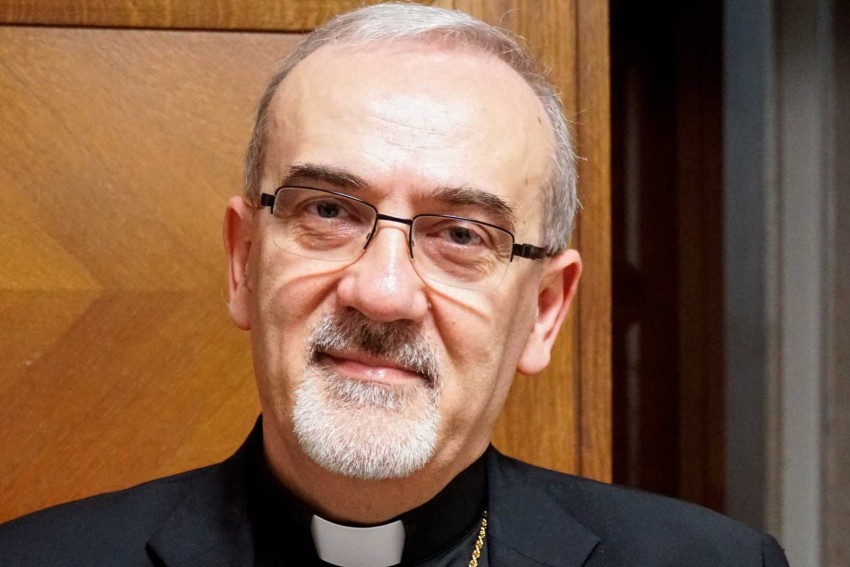

Italian Cardinal Fernando Filoni. He is a possible “dark horse” candidate to be elected Pope as the papal conclave begins today, May 7…
Letter #37, 2025, Wednesday, May 7: Cardinal Fernando Filoni
This afternoon, Wednesday, May 7, the papal conclave begins.
I will be podcasting on YouTube Urbi et Orbi Communications channel, live at this link or this link. (Membership is completely free, and once you sign in, you get a little message on your phone or email whenever we go live. Please consider joining us.)
***
Over the past few days, American Vatican John Allen, founder and editor of the Crux news service (link), has written a series of excellent profiles covering possible candidates to be elected the next Pope.
The profiles are well worth reading, if you wish to have an idea of the range of choices that the cardinals face as they begin, this afternoon, to vote.
Here is the most recent one, from this morning (link).
Recently, well before the conclave, so, not under the period of secrecy, I asked an Italian cardinal which cardinal he knew, among the Italians, if one or all of the “top” candidates seemed not to gain a consensus, who might be able to bring some order to the issues facing the Holy See.
He replied, after pausing for five seconds, with one word: “Filoni.”
In other words, Cardinal Filoni is a low-profile cardinal, yet, respected by his peers. And, he is especially well-versed in… China, having served as the Vatican’s man in Hong Kong for nine years, from 1992 to 2001.
So…
–RM
‘Papabile’ of the Day: Cardinal Fernando Filoni
May 6, 2025
ROME – At times there can be an odd dynamic to a papal election, almost like a tape delay, according to which candidates get their real bite at the apple in the conclave after the one in which they attracted the most attention.
Such was the case for Jorge Mario Bergoglio of Argentina, who was a hot pick in 2005 and the runner-up in that conclave, yet he didn’t get elected until eight years later following the resignation of Pope Benedict XVI.
The reason for the tape delay is often simple: Age.
When a candidate first bursts into prominence, they’re often judged too young, in the sense that their papacy would be too long.
By the time another few years have passed they’re often right in the wheelhouse, with the ironic result that their chances go up even as conventional wisdom says their moment has already passed.
If there’s a potential contender for whom the same tape delay dynamic might play out today, it could well be 79-year-old Cardinal Fernando Filoni, who was widely mentioned as a possibility in 2013 but has somewhat flown below radar this time around.
Should his fellow cardinals decide to dust off Filoni’s résumé, they’d be reminded of a major selling point that came up twelve years ago: “The Pope who didn’t blink when bombs fell on Baghdad.”
The reference is to April 2003, when Filoni was serving as the papal ambassador in Iraq. At a time when other diplomats fled for safety, as well as U.N. officials and journalists, Filoni refused to leave, saying he couldn’t abandon the local Catholic community and other suffering Iraqis.
“If a pastor flees in moments of difficulty,” he said later, “the sheep are lost.”
Filoni remained in the country for the aftermath of the war, as Christians found themselves primary targets amid rising chaos.
He refused to adopt special security measures, wanting to face the same risks as locals who didn’t have access to guards and armored vehicles.
He said his aim was to be seen “as an Iraqi, by the Iraqis.”
To this day, the pectoral cross he wears is a gift given to him by the Iraqi Muslim community for not abandoning them in their darkest hour.
That choice almost cost him dearly in February 2006, when a car bomb went off outside the nunciature, demolishing a garden wall and smashing window panes, but luckily leaving no one hurt.
Afterward, a Muslim contractor showed up with 30 workers to repair the damage out of respect for the solidarity Filoni had shown.
Born in Taranto, Italy, in 1946, Filoni’s seminary studies coincided with the period of the Second Vatican Council (1962-65), and his episcopal motto is Lumen gentium Christus, recalling the council’s dogmatic constitution on the Church.
In a 2012 interview, Filoni said one of the ways he survived the upheaval of the 1970s, when he was doing graduate study, was by living in a parish rather than a college.
As a result, he said, he kept contact with the practical concerns of real people instead of getting caught up in ideological debates.
Filoni earned doctorates in both philosophy and canon law from the Pontifical Lateran University. He also has a degree from Rome’s Libera Università Internazionale degli Studi Sociali, a prestigious secular institution, where he studied “techniques of public opinion,” specializing in journalism.
He entered the Vatican’s diplomatic service and was posted to a series of increasingly challenging assignments.
He served in Sri Lanka from 1982 to 1983; Iran from 1983 to 1985, shortly after the Khomeini revolution; Brazil from 1989 to 1992; Hong Kong from 1992 to 2001, where he opened a “study mission” on mainland China; Jordan and Iraq from 2001 to 2006; and the Philippines from 2006 to 2007.
These were hardly pleasure cruises.
Filoni was in Tehran during the bloodiest period of the Iran/Iraq war and in China for the upheaval caused by the reforms of Deng Xiaoping.
Filoni is especially well-versed on China, given his decade in Hong Kong and his fascination with the country and its people, though he doesn’t carry any of the baggage for the controversial deal with China regarding the appointment of bishops struck under Pope Francis.
From June 2007 to May 2011, Filoni held the all-important job of sostituto, or “substitute,” effectively the pope’s chief of staff.
That aspect of his background is a mixed blessing because it means Filoni was on the scene for a couple of the more spectacular implosions of Benedict’s papacy, including the cause célèbre surrounding a Holocaust-denying traditionalist bishop in 2009 and the surreal Boffo affair in early 2010.
On the other hand, most people blame Benedict’s Secretary of State, Cardinal Tarcisio Bertone, for those miscues, and give Filoni credit for trying to ameliorate them as best he could.
From 2011 to 2019, Filoni headed the Vatican’s Congregation for the Evangelization of Peoples, giving him a broad sense of the situation of the Church in the developing world.
Since 2019 he’s served as the Grand Master of the Equestrian Order of the Holy Sepulcher of Jerusalem, putting him once again in touch with the Church in the Middle East.
In 2021, Filoni accompanied Pope Francis on his pastoral visit to Iraq.
The case for Filoni?
Many cardinals have said they want a pope with global vision, especially someone who can embrace the two-thirds of the 1.2 billion Catholics in the world today who live outside the West.
Arguably, nobody among the 133 electors has broader life experience and understanding of the diverse situations around the world than Filoni.
In addition, his long Vatican experience creates a reasonable hope that he knows where the bodies are buried and could get its operations in order.
At the very least, he wouldn’t require much on-the-job training in terms of how the place works.
In an era of deep geopolitical uncertainty, Filoni may strike many cardinals as a safe pair of hands, someone with the diplomatic background and personal experience to be able to play on the world stage and not be out of his depth.
In general, Filoni could strike electors as a choice for broad continuity with the geopolitical and social agenda of the Francis papacy, but greater personal stability and reserve – which, frankly, might be a very attractive option.
The case against?
The mere fact of being a diplomat might count against Filoni with some electors, motivated by the motto “less diplomacy and more doctrine.”
Concerns in this camp may be augmented by the fact that on most of the contested issues in internal Catholic life, from the blessing of persons in same-sex unions to women deacons and beyond, Filoni really doesn’t have a clear track record.
It’s also true that aside from a few brief stints in parishes as a young priest, he has little pastoral experience and has never run a diocese.
Some cardinals regard such in-the-trenches seasoning as a prerequisite, on the assumption that it’s hard to understand today’s pastoral realities if you’ve never actually served as a pastor.
Perhaps most basically, while no one questions Filoni’s courage or integrity, there are reservations about his charisma.
Some see him as a relatively gray figure, better suited to a behind-the-scenes roles than being the front man.
Skeptics wonder if he would really have the capacity to inspire and to move people that’s obviously desirable in an Evangelist-in-Chief.
For all those reasons, Filoni probably has to be considered a long shot.
But every now and then, long shots do come through … and for a man who once braved American bombs, very little at this point probably would rattle him much.
Follow my daily coverage from Rome on the conclave.
Subscribe to Urbi et Orbi’s YouTube channel.
Click the bell to receive notifications when we go live from Rome.