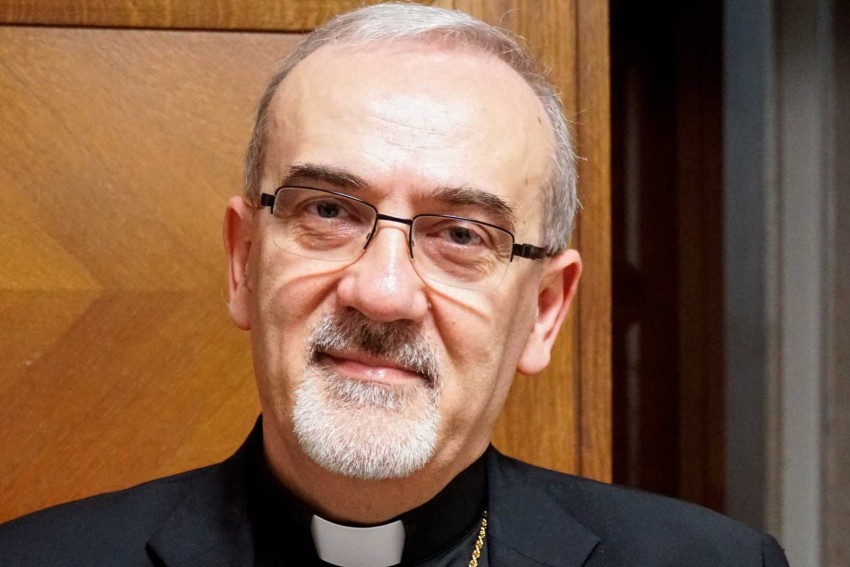

The late John Allen. He died this morning at the age of 61. (Photo Crux.com)
“He impressed upon me, and on all of his colleagues, the absolute importance of fairness and balance, which he considered essential to journalism.” Clair Giangravè, a correspondent for Religion News Service who was mentored by the late John Allen, speaking to Our Sunday Visitor (OSV) News (link)
“He was the best at explaining things in a fair way. Even in private conversations, he really didn’t show any signs of bias. He was very, very fair, always taking both sides, looking at it from different angles, and certainly always speaking to people.” —Delia Gallagher, an American colleague of the late Allen, recalling his character and integrity
“In the spirit of ‘where sin abounds grace abounds all the more,’ the same can be said about hope. Where pain and suffering are present, so is hope, and it is present everywhere: in the love and generosity of those around us, and in the many little signs and blessings God sends to assure us that we are not alone.” —Reflection this morning by Elise Allen, widow of John, on the virtue of hope during the last months of John Allen’s life
“What thou lovest well remains, the rest is dross/ What thou lov’st well shall not be reft from thee/ What thou lov’st well is thy true heritage.” —Lines of poetry by Ezra Pound in his 81st Canto, cited by John’s widow, Elise Allen, in her reflection on the life of her late husband, John Allen, who died this morning (full text below)
***
Letter #5, 2026, Thursday, January 22: John Allen
An important journalist of the Church has passed away.
An important soul.
John Allen, the founder of the Crux new service, passed away this morning after a long battle with cancer at the age of 61.
***
I met John upon his arrival in Rome in the year 2000 as a young correspondent for the National Catholic Reporter, and spoke with him often over the years.
I came to respect him deeply for his honesty, his balance, his courage, and his very hard work as a journalist.
He would “burn the midnight oil.”
He would interview people and “get the story”… even if it was difficult to contact people and to get them to talk about the story.
So he was “a journalist’s journalist” — a model of hard work, competence, professionality.
And that is what is being remembered today by dozens of journalists in notes on the chat board of the Vatican press corps.
***
But Allen was more than just that, more than just a hard-working and fair journalist.
He was a man with a passion for what is good, true, and beautiful, and a man of faith, hope, and love — so, a man of the classical universals, and of the three Christian theological virtues.
***
I last met John in May, when Pope Leo was elected.
I walked a few steps alongside him, just after the meeting of the Vatican press corps with the newly-elected Pope Leo XVI.
John had grown visibly quite thin, and I was concerned.
“How are you feeling?” I asked.
“It’s been a struggle,” he said. “But I have much to be grateful for.”
And that quality is what I remember, that he felt gratitude, to the end.
John said that though the cancer was evidently advancing and taking away his strength and life.
“All best wishes,” I said. “You are the best.”
***
I thank John for the example he gave, not only of hard work, and of fairness in reporting the news of the Church, but of graciousness in all that he did and said.
He was the leading English-speaking Vaticanist of our time.
Farewell, John. May eternal light shine upon you, and may you rest in peace.
—RM

John Allen Jr., a longtime Vaticanista and editor-in-chief of the Catholic publication Crux, died Jan. 22, 2026, at age 61. He is pictured in a 2009 file photo. (OSV News file photo/Jenna Teter, The Texas Catholic)
Here is an obituary written for OSV News by Junno Arocho Esteves.
Crux editor, veteran Vatican journalist John Allen loses battle with cancer (link)
John Allen, the editor-in-chief of Crux whose decades-long career in journalism defined him as one of the authoritative voices on the Vatican and the Catholic Church, has died at the age of 61.
Allen passed away in Rome Jan. 22, after battling cancer since 2022. He is survived by his wife, Elise Ann Allen, Crux’s senior Vatican correspondent.
In February 2025, Allen updated readers on his cancer diagnosis and asked them to keep him in their prayers.
“Never in my life have I believed more in the power of intercessory prayer than I do right now,” he said.
Several months later, in a second update, he chronicled his treatment for stomach cancer and noted that “without the tireless daily support of my wife, Elise Allen, I’m sure I probably would have imploded.”
He also expressed his gratitude to doctors, friends he regarded as family, and Crux readers for their messages of support and prayers.
“Over the years, I’ve often used the term ‘the Crux family’ to refer to the extended network of people who read our site, who consume our other media, and who interact with our coverage,” he wrote. “I know that formula these days can often be a sort of corporate catchphrase, or a marketing ploy, but I’ve never been more convinced than I am right now that when it comes to Crux, it’s not just words.”
Born in Hays, Kansas, in 1965, Allen taught journalism and supervised the student-run newspaper at Notre Dame High School in Sherman Oaks, California. He was previously married to Shannon Levitt, a teacher and later Crux‘s business manager and copy editor.
Among the students he inspired to pursue journalism was Stacy Meichtry, Paris bureau chief at The Wall Street Journal, who was on the school newspaper staff.
“John would spend long hours with us after school, putting the paper together in time for a weekly deadline,” Meichtry recalled. “I think this was actually his first taste of journalism as a teacher, which is interesting when you think about the role he would play much later.”
After establishing himself in Rome, Allen gained prominence in 2000 with the publication of his first major biography of Cardinal Joseph Ratzinger.
Meichtry recalled that before then-Cardinal Ratzinger’s ascension to the papacy, “it had been decades since anyone covered a conclave.”
“The internet was still in its infancy, so information on how exactly the Catholic Church went about picking a pope was very scarce. John changed all that. His book Conclave became a must-read for any journalist, including myself, on how to prepare for a papal death and election,” he told OSV News.
And while Allen’s deep knowledge of the Vatican’s inner workings made him known as “the guy with his finger on the pulse,” for Meichtry, “he was a mentor like no other.”
“His knowledge was encyclopedic. He was both brilliant and generous, which is a rare combination. He taught me journalism, but he also taught me about life. I’m going to miss him,” Meichtry said.
After teaching journalism, Allen joined the National Catholic Reporterin 1997 and subsequently established its Rome bureau in 2000.
“He was a giant of specialized journalism,” said Marco Carroggio, professor at the School of Church Communications of the Pontifical University of the Holy Cross in Rome. “I think he is going to be a reference for future generations.”
Carroggio recalled meeting Allen in 1998. At the time, Carroggio was handling communications for a conference hosted by Opus Dei and received a call from someone speaking Italian in a heavy American accent.
That call, he said, was the starting point of their nearly three-decade-long friendship.
Carroggio noted that Allen was a consistent presence in many conferences in Rome and always interested in “understanding the depth of the debates and understanding the different positions.”
“What caught my attention was that many times, he didn’t publish anything from those conferences. But he broadened his view, so all this made his information and writings form a vision that was nuanced and profound, showing you all the polyhedral sides of reality,” he told OSV News.
That vast understanding of all things Catholic served Allen well at CNN as a Vatican analyst following the death of St. John Paul II and the subsequent election of Pope Benedict XVI.
“John Allen was the best Anglophone Vaticanista in the business during the pontificates of John Paul II and Benedict XVI,” said American theologian and author George Weigel. “We were friends and colleagues but never competitors, because we shared information and impressions freely, not least at ‘our table’ at the Taverna Giulia” in Rome, he told OSV News.
For Delia Gallagher, who worked alongside Allen at CNN for two decades, the most important thing about John was that he was “a loyal and real friend.”
“One thing I do think about John, in terms of his life, is that he was somebody who really found his vocation and really lived it with a passion, and that was, I think, a gift to him and a gift to Catholic journalism: to really love what you do and do it with joy and, therefore, be completely above any kind of competition or jealousy,” Gallagher told OSV News.
His passion for journalism, she added, was “inspiring” and what people saw “in John was that he really loved what he did 100% and felt called to it.”
“That’s why he was great at it. He was the best at explaining things in a fair way. Even in private conversations, he really didn’t show any signs of bias. He was very, very fair, always taking both sides, looking at it from different angles, and certainly always speaking to people,” Gallagher said.
Allen left NCR in 2014 and joined the Boston Globe, where he launched Crux. Two years later, after the Boston Globe ended its sponsorship of Crux, Allen relaunched the news site independently, becoming its president and editor-in-chief.
Gallagher, who was with Allen when he announced Crux’s relaunch in 2016 at the Pontifical North American College, said it was “a standout moment.”
“He was so proud; it was such a big moment for him,” she recalled. “I remember asking him once what would be his dream vision of his professional life. And he said it was starting Crux, because he could give younger journalists a launching pad. For him, that was his legacy.”
Among those whose careers in journalism began at Crux was Claire Giangravè, Vatican correspondent for Religion News Service.
Giangravè told OSV News that Allen hired her as Crux‘s Faith and Culture correspondent in 2019, shortly after she graduated from college.
“Despite my inexperience, John immediately gave me the chance to meet, interview, and move among the people and prelates who shape life inside Vatican City,” she said.
“He impressed upon me, and on all of his colleagues, the absolute importance of fairness and balance, which he considered essential to journalism,” Giangravè told OSV News. “He urged us to cover the Holy See no differently than we would the White House: with rigor, without deference and with tough questions when they were warranted.”
But for Giangravè, Allen was above all a “genuine cheerleader” who “often showed more enthusiasm for uplifting others than for promoting himself.”
“He accepted interview requests from anyone, regardless of the size of the outlet, and always made time to speak with younger or lesser-known journalists,” she said. “In today’s highly polarized Church, John Allen’s balanced and nuanced voice — along with his ubiquitous sports references — leaves an unfillable void in the small world of Vatican reporting.”
Allen continued to appear on CNN as a Vatican analyst throughout the papacies of Pope Benedict and Pope Francis, and in 2025, he served as a CBS News contributor during the election of Pope Leo XIV.
Throughout his career, he was a highly sought-after public speaker, speaking at conferences and events around the globe. He wrote 11 books on the Vatican and the Catholic Church, ranging in topics from the Benedict and Francis papacies to the persecution of Christians around the world.
For his accomplishments and expertise, he garnered attention and praise, with the London Tablet calling him “the most authoritative writer on Vatican affairs in the English language.”
But what some may not know, with the exception of his family, close friends and Crux readers, was that John was an avid home cook and an Italian food aficionado. So much so, that he once stated in an editorial piece that “a compelling history of the Catholic Church could be written in the form of an Italian cookbook.”
And among those who had a taste of his quasi-reverential treatment of Italian cuisine was none other than Pope Leo.
Following the pope’s election in 2025, Allen recalled inviting then-Cardinal Robert Prevost to his home, where he cooked him “a four-course Italian meal.”
“About halfway through this meal, I realized that this was a fairly prodigious feast we’re putting in front of this guy,” Allen told CBS News. “And I said, ‘Cardinal, don’t feel obligated to eat everything if you’re not hungry anymore.’ And he said, ‘Where I come from, when food is put in front of you, you eat it.'”
Those who had the privilege of knowing him say he wasn’t just an inexhaustible font of knowledge and wisdom on all things Vatican (as well as a connoisseur of the classic Roman pasta dish, bucatini all’amatriciana, although some argue his favorite was penne alla vodka), he was also sharp-witted, engaging, extremely funny and disarmingly humble.
And the home he shared in Rome with Elise and their two pugs was always ready to welcome whoever had the fortune of crossing its doors. Whether it was a lowly journalist itching to learn the ins and outs of the Eternal City or a future pope, there was always a seat at the table.
Rest in peace, John.
Here is a brief piece by his colleagues at Crux:
John L. Allen Jr, 1965-2026 (link)
By Crux Staff
Jan 22, 2026
John L. Allen Jr. died on January 22, 2026, after a lengthy battle with cancer. The legendary Vatican beat reporter and Church affairs analyst was 61 years old. He is survived by his wife, Elise Ann Allen, who is Crux’s senior Rome correspondent.
Allen was a force of nature, certainly as a journalist who was not only our principal but also a model for us, whose counsel and whose company we already and forever shall sorely miss.
Allen was a patient mentor, a generous colleague, and the consummate newsman.
Keenly as we feel his absence in the newsroom, we also mourn the loss of a man who had been our dear friend for the better part of three decades.
We recall many convivial gatherings with Allen in restaurants and at his home in Rome, where he enjoyed exercising his formidable culinary prowess and was a prodigiously gracious host.
While we treasure the memories we made with Allen at table – some of them admittedly fuzzy – we clearly remember with powerful gratitude the countless kindnesses he visited on us in secret, through more than twenty years of friendship that began in the Eternal City and will, we fondly hope, continue in happy eternity.
Leading voices from across the spectrum of opinion in the Church praised Allen as “the journalist other reporters – and not a few cardinals – look to for the inside story on how all the pope’s men direct the world’s largest church,” to say it with Kenneth Woodward.
Allen spent seventeen years with the National Catholic Reporter, during which he became “the most authoritative writer on Vatican affairs in the English language,” according to The Tablet, and “the best Anglophone Vatican reporter ever,” according to conservative biographer of Pope St. John Paul II, George Weigel.
In 2014, Allen joined the Boston Globe’s Crux team, where he served for two years as associate editor before the Globe spun Crux off, leaving Allen to pilot the organization as CEO and editor-in-chief.
Under Allen’s editorial leadership, Crux has continued undaunted and undistracted in its mission of newsgathering and reporting, amid momentous changes in the Church and in global politics.
Through thick and thin, fat years and lean, Allen tenaciously preserved Crux’s editorial independence, always with both eyes firmly fixed on the work of getting the story, getting it right, and getting it out.
“Crux does the news,” Allen would say, and he led by example, relying on a core of dedicated and capable journalists and fostering an editorial culture infused with his newsman’s ethos.
Buttressed by new and dynamic business leadership in the creation of which Allen was instrumental, Crux is equipped to carry forward its mission: to provide – as Allen liked to say – the very best in smart, wired, and independent coverage of the Vatican and the Catholic Church around the world.
We ask your prayers for our friend, John L. Allen Jr., for his widow, Elise, for all who loved him, and for the work he advanced with whole-hearted and single-minded devotion, work we shall surely continue.
—Charles Collins and Christopher R. Altieri, The Editors
And here is a piece that his widow, Elise Ann Allen, has just published:
John L. Allen Jr.: A life remembered in gratitude (link)
Jan 22, 2026 | Senior Correspondent
Friends, colleagues, and regular Crux readers will know that my husband, John L. Allen Jr., has been battling cancer for some time, and has largely been absent from the site this year as he underwent treatment and fought for recovery.
It is with great sadness and a heavy heart that I convey, nearly four years after his diagnosis, that John lost his battle with cancer on Thursday, January 22, 2026, and is now resting in the arms of God, free from the pain and discomfort that he lived with for so long.
While words often fail in these moments, I want to offer a few words of thanks:
First, to our friends and community who have accompanied us throughout this journey, especially the past year. You have supported us with the sacraments, prayers, visits, meals, advice, rides to and from the hospital for treatment, and no small amount of chocolate and wine, but most importantly, with your presence, including a call system to ensure that I wasn’t alone at the end. We simply could not have gotten through this without you, and I will never have adequate words to thank you for the love and support you provided when we needed it the most. I’m convinced more than ever that authentic friendship is an image of the divine, because we certainly saw God in new and powerful ways in and through each of you.
Second, a big thanks to the doctors and healthcare professionals at the San Camillo Forlanini, Spallanzani, Salvator Mundi, and Pio XI hospitals and health clinics who treated John, not just his illness, with kindness and humanity over these past few years. Thanks also to Sant’Egidio’s ICare and the Antea Foundation teams who cared for John in his final days – you made one of life’s most difficult transitions bearable, and I will forever be indebted for the attentive and human care you showed not just to John, but to myself.
Third, thanks to all Crux readers: You are the reason we do what we do. John was passionate about his job, he loved being a vaticanista, but he was also passionate about you, his broader Crux community, some of whom have followed his impressive career for decades. You challenged him and made him think, and he loved that – he loved hearing your thoughts and answering your questions, because it kept his finger on the “Catholic pulse.” During this time, you have accompanied John and myself with love and concern, writing frequently to ask about his health, sending notes to assure us of prayers, and offering positive reinforcement online. This made us both feel loved and accompanied, and I want you to know how very much it meant to John.
Ezra Pound in his 81st Canto said, “What thou lovest well remains, the rest is dross/ What thou lov’st well shall not be reft from thee/ What thou lov’st well is thy true heritage.”
In that sense, John’s greatest “heritage” is not his legendary career, the prestige of the Crux website, or even the titanic impact he has had on journalism and the way the Catholic Church is understood and perceived in the world. It is the people he loved: it is me, our friends, our colleagues, and all of you. John’s greatest gift to the world was not his incredible and unparalleled mind, but it was his big and generous heart. Everyone who was blessed enough to call themselves John’s friend bore witness to his gift for friendship, his limitless self-giving, and his insatiable desire to help and empower others whenever and however he could. If he loved you, there were no lengths to which he wouldn’t go to help you or simply make your life easier. I hope that with his passing, the world will look back not just on his lifetime of impressive professional accomplishments, but more so, his personal ones.
John’s biggest lessons
As we mourn John’s passing and reflect on the outsized impact he had, I want to leave you all with two bits of advice that John lived by and which made him the person so many respected, as a man, and as a professional:
1) Be gracious. In a world where anger and contempt often dominate our interactions with others, John would always say, “Just be gracious. I have never regretted being the more gracious party in a dispute, but I’ve often regretted being the more reactionary.” Being gracious to him, in a dispute or not, wasn’t a matter of biting his tongue or a superficial way of blowing off others, it was part of his character. If the world were to put this personal code of his into practice, it would be a very different, and much more human place.
2) “Never reduce someone to their worst moment.” John lived by this motto. In many ways, it’s what gave him his sterling reputation for maturity and fairness. He would always give people the benefit of doubt and chose to interpret their words and actions through the kindest and most generous lens possible. For John, no one was the sum of their worst flaws and failures. He’d often say that people are a “package deal,” a mixed bag of their gifts and weaknesses, and that the best aspects of a person almost always overshadow the worst, so choosing to look at the totality of a person was always a healthier, and more real approach in the end. He treated people like who they were at their best, no matter what, which is a quality I hope many will emulate.
There are many more things I could list, but these two aspects are the most fundamental attitudes that made John ‘the adult in the room’, as he was so often, and so aptly, called. I hope they will remain a lasting part of his legacy, not as something to look back on, but as something that can transform the future.
The meaning of hope
As I close this note, I can’t help but reflect on the fact that John’s passing came just after the close of the Jubilee of Hope. The jubilee year, for us, was spent enduring the most difficult and trying phase of John’s illness. It was agonizing, but at the same time beautiful. We learned that hope is not a superficial wish that everything will get better, or that painful circumstances will change, but it is an attitude and perspective with which to live life that is chosen and which matures the more it is embraced. In the spirit of “where sin abounds grace abounds all the more,” the same can be said about hope. Where pain and suffering are present, so is hope, and it is present everywhere: in the love and generosity of those around us, and in the many little signs and blessings God sends to assure us that we are not alone.
Hope is not empty, and it does not disappoint when things don’t go our way or when God doesn’t answer prayers the way we want; in fact, it is precisely in those moments that hope holds its most precious meaning, because they challenge us. They force us to dig deep, to look beyond ourselves to God, remembering that his design for our lives is one of love, and it is far bigger than our limited understanding. As cliché as this is to say, Christian hope ultimately lies in the fact that we have been offered eternal life. The Jubilee of Hope was a potent reminder of this, and I am so humbled and grateful that after being reminded of this so clearly during the jubilee, John now gets to bask in that beautiful and mysterious gift to which we all aspire.
Looking to the future
John and I were married in Key West, Florida, where you hit Mile 0, which marks both the beginning of Highway 1 in the United States, and the end. For us, when we were married in the minor basilica of Saint Mary, Star of the Sea six years ago, it was a highly symbolic location for both of us: it marked the end of one phase of life, and the beginning of another; the end of one form and understanding of love, and the beginning of a new love entirely.
In that sense, right now I find myself standing right back there at Mile 0: this moment marks both the end of one phase of my life, and that of Crux, but the beginning of something new entirely; something painful but forged in hope and which I believe, while difficult, is opening to a bright and wonderful future. Thank you for making this journey with us.
[End, piece by Elise Ann Allen on the death of her husband, John Allen]