Photo Grzegorz Galazka | June 4, 2025
Letter #54, 2025, Tuesday, July 29: Who Leo is… and why he needs us
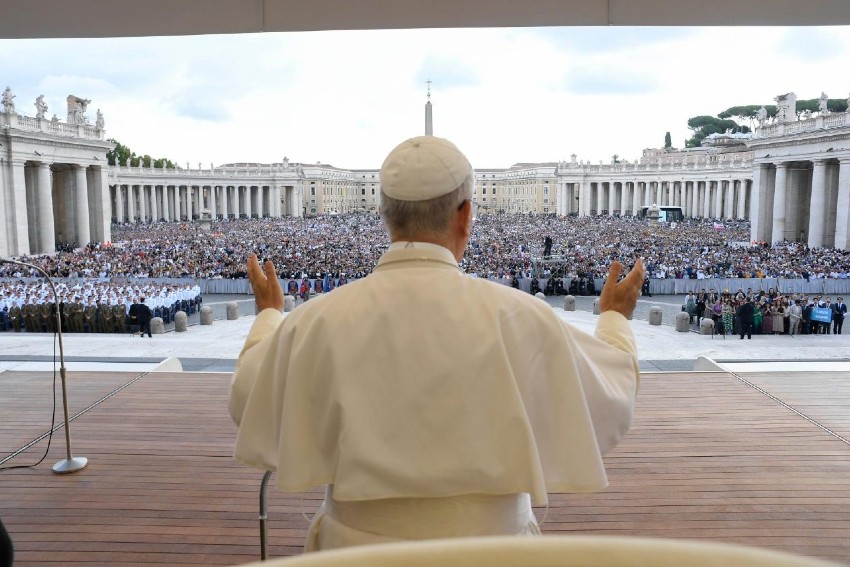
As I write these words, on the early evening in July 29, Pope Leo XIV has entered St. Peter’s Square to greet some 200,000 young people who have come to Rome for the “Jubilee of the Young,” which will continue all week, ending which a Jubilee Mass for an expected 1 million young people on Sunday on the edge of Rome at Rome’s Tor Vergata university.
The Pope’s entrance into the square was not expected.
Leo simply decided on his own to come to greet the young people even though such a papal greeting was not part of his published schedule.
Leo, after traveling through the crowds — he went around the entire piazza, then all the way down the via della Conciliazione and back. Then, he stopped at the front of the pizza, got out of the popemobile, and spoke extemporaneously to the young people, concluding by giving his apostolic blessing.
***
Special Note: We have just published a Special Commemorative Issue of Inside the Vatican magazine on the Election to the Throne of Peter of Leo XIV. This 80-page, full-color issue will be a wonderful keepsake for all Catholics and all those interested to know more about Pope Leo XIV. Order at this link.
***
The young people were moved with emotion, to see the Pope.
This is what he said, from his heart, without any prepared text or notes:
Buonasera!
Buenas tardes!
Good evening!
Jesus tells us: “You are the salt of the earth,” “You are the lights of the world!”
[In Spanish]
¡Vosotros sois la sal de la tierra, luz del mundo! Y hoy sus voces, su entusiasmo, sus gritos, que todos son por Jesucristo, y ¡los van a escuchar hasta el fin del mundo!!
[You are the salt of the earth, the light of the world! And today your voices, your enthusiasm, your cries, which are all for Jesus Christ, will be heard to the end of the world!]
(…)
[In Italian]
Speriamo che tutti voi siate sempre segni di speranza nel mondo! Oggi stiamo cominciando. Nei prossimi giorni avrete l’opportunità di essere una forza che può portare la grazia di Dio, messaggio di speranza, una luce alla città di Roma, all’Italia e a tutto il mondo. Camminiamo insieme con la nostra fede in Gesù Cristo. E il nostro grido deve essere anche per la pace nel mondo. Diciamo tutti: “Vogliamo la pace nel mondo!”. La Piazza: “Vogliamo la pace nel mondo!”. Preghiamo per la pace.
[We hope all of you are always signs of hope in the world! Today we are starting. In the coming days you will have the opportunity to be a force that can bring God’s grace, a message of hope, a light to the city of Rome, Italy and the whole world. Let us walk together with our faith in Jesus Christ. And our cry must also be for peace in the world. Let us all say: “We want peace in the world!” (The Square: “We want peace in the world!”) We pray for peace.]
[In Spanish] Oremos por la paz y seamos testimonios de la paz de Jesucristo, de la reconciliación, esta luz del mundo que todos estamos buscando. Hermanos y hermanas que el Señor esté con ustedes. Nuestra ayuda en el nombre de El Señor.. [bendición]
[Let us pray for peace and be witnesses of the peace of Jesus Christ, of reconciliation, this light of the world that we are all seeking. Brothers and sisters, may the Lord be with you. Our help in the name of The Lord.. [Blessing.]
Ci vediamo. Ci troviamo a Tor Vergata. Buona settimana!
[We will see each other again. We will meet at Tor Vergata. Have a good week!]
Here are some images from this evening in Rome….
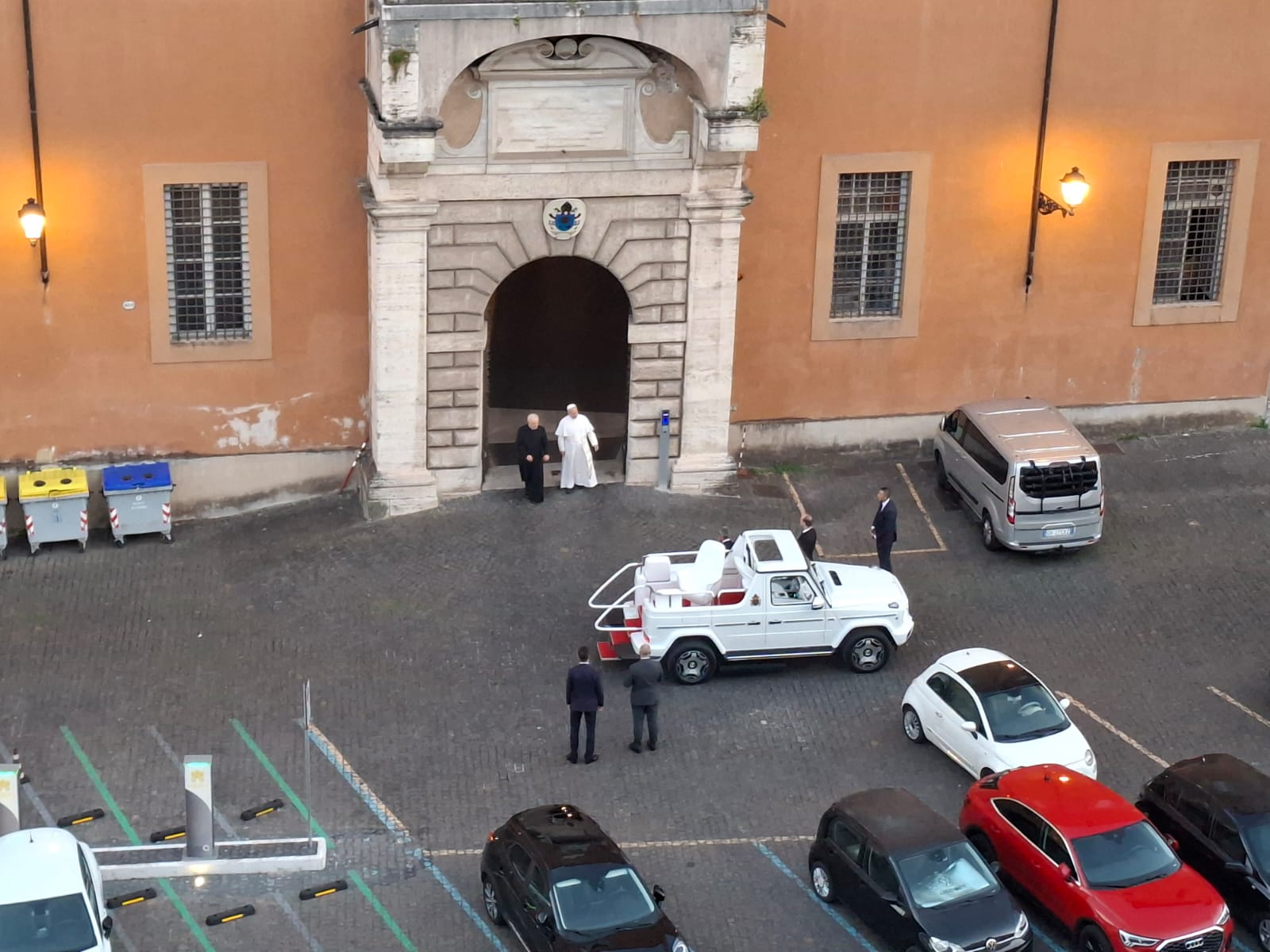
Pope Leo, 69 (he turns 70 in September), leaves the Palace of the Holy Office — where he is still living in his old personal cardinal’s apartment — accompanied by Italian Monsignor Leonardo Sapienza, 72. Sapienza, since August 4, 2012 (so, for 13 years), has been Regent of the Pontifical Household, making him one of the Pope’s closest collaborators, and he is present at almost every papal event. It appears that the two will get into the popemobile, but…instead they walk on foot toward St. Peter’s Square, with the popemobile following behind…
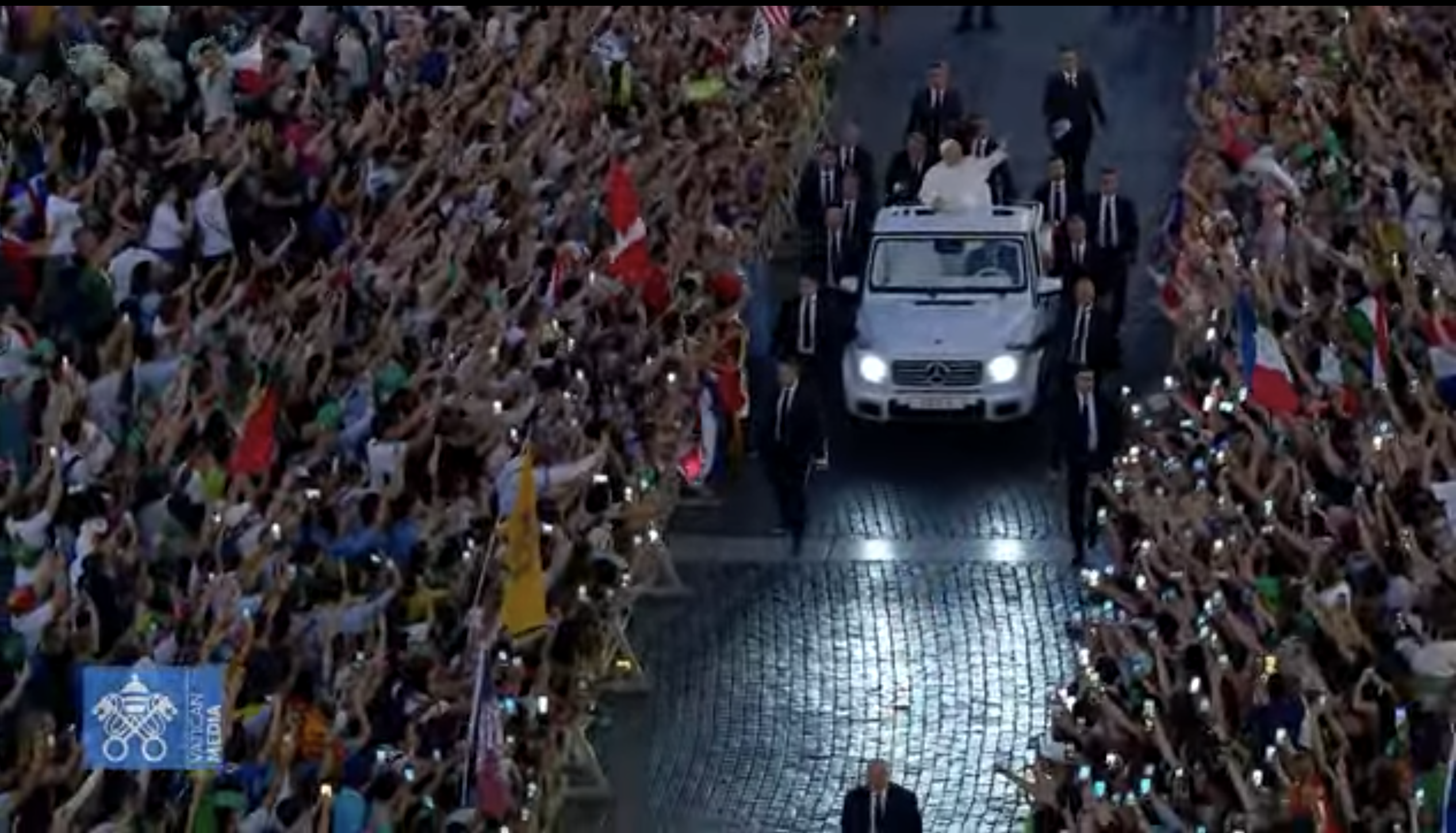
As evening starts to fall, Pope Leo in his popemobile makes his way through the crowds of young people in the piazza. The lights of the popemobile are turned on…
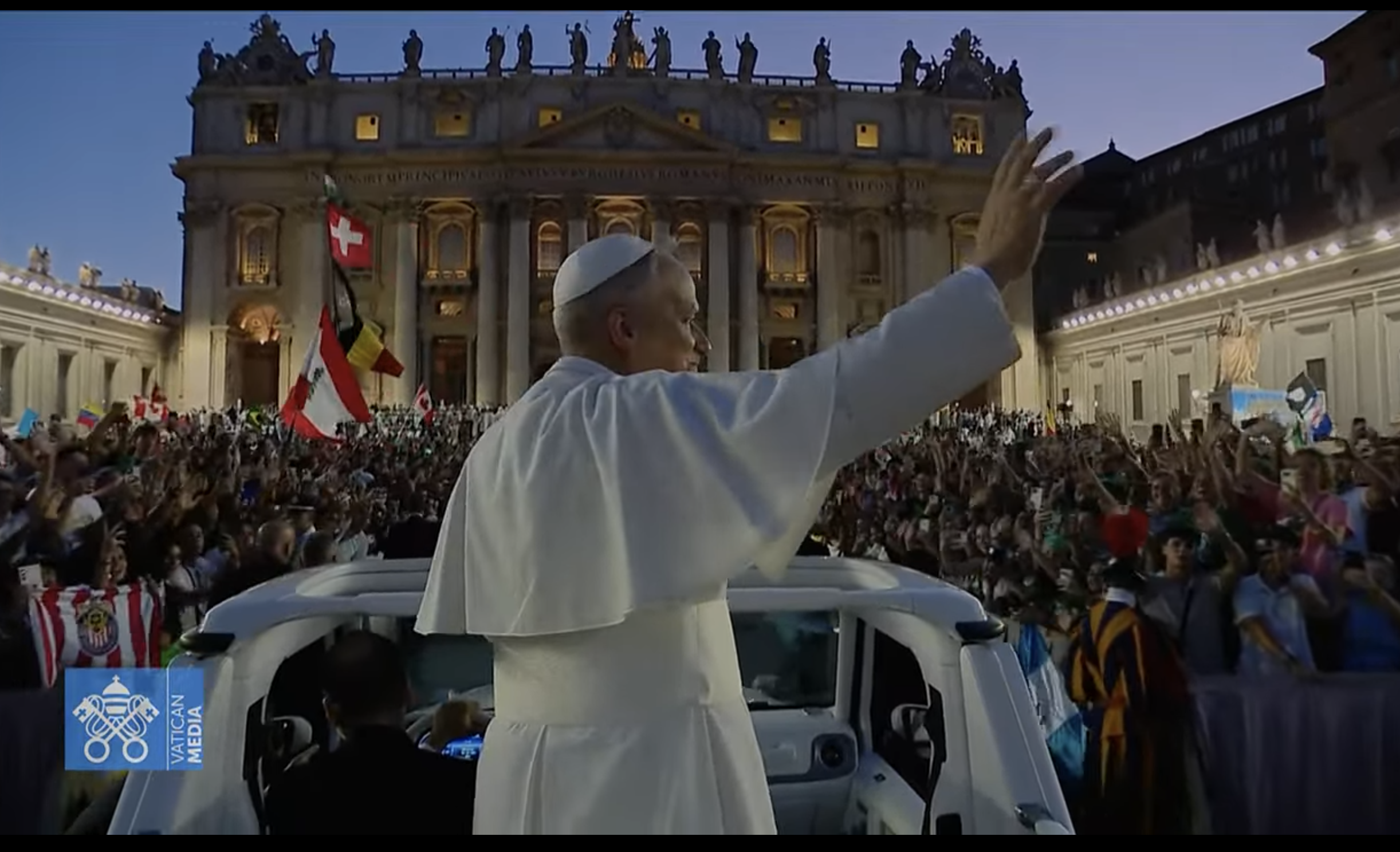
The Pope continues to greet and bless the crowds. This photo shows, in the upper right in the far distance — just beyond the Pope’s outstretched fingertips of his right hand —the roof of the Sistine Chapel, where Leo was elected Pope on May 8, 2025 — 81 days ago (August 8 will be three months since the election)
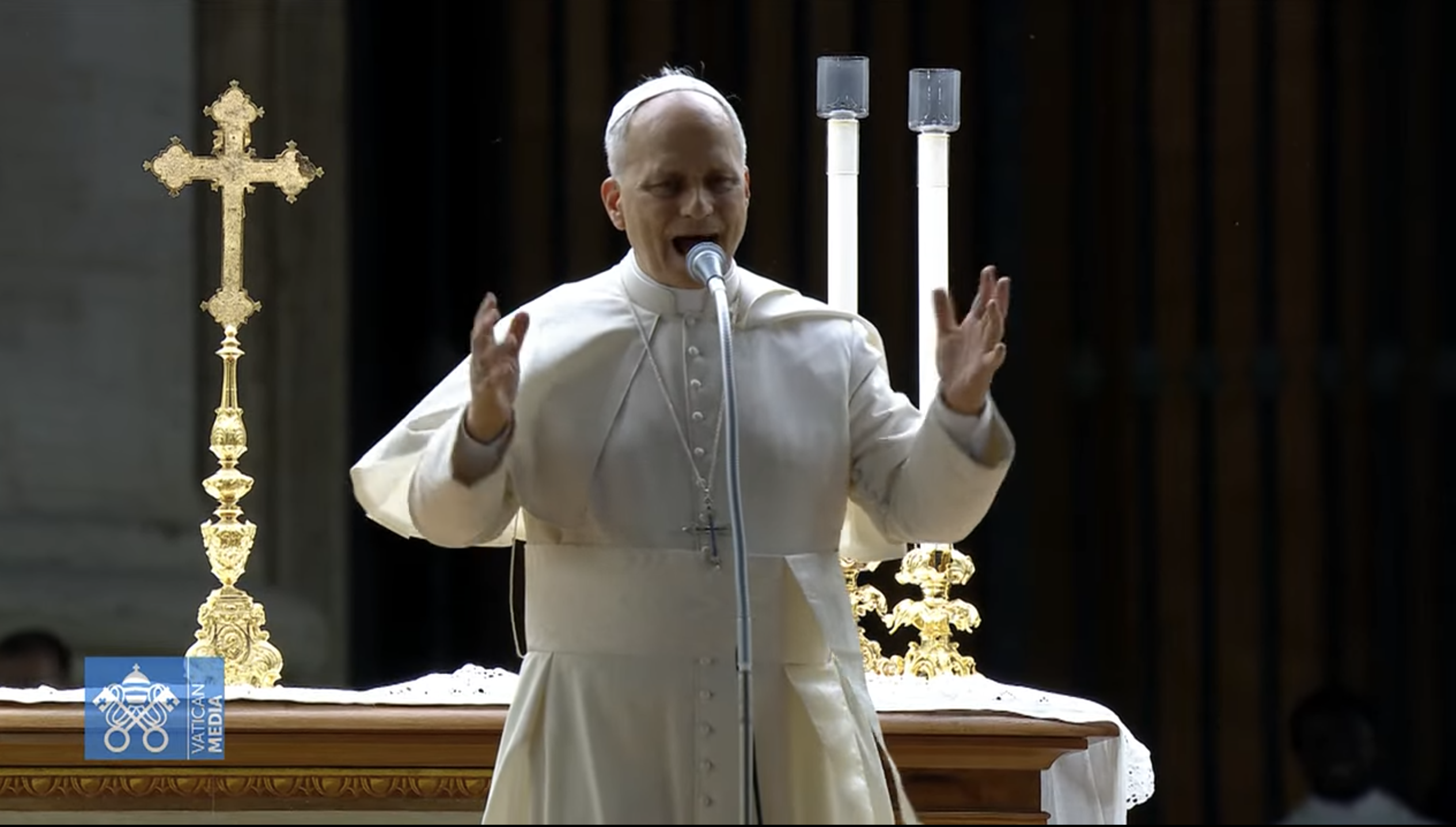
Pope Leo spoke to the vast crowds of young people for a few minutes after passing through the piazza. “Good evening!” the Pope began. “Jesus tells us you are the salt of the earth! You are the light of the world!” He then continued, speaking in Spanish and Italian… (link)

After speaking, the Pope left the sagrato, the flat then slightly-sloping area just in front of the facade of St. Peter’s Basilica. This picture shows the obelisk in the center of the piazza in the distance. The Pope will ride the popemobile downward, then turn right, and right again (as we see in the photo below)…
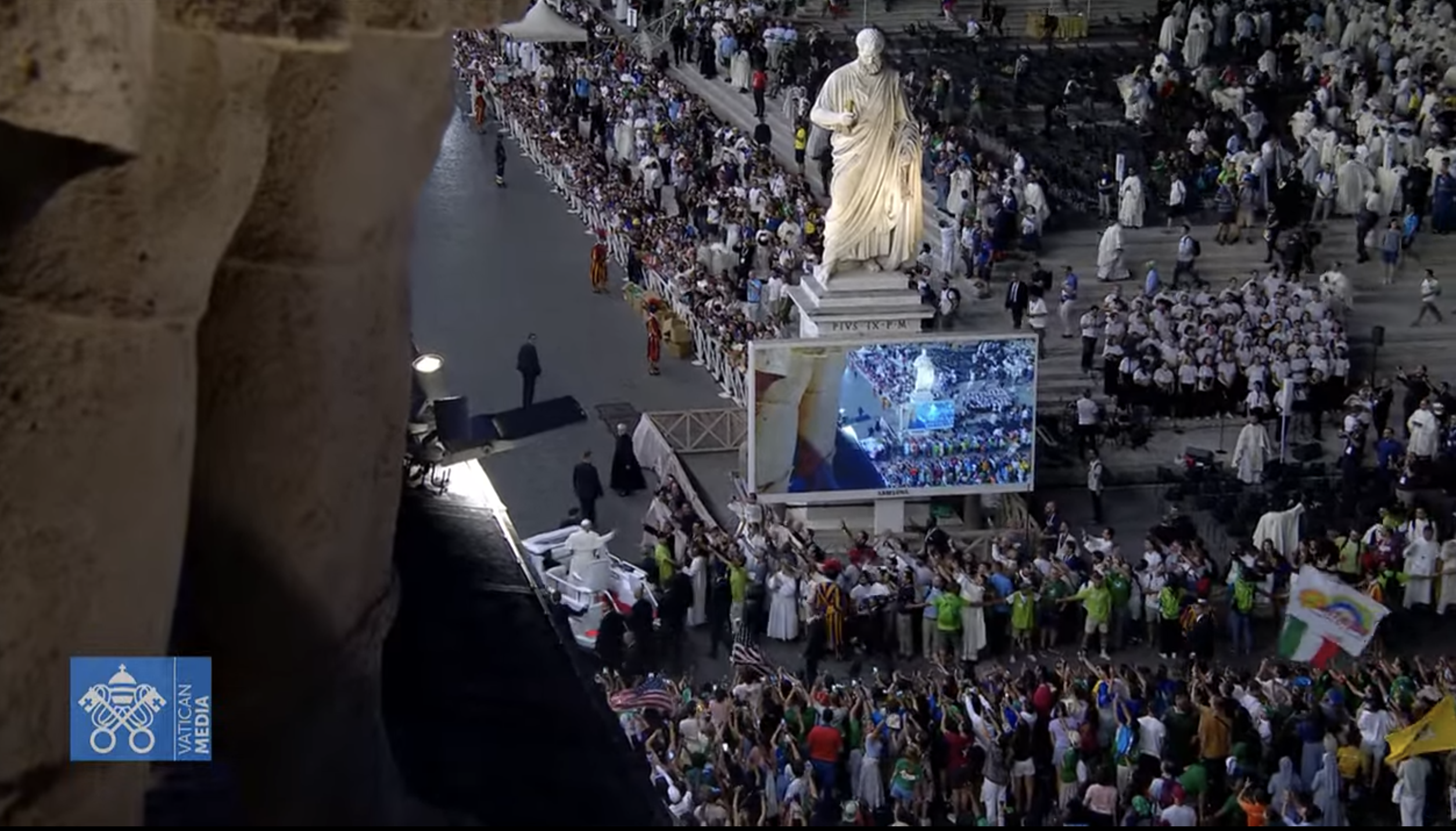
…and then go out of the piazza and into Vatican City, by passing under the Arch of the Bells, which is about 100 yards behind the statue of St. Peter (seen here in the middle). The Pope is the small white figure to the left, in his popemobile, just passing by the statue of St. Peter… this image is taken from the top of the colonnade above the piazza…
Reflections on the First 80 Days of Pope Leo
I have followed the words and actions of Pope Leo for some 80 days now.
I have seen him in many different venues, and watched videos of his many addresses, and conducted and listened to many interviews with his friends and colleagues over the years.
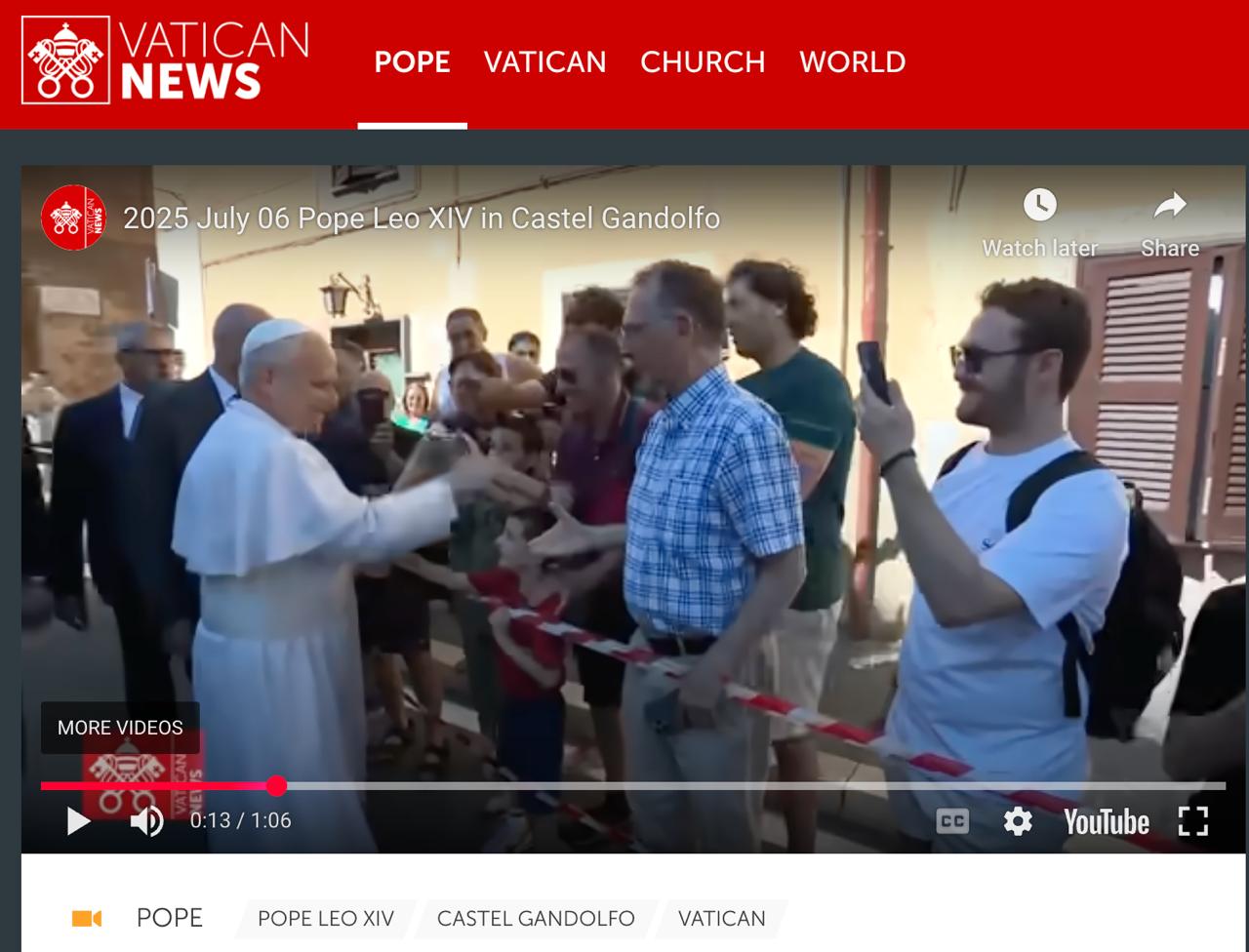
Three weeks ago, I was able to shake Pope Leo’s hand. It was July 6, in the town of Castel Gandolfo, when Leo came out from Rome to stay for his 2-week summer vacation on the edge of a volcanic crater about 15 miles outside the walls of Rome.
Yet, the only conversation I have ever had with him was in October, after a press conference in the Vatican Press Office, when he told me he felt he knew me because he had been reading these letters of mine for many years.
So when I shook his hand, I wanted to speak, and hear a word, but there was a crowd, and little time, so no word was spoken.
Here below is an image of the moment I shook his hand (that is me in the blue and white checkered shirt). The little boy in the middle of the picture, behind my hand, was trying excitedly to speak to the Pope. I think he said that it was his birthday. The Pope replied, kindly, “Quanti anni hai?” (“How old are you?”). Then, as the Pope shook my hand, he turned from the boy toward me then looked immediately to where he had to go next, and walked to the other side of the street.
Below the photo is a video of Pope Leo’s arrival to Castel Gandolfo, and it shows our brief handshake at second 1:34.
The Great Debate
The “great debate” among Catholics, and among those who have some interest in the Catholic Church, is over this question: “Who is Pope Leo?”
How traditional is he? How progressive? How, after Francis, will Leo lead the Church?
Many have praised and embraced Leo, pleased by his evident humility, selflessness, reasonableness, goodness.
Others have criticized him, and distanced themselves from him, persuaded that he is aiming at carrying forward the ideas and agenda of Pope Francis. Moreover, many of these Catholics, at the same time, have also criticized and have distanced themselves from Leo’s most recent predecessors: first of all, from Pope Francis, but also, in many cases, from Pope Benedict XVI, from Pope St. John Paul II (then, for the most part, skipping over Pope John Paul I, because his papacy in September 1978 only lasted 33 days), from Pope Paul VI, and from Pope John XXIII. In other words, there are a number of Catholics who are opposed to many of the “modernizing” pastoral, and sometimes doctrinal, decisions taken, not only by Pope Francis, but by some or all of the Popes since 1958.
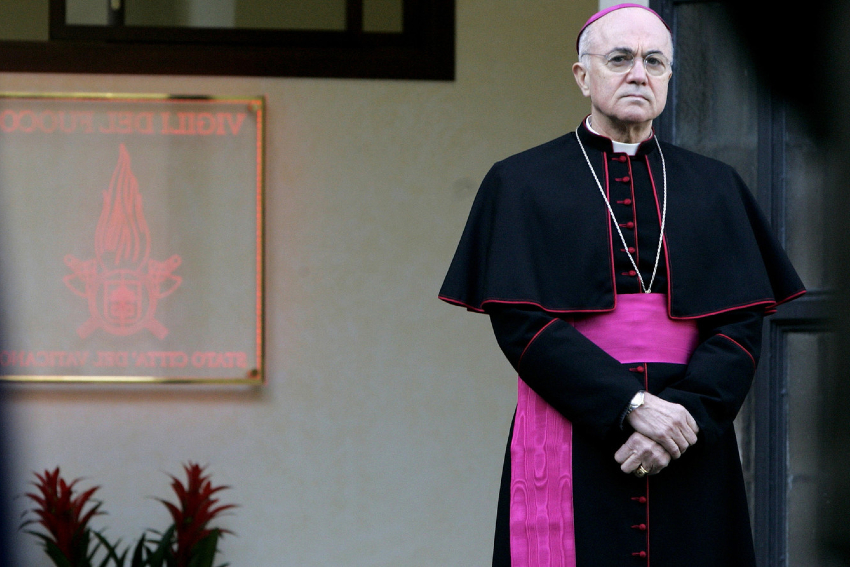
This is a position that Archbishop Carlo Maria Viganò, 84 — who was excommunicated a year ago, on July and 4, 2024, for his opposition and disobedience to Pope Francis — seems to have taken.
Here are some of Viganò’s thoughts from just a few days ago, in an interview with American Catholic writer Stephen Kokx, published on July 18, under the title “Solve et coagula.” [Note: “Solve et Coagula” is a Latin phrase meaning “dissolve and coagulate.” It’s a key principle in alchemy, seeking to break down substances into their base components, then to reassemble them in a new form. This concept extends beyond physical transformation and is also applied to spiritual, intellectual, and psychological processes. In essence, “Solve et Coagula” means to destroy in order to rebuild, to break down in order to create something new and better.]
Question 1
Published on KokxNews on July 18, 2025
Stephen Kokx – Your Excellency, many of Prevost’s decisions indicate that he wishes to continue along the heretical path of his predecessors, particularly the synodal path charted by Jorge Bergoglio. Many seem to believe we need to “give him time” and “hold out hope” that things will improve. At the same time, it seems Prevost’s agenda is quite clear and that silence or “giving him the benefit of the doubt” – while also putting a more positive spin on his reign – could cause scandal by omission and/or by creating false hope. What do you make of these arguments and how should Catholics be viewing this “pontificate” a little over two months in?
Archbishop Viganò – None of us can judge the internal forum, that is, the interior dispositions with which a person acts or speaks: only Our Lord, who sees into the depths of our hearts, can do that.
(…)
I myself, as I think many noted in the days immediately following the election, preferred to refrain from publicly expressing my views on Leo with comments that might have seemed hasty.
After just over two months, however, I believe it is possible to find consistency in Leo’s actions and statements with the line drawn by Bergoglio. And perhaps that impromptu appearance of Sister Nathalie Becquart(1) and other members of the Synod elite for a selfie with the newly elected pope(2) today acquires a significance that may have initially escaped most.
The message we can glean from this – and which is accompanied by the blissful and satisfied smiles of many ultra-progressive Electors (among them Cardinal Cupich of Chicago) who appeared on the Loggia after the white smoke – is that the synodal path from which the Bergoglian and post-Bergoglian Church can in no way escape has already been mapped out, and that Leo was elected on the fourth ballot as the continuator of the synodal mandate, and not of the munus petrinum.
I’ll say it without mincing words: the synodal lobby expects Leo to lend canonical legitimacy to a subversive process of disposing of the Papacy; a sort of voluntary abdication of the Monarch in favor of a Parliament that, in response to the surrender of the power of jurisdiction and governance, recognizes him as having an honorary primacy that can be useful at the ecumenical level.
In a legal paradox, this lobby demands that the holder of a divine right exercise supreme authority in order to transmit that right to the synod, something the Pope cannot do.
This ecclesial coup is intended to carry out to its extreme consequences the revolutionary process inaugurated at Vatican II with the episcopal collegiality of Lumen Gentium(3), extending the governance of the Catholic Church to the laity and to women, to the complete detriment of the indissoluble bond between the power of Holy Orders and the power of Jurisdiction that has existed in the Church since time immemorial. On the other hand, the extension to women of functions previously reserved for clerics opens up a practical opportunity for the introduction of para-ministerial roles such as deaconesses and non-ordained ministers. It is impossible not to see also in this the fulfillment of what the Agenda 2030 requests for Gender Equality.
I do not know if my brother Bishops and the faithful realize the mortal threat this subversive and fraudulent action represents for the Catholic Church.
(…)
I fear that Leo represents “Modernism with a human face” – to borrow the expression “Socialism with a human face” associated with the Prague Spring of 1968 – and that his undeniably persuasive and affable manner may mislead many, especially “conservative Catholics,” leading them to create a virtual image of the Pope that, however, does not seem to be borne out by reality.
The time between the Nuntio vobis and the promulgation of the “green” Missa votiva has seen a series of pronouncements on various topics come to light, all of which show us a Leo who is fully committed to conciliar and synodal ecclesiology, with the sole difference from his predecessor being his more polite demeanor.
Let us not forget that during the psycho-pandemic, Bishop Prevost did not hesitate to support the pro-vaccine narrative, recommending the use of masks, social distancing, and compliance with the WHO’s useless and harmful health regulations. His recent calls for a “green conversion” employ theological terminology that transforms an antiscientific psycho-environmentalist theory, steeped in neo-Malthusianism and Gnosticism, into a far more presentable Religion of Nature, to which he bows as the head of the Church of Rome, a key testimonial of globalism.
(…)
Leo finds himself at a crossroads: either choose the broad and comfortable path of the consensus of the world and of Christ’s enemies and lose his soul along with the Flock entrusted to him by the Lord; or choose the narrow and steep path of following Christ (sequela Christi) and returning to Tradition, in bearing heroic witness of Christ, and Christ Crucified (1 Cor 2:2).
The time has come to close once and for all the “conciliar experience,” with its terrible failures and devastation on all fronts.
To persist on this path of self-destruction and suicidal perdition would mean making oneself responsible for a foretold ruin, encouraging it rather than denouncing it and fighting it by every means. Let us confidently remember Our Lord’s words to Peter: I have prayed for you, that your faith may not fail; and you, when you have turned again, strengthen your brothers (Lc 22:32).
16 July 2025
Beatæ Mariæ Virginis de Monte Carmelo
- Undersecretary of the General Secretariat of the Synod.
- https://zenit.org/2025/05/08/which-is-the-first-document-signed-by-leo-xiv-here-is-the-video-and-first-selfie-with-women/
- The Synod “constitutes a further act of reception of the Council, prolongs its inspiration and relaunches its prophetic power for today’s world” (Final Document, n. 5). See in this regard the Pathways for the Implementation Phase of the Synod published by the General Secretariat of the Synod on 7 July 2025 (here)
***
Robert Prevost’s New Name
Despite these words of the archbishop, it is worth recalling that the election of Cardinal Robert Francis Prevost to the papal throne on May 8 changed everything.
Above all, Prevost agreed to change his name, as Cardinal Dominique Mamberti announced to all that evening:
“I announce to you a great joy.
We have a Pope.
The Most Eminent and Most Reverend Lord,
Lord Robertum Franciscum,
Cardinal of the Holy Roman Church Prevost,
who has taken upon himself the name Leo XIV.”
In other words, in a very real sense, at that moment, “Father Bob (Prevost)” and “Bishop Robert (Prevost)” and “Cardinal (Robert) Prevost” were no longer here, among us, in this world.
The man who was Robert Francis Prevost is gone.
The man Leo XIV is here.
And Leo XIV is as new as his name.
Archbishop Viganò, in his remarks above, speaks of “Prevost” — “Bishop Prevost did not hesitate to support the pro-vaccine narrative, recommending the use of masks, social distancing, and compliance with the WHO’s useless and harmful health regulations.”
But such observations are irrelevant to the question at hand.
Prevost is no longer here.
Leo is.
We all know there was there are a number of times in the Bible when names are changed.
These name changes signified significant spiritual transformations and new covenants with God. Abram became Abraham, Sarai became Sarah, Jacob became Israel, Simon became Peter. These changes represent a shift in identity, purpose, or relationship with God.
Here’s a more detailed look:
- Abram to Abraham and Sarai to Sarah: God changed these names as part of a covenant, signifying Abraham’s future as the “father of many nations” and Sarah as the “mother of nations”
- Jacob to Israel: Jacob’s name change to Israel followed his wrestling match with God and signified his new identity as one who has “striven with God and prevailed”
- Simon to Peter: Jesus renamed Simon as Peter, meaning “rock,” to signify his foundational role in the Church
- Saul to Paul: While not explicitly a divine renaming, Saul’s name change to Paul is associated with his conversion and new mission as an apostle to the Gentiles
These name changes mean God renames individuals to mark significant moments of spiritual transition and to reflect a new identity or purpose.
They often accompany a divine encounter or revelation, symbolizing God’s transformative power and the new life that follows faith and obedience.
This happened to St. Paul on the road to Damascus.
Here is how Acts Chapter 26 describes what happened.
Paul is speaking to the king, Agrippa:
12 “In this connection I journeyed to Damascus with the authority and commission of the chief priests. 13 At midday, O king, I saw on the way a light from heaven, brighter than the sun, that shone around me and those who journeyed with me. 14 And when we had all fallen to the ground, I heard a voice saying to me in the Hebrew language,[a] ‘Saul, Saul, why are you persecuting me? It is hard for you to kick against the goads.’ 15 And I said, ‘Who are you, Lord?’ And the Lord said, ‘I am Jesus whom you are persecuting. 16 But rise and stand upon your feet, for I have appeared to you for this purpose, to appoint you as a servant and witness to the things in which you have seen me and to those in which I will appear to you, 17 delivering you from your people and from the Gentiles—to whom I am sending you 18 to open their eyes, so that they may turn from darkness to light and from the power of Satan to God, that they may receive forgiveness of sins and a place among those who are sanctified by faith in me.’
Now, we do not know the inner spiritual life of Robert Prevost, now Pope Leo XIV.
But certainly he has been spiritually changed by his election as Pope and by the assumption of his new name, Leo.
Election to the papacy places a great burden on the shoulders of the man chosen.
Indeed, Cardinal Joseph Tobin of Newark, New Jersey, told journalists after the conclave that, during the final vote on May 8, he saw Prevost put his face in his hands as he realized the choice was falling upon him.
But there is a special charism granted to the Pope, a special grace, which goes beyond human calculation.
And for this reason, I believe that Leo, as he faces a task that is, humanly speaking, beyond his or any of our powers, will receive that special grace that will make him truly a “lion,” defending and promoting the faith for the glory of God and for a blessing to enlighten and bring wisdom and help to a sorely troubled mankind.
And toward this end, he needs our help, and we should help him.
***
In this regard, it seems right to note something that Leo said when he was Prevost, in 2012, 13 years ago, He gave a contribution to the Synod of Bishops which has been highly praised by Monsignor Charles Pope of Washington, D.C. (link)
Here below is Pope’s presentation of the Bishop Prevost 2012 remarks.
Very Insightful Cultural Analysis by Pope Leo XIV (Then Bishop Provost) at the 2012 Synod on Evangelization
“Here,” wrote Monsignor Pope, “is a transcript and two short videos of Pope Leo XIV, then Bishop Prevost, offering his intervention at the synod on evangelization in 2012. Great stuff! Really worth a read or a listen. We learn a lot about where he stood, at least then, on critical issues. The videos where he reads aloud his thoughts are below. Here is a transcript if you prefer to read it.”
Transcript of Bishop Robert Francis Prevost (Pope Leo XIV) 2012 reading from address to the Synod of Bishops:
“The Counterculture of the New Evangelization”
BISHOP PREVOST: Western mass media is extraordinarily effective in fostering within the general public enormous sympathy for beliefs and practices that are at odds with the Gospel — for example, abortion, homosexual lifestyle, euthanasia. Religion is at best tolerated by mass media as tame and quaint when it does not actively oppose positions on ethical issues that the media have embraced as their own. However, when religious voices are raised in opposition to these positions, mass media can target religion, labeling it as ideological and insensitive in regard to the so-called vital needs of people in the contemporary world.
The sympathy for anti-Christian lifestyle choices that mass media fosters is so brilliantly and artfully ingrained in the viewing public that when people hear the Christian message, it often inevitably seems ideological and emotionally cruel by contrast to the ostensible humaneness of the anti-Christian perspective. Catholic pastors who preach against the legalization of abortion or the redefinition of marriage are portrayed as being ideologically driven, severe, and uncaring — not because of anything they say or do, but because their audiences contrast their message with the sympathetic, caring tones of media-produced images of human beings who, because they are caught in morally complex life situations, opt for choices that are made to appear as healthful and good.
Note, for example, how alternative families comprised of same-sex partners and their adopted children are so benignly and sympathetically portrayed in television programs and cinema today. If the new evangelization is going to counter these mass media-produced distortions of religious and ethical reality successfully, pastors, preachers, teachers and catechists are going to have to become far more informed about the context of evangelizing in a world dominated by mass media.
The Church fathers offered a formidable response to those non-Christian and anti-Christian literary and rhetorical forces at work throughout the Roman Empire in shaping the religious and ethical imaginations of the day. The Confessions of St. Augustine, with its central image of the cor inquietam, has shaped the way that Western Christians and non-Christians reimagine the adventure of religious conversion. In his City of God, Augustine used the tale of Alexander the Great’s encounter with a captured pirate to ironize the supposed moral legitimacy of the Roman Empire.
Church fathers, among them John Chrysostom, Ambrose, Leo the Great, Gregory of Nyssa, were not great rhetoricians insofar as they were great preachers. They were great preachers because they were first great rhetoricians. In other words, their evangelizing was successful in great part because they understood the foundations of social communication appropriate to the world in which they lived. Consequently, they understood with enormous precision the techniques through which popular religious and ethical imaginations of their day were manipulated by the centers of secular power in that world.
Moreover, the Church should resist the temptation to believe that it can compete with modern mass media by turning the sacred liturgy into spectacle. Here again, Church fathers such as Tertullian remind us today that visual spectacle is the domain of the saeculum, and that our proper mission is to introduce people to the nature of mystery as an antidote to spectacle. As a consequence, evangelization in the modern world must find the appropriate means for redirecting public attention away from spectacle and into mystery.
At least in the contemporary western world, if not throughout the entire world, the human imagination concerning both religious faith and ethics is largely shaped by mass media, especially by television and cinema. Western mass media is extraordinarily effective in fostering within the general public enormous sympathy for beliefs and practices that are at odds with the Gospel.
However, overt opposition to Christianity by mass media is only part of the problem. The sympathy for anti-Christian lifestyle choices that mass media fosters is so brilliantly and artfully ingrained in the viewing public that when people hear the Christian message, it often inevitably seems ideological and emotionally cruel by contrast to the ostensible humaneness of the anti-Christian perspective.
If the “New Evangelization” is going to counter these mass media-produced distortions of religious and ethical reality successfully, pastors, preachers, teachers and catechists are going to have to become far more informed about the challenge of evangelizing in a world dominated by mass media.
The Fathers of the Church, including Saint Augustine, can provide eminent guidance for the Church in this aspect of the New Evangelization, precisely because they were masters of the art of rhetoric. Their evangelizing was successful in great part because they understood the foundations of social communication appropriate to the world in which they lived.
In order to combat successfully the dominance of the mass media over popular religious and moral imaginations, it is not sufficient for the Church to own its own television media or to sponsor religious films. The proper mission of the Church is to introduce people to the nature of mystery as an antidote to spectacle. Religious life also plays an important role in evangelization, pointing others to this mystery, through living faithfully the evangelical counsels.
[End, Bishop Prevost 2012 contribution to the Bishops’ Synod on evangelization]
I would like to note particularly Bishop Prevost’s words toward the end of his talk: “The proper mission of the Church is to introduce people to the nature of mystery as an antidote to spectacle.”
This idea is entirely in keeping with a concern for the solemnity and holiness of the liturgy.
And certainly his remarks about moral issues seem very thoughtful, wise, traditional and profound.
***
Here are links to two videos in which Bishop Prevost reads the text of his Synod contribution: 1) link and 2) link.
What Really Happened at the Conclave?
I hesitated to add this article to this long letter, because I cannot confirm anything about it, even whether the conversation with a cardinal that it describes ever occurred at all.
Therefore, surely, it is a matter to be cautious about.
On the other hand, some thousands of people in Italy have likely already read this account, since it was published eight days ago, on July 21, so what this article says is “out there” and at least one Catholic podcaster has cited it and commented on it in a podcast in the United States.
So, the article, which might be titled “A Priest, On the Throne of Peter,” is taking its place already as part of “the 2025 Conclave literature.” Therefore, it seems wrong not to provide the text to you, my readers, who may find it interesting.
But I repeat the proviso: I do not know whether this journalist actually recorded this conversation, or accurately recalled it if it was not recorded, and I do not know whether this cardinal was actually telling the truth about the Conclave (which of course he was not supposed to speak about in any case), but here is the story as it appeared in RomaToday eight days ago.
Without further comment….
At this link.
—RM
Intra conclavem
By Helder Red
July 21, 2025, 8:32 AM
Rome still reverberated with the echoes of the celebrations for the inauguration of the first American Pope. The warm weather had opened the famous terraces, where Roman nobility—Catholic, Apostolic, and Papal—vied to welcome the powerful of the day. Cardinals, princes of the Church of Rome, fresh from the labors of the Conclave, were sought-after and regular guests, always the center of attention of their hosts, never vulgar; tangible emblems of a silent, age-old power, and therefore accustomed to being unobtrusive. Their presence or absence alone was enough to elevate the reception.
The evening was warm and welcoming; from that terrace, Rome stretched out magnificently and imposingly, millennia old and restless like a teenager. A saucy breeze did justice to a scorching day.
The dinner had been informal and pleasant; many of the guests had already returned home, bidding farewell to the hostess, who was full of compliments: on the house, the food, and the company. She had been as impeccable as a medieval lady of the castle.
He was sitting on a deckchair, his collar untucked, the crucifix in his shirt pocket, a glass in his hand, his legs crossed; the posture of complete relaxation. The week’s exhaustion and the richness of the libations were taking their toll on his elderly but still athletic body. As he gazed at the immortal panorama of the Imperial Forums, a satisfied smile seemed to be creeping into his face. Now or never, I thought. I picked up my glass of cognac and approached him.
“Beautiful Rome, isn’t it?” I tried to break the ice, surprising him. “Especially when he’s sleeping!” he replied quickly, almost as if he were ready for the question: his legendary quick wit!
“Your Eminence, what were you thinking?” I insisted. “I was relaxing.” “If I bother you, I’ll leave,” I tried to say. “No! Stay,” he said with genuine good nature. So I took courage and pulled up a chair; I leaned back and crossed my legs too. I sipped a glass of that cognac and tried to steer her away: “Great company tonight, truly a very pleasant evening.” “Yes,” he replied, without taking his eyes off the Roman Senate. “There’s nothing to say,” I tried to insist. “The ‘old guard’ always has its charm. The people here tonight represent that old ruling class, which spoke complete Italian and didn’t limit themselves to Facebook profiles. The world is changing, and I don’t know if it’s changing for the better!” “My dearest son,” he replied, “the world is changing, not just the ruling class; and it never changes for better or worse, it simply changes.”
“From this point of view, the Church of Rome doesn’t need to take lessons from anyone. It has a capacity for reading and responding to new times that no human structure has ever had. After all, it has two thousand years of experience,” I concluded, smiling. “Some say it’s the Holy Spirit,” he said. “Like in the Conclave. True, Your Eminence?” I tried to catch him off guard.
He jumped; he was settling into a banal, easily understood discussion; he hadn’t expected this digression. Following the jolt, he stiffened and fixed me with a wary gaze for the first time. “Son, you’re not trying to get me excommunicated, are you? You know I can’t talk about the Conclave,” he scoffed, smiling. “Come on, Your Eminence! Only laypeople risk excommunication since the Supreme Pontificial Electio,” I said, spreading my arms and pulling back my chin with a smile.
He laughed heartily and slumped back in his chair. I risked everything and pressed him: “Your Eminence, how did it go? Is it true that Parolin withdrew his candidacy? Is it true that the College of Cardinals wanted to identify a more moderate profile after Bergoglio?” “My dear son,” he said to me, “you just don’t understand: Prevost was Bergoglio’s only candidate. Even shortly before he died, that old Argentine stubborn man had called all the cardinals he could trust and told them: ‘Please remember: after me, it’s the American’s turn. A missionary, an Augustinian, he will be the best for the Universal Church.’”
“So why those votes for Parolin?” I tried to contradict him.
“On the first ballot, Prevost was already ahead of everyone, far ahead of everyone. The black smoke on the evening of May 7th arrived so late because that holy man, Monsignor Cantalamessa, had overindulged in his spiritual exercises. Prevost, as competitors, had to his left, led by the hyper-Bergoglians, those I call ‘Bergoglians despite Bergoglio and beyond Bergoglio,’ namely Parolin, and to his right, the traditionalists, led by Robert Sarah, supported by Cardinal Erdo.”
“But why Prevost?” I asked.
“Because Bergoglio was very clear that after his pushback, a ‘normalizer’ was needed, someone who could reassure the Curia, even though he wasn’t a member of the Curia; someone who could reassure the progressives, even though he wasn’t a traditionalist; and finally, someone who could reassure the traditionalists, because he was seen as a moderate. This last thing was what most worried the old Pope; he had a clear feeling that, at a certain point in his pontificate, a schism had actually come close. In short, someone was needed to unite, even a little gray if you like, but after the fireworks, a little silence is good. Look,” he said, bringing his face closer to mine, “I’ll confess something to you, even the name, on that too I think the Argentine pampas had their say; they needed the name of a Pope of tradition, but also the first Pope who opened the Church to the modern world, the one of ‘Rerum Novarum’.”
“Who broke the deadlock?” I asked with intrusive curiosity.
“So you don’t understand! There was never an impasse! The other votes were only a few votes short. Only then, to put an end to the matter immediately, did Bergoglio’s most trusted man, Cardinal Jean-Claude Hollerich, coincidentally the general rapporteur of the Synod, Bergoglio’s brainchild, take action; Hollerich set things straight, and Parolin, at that point, declared his unwillingness to be elected. So it was a landslide: 107 votes. I believe poor Erdoğan even asked not to be voted for again, but the hardline traditionalists had figured out the game and wanted to represent their dissent. In short, only those who made a mistake didn’t vote for Prevost.” And so he burst into a loud, liberating, and therefore also a little raucous, laugh.
“And your position, Your Eminence, how were you positioned?”
“I’ve been on Prevost’s side since the beginning. I know him and I share Bergoglio’s logic. He’s the best choice, certainly less flashy, but we need someone who can consolidate Francis’s ‘shoulders’, we need a Paul VI who can reassure and confirm. Prevost is a worthy person, very serious, available, a missionary at heart. I have only one doubt, about his physical condition; the Pope’s workload is terrible, but you’ll see, he’ll be able to organize himself around this too. Regarding John XXIII, a distinguished theologian, Hannah Arendt, wrote of him: ‘A Christian on the throne of Peter.’ I think this expression could also be applied to Francis; while for Leo one could say: ‘A priest, on the throne of Peter.’ In short, that’s what’s needed in a historical period like this.”
“Well, of course, also as a geopolitical choice.” “Exactly, think about the relationship between an American and Trump. They were all ready to cry ‘Third World scandal’ with the election of an Asian, or worse, an African. The Argentine Jesuit had thought of that too and fooled them. Bergoglio was a genius!”
“Yes, but now, if I understand correctly, everything is on ice. The whole dynamic set in motion by the Bergoglian revolution has ground to a halt,” I objected.
“Quite the opposite. Bergoglio had realized he had reached the breaking point. In fact, he didn’t push any further on priestly celibacy, female priesthood, and other issues that have been the subject of doctrinal controversy for centuries. Now it’s a matter of consolidating the space he occupied, until the next pontiff, who will likely be an African and will take a further, decisive, final step forward. You’ll see that after Leo there will be a John XXIV,” he says smiling, “and then the Synod. That will be the spirit of Bergoglio that will remain in the Church to watch over Her.”
“I must say that this conversation presents a somewhat, shall we say, subdued profile of Prevost,” I added.
“It’s quite the opposite,” the cardinal became agitated. “He, Prevost, has the historic, almost mystical, task of keeping the Church of Christ united; Ut unum sint, non praevalebunt. Leo must represent the continuity of the mission. The Church’s mission functions if it is in continuity with itself; it cannot depend on the characteristics of the Pope at hand; we must carry forward the mission assigned to us by Jesus, corresponding in our actions to a divine plan.”
I tried to ease the tension: “So, on a mission from God, like the Blues Brothers, also from Chicago,” I said, laughing. “Exactly,” he concluded, laughing and relaxing back into the lounge chair.
“Your Eminence, shall we go?” a young priest, appearing from who knows where, almost whispered in his ear.
“Yes, help me up, or this young man will keep me here for another half hour,” he said with genuine good-naturedness.
“Your Excellency, I didn’t mean to disturb you,” I scoffed, mortified. [Note: This is in the original Italian: “Eccellenza, non volevo disturbarla” mi schernii mortificato. Normally, any Italian would continue to address the cardinal as “Eminenza,” so this is peculiar. “Eccellenza” is the address for a bishop, not a cardinal.—RM]
“Don’t worry, I only speak to whoever I want and only say what might leak out. I too am a humble worker in the Lord’s vineyard,” he said, winking at me as he leaned on his assistant.
Sollecita came up behind the landlady, who, offering him her arm, accompanied him to the door, asking for prayers and blessings, as well as thanking him for his presence, always precious and never banal. As he stood at the door, he turned and said to me: “Hey Helder, you write well, because you bear the name of one of the Fathers of the Church, someone who has been a source of reflection for all of us; someone whom Bergoglio considered one of his teachers.”
I smiled with satisfaction, and as he entered the elevator, I was struck by surprise: I was indeed certain that I hadn’t introduced myself to him. My thoughts then returned to the role of the Holy Spirit, which evidently sometimes takes unexpected forms; probably some people still believe it really exists.
–Helder Red
Intra conclavem
https://www.romatoday.it/attualita/intra-conclavem.html
© RomaToda
A final text, many may find of interest, posted by Diane Montagna on her Substack site. (link)
Cardinal Sarah’s July 26 homily in France
Cardinal Robert Sarah’s Homily for the 400th Anniversary of the Apparitions of Saint Anne in France
“What will save the world is man kneeling before God.”
Jul 26, 2025
BRITTANY, July 26, 2025 — Cardinal Robert Sarah today delivered a forceful and inspiring homily marking the 400th anniversary of the apparitions of Saint Anne, mother of the Blessed Virgin Mary, at her shrine in Sainte-Anne-d’Auray, Brittany, France.
Appointed by Pope Leo XIV as his special envoy for the historic celebration, Cardinal Sarah declared that France—and Brittany in particular—has been chosen by God as a sacred land. He urged the faithful to return to Eucharistic adoration and to place God first in both private and public life.
The former Prefect of the Congregation for Divine Worship and the Discipline of the Sacraments condemned what he called “barbaric and inhuman laws” that promote death—a clear reference to France’s ongoing debate over the legalization of euthanasia. He warned against a society that distances itself from God, making idols of “money” and “screens,” and affirmed instead that “what will save the world is man kneeling before God.”
Drawing on the Church Fathers, the Guinean cardinal called on believers to care for their souls—the inner sanctuaries where God speaks—through prayer, silence, and adoration. He offered particular encouragement to couples longing for children and to all those enduring suffering, inviting them to turn to Saint Anne as a source of hope and intercession.
What follows is a working translation of Cardinal Sarah’s homily, published in its essential entirety in the original French by Aleteia.
***
Homily on the Feast of St. Anne, Mother of the Virgin Mary
By Cardinal Robert Sarah
July 26, 2025
Most dear brothers and sisters of Brittany and of France,
I respectfully greet the civil authorities present here on the occasion of the 400th anniversary of the apparitions of Saint Anne in this place. Pope Leo XIV has sent me to you as his special envoy to this shrine of Sainte-Anne-d’Auray. Through this gesture, the Holy Father wishes to emphasize the importance he accords to your pilgrimage. I therefore bring to all of you, pilgrims of Saint Anne, the greetings and the blessing of our beloved Pope Leo XIV.
The Pope is praying for you on this day. Through his envoy, he expresses his fatherly affection for you. In his name, I extend warm greetings to Bishop Raymond Centène, Bishop of Vannes, who cherishes Saint Anne so dearly. I greet the other bishops, the abbots and superiors of religious communities here present, the priests who have come from Brittany and elsewhere, and you, dear pilgrims of Saint Anne, who have come to this shrine in response to the call of Saint Anne and above all to worship God.
In this place, four hundred years ago, Saint Anne appeared to Yvon Nicolazic and said to him: “Yvon Nicolazic, Me zo Anna, mamm Mari” (“I am Anne, mother of Mary,” in Breton, Ed. note). “Yvon, fear nothing, I am Anne, mother of Mary. Tell your rector, your priest, that on the land called the Bocenno—meaning this very place where we now stand—a chapel was once built in my name; it was the first in the entire region. For 924 years and 6 months it has lain in ruins; I desire that it be rebuilt as soon as possible, and that you care for it, because God wills that I be honored there; God wills that you come there in procession.”
Brittany, a Sacred Land Chosen by God
Dear brothers and sisters, Saint Anne said to Yvon Nicolazic: “God wills this place.” God chose this land to make of it a holy place; God willed that a portion of your land, a portion of your country—France—should be a sacred place, a place set apart. God willed that your ancestors not cultivate this place, not make use of it for livestock or agriculture. He chose this place to be honored there.
Here lies a great mystery, one that must be pondered. There were indeed many other churches available, many other possible places—but He chose this one. Why? First, to remind us that God comes first, that the glory of God precedes us and does not belong to us. God created us by an act of gratuitous love; all of creation is the work of His hands, the free gift of His love. […]
We have not merited His love; He loved us first. We owe Him everything, for it is from Him that we receive life, movement, and being. For us, who are His creatures and His children, to honor God and give Him glory is to act in justice. Rendering glory to God is not an optional choice—it is a duty, a necessity. It is most important that we recover this awareness, especially in your societies which tend to consider God as dead, useless, or irrelevant.
The False Western Vision of Religion
Too often in the West, religion is presented as an activity in the service of human well-being. Religion is equated with humanitarian efforts, acts of charity, the welcoming of migrants and the homeless, the promotion of universal fraternity and peace in the world. Spirituality is viewed as a form of personal development, meant to offer some comfort to modern man absorbed in his usual political and economic pursuits.
Even if these matters are important, this vision of religion is false. Religion is not a matter of food or humanitarian action. In the desert, this was the first temptation that Jesus rejected. To redeem humanity, one must overcome the misery of hunger and poverty—this is what the devil proposed to the Lord. But Jesus replied that this is not the path of redemption. He shows us that even if all people had enough to eat, even if prosperity extended to all, humanity would not be redeemed.
We see clearly how, in lands of comfort, wealth, and abundance, man destroys himself, self-destructs, because he forgets God and thinks only of his riches and earthly well-being. What saves the world is the bread of God. Man must be nourished with the bread of God—and the bread of God is Christ Himself. What will save the world is man kneeling before God, to adore and to serve Him. God is not at our service. It is we who are at His service.
Silent Adoration as the Only Remedy
We were created to praise and adore God. It is in the adoration of God that we discover our true dignity, the ultimate reason for our existence. It is on his knees before God that man discovers his true greatness and nobility. And if we do not adore God, we will end by adoring ourselves.
God has chosen this place to be adored. God has chosen France to be as it were a holy land, a land set apart for Him. Do not profane France with your barbaric and inhuman laws that promote death, when God wills life. Do not profane France, for it is holy ground, a land reserved for God. Brittany is sacred ground and must remain sacred ground—a land set apart for God. God must have the first place there.
And our first task is to adore and glorify God. It is the highest expression of our gratitude to Him and the most beautiful response our life can offer to the extraordinary love He bears us. To adore God, one must set oneself apart—in silence. Come here in the silence of the heart, to listen to God. This is what it means to enter into a sacred disposition.
There are sacred places, places set apart for God, chosen by God—these places must not be profaned by any activity other than prayer, silence, and the liturgy.
Our churches are not theatres, nor concert halls, nor venues for cultural or recreational events. The church is the house of God. It is reserved for Him alone. We enter it with reverence and veneration, properly clothed, because we tremble before the greatness of God. We do not tremble out of fear, but out of reverence, awe, and wonder.
I wish once again to thank the Breton men and women who know how to wear the most beautiful traditional garments to give glory to divine majesty. This is not a matter of folklore. The outward effort you make to dress yourselves is but the sign of the inward effort by which you present yourselves before God with a pure soul—cleansed by the sacrament, adorned by prayer and the spirit of adoration. Sacred places do not belong to us; they belong to God. The purpose of the liturgy is the glory of God and the sanctification of the faithful, and sacred music is a privileged means to foster the active and fully conscious participation of the faithful in the sacred celebration of the Christian mysteries. […]
Rebuilding the Church of the Soul
During the apparitions, Saint Anne asked Yvon Nicolazic that the ancient church be rebuilt and cared for. It is difficult, it is costly, it is demanding—and yet it is the image of what God desires today. God still wants us to rebuild His house. God says to each one of us today: “I have chosen your soul, I have chosen your heart as sacred ground, to be adored there.” Your baptized soul is a sacred place—do not profane it by giving it over to disordered passions and to the spirit of the world; do not profane it by stealing from God the first place. If the church of your soul lies in ruins, then listen to God’s call. It is time to rebuild it—and to rebuild it upon the rock, the solid foundation upon which we must build our life and our hope.
Yes, it is time to rebuild the church of your soul. It is time for you to go to confession: confess the sins you have committed in word or in deed, by night or by day; confess now, in this favorable time, and on the day of salvation receive the heavenly treasure. “Above all, watch over your soul,” says Saint Cyril of Jerusalem. It is time to care for it—by setting aside each day a real time of deep and silent prayer. It is time to cast out the idols of money, of screens, of easy and vulgar seduction. God wants your heart. God wants your soul, just as He wanted this land of Brittany.
Your soul is a sacred place—take care of it. It is only there, in the sacred sanctuary of your soul, that God can speak to you, console you, and draw you back to Himself through a radical conversion. It is only within this inner sanctuary that you can hear His call to holiness, to be an adorer. “Be holy, for I, the Lord your God, am holy.” It is in this inner and sacred place that you, young man, may hear His call to the priesthood or religious life. And you, young woman, may hear His call to consecrate yourself to Him in religious life, offering your body, your heart, and all your capacity to love. If you profane this inner place of your soul by a life dominated by sin and worldly distractions, you risk missing your life; you risk never truly becoming yourself.
My beloved brothers and sisters, let us not steal from God the sacred sanctuary of our soul. God created it; God redeemed it—let us not profane our body. Our body is the temple of God, and the Spirit of God dwells within us. Let us not destroy this temple, for the temple of God is sacred—and that temple is us. God entrusted it to us so that we might care for it and adore Him in silence. God wills it. God wills you.
Looking to Saint Anne Amidst Trial
Dear brothers and sisters, God chose this piece of land in Brittany with a special purpose; He wished to be honored here through the veneration of Saint Anne. There is no other place in the world where Saint Anne has appeared. What a privilege! What a grace! What a mystery! Saint Anne bears here a particular message—she who, with Joachim, had no child because of their advanced age. Her heart must have been full of sorrow and anxiety. What suffering for the heart of a woman who longs to become a mother yet sees her waiting prolonged.
How often Saint Anne must have wondered: Is it my fault? Why such a trial? Surely among you are men and women who suffer from childlessness. Surely among you are parents whose hearts, like Saint Anne’s, are overwhelmed by suffering, anguish, and worry—for sick children, for those who have abandoned the faith and seem to drift away from God, or for their families, or for their homeland which seems threatened.
Our trials and sufferings sometimes plunge us into a state of profound bewilderment. Why the death of a child? Why the suffering of the innocent? Why war? Why betrayal? Why, Lord? We sometimes feel abandoned by Him. Apparently, God is no longer present; for Europe, God is dead. Should we rebel? Should we believe that God has become indifferent to us? Should we abandon religious practice because He does not hear our prayers? Should we cease praying and attending Sunday Mass? Let us look to Saint Anne and listen to her voice. What does she do? Does she rebel against God? Does she turn away from Him? No, she remains in adoration. God is greater than our misunderstandings, greater than our doubts. God is greater than our hearts. In the face of evil, we have no ready-made answers; we have no human answers. Faced with evil, we have but one response: adoration. Our only response to the mystery of evil is silent adoration. Yes, evil is incomprehensible, but by faith, we know that trusting adoration in God is stronger than the absurdity of evil.
Saint Anne came here to tell the Bretons and all of France—and through them to the men of all countries and places—that adoration is the sole remedy for despair. Faith in God and adoration of God are the only remedies capable of granting men a firm and lasting peace. […]
To all of you who suffer, I speak to you: look to Saint Anne. To all of you who despair for your children, your parents, your homeland, look to Saint Anne. Like her, let us persevere in adoration. The adoration of God will never disappoint us. The patient and silent adoration of Saint Anne made possible the birth of Mary, the mother of the Savior, the most beautiful, the purest, the holiest of all creatures. To all of you whose hearts bear suffering and sorrow, your adoration will bear fruit in hope. Persevering and relentless adoration tears through darkness and brings the light of hope. […]
Even when all seems dark, we can always say, with our beloved Pope Leo XIV, evil will not triumph, evil will not prevail. God, our God, is infinitely good, infinitely beautiful, infinitely great. Today, with Saint Anne, in this place blessed and chosen by God, may this cry of love rise up in each of our hearts: “Come, let us adore the Lord, come, let us adore Him, let us bow down before Him, let us kneel before the Eternal, our Creator, for He is our God. Amen.”