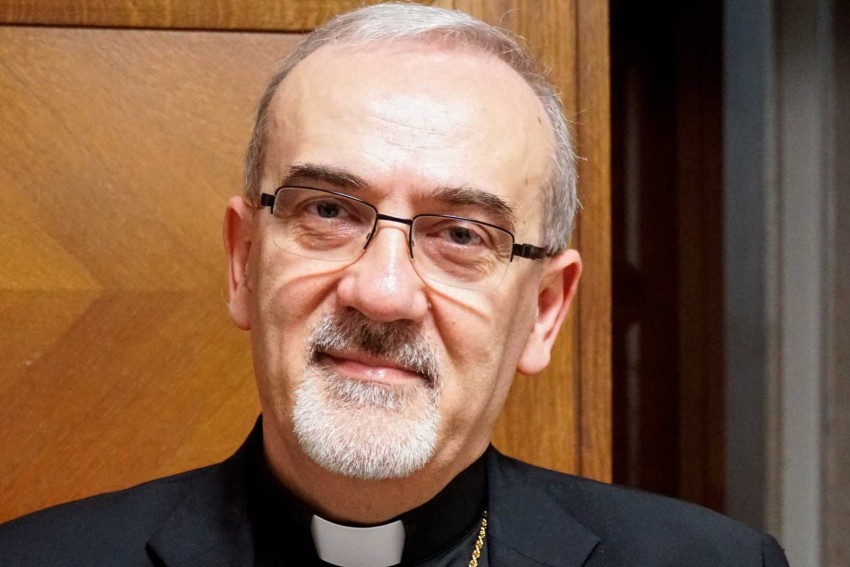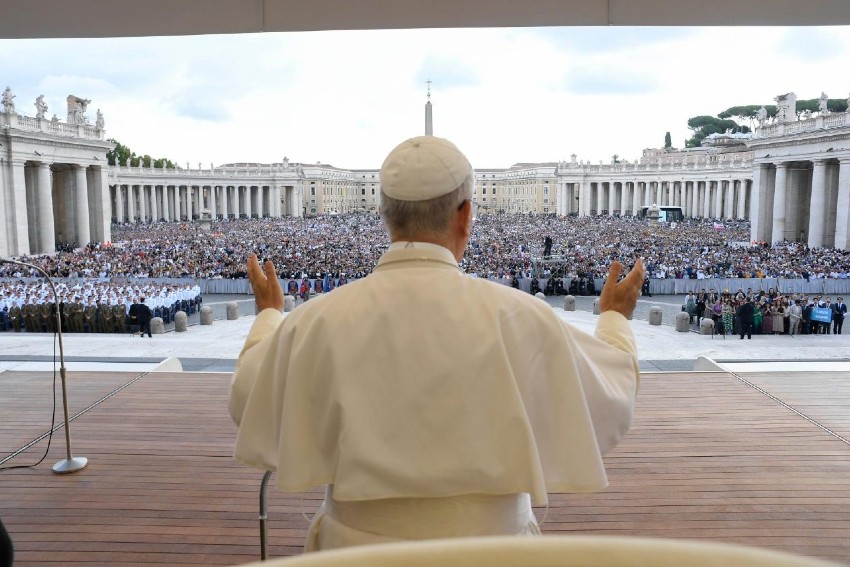

Pope Leo XIV meets Israel President Isaac Herzog inside the Vatican’s Apostolic Palace September 4, 2025. (link, Credit: Vatican Media (link)
Letter #59, 2025, Monday, September 8: Gaza
In the Vatican, Pope Leo, 69, met four days ago with the President of Israel, Isaac Herzog, on Sepetmber 4, to speak about Gaza’s plight, and the need to end the violence in the region (below a report on their meeting).
At the same time, the Vatican’s editorial director, Andrea Tornielli, 61, on September 2 issued a heartfelt statement on the situation in Gaza, showing the Vatican’s concern for the plight of the people of Gaza, and their hope for an end to the ongoing violence.
Both the meeting and the statement reveal the Vatican’s deep interest in assisting the coming of a just peace in Gaza.
About 60,000 Gazans have been killed since the violence broke out following an attack on Israel by Hamas, leaving some 1,200 Israelis dead, and 251 held hostage, on October 7, 2023. (link)
—RM

Andrea Tornielli (born 19 March 1964) is an Italian Catholic journalist and religious writer who serves as the editorial manager for the Vatican’s Dicastery for Communication. A graduate in History of the Greek language from the University of Padua in December 1987, Tornielli became a Roman Catholic journalist and writer. He collaborated at the Catholic newspaper Il Sabato and at the monthly 30Giorni, from 1992 to 1996. He was a journalist at the conservative daily Il Giornale, from 1996 to 2011. He started collaborating at La Stampa, in March 2011, as a Vaticanist, and he is the coordinator of their website Vatican Insider, published in three languages and entirely dedicated to information related to the Vatican and the Catholic Church.
Tornielli has published many books, including several biographies and on subjects like Pope Pius XII and the Holocaust, the historical Jesus and Padre Pio. On 18 December 2018, Pope Francis appointed Tornielli manager of the editorial department of the Dicastery for Communication.
Here is the text by Andrea Tornielli, editorial director of the Vatican communications department:
On plans for a ‘new Middle East’ without the Palestinian people (link)
Our Editorial Director criticizes plans to forcibly displace Palestinians from their land, calling for respect for the obligation to protect civilians.
By Andrea Tornielli
September 2, 2025
The Israeli–Palestinian conflict has long been a source of debate and polarization. The war now raging in Gaza, and the controversies surrounding it, have made this phenomenon even more extreme, if that were possible.
Intense—at times extreme—polarizations run through much of civil society in many countries around the world. As always, there is no shortage of manipulation, simplification, and approximation which, in such a complex context, risk misleading and doing harm.
This can be seen in the language used, in an extremely emotional approach, and in the inability to try to listen to the other.
In response to the horror of what happened nearly two years ago—the attack carried out by Hamas, which remains an inhuman act of terrorism to be condemned without any reservation—there followed a predictable Israeli reaction.
It has been a disproportionate reaction, going well beyond any ethically acceptable limit, as recognized not only by numerous international authorities but also by many voices within Israel itself and more broadly within the Jewish world.
If we analyze the war unleashed in Gaza while taking into account what is happening in the rest of Palestine—what was once called the West Bank—we cannot but think that, beyond the response to the massacre of October 7, there are other objectives as well.
The expansion of settlements, the continual and unpunished assaults by settlers, the public statements of some Israeli government ministers who hope for the end of the Palestinian Authority, the annexation of all the territories, and the deportation of Palestinians all lead one to think that the objective goes far beyond the elimination of Hamas or the guarantee of security for the State of Israel.
In recent days, a new settlement has been approved in the E1 area, which practically splits that territory in two. Likewise, there is talk of annexing Area C of the Palestinian Territories, which, moreover, is already under full Israeli control without ever having been formally annexed.
In this increasingly tense context, “plans” for a “new Middle East” are being published one after another—first quietly and now ever more openly—a kind of new order in which, however, there seems to be no place for the Palestinian people.
The latest of these is the plan now being discussed for the future development of Gaza. It envisions the construction of “smart” cities and luxury resorts.
Naturally, it provides for what is tellingly called the “voluntary evacuation” of Palestinians, who—if they wish—may one day return (sic!). And for those who do not want to leave, “special zones” are being designed… It is a plan that speaks for itself. One might have thought it was a work of science fiction, the plot of a fantasy film. Instead, it is—so it seems—sadly real.
It is sorrowful to note the weakness of the international community and multilateral bodies, unable to halt this drift, compounded by the deliberate ignoring of international conventions, respect for rules, and moral conduct. The only language left is that of force—first in words and then in military action.
The Church has no weapons and no power to impose anything. Her only weapon is prayer and the strength of the Gospel, which nevertheless compels us to speak a clear word of truth about the human person and about the life of the world.
No future can be built on force, on contempt for human life, or on the refusal of people’s aspiration to a dignified and secure existence.
We desire this—and we repeat it with conviction—for Israelis, continuing to call for the immediate release of all hostages still trapped in the tunnels of Gaza, as Pope Francis and then Pope Leo XIV have done in their appeals.
We desire it equally for Palestinians. We ask that the hostages be treated in a dignified and humane way, and at the same time that Palestinians in Gaza be treated in a dignified and humane way.
We hope that no-combat zones will be established throughout the Gaza Strip—true safe zones under international protection—where the sick, the vulnerable, and unarmed civilians can find shelter.
“Voluntary evacuations,” that is, forced displacement; total destruction; endless deaths; hospitals struck; daily killings of those standing in line for a crust of bread; the blocking of any clear political horizon that would give the Palestinian people dignity and a home in their own land—these will never build the future balance of the Middle East.
What is happening is, sadly, destined to create the next generation of people filled with hate and risks becoming yet another antechamber to yet another future wave of violence.
Certain development proposals that impose on Palestinians a future decided for them—and perhaps also over them, or worse, against them—are nothing but further proof of arrogance and blindness. The future of the Palestinians can and must be decided only together with them, never without them.
The Church, as she is already doing, will continue to bend down to bind the wounds of all.
She will continue to extend her hand to all who are willing to work together to create alternative contexts of life and dignity. Her doors will always remain open to those who refuse to surrender to the logic of hatred and war, and who seek practicable paths to peace.
For several years now, the Holy See has formally recognized the State of Palestine, and we cannot remain silent in the face of what is happening.
Once again we make Pope Leo XIV’s words our own, asking that the barbarity of war be stopped, that a peaceful solution to the conflict be reached, that humanitarian law be observed, that the obligation to protect the civilian population be respected, and that collective punishment, the indiscriminate use of force, and the forced displacement of the population be prohibited.
Here is a report from Crux on the Pope’s September 4 meeting with Israeli president Isaac Herzog:
Pope, Israeli president discuss war in Gaza and potential paths to peace (link)
Thursday, September 4, 2025
Senior Correspondent
ROME – During what is seen by many as a high-stakes conversation between Pope Leo XIV and Israeli President Isaac Herzog at the Vatican Thursday, the two discussed possibilities for peace in the Middle East, including a ceasefire in Gaza.
Herzog visited the Vatican Thursday, Sept. 4, where he met privately with Pope Leo XIV and held a subsequent conversation with the Holy See’s Secretary of State, Italian Cardinal Pietro Parolin, and Secretary for Relations with States, British Archbishop Paul Gallagher.
According to a Sept. 4 Vatican communique, the discussions were “cordial” and touched on “the political and social situation in the Middle East” and the numerous conflicts raging there, with special attention paid to “the tragic situation in Gaza.”
“Hope was expressed for a swift resumption of negotiations so that, with courage and willingness, as well as the support of the international community, the release of all hostages can be achieved, a permanent ceasefire can be reached urgently, the safe entry of humanitarian aid into the most affected areas can be facilitated,” the statement said.
There was also an appeal for “full respect for humanitarian law can be guaranteed, as well as the legitimate aspirations of the two peoples.”
As part of its longstanding diplomatic policy, the Holy See has consistently advocated for a two-state solution to the Israel-Palestine conflict, and since Pope Leo’s election top aides have repeated this call as what they believe is a secure way of obtaining lasting peace in the Middle East.
Vatican Editorial Director Andrea Tornielli published an editorial Wednesday ahead of Herzog’s visit calling Hamas’s Oct. 7, 2023, attack on Israel “inhuman” but said Israel’s retaliation has been “disproportionate” and unethical.
Tornielli also suggested that in addition to ensuring Israel’s own security, they have other expansionist motives for employing such a show of force in Gaza, implying that part of Israel’s motivation could be the complete eradication of the Palestinian people.
(…)
In a Sept. 4 post on social media platform X, previously known as Twitter, Herzog voiced gratitude to Pope Leo for his “warm welcome” to the Vatican.
Herzog insisted that “Israel is striving in every possible way to bring home the hostages held in brutal captivity by Hamas” and said that his country “yearns for a day when the peoples of the Middle East – the Children of Abraham – will live together in peace, partnership, and hope.”
(…)
He said the country is proud of its Christian community and wishes to guarantee the security and wellbeing of these local Christian communities in the Holy Land and throughout the Middle East.
“The Pope’s inspiration and leadership in the struggle against hatred and violence, and in promoting peace around the world, is valued and vital,” Herzog said, saying, “I look forward to deepening our cooperation for a better future of justice and compassion.”
Ahead of Thursday’s meeting between the pope and Israeli president, Palestinian Ambassador to the Holy See Issa Kassissieh told Crux that the meeting came amid “unusual times.”
“It is our hope, at a time when world leaders failed drastically to stop the war on Gaza, thus betraying the basic human values and dignity, that the Holy Father, the inherent of St. Peter on earth might succeed when others failed.”
“Our devastated people are hoping and praying for His Holiness Pope Leo to contribute substantially in bringing justice and peace in the Holy Land,” he said, and invited Pope Leo to visit Gaza and celebrate Mass at Holy Family Catholic parish, which was recently struck by an Israeli tank.
[End, piece by Elise Ann Allen]
Here are the words of US President Donald Trump, expressing earlier this year his vision for the future of Gaza, on February 5, 2025, while meeting with Israel’s Prime Minister, Benjamin Netanyahu:
Donald Trump’s words, in Washington on February 5 (link):
“I also strongly believe that the Gaza Strip, which has been a symbol of death and destruction for so many decades and so bad for the people anywhere near it, and especially those who live there and frankly who’s been really very unlucky. It’s been very unlucky. It’s been an unlucky place for a long time.
“Being in its presence just has not been good and it should not go through a process of rebuilding and occupation by the same people that have really stood there and fought for it and lived there and died there and lived a miserable existence there. Instead, we should go to other countries of interest with humanitarian hearts, and there are many of them that want to do this and build various domains that will ultimately be occupied by the 1.8 million Palestinians living in Gaza, ending the death and destruction and frankly bad luck.
“This can be paid for by neighbouring countries of great wealth. It could be one, two, three, four, five, seven, eight, 12. It could be numerous sites, or it could be one large site. But the people will be able to live in comfort and peace and we’ll make sure something really spectacular is done.
“They’re going to have peace. They’re not going to be shot at and killed and destroyed like this civilisation of wonderful people has had to endure. The only reason the Palestinians want to go back to Gaza is they have no alternative. It’s right now a demolition site. This is just a demolition site. Virtually every building is down.
“They’re living under fallen concrete that’s very dangerous and very precarious. They instead can occupy all of a beautiful area with homes and safety and they can live out their lives in peace and harmony instead of having to go back and do it again.
“The US will take over the Gaza Strip and we will do a job with it too. We’ll own it and be responsible for dismantling all of the dangerous unexploded bombs and other weapons on the site, level the site and get rid of the destroyed buildings, level it out. Create an economic development that will supply unlimited numbers of jobs and housing for the people of the area … do a real job, do something different.
“Just can’t go back. If you go back, it’s going to end up the same way it has for 100 years.
[End, Donald Trump’s remarks on February 5, 2025]
***
P.S. If you wish to become a “friend” of these letters, you may do so by clicking below and making a small contribution…
P.P.S. Our special sale on Inside the Vatican magazine is still going on for a limited time. Subscribe now for just $20 a year! https://insidethevatican.com/subscribe/