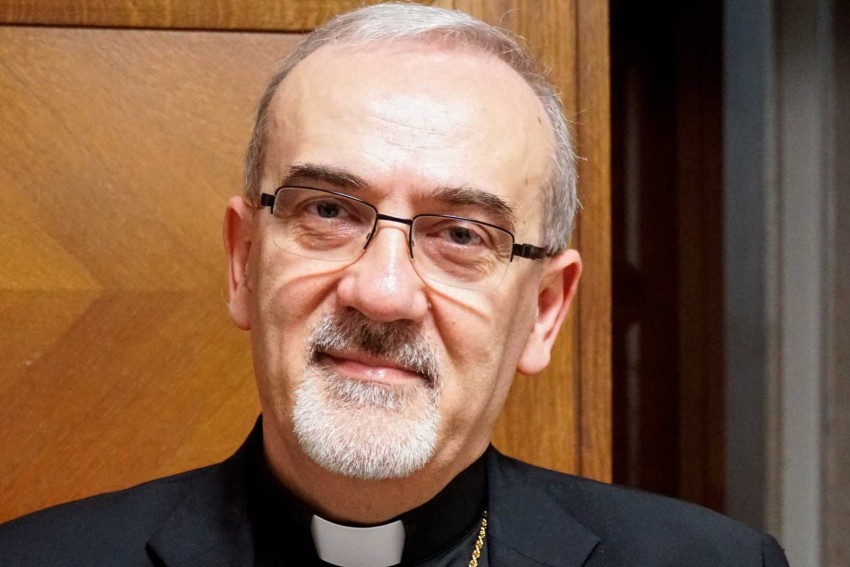

His Eminence Giovanni Angelo Becciu, 77, Prefect of the Congregation for the Causes of Saints, June 27, 2019 (photo: Daniel Ibanez / EWTN) (link)
Letter #66, 2025, Tuesday, September 23: Becciu
The scandalous Vatican “trial of the century” is coming to an end.
The multi-year case has cost millions of dollars in legal fees for the 10 men accused of financial crimes.
And the case involves a cardinal (the first such case in modern times; cardinals in modern times have never been put on trial in a Vatican court; any “issue” with a cardinal has always been settled “privately” — within the college).
So this is a unique case.
The Vatican’s appeals court is expected to issue a judgment later this week on the appeal of Cardinal Angelo Becciu, 77 (photo above) on his conviction of December 16, 2023, after a more than 2-year trial, for embezzlement and aggravated fraud in connection with a controversial London property investment, and other charges.
So, almost 2 years ago, Becciu was found “Guilty,” and received a rather lengthy sentence of “five years and six months in prison” — but, Becciu has not gone to prison, yet, because… he has filed an appeal of his sentence.
So we have arrived, finally, at the moment of truth — or at least of decision (as it is difficult to be confident we will have the full truth, even after all these years…)
***
In Rome, I have met with Becciu many times, for many hours, over the past two years, and have discussed his case with him with great frankness.
The accusations against him… his arguments for his innocence… his relations with the late Cardinal George Pell… his relations with Pope Francis… we have discussed all of these matters.
Becciu argues, first, that he did not receive a fair trial.
Becciu argues, second, that he is, in fact, innocent.
Becciu maintained to me, with considerable emotion, that he was a victim of a “plot” against him led principally by two women, Immacolata Chaouqui and Genevieve Cifferi.
The latter, he said, told him in early September 2020, in the living room of his apartment in the Palace of the Holy Office, that within days he would “lose his red hat.” On September 24, 2020, Pope Francis did in fact announce that Becciu no longer had all of the rights of a cardinal, though he did not remove him from the College of Cardinals. (link)
In all of our conversations, and in reading the transcripts of the trial, and many press reports, I have never found solid evidence that Becciu himself personally profited — let us say, siphoned some millions of dollars into his own bank accounts — only that he made poor financial decisions and that those decisions caused the Vatican to lose money. That is what he was convicted of: improper management of funds.
Total cost to the Vatican
The total amount invested by the Vatican in the London building, acquired through a complex series of transactions between 2014 and 2018 (Note: Becciu left the office of “Sostituto” already in 2016) was approximately €350 million.
This, it appears, was considerably higher than the market value at the time, due to dubious deals with brokers.
So that does look a bit suspicious…
Then, the Vatican’s loss: by selling the property for £186 million in 2022, the Vatican incurred a loss of well over €100 million.
Reports vary on the precise figure, but one source cites a loss of about €140 million.
Still, note: if the Vatican had held the property all the way until today, its value would, it seems, have considerably recovered.
So, had the Vatican not sold in 2022, it might (perhaps) even have made a profit on this property at the center of this trial.
***
Revelations of (alleged) “witness tampering”
The arguments Becciu makes about the procedures of the investigation and trial do seem to have some weight.
This has led a number of legal scholars and journalist observers in Italy to conclude that, even if Becciu was and is guilty, the decisions and procedures of the trial were unjust, illegal, or in some way problematic.
Various articles in the Italian press have included:
- Revelations of witness tampering. In April 2025, the Italian newspaper Domani published WhatsApp messages suggesting two women, Francesca Chaouqui and Genevieve Ciferri, colluded to manipulate testimony from key witness Msgr. Alberto Perlasca. Chaouqui, previously convicted in a separate Vatican scandal, and Ciferri, a close friend of Perlasca who prepared a chapel for him so that he could come from Rome to celebrate Mass in Umbria, allegedly helped prepare his testimony while coordinating with prosecutors.
- Prosecutorial misconduct. The messages point to potential improper coordination between the prosecution and Chaouqui. During the trial, prosecutor Alessandro Diddi entered some of the women’s text messages into evidence but redacted the bulk of them, prompting complaints from the defense.
- Influence from Pope Francis. During the trial, defense lawyers pointed to Pope Francis‘s unprecedented interventions in the legal process, which enabled prosecutors to use investigative techniques previously considered off-limits. Critics argue these interventions compromised the Vatican’s claims of judicial independence.
- Secretly recorded conversations. An audiotape of a secretly recorded phone conversation between Pope Francis and Cardinal Becciu became a point of contention. The defense alleged Becciu was “framed” when the transcript, which the prosecution interpreted as evidence of guilt, was published in Italian media.
- Appeal and outside scrutiny. Following his conviction in December 2023, Becciu filed an appeal, citing “conspiracy” and claiming to be the victim of a plot to frame him. Raffaele Mincione, another defendant, has sought a finding from the United Nations that the trial lacked due process.
***
The missing chat messages
I do wonder, especially in regard to the decision of the prosecution to submit into evidence only eight out of 126 Whats App text messages between two women (sometimes involving the chief prosecutor, Alessandro Diddi): Why were all the messages not submitted?
The text messages that were not submitted have now been leaked, and they seem to show that the two women, and the prosecutor, carefully assisted a chief witness against Becciu, his former right-hand man, Monsignor Alberto Perlasca (whom I also know and have spoken to at some length).
Here is a summary of this important question:
Leaked WhatsApp messages involving public relations specialist Francesca Chaouqui have raised serious questions about potential witness tampering and prosecutor misconduct in the Vatican’s high-profile financial trial against Cardinal Angelo Becciu.
In 2022, Vatican prosecutor Alessandro Diddi entered some of the chats into evidence but redacted all but eight, prompting defense complaints that crucial evidence was being withheld.
The issue reemerged in September 2025 (just in recent days) during the appeals phase, when thousands of additional pages of unredacted chatsbetween Chaouqui and another woman, Genevieve Ciferri, were revealed.
Timeline of the WhatsApp revelations
- August 2020: Monsignor Alberto Perlasca, originally a key suspect in the financial misconduct case, changes his story and becomes a central witness for the prosecution against his former boss, Cardinal Becciu.
- 2020–2024: Chaouqui and Ciferri exchange over 3,200 pages of WhatsApp messages, with Chaouqui reportedly posing as a retired magistrate to offer Perlasca legal advice through Ciferri.
- 2022: Diddi tells the court that Ciferri forwarded him 126 chats with Chaouqui and enters a redacted version of the messages into evidence. Diddi claims to have blocked Ciferri after the first night. The defense objects to the redactions, arguing crucial evidence is being withheld.
- December 2023: Becciu is convicted and sentenced to 5 1/2 years in prison.
- April 2025: Italian media reports on previously unseen WhatsApp messages suggesting judicial meddling and a behind-the-scenes effort to manipulate Perlasca’s testimony against Becciu.
- September 2025: During the appeals trial, it is revealed that Diddi received more than the 126 chats he originally disclosed. Ciferri also provides thousands of additional messages to defense lawyers, who use them to file motions demanding Diddi’s recusal.
Key allegations from the messages
According to the leaked chats, Chaouqui and Ciferri allegedly devised a plan to influence Perlasca‘s testimony to target Cardinal Becciu.
The messages reveal some troubling points (italics are mine, RM):
- Possible tampering with evidence: Defense lawyers argue the messages “demonstrate a disturbing activity of evidence tampering” to influence Perlasca’s testimony.
- Questionable conduct by prosecutors and police: The chats suggest Vatican police commissioner Stefano De Santis advised Chaouqui on how Perlasca could implicate others. The defense claims this shows the investigation was tainted from the start.
- Manipulating testimony: The messages include a conversation where Chaouqui appears to instruct Ciferri on how to manipulate the narrative. Chaouqui tells Ciferri there are “two levels,” the truth and the “trial level,” where they must maintain ignorance to avoid the trial being nullified as a conspiracy.
- Prosecutorial conflict of interest: Becciu’s defense lawyers claim that Diddi has a personal interest in the outcome of the appeals case and should be recused.
Consequences for the trial
The explosive revelations about the missing and manipulated WhatsApp messages have cast fresh doubt on the fairness of the initial trial and triggered new legal motions in the ongoing appeals process.
The Vatican’s high Court of Cassation is now faced with addressing these allegations of judicial misconduct as it prepares to issue its final verdict.
***
A Special Meeting in May…
Interestingly, Pope Leo met with Becciu, soon after Leo’s May 8 election.
Here is what Elise Ann Allen of Crux — the journalist who has just conducted the first long interview with Pope Leo — wrote at the time.
***
Pope meets cardinal sentenced for financial crimes, banned from conclave (link)
By Elise Ann Allen of Crux
May 27, 2025
ROME – As with any new papacy, a quick look at their first appointments and audiences inside the system offers at least a small insight into what is first and foremost on their minds in terms of pastoral and administrative priorities.
For Pope Leo XIV, with nearly a month at the helm and around two weeks of scheduling meetings and making some initial decisions, beyond the expected meetings with state leaders in town for his election and installation activities, his top priorities are already beginning to take shape.
On the whole, they seem to indicate his intention to carry on the unfinished business of the Francis papacy, from finances to the abuse crisis to the reform of the Roman Curia.
One of the most notable meetings came Tuesday, May 27, when Pope Leo held a private meeting with the disgraced Italian Cardinal Angelo Becciu, 76, who in December 2023 was sentenced to five and a half years in jail at the culmination of the Vatican’s Trial of the Century for financial crimes related to a shady real estate deal in London, in which the Vatican took a bath of roughly $250 million.
In addition to his jail time, Becciu was also fined roughly $8,700 and permanently barred from holding any public office in the Vatican City State.
Becciu, the first cardinal to ever be convicted and sentenced in a Vatican civil court, has consistently denied the allegations against him and has filed an appeal.
Prior to the conclave that elected Pope Leo XIV, Becciu attended pre-conclave general congregation meetings, insisting he had not been barred from voting in the conclave until he was apparently shown a letter from Pope Francis stating that Becciu could not vote, and withdrew from participation.
The cardinals participating in the general congregations then published a communique thanking Becciu for bowing out gracefully, and voiced hope that the competent judicial authorities would “definitively ascertain the facts.”
Some cardinals were reportedly unhappy with the way Becciu was treated, and believed he got a raw deal. [Note: italics added, RM]
By meeting with Becciu, Pope Leo is not necessarily rehabilitating or reinstating him, or giving any stamp of approval, but is potentially trying to address one of the most urgent and glaring situations that emerged during pre-conclave meetings that left a bad taste in the mouths of at least some cardinals.
[End, May 27 piece by Elise Ann Allen]
***
Summary of the case
Cardinal Becciu argues, essentially, that the London property deal was not entered into, or exited from, on his own initiative, but was entered into with the approval of other Vatican officials, then exited (sold), six years after Becciu had left the Sostituto post (Deputy Secretary of State), which had authority over the decision. So Becciu was long gone when the order to sell the property came directly from Pope Francis.
Becciu was charged on two other counts:
(1) paying money to a type of “secret agent” Italian woman in her 30s, Cecilia Marogna, who presented herself as a possible go-between to help the Vatican accomplish the release of a nun taken as a hostage to be ransomed, by a militant Islamic group in Mali. The nun was eventually released, but no real help came from Marogna, who received more than 500,000 euros for her efforts. Later investigation showed that she had spent the funds on expensive clothing and boots. But, Becciu argues that he told Pope Francis that he planned to hire this woman to try to free the hostage, and that Pope Francis approved the plan, though knowing it might be risky, or unsuccessful — all in the hope of releasing the nun.
(2) transferring 100,000 euros from the Vatican to a Catholic charity in Sardinia (Becciu is from Sardinia). The charity was run by… Becciu’s brother. Becciu claims that the 100,000 euros are still on deposit years later, in the account of the charity. But he was found guilty of misuse of funds for the sending of this amount to Sardinia.
Here below are three more articles on this case, for your reading pleasure.
We await the results later this week.
—RM
Note: If you would like to subscribe to this letter, or add a friend as a subscriber, you may do so here.
If you wish to donate to this letter, click here.
Vatican News report
Sunday, September 21, 2025
Vatican: Appeal trial for London property case opens Monday (link)
On September 22, in the new chambers of the Vatican Tribunal, the second chapter of the high-profile case over the London property deal begins. The first trial ended in December 2023 with ten convictions. Now comes the appeal phase, starting with five hearings this week.
By Salvatore Cernuzio
A new courtroom, under a new pontificate, and 644 days after the first verdict, the appeal trial concerning the management of Holy See funds opens tomorrow, Monday, 22 September, in the Vatican.
Five hearings are scheduled in the first week (September 22–26), marking a new chapter following the initial trial, which began in July 2022 and ended on 16 December 2023, with the conviction of 10 defendants for crimes ranging from fraud to corruption, among others.
The first trial
At the center is the purchase of a building in a fashionable district of London, a transaction which, according to the first-instance ruling of the Vatican Tribunal – presided over by Giuseppe Pignatone – in a loss of at least €139 million.
Pope Leo XIV himself referred to the situation in his first interview, published September 18, when, speaking about Vatican finances, he said: “There was great publicity given to the purchase of this building in London, Sloane Avenue — and how many millions were lost because of that.”
Other strands of investigation — involving payments to a cooperative in Sardinia and to a manager who allegedly used funds for the release of kidnapped religious to buy luxury goods — became intertwined in what much of the world’s press described as the “trial of the century.”
The label referred to its length (86 hearings, a record for the Vatican), its complexity, and the fact that for the first time a cardinal, Giovanni Angelo Becciu, was among the defendants.
Appeals and new arguments
Cardinal Becciu, sentenced by the Vatican City court of first instance to five years and six months in prison, is among those who have appealed the 2023 ruling; his lawyers announced the appeal the very evening the verdict was read.
Other defense teams did the same on behalf of their clients.
The appeals are being heard by a panel presided over by Archbishop Alejandro Arellano Cedillo, dean of the Roman Rota, alongside two lay judges.
Defence lawyers have filed motions with “additional grounds” in view of the upcoming proceedings.
WhatsApp chats
In recent months, renewed attention has fallen on the trial following the publication in an Italian newspaper of WhatsApp chats between Francesca Immacolata Chaouqui and Genoveffa Ciferri, both witnesses in the first trial due to of their connections to Monsignor Alberto Perlasca, former director of the Administrative Office of the Secretariat of State. His statements, according to the prevailing narrative, triggered the investigation that ended with the indictments — though the court ultimately determined he was not a reliable witness.
During the 2022–23 hearings, some defence lawyers argued that the two women — one of them pretending to be an elderly magistrate — influenced Monsignor Perlasca in his choices and statements. This allegedly took place through WhatsApp chats, some of which were redacted by the Promoter of Justice, Alessandro Diddi (also prosecutor in the appeal trial), for reasons he described as relating to security and the integrity of the trial. The defense raised this issue repeatedly over the 86 hearings.
Ciferri later gave the same chats to one of the defendants, financier Raffaele Mincione, who is said to have passed them to a UN special rapporteur. The conversations were then published in full by the Italian daily Domani and reported by other media outlets. According to defence lawyers, they show that Perlasca’s memo and interrogations were the result of a plot against Cardinal Becciu, involving not only Chaouqui but also official of Vatican City State. Many denounced the scandal of an investigation — and thus an entire trial — thought to be “contaminated” by pressures and behind-the-scenes manoeuvring, and the suggestion of personal vendettas.
The reasoning behind the verdict
Certainly an unpleasant matter for Cardinal Becciu, who has always declared his “absolute innocence” and spoken of a “worldwide public humiliation.” As for the exchanges between Ciferri, Chaouqui and others, and what followed from them — namely Perlasca’s memo, his interrogations in 2020, and his later testimony — the reasoning of the judgment itself makes clear that this material did not influence the verdict. One passage states: “…without the probative contribution offered by Monsignor Perlasca having in any way influenced the assessment of criminal liability, since instead the Tribunal relied exclusively on multiple factual elements in the record that remained unchallenged, proving responsibility beyond any reasonable doubt.”
In other words, the issues raised by Monsignor Perlasca — some “without criminal relevance and in any case extraneous to the present trial,” as another passage notes — were not deemed credible by the Vatican court and did not weigh on the proceedings.
The Rescripta
A more complex question surrounds the Rescripta issued by Pope Francis during the investigation, which changed procedures by granting extraordinary powers to prosecutors. Defence lawyers strongly contested these papal interventions, arguing that, among other things, they allowed the Promoter of Justice, to decide at his discretion which documents to hand over to the defence, and to heavily redacted them.
The issue has fueled debate both inside and outside the Vatican about the principle of separation of powers and the right to defence. While the independence of the Vatican judiciary was “explicitly recognized” by many foreign judicial authorities, including Italy’s Court of Cassation and Switzerland’s Federal Criminal Court, defence lawyers — especially Luigi Panella, representing financier Enrico Crasso — have argued that this independence was undermined by the Pope’s “multiple” and “unusual” interventions, made “without any prior notice” and to “the detriment of the defendants’ rights.”
Prosecutor Diddi has consistently explained that the rescripts “served to regulate activities otherwise not regulated,” and thus “were a safeguard for all those affected.” An order by the President Pignatone on 1 March 2022, rejecting motions to annul the indictments, addressed the issue in depth and concluded that the Rescripta did not amount to any violation of legality or the rule of law. The judgment also underscored that “the guarantees of a fair trial” were “fully respected by Vatican justice.”
What happens next
Thus a new phase begins on Monday [Note: yesterday]. The first day will be devoted to the reporting judge’s summary, after which each party will present the grounds of its appeal.
In addition to Cardinal Becciu, appeals were filed by:
– Enrico Crasso, former financial adviser to the Secretariat of State (sentenced to 7 years in prison; a €10,000 fine; and permanent disqualification from public office);
– Raffaele Mincione, financier (5 years and 6 months; €8,000 fine; permanent disqualification from public office);
– Fabrizio Tirabassi, former Secretariat of State employee (7 years; €10,000 fine; permanent disqualification);
– Nicola Squillace, lawyer (1 year and 10 months, sentence suspended for 5 years);
– Gianluigi Torzi, broker (6 years; €6,000 fine; permanent disqualification; plus one year of special supervision under article 412 of the Penal Code);
– Cecilia Marogna, consultant (3 years and 9 months; temporary disqualification for the same period).
Prosecutor Diddi has also appealed. By contrast, the Secretariat of State and APSA, which had joined the case as civil parties in the first trial, have not.
Cardinal Becciu’s Vatican Appeal Hearing Begins (link)
By Edward Pentin, National Catholic Register, 2025-09-22 [Note: yesterday]
September 20, 2025
The appeal hearing for Cardinal Angelo Becciu, the former deputy Vatican secretary of state who was convicted in December 2023 of embezzlement, aggravated fraud and abuse of office, was set to begin Monday.
Heard by a six-judge Vatican Court of Appeal, the appeal is expected to revisit both factual and procedural objections from the first trial, including evidence, court transcripts and all submissions from both Cardinal Becciu’s defense and the Vatican prosecution.
After the so-called “Trial of the Century” lasting two and a half years, Cardinal Becciu, 77, was convicted of financial malfeasance and sentenced to five years and six months in prison. He was also handed a fine of 8,000 euros and permanently disqualified from holding public office.
The cardinal’s appeal will be heard alongside those of eight other defendants who were also tried, found guilty, and given a variety of sentences. Five of those defendants — Raffaele Mincione, Enrico Crasso, Gianluigi Torzi, Fabrizio Tirabassi and Cecilia Marogna — also received prison sentences of varying length.
Becciu was the first cardinal to be tried by a Vatican tribunal and has remained free pending the outcome of his appeal. Despite initially claiming he was eligible to vote in the May conclave, he decided to withdraw his participation for the “good of the Church” and out of “obedience” to Pope Francis.
The Vatican court said the cardinal’s conviction was based on “full and irrefutable evidence” that he was investing Vatican money in a highly speculative real-estate deal in London’s Sloane Avenue with “total disregard” for Vatican policies. Due to the way the deal was structured and restructured, it ended up losing the Vatican more than $200 million. The Italian cardinal was deputy Vatican secretary of state at the time when the secretariat began negotiating the property deal using the secretariat’s funds in 2014.
The cardinal was also found guilty of making at least 125,000 euros in unauthorized payments to his brother’s charity in Sardinia, as well as funneling more than 500,000 euros from Vatican funds to geopolitical expert Cecilia Marogna who, instead of using it for intelligence and a humanitarian mission to help free a kidnapped religious sister in Mali, was accused of spending the funds on luxury goods and travel.
Cardinal Becciu has consistently protested his innocence, maintaining that he acted with papal approval or authority. He has insisted that donations were for humanitarian or ecclesial purposes, and that there was procedural misconduct during the investigation and trial.
He has stressed that his office as sostituto (deputy in the secretariat of state) required acting on papal trust and this role gave him broad discretion for diplomatic and humanitarian missions, such as the ransom effort to free the kidnapped religious sister.
The cardinal has insisted the money sent to the Sardinian charity was requested by the local bishop for social projects, remained in diocesan coffers, and was not used for personal or family benefit. Regarding Marogna, Becciu has claimed that all payments were for legitimate diplomatic and security services, not for improper or private ends.
Arguing for his defense, his lawyers have said the prosecution benefited from undisclosed papal decrees that included permitting secret wiretaps and warrantless detentions, and that witnesses were coached by Vatican police, undermining fair-trial guarantees.
Cardinal Becciu also has alleged new evidence of outside manipulation and collusion with Vatican prosecutors, reiterating a claim of being “framed” by a campaign built on falsehoods and media pressure — claims that have been strenuously denied.
He has also said he was unjustly presumed guilty from the outset, and that key exculpatory evidence was ignored or overlooked at trial — accusations that the Vatican tribunal dismissed. His defense intends to challenge both the factual findings and legal procedures in his appeal.
Last October, the Vatican released its reasons for convicting Cardinal Angelo Becciu, stating he was involved in the illicit use of Holy See funds despite having no “profit-making purpose” and stressing that the trial was fair.
Commenting on the court’s 800-page judgment in an editorial in L’Osservatore Romano, Andrea Tornielli, Vatican Media’s editorial director, reasserted the judgment’s assessment of a fair trial. He added that the trial’s outcome showed the need for prelates and those in charge of Vatican finances to be held accountable for their actions.
Although Tornielli did not name Cardinal Becciu, the cardinal criticized the editorial for its “vaguely moralistic tone” and again protested his innocence. He acknowledged that the sums involving the London property were “enormous” but insisted they were not without precedent and had the “approval of the superior at the time,” namely the head of the Vatican’s administrative office, Msgr. Alberto Perlasca, who, as a star witness in the trial, avoided prosecution.
As in the trial, Cardinal Becciu was accused of seeking to shift responsibility to others, including Pope Francis, whom he said knew all about the London property deal, although the extent of the Pope’s involvement has never been fully known.
Edward Pentin began reporting on the Pope and the Vatican with Vatican Radio before moving on to become the Rome correspondent for EWTN’s National Catholic Register. He has also reported on the Holy See and the Catholic Church for a number of other publications including Newsweek, Newsmax, Zenit, The Catholic Herald, and The Holy Land Review, a Franciscan publication specializing in the Church and the Middle East. Edward is the author of The Next Pope: The Leading Cardinal Candidates (Sophia Institute Press, 2020) and The Rigging of a Vatican Synod? An Investigation into Alleged Manipulation at the Extraordinary Synod on the Family (Ignatius Press, 2015).nd, National Catholic Register article]