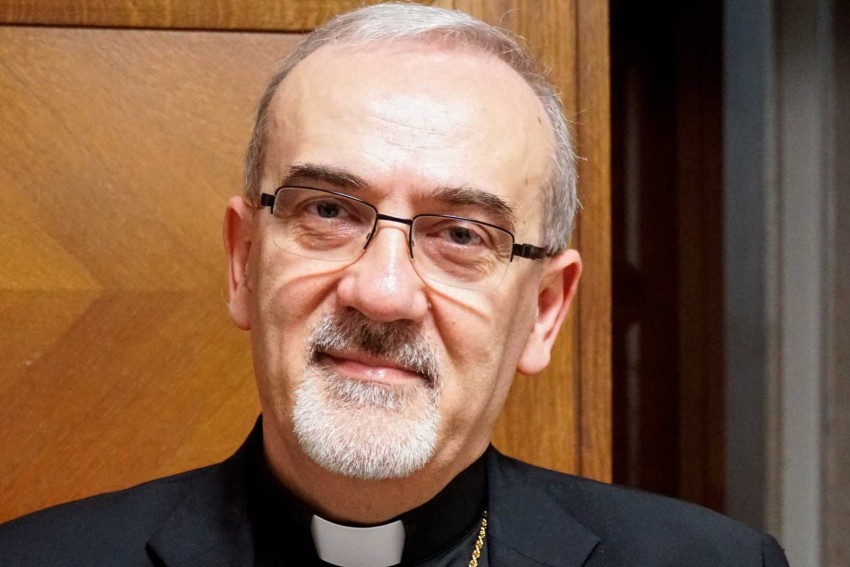
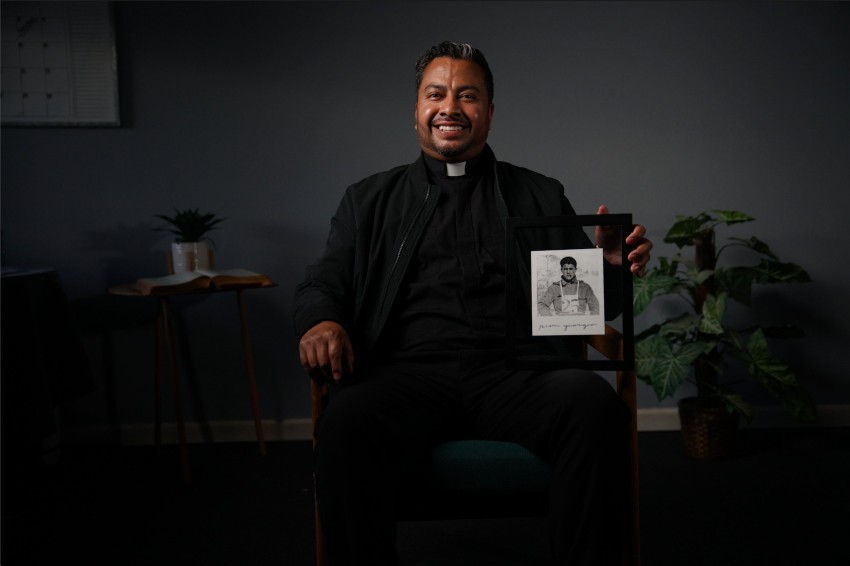
Fr. Juan Gutierrez | Photo: hope.lacatholics.org
Letter #68, 2025, Wednesday, October 1: Fr. Juan Gutierrez
An intimate account of a miracle that made a canonization possible.
—RM
Note: If you would like to subscribe to this letter, or add a friend as a subscriber, you may do so here.
If you wish to donate to this letter, click here.
Special to Inside the Vatican magazine:
The Priest Healed by a Miracle
By Andrew Rabel of Melbourne, Australia, who was recently in Rome to be present at the canonization of Carlo Acutis and Pier Giorgio Frassati on September 7 in St. Peter’s Square.
Fr. Juan Gutierrez is 38 years of age, and is a priest of the archdiocese of Los Angeles, where he is the assistant pastor at St Frances Xavier Cabrini Church.
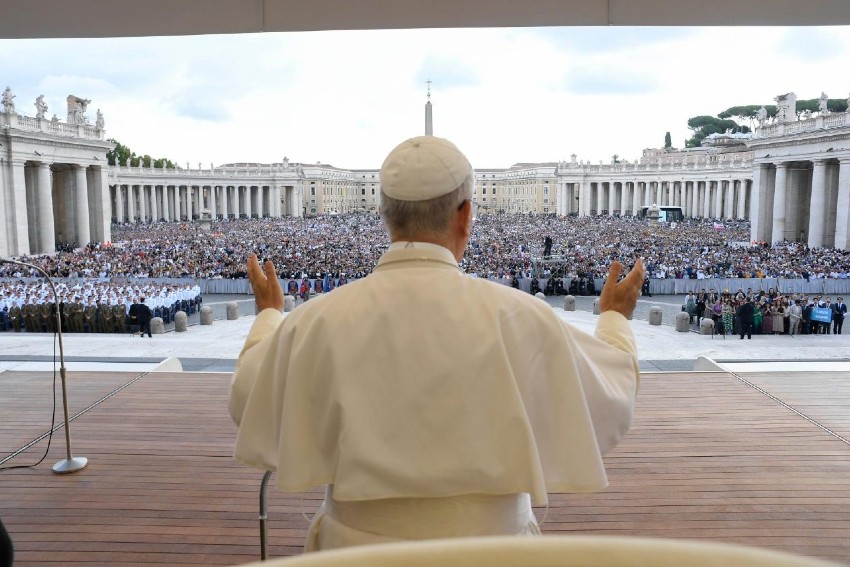
He was in Rome earlier this month to attend the September 7 joint canonization of Carlo Acutis and Pier Giorgio Frassati.
An immigrant from Mexico to the United States, he was miraculously healed of a torn Achilles tendon on November 25, 2017, through the intercession of Pier Giorgio Frasatti.
This is his account of that miracle.
St Pier Giorgio Frasatti was an athletic young man, from a wealthy family, who lived in Turin, in northern Italy at the turn of the century. He was renowned for his work with the poor and needy of his city, and his strong commitment to Catholic Action, in opposing both fascism and communism. Though not from a particularly religious family, his father, Alfredo, the founder of the Italian journal La Stampa, was, like his son, a staunch anti-fascist in those unstable years between World War I and II.
I was in Rome for the canonizations, and so I was able to have a lengthy interview with Fr. Gutierrez, who described to me in-depth the circumstances of the miracle. —Andrew Rabel
1. Now, the first question I want to ask you is, what made you decide to become a Catholic priest?
Fr. Juan Gutierrez: It was a journey of discernment and even fighting with the Lord, because I personally did not want to be a priest.
I did not think that I was born to be a priest.
But through my years of preparation at the seminary, with the help of my formators, with prayer, with working with the people of God as a seminarian, the Lord allowed me to find out that He had called me to be a priest.
So, what made me decide to become a priest? God allowed me to discover that I was born to be a priest. And so I acted on that discovery.
2. Good. Describe what happened when you received the accident to your Achilles tendon, and in what circumstances?
Fr. Juan Gutierrez: Well, it was the evening of September 25, 2017, when I went to play basketball at a gymnasium, a gym that was near the seminary in Camarillo, California. We were playing basketball. I was running, and I felt as if someone had tripped me from behind, hitting my right ankle. And when I turned around to see who had tripped me or who had bumped me, I noticed that nobody was there. And I also noticed that I heard like a sensation of a pop, a sound of a pop when that happened.
So, immediately after, I noticed that I couldn’t walk normally anymore. I had to limp.
So, that evening I was taken to the seminary right after that, and the following day I was taken to the emergency room nearby the seminary, and the doctors took x-rays, and they told me that I didn’t have any broken bones, but most likely one of my calf muscles had been strained, and that’s why I was having the problem that I had. My ankle was swollen and purple, so they couldn’t notice any other issue with it. So, I was sent back home with some painkillers, some pain medicine, and that was it. Okay.
3. All right. Did the medical experts, obviously you went to see a doctor that you consulted, did they give any hope that there would be a recovery of your tendon and that you could walk properly again?
Fr. Juan Gutierrez: Yes, but when I went to see the doctor at the emergency room the day after my injury, we didn’t know I had a torn achilles. We didn’t know it for a whole month, because since the emergency room doctors told me that I had a pulled muscle of my calf, then I addressed it as such, waiting about two weeks, because in about two weeks I should have been okay.
One of the seminarians was also a chiropractor with a current license to practice, and he told me that after a few days of rest and icing my injury, that I could start some stretching exercises to bring the muscle of my calf back to its normal activity. So, that’s what we did. He would check me every other day, do some stretching exercises in which I would point my toes up and push little by little to bring the calf muscles back to their normal activity.
And that was painful, but I believed that it was part of the deal, that that was normal.
But about two weeks after we started doing that, he told me that I was not showing signs of improvement anymore, and that most likely there was something wrong with one of my ligaments, and only an MRI would show it.
When he told me that it was October 13. He also told me that my doctor, my primary care physician, would want to immobilize my foot until he found out what I had.
So, I tried to be proactive, went back to the emergency room that day, October 13, to see if the doctors could immobilize my foot ahead of time.
But they didn’t want to. They said that the only thing they could give me was crutches, which I already had at the seminary, so I didn’t take them.
And that same day, I spoke over the phone with my primary care physician, and he told me that he was going to arrange for me to have an MRI, so that we could know what I had. This happened on October 13, more or less.
But I wasn’t able to get the MRI done until October 31. And it was on October 31 that I found out that what I had in reality was a torn Achilles tendon.
When my doctor called me to tell me that the results of the MRI were that I had a torn Achilles, my doctor told me, I recommend you to go through the surgery to repair your tendon, because you’re still a young man. I was 31 years old at the time.
“You’re still a young man,” he said, “and you’re going to be active doing sports, so surgery is your best option.”
So, yes, there was a path forward.
There were actually two options. I could do the surgical process, by which I would do the surgery, and after 10 or 14 days of rest, the casts that would be put on the day of my surgery would be removed, and then after those 10 to 14 days after the surgery, I would start physiotherapy, which lasts from six months to eight months. And in about a year, I would recover, quote-unquote, my normal life. That is the surgical process. And that would have been head-to-head surgery.
Then, there is a non-surgical process by which they put you in a cast, an air cast, pointing your toes down, more or less in a 90-degree angle, day and night for about two to three months. And after those two to three months, they remove the cast, and then you can start physiotherapy that also goes from six months to eight months. And the same thing, in about a year, I would, quote-unquote, “recover my normal life.”
So both the surgical and non-surgical processes to deal with a torn Achilles tendon would take about a year. It would be the same period.
4. Okay, well, how did this miracle take place? And what made you invoke, specifically, Blessed Pier Giorgio Frassati?
Fr. Juan Gutierrez: So, after I heard the news from my doctor on October 31 that I needed to get the surgery — that was his recommendation for me — I started to research on-line Achilles tendon surgeries, and that started to be worrisome for me.
The recovery process, the high rate of infection for the surgeries, because of the low blood supply to the tendon.
So the following day was November 1. In the Catholic Church, we celebrate the solemnity of all the saints.
So I went to Mass at the seminary, and after Mass I stayed behind to pray.
And while I was praying, I began to think that maybe I should do a novena, nine days of prayer, to ask for God’s help for my injury.
And I, oftentimes when I do novenas, I invite a saint to come and pray with me, so that they could help me with their prayers, depending on the necessity or the intention of the novena.
So when I was thinking who, which saint I will invite to pray with me this novena, my first thought was, maybe I should pray with all the saints in heaven, because today is the solemnity of all the saints, and I think I need all the help I could get.
And as I was thinking this, I received an inspiration to my heart, that said, why don’t you make it to Blessed Pier Giorgio Frassati.
And it was something so simple, so casual, but I thought that it was a good idea, so that’s why I decided to do the novena with Pier Giorgio Frassati.
It’s as simple as that.
So, the way the miracle happened is that I prayed for a few days, a prayer that I created myself, and I prayed in this way, “Lord, through the intercession of Blessed Pier Giorgio Frassati, I ask you to help me with my injury.”
I asked for help, I didn’t ask for healing.
My request was for God’s help in my injury.
So I prayed the first day, the second day, the third day, about the fourth day, and everything was just normal. I would pray this prayer, and after this prayer, I would do a rosary, and that was it.
But one day, I went to pray to the chapel by myself, nobody was in there. And when I was kneeling down, I was praying, and I started to feel, like in the area of my feet, I felt like a sensation of heat, which I thought was a fire that had been begun, or started, by one of the electrical outlets that was closest to the wall, since I was kneeling near to the pews closest to the wall.
And I started to look for the fire, because I was concerned that the fire would take momentum with the books and the wood of the pews, but I couldn’t find the fire, I couldn’t smell anything burning.
So eventually, I realized that the source of heat was the area of my injury.
And I myself began to think that sometimes, people, like for example, in the Charismatic Renewal, they give testimony that when someone is healed from one of their illnesses, the person testifies that in the area of their illness, when they were being prayed for, or they were praying, they began to feel a sensation of heat.
So I was saying to myself, “Lord, I don’t think you’re healing me right now, not because you don’t have the power to heal me, but because I don’t think I have the faith for something like this.”
And that was very moving to me. You feel unworthy. Yes, that was very moving to me. So that moved me to tears, and eventually I finished my prayer, and I went on with my normal day.
By this point, I was wearing a brace that was kind of like a sock, with shoelaces that would help my ankle be locked in place.
But after this prayer in the chapel, I completely forgot about my injury.
I didn’t wear the braces anymore.
I already had an appointment scheduled to go see the surgeon who would do the surgery that I was supposed to undergo. Right….
5. What happened at that conference?
Fr. Juan Gutierrez: Well, I finished my novena with Pier Giorgio November 9, and I went to see the surgeon November 15, about six days after I finished my novena.
When I was about to drive to see the surgeon, I noticed that I was not wearing any braces anymore because I didn’t need them.
I believed that my doctor was not going to be pleased seeing that I was not taking care of my injury.
So I looked for one of the simple braces that in the past didn’t help me, that’s why I had bought more, that was kind of like half of a sock with a strap-on Velcro wrap, and I thought, “Well, at least this one I could put on so that the doctor could see that I have something on protecting my ankle.”
And I went to see the surgeon.
And when the surgeon came into the room where I was, he started to see the images of my MRI, and he explained them to me. “This is how we know that you have a torn Achilles,” he said, “because there is this gap, like a triangle, that is being filled with blood, and that’s how we know you have a torn Achilles.”
So then he told me, “Now I’m going to check you myself.”
So he told me to lay flat on my belly on a bed, facing the floor, with my foot hanging from the bed.
And he told me that he was going to squeeze my calf muscles, so when he did that, if my foot moved, that would mean the tendon was connected. If it didn’t move, it would meant the tendon was not connected.
This test is, to my knowledge, about 70% accurate in detecting a torn Achilles tendon.
So I’m facing down to the floor, and I feel that he presses my calf, and I hear him just make a noise. Hmm.
And that intrigued me, but then he went ahead and told me, “Now I need to palpate,” which means to touch with my thumb, the area of your injury, “and I apologize for any pain that you will feel.”
So he started to palpate, to feel the area, and he asked me, “Do you feel any pain?”
And I told him, “No.”
I couldn’t describe it as pain. I would describe it more as when you walk a lot, or you do exercise, and your muscles become sore. We have a word in English for that, soreness.
And I told him that it was sore, but it was not pain.
And he told me, okay, now I will push a lot harder, and I apologize for any pain you may feel, but I need to make sure. And I told him, okay.
So he started to push a lot harder. And he asked me, do you feel any pain? And I told him, no. I feel exactly the same. Now I just feel that you’re pressing harder.
So he told me, okay, now you could sit down and put on your socks, put on your brace and your shoes.
And we were sitting right across one another, just like this, sitting in front of each other.
And I could see him staring at the floor, puzzled.
And I noticed that he wasn’t saying anything.
So I asked him, doctor, is everything okay?
And he just looked at me and said, okay, what did your primary care physician tell you to do with your injury?
And I told him, well, my doctor told me to get the surgery.
And the surgeon told me, well, if your situation was any different, I would say yes to the surgery, but I don’t think we need to put you through it anymore. This was surprising for me.
So I asked him, how come?
And he told me, well, when I examine you, I am supposed to feel the hole, the tear, the gap of the tendon, and I cannot find it.
I myself had been able to feel the gap before when I would touch my ankle. So I knew what he was looking for.
So the doctor, the surgeon, knowing that I was a seminarian studying to become a priest, looked at me and said, you must have somebody up there looking after you.
And when he said that, when he said that, I felt chills just running all over my body because my mind connected this thing that the doctor was telling me, that I must have somebody up there looking after me, with what happened in the chapel when I felt the sensation of heat.
And I started to get really nervous.
So I was thinking, well, ask the doctor medicine questions, not faith questions.
So I asked him, doctor, then is it normal for these injuries to close on their own? And he told me no.
What is more common in them, especially with injuries as old as yours that is almost two months old, is that they will gap. They will open even more.
The surgeon didn’t know that my friend, the chiropractor, thinking that this was a pulled muscle of the calf, had asked me to do stretches of my ankle, which is the absolute worst that you could do to a torn Achilles, because it makes it worse.
The surgeon told me, there is no way this closed on its own.
And then I asked him, well, maybe the MRI was wrong., maybe I didn’t really have a torn Achilles.
And he chuckled a little bit. And he told me no. This is the most advanced piece of technology we have. So as of October 31st, you had that torn Achilles, but today I cannot find it.
And I just asked him to give me that in writing. And he did.
He put it in writing: “Upon examination, I detect an intact Achilles tendon.”
So I went on with my day, being overjoyed in my heart, knowing that this was a miracle from God.
I know I used to call it “my little miracle,” because I know there’s not a tumor that has disappeared, but I had a torn tendon and it grew again. I know this was a little miracle, but, a miracle nonetheless, which I wanted to keep private, not to call attention to myself.
6. How was it that people around you were also convinced that it was a miracle? And what made Church authorities in Los Angeles get involved, so that the case eventually reached the Vatican, which also had its own interests?
Fr. Juan Gutierrez: Well, after the miracle took place, I only told a few people, especially workers at seminary, who had seen me limping around for many months, they would ask me, how was my injury going?
So eventually, I couldn’t hide the fact from them that I was healed, in my impression, from a miraculous intervention.
But it wasn’t until 2020, the year 2020, when Monsignor Robert Sarno, who had just retired after working for so many decades in the Dicastery for the Causes of Saints, who came to teach a class at the seminary, where I was studying, on the initial phase on how to begin at the cause of canonization at the diocesan level.
By the providence of God, although I didn’t need the class, I ended up taking this class as a favor to a friend, and covering the material that Monsignor Sarno was teaching, which included proving miracles for a cause of canonization,
I began to think that maybe what happened to me covered all the requirements that the Vatican looks for in proving a miracle.
Initially, I didn’t want to tell him anything, but I would pray to the Lord that if he wanted me to share my experience with Monsignor Sarno, I would do so. So eventually, I did.
I told him, Monsignor, I need to tell you something, and I told him the whole story.
So, that same day, he reached out to the Vatican, here in Rome, and I told him all this story in the morning, after breakfast. After dinner, he came to me and said, I have reached out to Rome, and they are very interested in investigating your case.
So that’s how people started to get interest, because God put the right people in the right place.
If it wasn’t for Monsignor Sarno, who came to LA to teach that class, the world would have never found out that this took place.
And nobody started to call it a miracle, including Monsignor Sarno, until the official investigation of the miracle took place in September of 2023, and was conducted by the Archdiocese of Los Angeles.
Well, when it comes to something like this, the person that has jurisdiction upon investigating a miracle is the Bishop of the Diocese. Just as the person who has jurisdiction to start a cause of canonization is the Bishop of the place where the saint lived. So my Archbishop was the one who had the authority to investigate if he wished to do so. So Monsignor Sarno requested my permission and the permission of Archbishop José Gómez from Los Angeles to actually carry out an investigation. And both of us said, yes, you may investigate. All for the glory of God.
7. So now we’re in 2025 and we’ve had the canonizations. After all this time, because some time has passed since 2017, do you still believe your healing to be a miracle?
Fr. Juan Gutierrez: I knew it from the beginning this was an unusual circumstance.
As I said, I used to call it my little miracle. I always knew my recovery was unusual. Nobody recovers from a tourniquet in less than nine days. Nobody.
So I already thought that it was a special healing.
After the investigation took place and doctors corroborated that indeed there is no way a tourniquet is going to put itself back together in less than nine days.
Now I know, because of a statement from doctors and theologians, that this is a miracle. But I have always known in my heart that this was a grace from God.
One of the things that the Vatican looks for in healings like this is that the healing needs to be instantaneous, permanent and complete. If one of these three elements is missing then it cannot be taken as a miraculous healing. It needs to be instantaneous, long-lasting and complete.
That’s why the fact that I didn’t have any need of physiotherapy also contributes to the testimony of the miraculous character of this case. Because when someone has to go through physiotherapy, you don’t know how much of the physiotherapy helped in the recovery process.
8. Okay. The canonization of Pier Giorgio Frassati was scheduled for the 3rd of August 2025 on the Jubilee Day for Youth. Do you see any message in combining this event with Carlo Acutis’ canonization which was also put on hold because of Pope Francis’ passing?
Fr. Juan Gutierrez: Yes, for sure.
I think that the Holy Spirit is telling the Church that the youth need to be reminded that it’s worth giving our youth to the Lord.
Being teenagers just like Carlo Acutis was or being young adults just as Pier Giorgio Frassati was.
So I think that, with this statement, the Lord is reminding the world that it’s always worth it to give our youth to the Lord as teenagers or as young adults.
9. So here you are in Rome for this event. And what was the canonization like for you?
Fr. Juan Gutierrez: It was a ceremony marked with serenity and peace.
It was also a ceremony marked with beauty and gratitude on my behalf.
Because as I was listening to Pope Leo making the declaration of having Pier Giorgio and Carlo being declared saints and I could see to my left as a concelebrant the tapestry of the image of Pier Giorgio. It just gave me the profound feeling of fulfillment, that this process that began the moment his canonization course was opened in the year 1930-something and now his canonization was being completed by the ceremony a few days ago, it just fills me with gratitude and awe.
10. Have there been any other events connected with the canonization that you attended?
Fr. Juan Gutierrez: Oh for sure.
There have been prayer vigils, and forums in which people like Cardinal Semeraro have spoken about the life of Pier Giorgio. Not to advertise a person, but to give a testimony of Christian living.
All these things do is to show in our flesh what it looks like to become a Christian, so that when we see their testimony of faith, we may also be inspired.
This young man was able to follow Jesus in his youth, and to make his Christian faith be an influence, not only for his family, and his friends, but also for society, because Pier Giorgio was very adamant in having his Christianity permeate to the social life of Italy.
More and more people are starting to hear and find out the testimony of Pier Giorgio. Although he died in 1925, one hundred years later, literally, his testimony and his message are very present to us.
11. Did you also have the chance to meet Pope Leo XIV?
Fr. Juan Gutierrez: Yes, yes. I was able to meet Pope Leo. I had the opportunity to share with him that I am the person who received the miracle that led to the canonization of Pier Giorgio… He was visibly surprised when I told him that. And just to see the warmth, the humility the attention with which he listens to you, just reiterates to me that the Church is in good hands with this vicar of Christ who is Pope Leo.
[End, Andrew Rabel interview with Fr Juan Gutierrez]