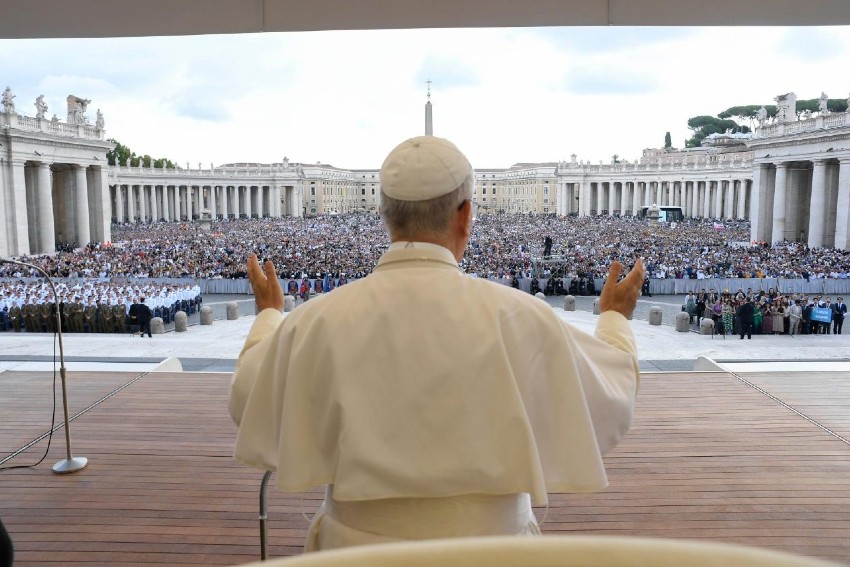
Pope Leo XIV presides over his weekly general audience in St. Peter’s Square at the Vatican on Sept. 24, 2025. | Credit: Vatican Media
Letter #69, 2025, Friday, October 10: Pope Leo XIV
Pope Leo has issued his first major writing, an Apostolic Exhortation entitled Dilexi te (“I have loved you,” link).
It was published yesterday, October 9, but dated October 4, the Feast of St. Francis of Assisi, a few days ago.
In so doing, Leo has taken a decisive step in clarifying his vision for his pontificate — and this has sparked both praise and criticism.
So, this letter will attempt to assess Leo’s vision, and the contrasting reactions to it.
***
Yesterday, October 9, Leo published his 1st Apostolic Exhortation, Dilexi te (“I have loved you”), on love for the poor.
The text is actually dated October 4, the Feast of St. Francis of Assisi.
The first words, Dilexi te (“I have loved you”) are the words of Jesus Christ to the Church in Philadelphia in Asia Minor, in Chapter 3 of the Book of Revelation, verse 9 — the very last book of the Bible… the Book of the Apocalypse…
(In the original Latin Vulgate:
“Verse 9: ecce dabo de synagoga Satanae qui dicunt se Iudaeos esse et non sunt sed mentiuntur ecce faciam illos ut veniant et adorent ante pedes tuos et scient quia ego dilexi te [Note: these two words became the title of this papal letter]
Verse 10: quoniam servasti verbum patientiae meae et ego te servabo ab hora temptationis quae ventura est in orbem universum temptare habitantes in terra”
In the English Standard Version:
9 Behold, I will make those of the synagogue of Satan who say that they are Jews and are not, but lie—behold, I will make them come and bow down before your feet, and they will learn that I have loved you.
10 Because you have kept my word about patient endurance, I will keep you from the hour of trial that is coming on the whole world, to try those who dwell on the earth.)
***
This is the first major document of Leo’s pontificate.
And many are saying that it makes very clear, now, who Leo is, and where he intends to lead the Church.
Here is a link to the entire text.
***
First words
This is how the Apostolic Exhortation begins, with the words, first, of Jesus, and then, second, of the Virgin Mary, his mother, in her Magnificat, her spontaneous prayer when she learned she would be the mother of the Savior:
1. “I HAVE LOVED YOU” (Rev 3:9). The Lord speaks these words to a Christian community that, unlike some others, had no influence or resources, and was treated instead with violence and contempt: “You have but little power… I will make them come and bow down before your feet” (Rev 3:8-9). This text reminds us of the words of the canticle of Mary: “He has cast down the mighty from their thrones, and lifted up the lowly; he has filled the hungry with good things, and sent the rich away empty” (Lk 1:52-53).
***
(Note: Also in recent weeks, a key figure in the American high-tech world, with connections to the US government, spoke in reference to the Apocalypse, especially in reference to the figure of the Antichrist. See this link)
(Note: But one of the most perceptive analyses of the Pope’s text is by Gavin Ashenden of Great Britain, a convert from the Anglican Church, who for a time was the chaplain of the Queen of England, Elizabeth, who wrote today on his substack (link):
Leo Laid Bare: Progressive Head and Catholic Heart
Discovering the complexities of compartmentalisation.
By Gavin Ashenden
October 10, 2025
So, now, after Dilexit Te, we know.
Two steps to the left when it comes to firstly, immigration- and secondly, politics and economics; and one to the right – sex and morals; and a sort of probable semi-benign neutral hovering on the Latin Mass so far.
People are often compartmentalised of course. It’s sometimes described as ‘bi-lateral identity’, but in the case of a pope politics and faith may be a matter of the head and the heart.
Last week I found myself invited to a small dinner party with Bishop Schneider. Just he and I and two others. He is a deeply serious, holy and astute man. We sat opposite other talking generally. Some of the conversation was about his extraordinary upbringing in Kazakhstan.
People sometimes think it’s a little odd to have a German bishop from Kazakhstan. But the background to it was that Catherine the Great invited German settlers into Russia in the late 18th century to farm the Volga steppe. They were promised land, local autonomy and freedom from military service. Over the next century, tens of thousands established prosperous colonies there. World War one caused a problem, but the real disaster came under Stalin. He accused the entire Volga German population of collaboration and forcibly relocated them to Kazakhstan and Siberia by train, where they lived in internal exile. So bishop Schneider grew up in the Soviet Union dictatorship in the German speaking ‘catacomb church.’
I grew up in Britain but reading Solzhenitsyn, which when I became a practicing Christian as a student, lead to me becoming a smuggler of Bibles into Moscow and Thomas Aquinas into Prague for the Catholic underground seminaries there in the 1980’s. There is a lot that Bishop Schneider and I agree upon when it comes to Marxist totalitarianism and economics.
As we talked, a couple of time he lifted his head and said slightly sorrowfully “Ach Gavin, you are wrong.” Until we got to talking about Pope Leo, and I got an “Ach Gavin you are right.”
Well, perhaps.
After the appalling car-crash with reporters where he defended Cupich’s award to Durkin the Democrat senator, and made that highly offensive equivalence between immigration and abortion, it was becoming clear that Pope Leo had leftish political instincts.
But, unlike Pope Francis, he seemed willing to own the traditional clothes of the papacy and was relaxed with Latin in the liturgy.
I wondered if what we had was a pope with a politically progressive head and a Catholic heart? (“Ach, Gavin you are right.”)
How much of a Catholic heart we still have to discover. Things do emerge in casual conversations however, and one of the other very well-informed people at the table relayed a conversation they had been present at where Pope Leo expressed caution about the Latin Mass diehards, “because they were determined to resist and revoke Vatican Two.”
“Not at all” was the response. “They are not Traddy Catholic fifth columnists.” They simply love the Mass of the Ages and wonder if a ‘spirit of the council’ hasn’t emerged which in itself in less than faithful to the Council fathers. “Cardinal Prevost” as he then was seemed astonished at this. It was new information to him.
Can this be possible, that a bishop and a cardinal can so live in a bubble that second hand gossip forms a settled view about another part of the Church, a different spirituality where motives are misattributed and a whole section of the Church effectively demonised?
Probably yes.
There is some hope then that the vicious campaign in places like the Diocese of Charlotte and elsewhere against the Latin Mass may be rethought at the centre. But in the meanwhile, Pope Leo seems to be solid on sexual ethics.
If that is the case, then ‘Catholic teaching’ on sex and the family will be safe under him, but we will get a lot more of what sounds like liberation theology when he talks economics and politics.
For someone like me, who watched the Catholic Left fall prey to the seduction of Liberation Theology in the 1980’s which turned Jesus the Saviour of souls into a figure more like Che Guevara, liberator from Capitalism, Leo’s celebration on behalf of Francis’ involvement of the “Conference of Aparecida”, in 2007 which we were offered in ‘Dilexit T’e, is depressing.
“Not this again.”
Especially Pope Benedict the 16th so nailed the relationship between the practice of economics and personal virtue.
“The economy needs ethics in order to function correctly — not any ethics whatsoever, but an ethics which is people-centred.”
That means laws or regulations can’t replace personal virtue. Justice in trade or labour only holds when the people involved are animated by something deeper than profit—the caritas that joins truth and love.
It seems a tragically retrograde step to immerse the Catholic Church in the social revolution of the Left incubated in the heat of South American revolutionary fervour.
Wherever the economics of socialism has been practiced in my life time it has failed. The closer it gets to Marxism, the more dramatically it fails. Capitalism as a system has no visionary moral virtue in itslef but encourages personal responsibility.
Jordan Peterson became a voice that people could hear, at least on the statistics. He was rather good at applying statistics, a skill he learnt when he was developing his skills as an experimental psychologist.
He often cites World Bank and UN data to back this up:
Around 1970, roughly 30–35% of the world lived in extreme poverty.
By the 2010s, that figure had dropped below 10%—a decline affecting billions.
He attributes that mainly to global trade, private enterprise, and liberal democracy, not to top-down planning or redistributive policies.
Peterson tends to frame it morally or ethically as well as economically. He says capitalism rewards competence, responsibility, and voluntary cooperation, which he contrasts with the coercion and moral corruption of collectivist systems.
He claimed in 12 Rules for Life
“There’s been a 90% reduction in absolute poverty in the world in the last 40 years, and that’s the fastest period of economic improvement in human history. And it’s precisely because of capitalism.”
I prefer Pope Benedict and Jordan Peterson as commentators on the relationship between politics, economics and the ethical transformation of the individual.
If, as seems likely, Pope Leo takes us back into a South American political and economic collectivism, he will have a diminished authority for things that it really matters for a pope to speak to the world about, the transformation of the human heart in the hands of the Holy Spirit, and the gift of salvation of the soul through Jesus alone who will carry us to heaven.
If I’m right about him having a Catholics heart and a progressive political head, let’s hope we hear our pope speaking more to the Church and the world from his heart.
(link)
[End of analysis by Gavin Ashenden]
***
In issuing this text as his 1st magisterial teaching, Leo has revealed his vision for his pontificate: a vision, he says, which seeks to enter into the very heart of God, “who is always concerned for the needs of his children, especially those in greatest need” — those in poverty, misery, and oppression.
Thus, Leo as Pope is and will be concerned for the poor of our world.
He writes: “On the wounded faces of the poor, we see the suffering of the innocent and, therefore, the suffering of Christ himself.”
Then, Leo notes that some sharply criticize this vision.
He writes:
“The fact that some dismiss or ridicule charitable works, as if they were an obsession on the part of a few and not the burning heart of the Church’s mission, convinces me of the need to go back and re-read the Gospel, lest we risk replacing it with the wisdom of this world.”
These are sharp words.
Demanding words.
He adds:
“The poor cannot be neglected if we are to remain within the great current of the Church’s life that has its source in the Gospel and bears fruit in every time and place.”
So here we are…
Pope Leo is issuing his call.
Five months and 2 days into his papacy (May 8 to October 10), Leo has set his course… to embrace and announce the “burning heart of the Church’s mission” — to care for the needs of all God’s children, but especially those children in poverty, misery, despair, and hopelessness — to give hope especially to the hopeless.
How many Catholics will follow Leo in this vision? And how fervently will they follow, in the present political and social circumstances of our world?
This is what many are now wondering in Rome… —RM
The heart of the Pope’s new text: Paragraph 8
Par. 8. The cry of the poor
“The passage of Sacred Scripture in which God reveals himself to Moses in the burning bush can serve as a constant starting-point for this effort.
“There he says: ‘I have observed the misery of my people who are in Egypt; I have heard their cry on account of their taskmasters. Indeed, I know their sufferings, and I have come down to deliver them… So come, I will send you’ ( Ex 3:7-8,10).
God thus shows his concern for the needs of the poor: ‘When the Israelites cried out to the Lord, he raised up for them a deliverer’ ( Judg 3:15).
“In hearing the cry of the poor, we are asked to enter into the heart of God, who is always concerned for the needs of his children, especially those in greatest need.
“If we remain unresponsive to that cry, the poor might well cry out to the Lord against us, and we would incur guilt (cf. Deut 15:9) and turn away from the very heart of God.”
—Dilexi te, the new Apostolic Exhortation of Pope Leo XIV, the first magisterial teaching of his pontificate, Paragraph 8
To clarify a papacy’s direction
In recent weeks, Leo has spoken out more than in his first weeks as Pope, sometimes raising eyebrows, and sparking sharp criticism:
1) in the summer, he granted his first lengthy interview to a Vatican press corps journalist (Elise Allen of Crux, wife of John Allen, founder of Crux; scroll down to the bottom to see all of the links to the various parts of the multi-hour interview). In these hours of interviews, Pope Leo set forth his position on many contentious issues, sometimes taking more conservative or “traditional” positions, other times in a seemingly more “progressive” way, leaving many observers uncertain about where Leoreally would take his stand (I will try to work through these positions in upcoming letters)
2) more recently, Leo spoke out on the decision of Chicago Cardinal-Archbishop Blase Cupich‘s controversial decision to honor Senator Richard Durbin, D.-Illinois, with a “lifetime service” award, a decision condemned by 10 US bishops (link) [Note: Senator Durbin decided to withdraw himself from consideration for the award.]
Here is a portion of a September 30 account of this controversy by Catholic News Agency writers Valentina Di Donato and Madalaine Elhabbal:
“Several U.S. bishops condemned Chicago Cardinal Blase Cupich’s plans to honor U.S. Sen. Richard Durbin, D-Illinois, with a ‘lifetime achievement award’ for his work surrounding immigration policy despite his pro-abortion voting record.
“‘I am not terribly familiar with the particular case. I think it’s important to look at the overall work that a senator has done during, if I’m not mistaken, in 40 years of service in the United States Senate,'” the pope told reporters on Tuesday in response to a question from EWTN News.
“He said: ‘I understand the difficulty and the tensions. But I think as I myself have spoken in the past, it’s important to look at many issues that are related to the teachings of the Church.’
“‘Someone who says I’m against abortion but is in favor of the death penalty is not really pro-life,’ the pope explained. ‘Someone who says I’m against abortion but I’m in agreement with the inhuman treatment of immigrants in the United States, I don’t know if that’s pro life.’
“‘So they are very complex issues and I don’t know if anyone has all the truth on them,’ he continued, ‘but I would ask first and foremost that they would have respect for one another and that we search together both as human beings and in that case as American citizens and citizens of the state of Illinois, as well as Catholics, to say that we need to be close to all of these ethical issues. And to find the way forward as a Church. The Church teaching on each one of those issues is very clear.'”
3) and still more recently, just two days ago, Leo spoke out on the immigration policies of U.S. President Donald Trump.
Here is a Daily Beast report on the matter, citing a Reuters report (link):
“Pope Leo has escalated his growing feud with the Trump administration, instructing U.S. bishops to take a stronger public stand against the president’s hardline immigration policies, according to Reuters.
“Meeting a delegation of bishops and social workers from the U.S.-Mexico border at the Vatican on Wednesday, the first American-born pope urged them to ‘speak strongly’ on behalf of migrants and refugees affected by Trump’s deportation drive.
“El Paso Bishop Mark Seitz, who attended the meeting, said Leo, who was born and raised in Chicago, was visibly moved after being handed dozens of letters from immigrants describing their fears of arrest and separation under the administration’s enforcement policies.
“‘Our Holy Father is very personally concerned about these matters,’ Seitz told Reuters. ‘He expressed his desire that the U.S. Bishops’ Conference would speak strongly on this issue.'”
(…)
“Leo’s latest move underscores a shift in tone from his early papacy. Initially viewed as more restrained than Francis, Leo has increasingly positioned himself as a moral counterweight to Trump’s hardline policies.
“One of the letters given to Leo on Wednesday, shared with Reuters, came from a family living in fear of deportation. “I believe the Pope should speak out openly against the raids and the unfair treatment the community is experiencing,” the note, written in Spanish, read.
***
A Pope at the crossroads
So, some watching Leo, both inside and outside of the Church, are applauding him… and some, both inside and outside of the Church, are criticizing, even condemning him.
Many are now saying that they finally have the measure of the man, this new Pope, Leo XIV, elected on May 8, just 5 months and 2 days ago.
So I write letter as a sort of preliminary vademecum — the word means“go with me” — and may perhaps be helpful as a type of “handbook” or “guidebook” to this mopment in the pontificate (consider, for example, thisVADEMECUM FOR CONFESSORS CONCERNING SOME ASPECTS OF THE MORALITY OF CONJUGAL LIFE, put out in 1997 by the Pontifical Council for the Family (link).
As for me, if you would possibly like to do something to help me to continue to write this letter, then please consider:
1) finding a friend or colleague who would like to receive this free letter, and add their name to my email list, at this link; it would be a great help to me if every reader would find one additional reader, to join the community that receives this letter; or
2) considering subscribing to my print magazine Inside the Vatican, founded in 1993, at a special rate of just $20 per year, including unlimited gift subscriptions, also at $20 per year; everyone knows the print media faces challenges — for example, Our Sunday Visitor just announced they will cease print publication of their magazine, which once had 1 million subscribers, before the end of the year; yet, we are still publishing our print magazine, and receiving many thanks from our readers, for the magazine’s beauty and quality and balance; this is to say, yes, we could very much benefit from more subscribers, and are asking only $20 per subscription, the cost of just a couple of coffees and cinnamon cakes at Starbucks; you may susbcribe for 1 year for $20 at this link. That would help me greatly.
—RM