Letter #74, 2025, Mon, November 17: Barron and Mueller
The British Catholic convert Gavin Ashenden has just published on his Substack (link) and very interesting and important discussion between American Catholic Bishop Barron and German Cardinal Gerhard Mueller: “Nietzsche, Vatican II, and the Catholic Church as the Antidote to Despair.
Readers should consider subscribing to Aschenden’s Substack, here.
Here is the first part of the text of Ashenden’s piece. Readers should consider subscribing to his Substack.
—RM
Barron and Müller — Nietzsche, Vatican II, and the Catholic Church as the Antidote to Despair.
We have been given one of the most prescient theological conversations for decades- and a cogent reaffirmation of however you phrase the question ‘Jesus & His Catholic Church are the answer.’
Nov 17, 2025
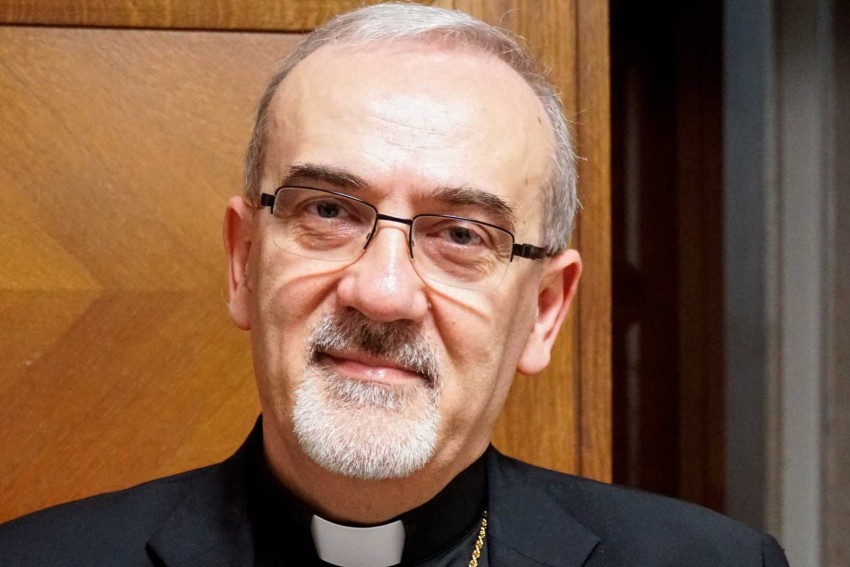
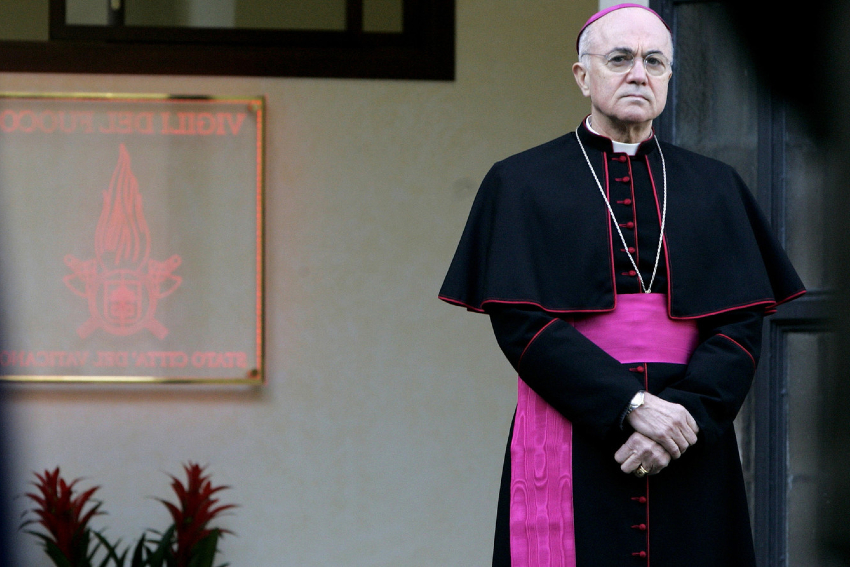
When Bishop Robert Baron and Cardinal Müller sat down to talk for over an hour together a few days ago, it was always going to be a matter of intellectual interest.
There is always a danger that when clever people start talking that they are tempted to want to show off and dazzle their audience with their learning, but this was one of those very rare meetings where both men had the rare capacity of gearing their learning to the need of the moment, and allowing it to come out as wisdom, offering an antidote to the existential crisis faced by Church and culture.
Their conversation produced some scintillating quotations which summed up the condition of the Church and society today and have given the rest of us a great deal to work with.
One of the temptations faced with conversations of that depth is to make a precis of the whole span of it. The real challenge for commentators is to bring the most important moments and perceptions into focus, and highlight them.
The conversation (it seemed to me) almost unexpectedly took off when Bishop Barron asked what appeared to be a casual question of not great immediate importance. I wondered if he entirely expected the extraordinary perspicacity with which Müller responded and which set the tone for everything that followed.
He asked casually: “Why do you think American teenagers are interested in Nietzsche?”
And Müller’s response was to give a laser-focused deconstruction, in the popular not the academic sense, of the way in which Nietzsche represented one of the main threats to the Christian faith. But he introduced Nietzsche with a brief analysis of delusion.
Delusion
We are all familiar with delusion! We all suffer from our own delusions, some of them may emerge from the pressure of unmastered appetite and others brought on by the fog of spiritual warfare. But in this case Müller synthesised the cultural delusions by choosing three particular fathers of delusion which set the scene for the damage Nietzsche was to do.
They were Copernicus, Freud and Darwin.
I was taken aback when I heard him start with Copernicus because I wondered how on earth he was going to use the shift in astronomical perspective to offer us a lesson on spiritual delusion. But soon it became clear, and I had never heard the link made quite so potently and dramatically before.
Müller’s point was that moving us scientifically from Ptolemy to Copernicus had a powerful effect on our sense of spiritual and philosophical perception.
The implications of moving from a Ptolemaic perspective — where we were at the centre of the universe and the focus of God’s attention — to the Copernican universe where we were an outlying planet attached to an outlying star nowhere near the centre of the universe, had a powerful effect on the mind of humanity. It interpreted our geographical coordinates in the universe as an existential threat: instead of being the centre of God’s attention we moved to a place where we just didn’t matter.
And it was this state of feeling — that we just didn’t matter — which underlay the whole arc of Cardinal Müller’s brilliant exegesis that followed.
Freud
He followed it up with an attack on Freud and condensed Freud’s influence into the suggestion that, in part because of his emphasis on the power of the unconscious, we were not masters of our feelings but instead victims. So now we are victims who cosmologically don’t matter.
Darwin
And then he added Darwin and suggested that the consequence of Darwinian biology was that we really were just evolved animals, and this gave us a triple whammy: animals subject to our feelings, and victims who lived in a place where God could not see us and was not interested in us — and so the seeds of existential despair were sown.
Before discussing Nietzsche, he offered us a brief synopsis of the gospel, and one of the great surprises of this conversation was to find a theologian of such stature, a philosopher of such depth and an ecclesiastical person of such distinction, capable of giving us the gospel summarised in a paragraph in a way that healed both mind and heart. That doesn’t happen very often.
He said:
“We must counter this Nietzscheanism with a discovery that it is a joy to exist — a great luck, a good luck. Nothing is better than your existence. You have eternal meaning. You come out of nothing by the goodwill of God. All education ought to be directed at the experience of discovering you are accepted absolutely, because you are accepted by God; you are a creature of God; and the same God is saving you by the blood of his Son who took your flesh.”
Having given us the good news that every human being belongs, he began to offer a deeper commentary on the state we were in, which began with the warning that original sin had wounded us but not destroyed us — and that the knowledge of God as Love, in the realisation of Christ, would carry us into that final healing we call salvation.
The Church Has an Answer to Our Despair
One of the leitmotifs in my own writing has been trying to explain that my becoming a Catholic was in part inspired by the discovery and conviction that only the Catholic Church has the capacity to offer a repudiation — and an antidote — to the decay and delusion of our culture.
Barron raised this whole exciting and, to my mind, under-developed dramatic perspective when he asked of Müller:
“Do you agree the Church is the most important voice battling the nihilism in our culture?”
Müller’s reply was devastating:
“The Church is a great counter-voice and therefore must not retreat into our privacy. We are so attacked because we are presenting the truth about Jesus Christ — and we are destroying their model for making money.”
For me this was one of those extraordinary penny-drop moments — or as the philosophers put it more pithily, a moment of disclosure — because Müller went on:
“They are making money from their delusions, by saying: you are nothing, and you have to accept our medicine and our drugs. Modern ideologies are only drugs to help you overcome this feeling that you are nothing.”
This is one of the most powerful takedowns of our culture that I’ve heard for a long time. We are only slowly becoming aware that we live within a post-capitalistic machine that is subjecting all value to the pursuit of profit, and whether it is the apocalyptic delusions of climate disaster, pornography, the pharmaceutical industry, or the psycho-dominance of advertising, we have found ourselves to be cogs in a money-making machine predicated on fostering our delusions and creating money for others.
But Müller went on again to offer the antidote in a few simple illuminated words:
“But if you are listening (to the Catholic Church), you don’t need all these drugs; you don’t need sex in the wrong sense; you are a partner of the Word of God. You are a son or a daughter of God.”
“Those who listen to the voice of God need no substitutes: they possess a dignity that no ideology can give them.”
Delightedly, Barron picked up the baton and — accompanied by Augustine — ran with it by amplifying this as he said:
“People make the mistake of taking the creature for the Creator, and they lose their way trying to fill themselves with stuff to satisfy their appetite for God.”
In a few words, Barron and Müller had exposed the vacuity of the deus-ex-machina strategy our culture has pursued in order to drive a wedge between us and the reality of God — and quite rightly identified the Catholic Church as what seems to be the last man standing capable of countering these delusions and replacing them with the truth about our God-given instincts, the love and forgiveness of God, and his invitation to make our journey and pilgrimage closer to him step by step.
Nietzsche: Prophet and Victim & Master of Suspicion.
Müller described Nietzsche pithily as the “Master of suspicion.”
They went on to discuss some of the implications of Nietzsche’s influence. For those who don’t know what Nietzsche wrote, or have trouble remembering, or have never read him, Barron and Müller offered a brief but powerful synthesis.
They reminded us that everyone knows the phrase “God is dead,” but they don’t really understand how disaster follows from Nietzsche’s original premise. Nietzsche was both a prophet and a victim: he perceived the nihilism and wanted to escape from it with his “eternal return” theory — but as Müller said, he failed and simply produced more nihilism.
(Nietzsche’s eternal return (or eternal recurrence) is the idea that every moment of your life will recur again and again, endlessly, in exactly the same sequence, for all eternity. He essentially asks: If we had to live this life again, exactly as it is, eternally — would we affirm it joyfully? Or would the thought crush one? If the idea exalts us, we’re living authentically — with amor fati, a love of fate.
If it terrifies us, something in our life (or values) needs reordering. It is not therefore about physics, but about courage. It’s Nietzsche’s way of asking whether we are living a life we could wholeheartedly live forever?)
However,-
“Nietzsche did not celebrate the death of God — he announced it as a catastrophe for Western civilisation. When the Christian God dies, the whole architecture of objective truth and objective morality collapses. What fills the vacuum? The Will to Power. And we see this today: truth becomes whatever the stronger party can impose.”
And then came one of the most powerful lines in the whole conversation, which becomes a devastating critique of the corrosion of theology tempted by Nietzscheanism within the Church:
“Many people today — even inside the Church — live as functional Nietzscheans without knowing it. When doctrine or moral teaching is treated as an obstacle to ‘pastoral accompaniment’ or to ‘inclusion,’ and we are told we must simply override it because ‘the Spirit is doing a new thing,’ that is the Will to Power dressed in theological language.”
(for the end of this piece, go here)