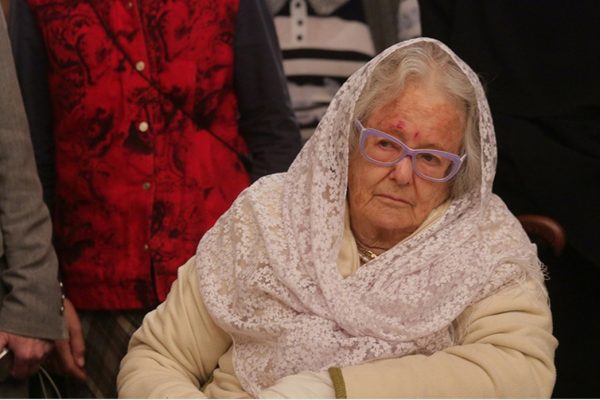
Marquise Immacolata Solaro del Borgo has passed away.
Immacolata, an Italian from an ancient noble Italian family, labored for 50 years to improve relations between the Orthodox and Catholic Churches, and between Russia and the West. She died yesterday in Rome at the age of 95, surrounded by members of her family

In this photo from June 2012, when Immacolata was 82, she was part of a Knights of Malta delegation to Russia. The delegation met with Russian Orthodox Church leaders, including Patriarch Kirill. Immacolata is the only woman in the photo. She is dressed in black, and stands just to the right of the Knights of Malta Grand Master, Fra Matthew Festing (link)
Letter #75, 2025, Tuesday, November 18: Immacolata
Marquise Immacolata Solaro del Borgo, an Italian noblewoman who tried for half a century to build enduring bridges of understanding between Russia and the West, has passed away in Rome at the age of 95, surrounded by family members.
***
Mission to Kazan (May 2007)
I had the privilege of traveling with Immacolata for a week in May 2007.
We went together to Kazan, the capital of Tatarstan, in Russia, 600 miles to the east of Moscow.
Immacolata, then 76, brought Christian relics with her to give as gifts to representatives of the Russian Orthodox Church — signs of her deep respect and love for the Russian people.
Due to a skin condition, her feet sometimes caused her great pain, and, on the occasion of handing over the gifts, she went without shoes.
As she approached the Orthodox bishop of Kazan, Anastasi, to hand over to him relics from her family’s personal archives of ancient Christian saints, he greeted her warmly and received the relics with friendship.
Throughout Russia, the Russian people watched the TV broadcast of the elderly Italian noblewoman, walking without shoes, bringing signs of Christian friendship to the Russian people and land.
“For historical reasons, due to the early rapid technological development of the more western countries, the Russians have developed a kind of complex of cultural inferiority,” Immacolata told me. “Therefore, never speak or act in any way that might contribute to this complex. Always treat the Russians with respect — the same respect due to all people.”
Such is my memory of Immacolata — a messenger of peace and friendship in a world of war and conflict.
May her soul rest in peace, and may eternal light shine upon her.
—RM
***
Here is a report on her 2012 trip to Russia:
Patriarch Kirill encounters the Grand Master of the Order of Malta
July 6, 2012
By the Russian Orthodox Church, Department of External Relations
On the 6th day of July, 2012, the Patriarch of Moscow and the Russian Federation, Kirill, received at his official residence in the Monastery of St. Daniel of Moscow, the Prince and Grand Master of the Sovereign Military Order of Malta, Matthew Festing.
Fra Matthew Festing was in Moscow to participate in the opening of the exhibition “The Treasures of Malta” on 5 July at the Kremlin.
During the meeting, the themes of humanitarian and cultural cooperation were discussed, as well as the problem of discrimination against Christians. (link)
***
And here is a report on her 2007 trip to Kazan (link):
Immacolata Solaro Del Borgo: Non-stop Service to the Church
By Serena Sartini
January 21, 2008
“I’m a ‘granny.’ I have 11 grandchildren, and my family, made up of my nephews and nieces and their children, in addition to my husband and myself and our children, constitutes for me a fixed and important point in my life. So this naturally limits the time that I can devote to my other great interest, ecumenism, and the improvement of relations between separated Christians. But I consider it my duty to place myself at the service of the Church and thus of Christianity.”
These few words give an insight into the character of another one of Inside the Vatican‘s choices for “Person of the Year,” the Italian noblewoman, the Marquise Immacolata Solaro del Borgo, 77, a member of Rome’s historically powerful Colonna family.
Immacolata’s ancestors include princes and Popes, and she is among our “Top Ten” because of her commitment to building better relations between the Catholic and Orthodox Churches, divided since 1054 — now nearly 1,000 years.
She is firmly convinced that “in a time of ferocious de-Christianization, Catholics, Orthodox and Protestants ought to unite against the atheistic thought which has been increasingly bold and now seems in many places to dominate our culture.”
Immacolata learned Russian in mid-life, during tourist visits to Russia before the Berlin Wall came down. She learned the language easily, “almost without noticing it,” she says.
This energetic and decisive grandmother, after the nuclear disaster in Chernobyl in Ukraine in 1986, dedicated herself to raising money for the children in Chernobyl.
After making many trips to Russia, she has been able to build up a remarkable network of friendships and contacts in that country, especially among the leadership of the Russian Orthodox Church. She counts as personal friends many of the leading members of the Russian Orthodox hierarchy, including Metropolitan Kirill and Metropolitan Sergei.
On May 13, 2007, though nearly 80 and suffering from soreness in her feet, she traveled to Kazan, capital of Tatarstan, bringing with her six precious relics of saints and a tiny fragment of clothing which once belonged to Mary, the mother of Jesus. The relics, belonging to St. Basil the Great, St. Blaise, St. Nicholas, St. Daria, St. Natalia and St. Pancratius, were collected in a single reliquary, fashioned by a Neapolitan jeweler in the 1600s, with a small silver box in the center where the fragment of Mary’s clothing was preserved.
“I bring these relics as my gift to you, and to the people of Russia, as a sign of my respect and love for Russia and all her people,” Immacolata said to the Russian Orthodox bishop of Kazan, Anastasi, as she handed over the gift. “I hope the relics can enrich the new Marian sanctuary you are building around the icon of Our Lady of Kazan.”
Still today Immacolata recalls that moment with sincere emotion. She handed over the relics in the main Orthodox cathedral of Kazan.
Kazan is where the famous icon of Kazan was first found, the icon which is considered one of the holiest in Russia, and which left the country after the Bolshevik Revolution in 1918, but was protected and venerated for many years by Pope John Paul II in his private apartment in the Vatican (from 1993 until 2004) before it was returned to Russia on August 28, 2004.
The ceremony of the handing over of the relics was attended by thousands of Orthodox believers and was broadcast throughout Russia by Russian national television. Immacolata even received an email from a friend in Moscow who said he had seen her on television, walking without shoes. He said all Russia marveled at the humility and simplicity of this Italian lady.
On that occasion, among the many Russian journalists present, there was also a foreign correspondent, Robert Moynihan, the editor-in-chief of Inside the Vatican. After the ceremony of the donation of the relics, he spoke briefly with Bishop Anastasi, who said the people of Kazan would never forget the gift brought by Immacolata, and the fact that at the age of almost 80, she had traveled from Rome to Kazan to bring the extraordinary gifts personally.
On earlier occasions, Immacolata had given a relic of St. Nicholas to Alexy II, Patriarch of Moscow and of All Russia, and a relic of St. George to the Orthodox monastery of Nikolo-Ugreshsky, near Moscow.
In fact, whether in Rome or in Moscow, whenever there is an ecumenical occasion involving the Russian Orthodox, the Marquise Immacolata generally finds a way to be present in a discreet and humble way. And this past spring, she was present at the concert sponsored by Inside the Vatican just before Easter, on March 29, 2007, in the Auditorium of St. Cecilia on Via della Conciliazione, a few steps from the Vatican.
At the end of the concert, an event which marked a moment of closeness between Catholics and Orthodox, especially because Easter this past year was celebrated on the same Sunday in both Churches, who offered a just homage to the composer of The Passion According to St. Matthew? The Marquise Immacolata, carrying a bouquet of flowers up the steps and onto the stage.
A year ago, Immacolata became the highest-ranking woman in the Knights of Malta in Italy.
She now holds a diplomatic passport for the sovereign military order, and continues to work in Russia to fight the tragedy of alcoholism.
“I believe each one of us has a task to perform,” she says. “I believe that the Lord never asks us to do anything that is impossible. It is up to us to listen for his call and to accept it when we hear it, and act.”
[End, report on Immacolata’s trip to Kazan, Russia, in 2007]
A Full Text of the Gavin Ashenden Summary of the Bishop Barron-Cardinal Mueller Discussion (only half was published here yesterday)
Yesterday I sent out a letter containing a summary by the British Catholic convert Gavin Ashenden published on his Substack site (link) of a very interesting and important discussion between American Catholic Bishop Robert Barron and German Cardinal Gerhard Mueller: “Nietzsche, Vatican II, and the Catholic Church as the Antidote to Despair.
I noted that readers should consider subscribing to Ashenden’s Substack, here.
But some readers were sad that I sent out only the first part of the text of Ashenden’s piece, and asked me to send it out again, with the entire text.
So here it is, complete.
—RM
Barron and Müller — Nietzsche, Vatican II, and the Catholic Church as the Antidote to Despair. (link)
We have been given one of the most prescient theological conversations for decades- and a cogent reaffirmation of however you phrase the question ‘Jesus & His Catholic Church are the answer.’
Nov 17, 2025
When Bishop Robert Baron and Cardinal Müller sat down to talk for over an hour together a few days ago, it was always going to be a matter of intellectual interest.
There is always a danger that when clever people start talking that they are tempted to want to show off and dazzle their audience with their learning, but this was one of those very rare meetings where both men had the rare capacity of gearing their learning to the need of the moment, and allowing it to come out as wisdom, offering an antidote to the existential crisis faced by Church and culture.
Their conversation produced some scintillating quotations which summed up the condition of the Church and society today and have given the rest of us a great deal to work with.
One of the temptations faced with conversations of that depth is to make a precis of the whole span of it. The real challenge for commentators is to bring the most important moments and perceptions into focus, and highlight them.
The conversation (it seemed to me) almost unexpectedly took off when Bishop Barron asked what appeared to be a casual question of not great immediate importance. I wondered if he entirely expected the extraordinary perspicacity with which Müller responded and which set the tone for everything that followed.
He asked casually: “Why do you think American teenagers are interested in Nietzsche?”
And Müller’s response was to give a laser-focused deconstruction, in the popular not the academic sense, of the way in which Nietzsche represented one of the main threats to the Christian faith. But he introduced Nietzsche with a brief analysis of delusion.
Delusion
We are all familiar with delusion! We all suffer from our own delusions, some of them may emerge from the pressure of unmastered appetite and others brought on by the fog of spiritual warfare. But in this case Müller synthesised the cultural delusions by choosing three particular fathers of delusion which set the scene for the damage Nietzsche was to do.
They were Copernicus, Freud and Darwin.
I was taken aback when I heard him start with Copernicus because I wondered how on earth he was going to use the shift in astronomical perspective to offer us a lesson on spiritual delusion. But soon it became clear, and I had never heard the link made quite so potently and dramatically before.
Müller’s point was that moving us scientifically from Ptolemy to Copernicus had a powerful effect on our sense of spiritual and philosophical perception.
The implications of moving from a Ptolemaic perspective — where we were at the centre of the universe and the focus of God’s attention — to the Copernican universe where we were an outlying planet attached to an outlying star nowhere near the centre of the universe, had a powerful effect on the mind of humanity. It interpreted our geographical coordinates in the universe as an existential threat: instead of being the centre of God’s attention we moved to a place where we just didn’t matter.
And it was this state of feeling — that we just didn’t matter — which underlay the whole arc of Cardinal Müller’s brilliant exegesis that followed.
Freud
He followed it up with an attack on Freud and condensed Freud’s influence into the suggestion that, in part because of his emphasis on the power of the unconscious, we were not masters of our feelings but instead victims. So now we are victims who cosmologically don’t matter.
Darwin
And then he added Darwin and suggested that the consequence of Darwinian biology was that we really were just evolved animals, and this gave us a triple whammy: animals subject to our feelings, and victims who lived in a place where God could not see us and was not interested in us — and so the seeds of existential despair were sown.
Before discussing Nietzsche, he offered us a brief synopsis of the gospel, and one of the great surprises of this conversation was to find a theologian of such stature, a philosopher of such depth and an ecclesiastical person of such distinction, capable of giving us the gospel summarised in a paragraph in a way that healed both mind and heart. That doesn’t happen very often.
He said:
“We must counter this Nietzscheanism with a discovery that it is a joy to exist — a great luck, a good luck. Nothing is better than your existence. You have eternal meaning. You come out of nothing by the goodwill of God. All education ought to be directed at the experience of discovering you are accepted absolutely, because you are accepted by God; you are a creature of God; and the same God is saving you by the blood of his Son who took your flesh.”
Having given us the good news that every human being belongs, he began to offer a deeper commentary on the state we were in, which began with the warning that original sin had wounded us but not destroyed us — and that the knowledge of God as Love, in the realisation of Christ, would carry us into that final healing we call salvation.
The Church Has an Answer to Our Despair
One of the leitmotifs in my own writing has been trying to explain that my becoming a Catholic was in part inspired by the discovery and conviction that only the Catholic Church has the capacity to offer a repudiation — and an antidote — to the decay and delusion of our culture.
Barron raised this whole exciting and, to my mind, under-developed dramatic perspective when he asked of Müller:
“Do you agree the Church is the most important voice battling the nihilism in our culture?”
Müller’s reply was devastating:
“The Church is a great counter-voice and therefore must not retreat into our privacy. We are so attacked because we are presenting the truth about Jesus Christ — and we are destroying their model for making money.”
For me this was one of those extraordinary penny-drop moments — or as the philosophers put it more pithily, a moment of disclosure — because Müller went on:
“They are making money from their delusions, by saying: you are nothing, and you have to accept our medicine and our drugs. Modern ideologies are only drugs to help you overcome this feeling that you are nothing.”
This is one of the most powerful takedowns of our culture that I’ve heard for a long time. We are only slowly becoming aware that we live within a post-capitalistic machine that is subjecting all value to the pursuit of profit, and whether it is the apocalyptic delusions of climate disaster, pornography, the pharmaceutical industry, or the psycho-dominance of advertising, we have found ourselves to be cogs in a money-making machine predicated on fostering our delusions and creating money for others.
But Müller went on again to offer the antidote in a few simple illuminated words:
“But if you are listening (to the Catholic Church), you don’t need all these drugs; you don’t need sex in the wrong sense; you are a partner of the Word of God. You are a son or a daughter of God.”
“Those who listen to the voice of God need no substitutes: they possess a dignity that no ideology can give them.”
Delightedly, Barron picked up the baton and — accompanied by Augustine — ran with it by amplifying this as he said:
“People make the mistake of taking the creature for the Creator, and they lose their way trying to fill themselves with stuff to satisfy their appetite for God.”
In a few words, Barron and Müller had exposed the vacuity of the deus-ex-machina strategy our culture has pursued in order to drive a wedge between us and the reality of God — and quite rightly identified the Catholic Church as what seems to be the last man standing capable of countering these delusions and replacing them with the truth about our God-given instincts, the love and forgiveness of God, and his invitation to make our journey and pilgrimage closer to him step by step.
Nietzsche: Prophet and Victim & Master of Suspicion.
Müller described Nietzsche pithily as the “Master of suspicion.”
They went on to discuss some of the implications of Nietzsche’s influence. For those who don’t know what Nietzsche wrote, or have trouble remembering, or have never read him, Barron and Müller offered a brief but powerful synthesis.
They reminded us that everyone knows the phrase “God is dead,” but they don’t really understand how disaster follows from Nietzsche’s original premise. Nietzsche was both a prophet and a victim: he perceived the nihilism and wanted to escape from it with his “eternal return” theory — but as Müller said, he failed and simply produced more nihilism.
(Nietzsche’s eternal return (or eternal recurrence) is the idea that every moment of your life will recur again and again, endlessly, in exactly the same sequence, for all eternity. He essentially asks: If we had to live this life again, exactly as it is, eternally — would we affirm it joyfully? Or would the thought crush one? If the idea exalts us, we’re living authentically — with amor fati, a love of fate.
If it terrifies us, something in our life (or values) needs reordering. It is not therefore about physics, but about courage. It’s Nietzsche’s way of asking whether we are living a life we could wholeheartedly live forever?)
However,-
“Nietzsche did not celebrate the death of God — he announced it as a catastrophe for Western civilisation. When the Christian God dies, the whole architecture of objective truth and objective morality collapses. What fills the vacuum? The Will to Power. And we see this today: truth becomes whatever the stronger party can impose.”
And then came one of the most powerful lines in the whole conversation, which becomes a devastating critique of the corrosion of theology tempted by Nietzscheanism within the Church:
“Many people today — even inside the Church — live as functional Nietzscheans without knowing it. When doctrine or moral teaching is treated as an obstacle to ‘pastoral accompaniment’ or to ‘inclusion,’ and we are told we must simply override it because ‘the Spirit is doing a new thing,’ that is the Will to Power dressed in theological language.”
Barron picked this up immediately and responded:
“So the danger is not just secular culture, but the spirit creeping into ecclesiastical life?”
And Müller, deepening the precision of his analysis, went on:
“Precisely. Nietzsche prophesied the arrival of the letzter Mensch (the Last Man) who blinks and says: ‘We have invented happiness’ — a soft, comfortable, mediocre humanity with no transcendence. And he feared even more the Übermensch, who would create values ex nihilo by sheer force of will. Both dangers are present now: the soft Nietzscheanism of consumerism and the harder Nietzscheanism of ideological imposition.”
Nobody mentioned Pope Francis and the Synodal process as it has been presented to the Church — but as we know, accompaniment has become the code-word by which we identify this new spirit. And without putting it in so many words, Müller was identifying the overriding theological preoccupations of the last 12 years as being a form of papally driven theological Nietzschenism.
Three Symptoms of the Nietzschean Spirit
In case we hadn’t grasped the implications of this new spirit, three areas of life were identified as having been influenced by it:
1. A rejection of an objective moral order
Müller commented:
“Nietzsche said Christianity is a slave morality because it protects the weak. Today when the Church’s sexual ethics or defence of unborn life is dismissed as rigidity, or as not ‘accompanying’ people, we are hearing that Nietzschean accusation afresh again.”
2. Truth reduced to power
Barron quoted Nietzsche’s fragment from The Will to Power:
“There are no truths — only interpretations.”
And then he asked:
“Isn’t this the air we breathe in gender ideology and in so much language that speaks of ‘paradigm shifts’ rather than fidelity to revealed doctrine?”
Müller nodded and added:
“Yes. When a bishops’ conference or theologian says ‘the Church must change a teaching because culture has changed,’ that is Nietzsche’s hammer smashing the old tablets to make room for the new ones.”
3. The death of metaphysics and the rise of pure subjectivity
Barron observed:
“Nietzsche saw that once God is removed as guarantor of being, man becomes the measure of all things — but not in the gentle Protagorean sense, but in the violent, self-creating sense. This is why some modern theology speaks of resurrection as a symbol, or God as a horizon of meaning, rather than the living God who raises Jesus bodily from the dead.”
Müller drew this powerful attack on secular culture and its progressive ecclesiastical echo to a close by saying:
“We do not need to fear Nietzsche the diagnostician — he saw clearly what happens when Christ is pushed out of the culture. What we must fear is Nietzsche the false prophet who offers the Will to Power as a solution.
The only real answer is the one Ratzinger gave at Regensburg and Subiaco: calling us back to the Logos who became flesh — the God who is Love and Reason together. Without that, everything collapses into power-games, even (and sometimes especially) inside the Church.”
Müller, Barron, and the Battle for Vatican II
Both Barron and Müller set out to rehabilitate the Second Vatican Council in the face of two polarised extremes: on the one hand, the proponents of the so-called “spirit of Vatican II” — progressives who wanted to hijack the Council and drive it far beyond what the Fathers intended; and on the other, the radical traditionalists (or “rad-trads”) who insist that Vatican II was aberrational or even harmful to the Catholic magisterium.
This seemed to me to be the part of the conversation that had the least energy and was perhaps the most unsuccessfully scripted
Barron expressed it like this:
“You’ve got the progressives who, well, kind of go beyond the text of Vatican II — let’s reinvent the Church. And then you have the radical traditionalists in our country that are also uneasy with Vatican II.”
Barron then referred to the unifying influence of the late Cardinal Francis George. He appealed to Cardinal George’s insistence that the Council’s texts were both authentic and profound — and observed, with pointed understatement, that many among both progressives and rad-trads “haven’t succeeded in reading the text of Vatican II adequately.”
Müller took this further. He explained that these two poles of critique represent:
“a splitting of the mentality of Occidental society — but this is the ideological splitting; the question in the Church is the truth revealed in Jesus Christ.”
In other words, Müller sees the ecclesial polarisation as mirroring the wider cultural schizophrenia of the West — a fracture that can only be healed by returning to the authenticity and integrity of the Council’s actual documents.
Müller was emphatic that no rupture exists with earlier councils:
“The Council’s doctrine is nothing other than the doctrine of the Church from the beginning. There is no rupture, but rather continuity.”
I found his reading of the Church’s polarised critiques — as symptoms of a deeper cultural split — perceptive and genuinely clever. It gives the contemporary fractures a kind of paradigmatic continuity with the wounds of the broader historical psyche.
But I wasn’t entirely convinced by his defence of the Council.
Although everything he said was true — Vatican II does, after all, explicitly refer to Nicea, Chalcedon, Trent and Lateran IV, and situates itself in that theological continuity articulated through modern language — he didn’t actually engage the traditionalist criticisms.
His defence of the liturgical reform was, frankly, one of the few limp moments in what was otherwise a brilliant tour de force.
And in truth, listeners’ evaluations of that section were always going to be governed by their pre-existing stance on Vatican II.
He did, however, offer something important in interpreting the present papacy. It certainly sounded as though we were being given a glimpse into Pope Leo’s own mind when Müller said that Leo is acutely aware of the “schism in the mind of the Church” — the pull between a mistaken medievalism and false progressivism — and wants to move slowly and cautiously in order to heal what would otherwise harden into ideological party-spirit.
Liberation Theology
The closing reflections on liberation theology carried a particular weight, given that Pope Leo spent so many formative years as a bishop in Peru. Müller’s analysis, therefore, may well echo aspects of Leo’s own thinking.
In favour of the movement, Müller offered the intriguing suggestion that liberation theology might be understood as “a capture of Marxism by Christianity rather than a capture of Christianity by Marxism.”
On this reading, it borrows Marx’s concern for oppression and pours it into Christian categories — though, he cautioned, this always risks a clash of interpretative frameworks. Which one ultimately dominates?
In the end, Müller reverted to the more conventional critique: that a Marxist framework, even when baptised in theological language, tends to reduce salvation to structural change — and in doing so, quietly removes the need for God. Liberation, he warned, ends by swapping surrender for struggle, turning Jesus into a kind of socialist prophet rather than the suffering servant who saves souls.
Conclusion
What emerged from this remarkable dialogue was not simply a commentary on Vatican II, nor even a critique of the polarities that shape the modern Church. It was something more like a map of the Catholic mind at this moment in history. Both Barron and Müller, each in his own voice, were trying to rescue the Church from the false choices imposed by our age, by this post-Christian culture — the illusion that we must be either nostalgic reactionaries or ideological progressives. Their shared insistence was that the Church’s life does not succumb to the contours of non-ecclesial ideology but on the continuity of revelation and the living tradition.
Müller’s diagnosis of the cultural schizophrenia of the West — mirrored in the divisions within the Church — felt particularly compelling. It offered not only an analysis but a kind of pastoral realism: if the Church appears divided, it is because the world to which she ministers is fractured at its root. The task, then, is not to take sides as they are proffered, but to heal the wound.
And perhaps that is where Pope Leo’s intended strategy and significance may reveal itself.
If Müller is right, Leo recognises that the true danger is not this or that faction, but the hardening of ideological identities within the Body of Christ. His instinct is to move cautiously, carefully, abjuring the polarities and without theatrics. This may frustrate some, but it may also be the only way to restore unity without sacrificing truth.
The conversation ended — as so many authentic theological conversations do — with the Cross. The temptation of every age is to turn Christ into a symbol of our politics, our movements, our ambitions; liberation theology errs when it makes Him primarily a social revolutionary, just as neo-medievalism errs when it reduces Him to a mascot for reaction. But the real Christ stands above both: the suffering servant, the Lamb who was slain, the Word who judges all ideologies and redeems all realities.
To follow Him is not to take up a side, so much as to renew our willingness to take up the Cross. The renewal of the Church may depend on our willingness to both see beyond and to slip the grip of the fractures of our age, and recover a commonality of mind that reflects more the mind of Christ than the agendas and coordinates of philosophy and history.
After an informed excursus into European philosophy, Müller returned to the sources, In a moment of sincerity, fidelity and clarity he reiterated;
“No philosopher or politician can save me at the hour of my death. Only Jesus Christ, the Son of God made man, can do so. He is the only Savior of the world.”
(End, Ashenden’s summary of the Bishop Barron-Cardinal Mueller conversation, here)