Letter #78, 2025, Tuesday, November 25: “One flesh,” #2
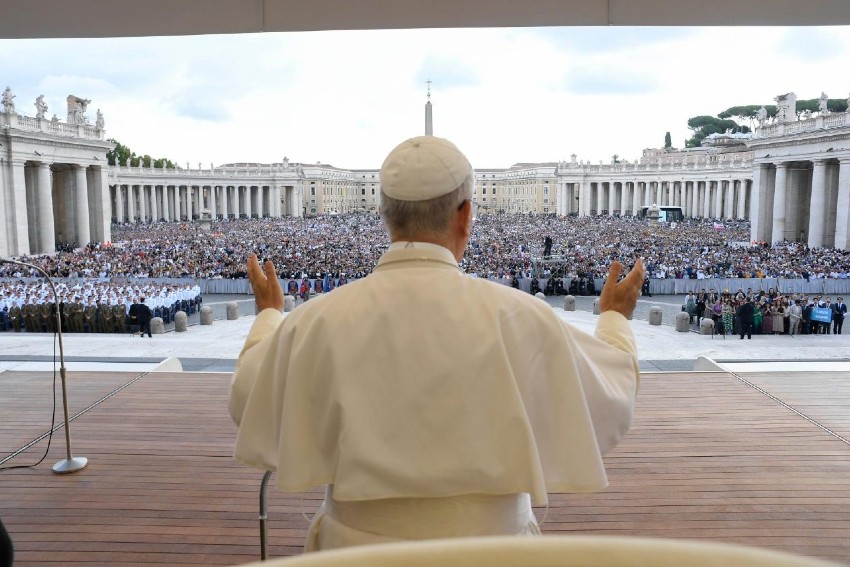
The Vatican today issued a document on the sacral character of marriage entitled Una caro [“One flesh”]. In Praise of Monogamy.
I wrote: “I intend to send the whole document out when the official English version is completed.”
I then received this email from my friend, Bill Doino:
Dear Bob,
Thanks so much for taking time to write about Una Caro: In Praise of Monogamy, a doctrinal note on the unity, exclusivity and fruitfulness of marriage, defined as a unique and everlasting sacramental bond between a man and a woman. Specifically ordered and authorized by Pope Leo XIV, the Church thus makes it crystal clear, once again, that there is no other authentic definition of marriage.
Remarkably, the document highlights the insights of the much-maligned Humanae Vitae at least eight times—and even more incredibly—did you see this?– cites the great Dietrich AND his wife and my/our dear friend, Alice von Hildebrand, a combined ten times (!!).
What a spectacular, crowning achievement for this legendary couple, now reunited and no doubt celebrating in Heaven!!
Here is the full text:
Una Caro: In Praise of Monogamy
God Bless and Happy Thanksgiving!!
When I clicked on the link, it gave me the choice of Italian or English, and when I chose English, it gave me the full text. But my email provider said the file was too big, so I am compelled to divide it into three parts.
So here is the 1st third of the full text. The 2nd two-thirds will follow in the next one or two emails.
***
I also received another email, from a longtime reader:
Robert,
Is it clear that the couple is a man and woman as you say — it says only 2 people can give themselves fully and completely?
Rich Maggi
The answer is clear from a sentence in the last paragraph of the opening Presentation by Cardinal Fernàndez, as follows (I have added the italics emphasis here, and below in the text itself, to highlight the cardinal’s words on this point):
“If, however, one wishes to grasp only a brief reflective summary to justify the choice of an exclusive union between a single woman and a single man, it will be sufficient to read the last chapter and the conclusion of this Note, which focus on the mutual belonging of spouses and on conjugal charity.”
So, the text does refer to marriage as something that is a union “between one man and one woman.”
—RM
DICASTERIUM PRO DOCTRINA FIDEI
UNA CARO
In praise of monogamy
Doctrinal note
on the value of marriage as an exclusive union
and mutual belonging
Index
The nuptial symbolism of the New Testament
III. Echoes of Scripture in History
Some reflections by Christian theologians
Early developments on marital unity and communion in the Fathers of the Church
Some medieval and modern authors
The development of the theological vision in recent times
The times of the Second Vatican Council
IV. Some perspectives from philosophy and cultures
In classical Christian thought
One person entirely referred to another
VI. Some reflections to be explored further
The multifaceted fruitfulness of love
Presentation
This is a text for the universal Church, yet it can be duly considered in every place in the face of local cultural challenges. The document, in fact, takes seriously the current global context of the development of technological power, in which human beings are tempted to think of themselves as limitless creatures, capable of achieving anything they imagine. In this way, the value of an exclusive love, reserved for a single person, is easily obscured, which in itself implies the free renunciation of many other possibilities.
In truth, the intention of this Note is fundamentally propositional: to extract from the Sacred Scriptures, from the history of Christian thought, from philosophy and even from poetry, reasons and motivations that push us to choose a unique and exclusive union of love, a rich and all-encompassing mutual belonging.
This effort will enrich reflection and teaching on marriage with an aspect that has so far been underdeveloped. At the same time, it could provide varied and useful material for marriage movements and groups for study and dialogue. This explains the length of the Note and the number of authors and texts cited. Some may find this selection excessive, but we believe that each of the authors and texts cited can provide nuances and nuances that stimulate serene reflection and sustained study.
We will consider the most important works of the Magisterium and a series of authors from ancient to recent times: theologians, philosophers, and poets. We have found a wealth of reflections that emphasize the union of spouses, reciprocity, and the all-encompassing meaning of the marital relationship. Thus, the diverse texts will compose a beautiful mosaic that will surely enrich our understanding of monogamy.
If, however, one wishes to grasp only a brief reflective summary to justify the choice of an exclusive union between a single woman and a single man [Note: Emphasis added], it will be sufficient to read the last chapter and the conclusion of this Note, which focus on the mutual belonging of spouses and on conjugal charity. In any case, we suggest patiently reading the Note in its entirety to fully grasp the breadth of the aspects involved in this rich subject.
Víctor Manuel Card. Fernández
Prefect
I. Introduction
1. [ Una caro ] “One flesh” is the way the Bible expresses marital unity. In everyday language, however, “the two of us” is an expression that appears when there is a strong sense of reciprocity in a marriage, that is, the perception of the beauty of an exclusive love, of an alliance between two people who share life in its entirety, with all its struggles and hopes. “The two of us” is used when referring to shared desires, sufferings, ideas, and dreams: in a word, when referring to stories that only spouses have experienced. This is a verbal manifestation of something deeper: a conviction and a decision to belong to each other, to be “one flesh,” to walk the path of life together. As Pope Francis said : “Spouses too should form a first person plural, an “we.” Standing before each other as an “I” and a “you”, and standing before the rest of the world, including the children, as an “us”» [1] . This happens because, although they are two different people, two individualities who each retain their own and non-transferable identity, they have forged with their free consent a union that places them together before the world. It is a union that opens generously to others, but always starting from that unique and exclusive reality of the conjugal “us”.
2. Saint John Paul II , speaking of monogamy, maintained that it «deserves to be studied ever more deeply» [2] . His indication of the need for a broader treatment of this theme is one of the motivations that prompted the Dicastery for the Doctrine of the Faith to prepare this Doctrinal Note . Furthermore, at the origin of this text are, on the one hand, the various dialogues with the Bishops of Africa and other continents on the question of polygamy, in the context of their ad limina visits [3], and, on the other, the observation that various public forms of non-monogamous unions – sometimes called “polyamory” – are growing in the West, in addition to the more private or secret ones that have been common throughout history.
3. But these reasons are subordinate to the first, because, properly understood, monogamy is not simply the opposite of polygamy. It is much more, and a deeper understanding of it allows us to conceive of marriage in all its richness and fruitfulness. The issue is intimately linked to the unitive purpose of sexuality, which is not limited to ensuring procreation, but helps enrich and strengthen the unique and exclusive union and the sense of mutual belonging.
4. As the Code of Canon Law itself states: “the essential properties of marriage are unity and indissolubility” [4] . Elsewhere, the same Code states that marriage is “a bond which by its nature is perpetual and exclusive ” [5]. It is worth noting that there is an abundant bibliography on the indissolubility of the conjugal union in Catholic literature: this theme has had much more space in the Magisterium, in particular in the recent teaching of many Bishops in the face of the legalization of divorce in various countries. On the unity of marriage – marriage understood, that is, as a unique and exclusive union between one man and one woman – one finds, on the contrary, a less extensive development of reflection than on the theme of indissolubility both in the Magisterium and in manuals dedicated to the subject.
5. For this reason, in this text we have chosen to focus on the property of unity and its existential reflection: the intimate and all-encompassing communion between spouses. Therefore, in order not to expect from this Note something it does not intend to develop, it is necessary to insist that, in the pages that follow, it will not deal with marital indissolubility—a union that lasts until death separates Christian spouses—nor with the purpose of procreation: both themes are abundantly treated in theology and the Magisterium. The Note will focus only on the first essential property of marriage, unity, which can be defined as the unique and exclusive union between a single woman and a single man, or, in other words, as the mutual belonging of the two, which cannot be shared with others.
6. This property is so essential and primary that marriage is often defined simply as “union”. Thus, the Summa Theologiae of St. Thomas Aquinas states that «marriage is the marital union ( coniunctio ) of man with woman, contracted by legitimate persons, which implies an inseparable communion of life» [6], and that «it is evident that in marriage there exists a union by which one is called husband and the other wife; and this union is marriage » [7]. A similar definition was already found in Justinian, who collected pre-existing opinions: «it is the union ( coniunctio ) of man and woman which contains an inseparable communion of life» [8]. Closer to us, Dietrich von Hildebrand maintains that marriage «is the deepest and most intimate union between human persons» [9].
7. Already in these classical definitions we see that the unity of the two spouses, as an objective foundational fact and essential property of every marriage, is called to constant expression and development as a “communion of life”, that is, as conjugal friendship, mutual help, total sharing which, with the help of grace, increasingly represents another union that transcends and encompasses it: the union between Christ and his beloved bride, the Church, the People of God for whom he gave his blood (cf. Eph 5:25-32).
8. Saint John Paul II intimately connects these two aspects. Indeed, if «by virtue of the covenant of conjugal love, man and woman ‘are no longer two, but one flesh’ ( Mt 19:6; cf. Gen 2:24)», at the same time «they are called to grow continually in their communion […] so that every day they progress towards an ever richer union between them at all levels» [10].
9. In this Note, therefore, we will examine both unity as an essential property, an objective and constitutive reality of marriage, the first and founding characteristic of all its manifestations, and the different expressions of that same unity which enrich and strengthen the conjugal alliance, thus making it possible at the same time to perceive this unity not as a monolithic reflection of divine unity, but as an expression of the one God who is communion in Trinitarian relations.
10. Finally, it is hoped that this Note on the value of monogamy, intended primarily for Bishops, referring to such an important and at the same time very beautiful theme, may be of help to already married couples, engaged couples and young people thinking of a future union in order to grasp even better the richness of the Christian proposal on marriage. It is true that, for many, such a message may sound strange or against the current, but we can apply to it the following words of Saint Augustine: “Give me a heart that loves, and it will understand what I say” [11]. Moreover, a true passion for the beauty of conjugal love has found expression in the dedication of many believers, men and women, clergy and laity, individually or in ecclesial groups, who have accompanied many couples on their life journey and have also developed a spirituality and a pastoral approach to marriage. For all these shining examples we can only express our dutiful thanks.
II. Monogamy in the Bible
11. «They are no longer two, but one flesh» ( Mk 10:8). This declaration of Jesus regarding marriage expresses the beauty of love, a cement which «gives solidity to this community of life, and the impetus which draws it towards an ever more perfect fullness» [12]. Instituted “at the beginning” already at the moment of Creation, marriage appears as a conjugal pact willed by God, as «a sacrament of the Creator of the universe, therefore inscribed in the human being himself, who is oriented towards this path, in which the man abandons his parents and unites himself to his woman to form one flesh, so that the two may become a single existence» [13]. Even if «it is known that the history of the Old Testament is the scene of a systematic defection from monogamy» [14], given for example the events of the Patriarchs where we read, according to the custom of the time, of characters with more than one wife (cf. 2 Sam 3,2-5; 11,2-27; 15,16; 1 Kings 11,3), at the same time many passages of the Old Testament celebrate monogamous love and exclusive union: «Though the king’s wives be sixty, the concubines eighty, the girls innumerable! But my dove is one, my all» ( Song 6,8-9a). This is also attested by the examples of Isaac (cf. Gen 25:19-28), Joseph (cf. Gen 41:50), Ruth (cf. Rut 2-4), Ezekiel (cf. Ez 24:15-18) and Tobias (cf. Tob 8:5-8). On the other hand, if from a factual and normative point of view monogamy does not have solid foundations in the Old Testament, its theological foundations develop in depth, and this is the fruitful path that will be followed in the following reflections [15].
Monogamy in Genesis chapter 2
12. At the root of the monogamous model, chapter 2 of the book of Genesis presents itself as a true anthropological manifesto placed at the incipit of the Scriptures. It describes the project that the Creator proposes as the ideal for the freedom of the human creature. The divine exclamation: “It is not good that the man should be alone: I will make him a helper ( ‘ēzer ) suitable for him” ( Gen 2:18), clearly highlights the need in which man finds himself as soon as he emerges from the hands of God, namely, a state of solitude-isolation. Despite the presence of other living beings, man wants a helper suitable for him (cf. Gen 2:20), a living ally, unique and personal, whom he can look into the eyes, as suggested by the word k e neḡdô , usually translated as “similar” or “corresponding”, to highlight the need for a dialogical encounter of glances and faces. In fact, «the original Hebrew expression refers us to a direct, almost “frontal” relationship – eyes to eyes – in a dialogue that is also tacit, because in love silences are often more eloquent than words. It is the encounter with a face, a “you” who reflects divine love and is “the first of all goods, a helper fit for him and a pillar of support” ( Sir 36:26), as a biblical sage says» [16]. Man therefore seeks an irreplaceable face before him, a “you”, with whom he can weave a true relationship of love made of giving and reciprocity.
13. In his commentary on this passage from Genesis, Benedict XVI states: «The first novelty of biblical faith consists […] in the image of God; the second, essentially connected to it, is found in the image of man. The biblical account of Creation speaks of the solitude of the first man, Adam, to whom God wishes to place a helper. Among all creatures, none can be for man the help he needs, although he has given names to all the wild beasts and all the birds, thus integrating them into the context of his life. Then, from one of the man’s ribs, God creates the woman. Now Adam finds the help he needs: “This at last is bone of my bones and flesh of my flesh” ( Gen 2:23). […] The biblical account does not speak of punishment; the idea, however, that man is in some way incomplete, constitutionally on the way to finding in the other the integral part for his entirety, the idea, that is, that he can become “complete” only in communion with the other sex, is certainly present» [17].
14. The conclusion of the biblical story: “a man will leave his father and mother and be joined ( dāḇaq ) to his wife, and they will become one flesh ” ( Gen 2:24), expresses well this need for an intimate union, such a physical and interior attachment that the Psalmist uses it to describe the mystical union with God: ” My soul clings to you ( dāḇaq )” ( Ps 63:8; cf. 1 Cor 6 :16-17). As Pope Francis states, “the verb ‘to cling’ in the original Hebrew indicates a close harmony, a physical and interior adhesion, to the point that it is used to describe union with God: ‘My soul clings to you’ ( Ps 63:8), sings the person praying. Thus the marital union is evoked not only in its sexual and corporeal dimension, but also in its voluntary gift of love. The fruit of this union is to “become one flesh”, both in the physical embrace and in the union of the two hearts and of life and, perhaps, in the child who will be born from the two, who will carry within himself, uniting them both genetically and spiritually, the two “fleshes”» [18]. With the formula ” una caro “, the reciprocal and total donation of the couple becomes an exclusive and integral relationship. Therefore, with the suggestive term of ‘iššāh applied to the woman (cf. Gen 2:23), the sacred author wanted to remember that these two people constitute a couple, equal in their radical dignity, but different in their individual identity. The fullness of the union between human beings is in this equality made of necessary, dialogical and complementary reciprocity. Ultimately, according to the Creator’s original plan, to which Jesus himself refers using the expression “in the beginning” in his commentary on the indissolubility of marriage (cf. Mt 19:4), a man and a woman are called in marriage to a unique, personal, full, and lasting relationship, to an exclusive covenant of life and love, which takes precedence over the social bond of blood (cf. Gen 2:24). From this perspective, the application of the nuptial metaphor to God’s relationship with Israel, which emerges with all its force in the prophetic texts, opens an even richer horizon for understanding the life of spouses as a mutually belonging.
Prophetic wedding symbolism
15. In the Prophets, the categories of conjugal love give particular features to the understanding of the alliance between God and his people, no longer modulated according to the canon of pacts between the king and vassal princes.
16. Here, the personal story of the prophet Hosea (8th century BC) emerges in an emblematic way, which is taken as a theological paradigm for rereading the love story between the Lord and Israel (cf. Hos 2:4-25). Despite the betrayal suffered by his wife Gomer, he cannot extinguish his love for her and instead nurtures the hope that she, abandoned and disappointed by her lovers, will “return” on the way home in order to fully restore their love relationship, since that woman is the only one in his life, forgiving her for her betrayals (cf. Hos 2:16-17).
17. This symbolic nuptial transposition of divine fidelity will continue in the prophetic tradition, with different emphases: Ezekiel recounts how God cares for his people, like a man spreading his cloak over a woman (cf. Ezekiel 16:8). On the one hand, this gesture indicates the marital pact in which protection is offered to the wife; on the other, it aims to shield the woman from the gaze of others, thus evoking the exclusivity of the bond.
18. The prophet Malachi condemns the breaking of marital ties among members of Israel and remarriage to pagan women: “For I hate divorce, says the Lord, the God of Israel, and anyone who covers his garment with iniquity, says the Lord of hosts” ( Mal 2:16). This passage has also had another interpretation called “cultic” or “typological,” as if it referred to a single perversion (idolatry), placing an implicit parallel between profaning the covenant with God and deceiving one’s spouse (adultery).
19. Ultimately, conjugal love truly allows us to describe a dialectic of covenant between Israel and the Lord, between humanity and God. The idea of God as Israel’s sole husband is also linked to that of Israel as its sole bride. The uniqueness of the beloved is also evident in the theme of election, which makes Israel the sole chosen people (cf. Amos 3:2). The covenant thus takes on a further dimension in that it designates the bond between God and his people, based on a monogamous bond so real that the worship of another god constitutes adultery.
20. Saint John Paul II offers, in this regard, a beautiful synthesis: «In many texts, monogamy appears to be the only and correct analogy of monotheism understood in the categories of the Covenant, that is, of fidelity and trust in the one and true God-Yahweh: the Husband of Israel. Adultery is the antithesis of that spousal relationship, it is the antinomy of marriage (also as an institution) in that monogamous marriage brings into effect in itself the interpersonal alliance between man and woman, it realizes the alliance born of love and accepted by both respective parties precisely as marriage (and, as such, recognized by society). This type of alliance between two people constitutes the foundation of that union whereby “the man… shall be joined to his wife and the two shall become one flesh” ( Gen 2:24)» [19].
Wisdom literature
21. All wisdom literature that praises monogamous union as the true expression of love between a man and a woman follows the same line. The passage from the Song of Songs: “My beloved is mine and I am his” ( Song 2:16) represents a true pinnacle here. In this poetic jewel, the woman of the Song expresses her love, using the symbol of the seal that in the ancient Near East designated a person, identified them and was worn either on a bracelet or on a chain around the chest: “Set me as a seal upon your heart and upon your arm. Love is as strong as death” (8:6). The beloved, therefore, declares that she is almost her man’s “identity card”: one does not exist without the other and vice versa. Intelligence, will, affection, action, and the entire personality of one communicate in the other in a reciprocal and exclusive way, in full symbiosis. Death rises in vain against this vital unity.
22. Furthermore, the affirmation repeated twice in the Song of Songs: “My beloved is mine and I am his […]. I am my beloved’s and my beloved is mine” ( Song 2:16; 6:3), expresses this unity of total giving, of reciprocity and of mutual belonging, as a re-edition of the declaration of love addressed by the man to his woman in Gen 2:23: “bone of my bones, flesh of my flesh”.
23. The Jewish and Christian traditions (especially in mysticism) have agreed in interpreting the Song of Songs as an allegory of the covenant between God and Israel, of the relationship between God and the soul. In a symbolic sense, it can be said that the book of the Song of Songs exalts the love of a man and a woman by placing the accent precisely on the uniqueness of an exclusive relationship. In the love story, the two lovers seek and desire each other with a reciprocity in which there is no room for a third party. This fundamental anthropological fact refers back to Israel’s profession of faith: “Hear, O Israel: The Lord our God is one Lord” ( Deut 6:4). This is one of the most solemn proclamations of God in the Old Testament and it is a proclamation that uses the language of uniqueness when professing the truth of faith. In other words, the Song of Songs affirms that, at the heart of one of the most profound anthropological experiences, such as the loving relationship, there is a uniqueness analogous to that which faith proclaims about God. Therefore, monogamy is profoundly connected to the uniqueness and exclusivity of the God of Israel and goes hand in hand with monotheism.
24. In this regard, Benedict XVI states: «God used the way of love to reveal the intimate mystery of his Trinitarian life. Furthermore, the close relationship that exists between the image of God as Love and human love allows us to understand that “monogamous marriage corresponds to the image of the monotheistic God. Marriage based on an exclusive and definitive love becomes the icon of God’s relationship with his people and vice versa: God’s way of loving becomes the measure of human love”. This indication still remains largely to be explored» [20].
25. The double formula: “My beloved is mine and I am his […] I am my beloved’s and my beloved is mine” ( Song of Songs 2:16; 6:3), therefore recalls the theological formula of the covenant between God and biblical Israel: “The Lord is your God and you are his people” (cf. Dt 7:6), and allows us to access the theological category of the covenant as a mutual commitment of fidelity. The biblical category of the covenant allows us, finally, to outline the sanctity of marriage between husband and wife in its expression of a true community of life and love through a mutual and exclusive gift. All this will become fully evident in the texts of the New Testament [21].
The wedding symbolism of the New Testament
26. In the Gospel, Jesus explicitly refers “to the beginning”, that is, to the origins of the first human couple (cf. Gen 1:27; 2:24), to reiterate that monogamous, faithful and indissoluble love exalts the relationship of the couple, conceived by the Creator in a dimension of totality and exclusivity (cf. Mt 19:3-9).
27. In the Gospel narratives of Mark and Matthew, Jesus expressed himself unequivocally on monogamy, referring to the origins, to the will of the Creator. The debate with the Pharisees on the possibility of divorce offers him the opportunity to make an authoritative pronouncement. He reaffirms the principle of monogamy which is the foundation of God’s plan for the family: “From the beginning of creation, ‘God made them male and female.’ For this reason a man shall leave his father and mother and be joined to his wife, and the two shall become one flesh. So they are no longer two, but one flesh. Therefore what God has joined together, let no man separate” ( Mk 10:6-9; cf. Mt 19:4-6). As the basis of his statement, Jesus combines two weighty exegetical elements: “He made them male and female” ( Gen 1:27) and “for this reason a man shall leave his father and mother and be joined to his wife, and [the two] shall become one flesh” ( Gen 2:24). The first man and the first woman are therefore united by God himself in the one-flesh couple. In other words, Jesus restores validity to God’s original plan, going beyond the norm given by Moses and recalling an older one, while at the same time underlining a divine presence at the very root of this relationship: “What God has joined together, let no man separate” ( Mt 19:6).
28. Furthermore, the New Testament, in the wake of prophetic theology, repeatedly introduces nuptial symbolism into Christological and ecclesiological themes (cf. Rev 19:7-9): Christ is called by the Baptist the “bridegroom” par excellence (cf. Jn 3:29), while the bride of the Lamb is the new Jerusalem (cf. Rev 21:1ff.), a fertile mother, saved from the attack of the dragon (cf. Rev 12:3-6).
29. St. Paul systematically develops the theme of full and perfect marital love between Christ and the Church in his Letter to the Ephesians (cf. Eph 5:21-33), taking up, among other things, the passage from Genesis about the couple’s being “one flesh” (cf. Gen 2:24). The indissoluble monogamous love between the two spouses—always in line with the theme developed by the prophets to define the covenant between the Lord and Israel—reveals itself as the symbol describing the bond between Christ and the Church. Christian marriage in its authenticity and fullness is, therefore, a sign of the new Christian covenant.
30. The formula of the “great mystery” also deserves attention, as a translation of the original Greek mysterion. This was rendered by St. Jerome, in the Vulgate , with the term sacramentum , which allowed ecclesial tradition to adopt the Pauline formula as an explicit proclamation of the sacramentality of marriage. The passage in its entirety intensely exalts the theological function performed by exclusive nuptial love. The two spouses who unite indissolubly are a sign that refers to the embrace with which Christ draws the Church to himself. Christian spouses, therefore, bear witness in the world not only to a human bond, eros and agape, but are also the living “image” of a sacred and transcendent bond, that is, the one that unites Christ with the community of Christians. Already in Genesis the couple who love and generate were defined as the “image” of the creator God: “God created man in his own image, in the image of God he created him; male and female he created them” ( Gen 1:27).
31. The Apostle, evoking above all the passage from Genesis in which the two, man and woman, form one flesh (cf. Gen 2:24), defines the intimacy of love between husband and wife as a luminous emblem of the communion of life and charity that exists between Christ and the Church (cf. Eph 5:32). Through this passage from the Letter to the Ephesians, so fragrant in its humanity but also so dense in its theological quality, Paul does not limit himself to proposing a model of Christian marital behavior, but indicates the perfect and unique union between Christ and the Church as the original source of monogamous marriage. It is not only an image of that union, but reproduces and embodies it through the love of the spouses. It is an effective and expressive sign of the grace and love that substantiate the union between Christ and the Church.
32. Finally, we find a beautiful exhortation in the Letter to the Hebrews. After the appeal to charity (cf. Heb 13:1-3), the Author briefly treats marriage, recommending esteem for this bond and respect for conjugal fidelity: “Let marriage be held in high regard by all, and let the marriage bed be undefiled” [22] ( Heb 13:4). The Author exhorts us to hold the institution of marriage in honour, underlining the value of faithful conjugal relations. A solemn warning is added: God will judge fornicators and adulterers, that is, those who do not respect the sanctity and uniqueness of marriage. The exhortation to esteem marriage and the conjugal bed was historically motivated by the fact that various ascetic tendencies denigrated this institution and saw it as a compromise with matter, repeating in their own way what is expressed in Col 2:20-23. The exhortation, however, is not directed against sexual relations, but against those who denied the fidelity of spouses and the uniqueness of marriage.
III. Echoes of Scripture in History
33. The revealed Word contained in the Sacred Scriptures has produced, over the long history of the Church, various echoes that we will try to gather at least in part.
Some reflections by Christian theologians
34. It is useful to welcome the richness of Christian thought throughout the centuries, starting from the Fathers of the Church, with their particular importance, up to theologians of different schools and orientations.
Early developments on marital unity and communion in the Church Fathers
35. St. John Chrysostom recognizes a particular value in marital unity. Unlike other Fathers, he maintains that “once marriage had two motives, now it has only one.” He explains, in fact, that St. Paul (cf. 1 Cor 7:2, 5, 9) “commands them to unite, not so that they may become fathers of many children,” but because this leads spouses to “the abolition of debauchery and unbridled desire” [23]. Ultimately, the holy Doctor considers that the unity of marriage, with the choice of a single person to whom one is united, leads to the liberation of persons from unbridled sexual outbursts, without love or fidelity, and gives adequate direction to sexuality.
36. St. Augustine, while emphasizing above all the importance of procreation, emphasizes first and foremost the good of unity which is expressed in fidelity: “Fidelity requires not having sexual relations with another man or woman” [24]. Augustine was also able to express the beauty of conjugal unity as a good in itself, described dynamically as walking together, “side by side”: “The first natural bond of human society is that between man and woman. And God did not produce each of the two separately, joining them together as strangers, but created one from the other, and the side of the man, from which the woman was taken and formed, indicates the strength of their union. For side by side are joined those who walk together and who together look to the same goal” [25].
37. Even before Augustine, Tertullian’s praise of marriage understood as a unity in the flesh and in the spirit of two who walk “in one hope” was well known: «How shall I be capable of expounding the happiness of that marriage which the Church unites […]. What a yoke that of two believers united in one hope, in one observance, in one servitude! They are both brothers and both serve together; there is no division as to the spirit and as to the flesh. Indeed they are truly two in one flesh, and where the flesh is one, there is one spirit» [26].
38. This fact of being “one flesh” is interpreted by the Fathers in an intensely realistic way, to the point that, faced with contradictions in the facts of the reality of conjugal unity, they do not fear to pronounce affirmations such as the following: “he divides his flesh, he divides his body” [27]; “as the wickedness of cutting his flesh” [28]; “God did not want the body to be divided and disjoined” [29].
39. In any case, it must be remembered that the Latin Church particularly emphasizes the juridical aspects of marriage, which have led to the beautiful conviction that the spouses themselves are ministers of the Sacrament [30]. With their consent, they give rise to the unique and exclusive marital union, an objective fact prior to any experience or feeling, even spiritual. The Eastern Fathers, and the Eastern Churches, emphasize more the theological, mystical and ecclesial aspects of a union which, thanks to the blessing of the Church, is enriched over time under the impulse of grace, while the communion between the spouses is ever more integrated into ecclesial communion. This is why in the East the rite of marriage, with all its signs, the prayer and the gestures of the priest, has been given greater value. Already St. John Chrysostom speaks of the coronation of the spouses ( stephánōma ) performed by the priest and explains its mystagogical meaning: «For this reason crowns are placed on their heads, as a symbol of victory, since, having remained undefeated, they reach the marriage bed» [31].
40. At the same time, a more positive vision of the relational aspect prevails in the East, which is also expressed in sexual union in marriage, without reducing its purpose to procreation alone. This is demonstrated, for example, when Saint Clement of Alexandria takes a strong distance from those who consider marriage a sin, even when they tolerate it in order to ensure the prolongation of the species. Instead, he reiterates: “If marriage according to the Law is a sin, I do not know how anyone can say they know God when they affirm that God’s commandment is a sin! No, if ‘the Law is holy,’ marriage is holy” [32]. Furthermore, for Saint John Chrysostom, marriage “is not to be considered a purchase and sale, but a communion of life ” [33] , and he underlines that exaggerated continence in marriage could put marital unity at risk.
41. Conjugal unity and communion as a reflection of the union between Christ and the Church (cf. Eph 5:28-30) is a theme particularly developed by the Eastern Fathers, and St. Gregory of Nazianzus draws concrete spiritual consequences from it: «It is good for the wife to respect Christ through her husband, and it is good for the husband not to despise the Church through his wife […]. But let the husband also take care of his wife: and, in fact, Christ takes care of the Church» [34].
Some medieval and modern authors
42. In the thought of St. Bonaventure on marriage, substantially homogeneous with that of St. Thomas, which will be discussed later, we can identify a reflection, within the framework of a theological vision, which includes the necessity of consummation so that marriage can fully signify the union between us and Christ: «Since consent, as consent on future action, is not properly consent, but rather a promise of it; and since consent, in truth, before carnal union does not produce a full union, given that they are not yet one flesh, it follows that through the words about the future it is said that marriage has begun, is ratified with words referring to the present, but consummated in carnal union, because then they are one flesh and become one body; and with this the union which is between us and Christ is fully signified. Then, in fact, the body of one is fully given to the body of the other» [35].
43. It is also useful to recall the theological-pastoral thought of St. Alphonsus Maria de’ Liguori, who presents the union and mutual gift of spouses in an integral way (including sexual relations), presenting them as essential intrinsic ends , while considering procreation as an intrinsic but accidental end. Therefore, he maintains that «three ends can be considered in marriage: essential intrinsic ends, accidental intrinsic ends, and extrinsic accidental ends. The essential intrinsic ends are two: the mutual gift with the obligation to satisfy the debt [i.e. sexual relations], and the indissoluble bond. The accidental intrinsic ends are equally two: the generation of offspring, and the remedy of concupiscence» [36].
44. St. Alphonsus also refers to extrinsic ends, such as pleasure, beauty and many others, which are licit [37] . In this way, the holy Doctor of the Church tries to enrich the vision of marriage in order to develop a pastoral approach that helps spouses to live their union in a richer and more stimulating way. It is permitted to desire marriage also on the basis of a particular attraction to one of these extrinsic ends, because, as long as the principal ends are not excluded, this «is not a disorder» [38].
45. Closer to our times, the theologian and personalist philosopher Dietrich von Hildebrand takes up the emphasis on the centrality of love in marriage given by the teaching of Pope Pius XI, in order to deepen the understanding of the properties and meanings of marriage itself [39]. With respect to the topic in question, he distinguishes two forms of union which complement each other and enrich the initial approach of this document: the first form of union is expressed with the pronoun “we”, the second with the pair “I-you”. In the “I-you” the two find themselves face to face, they give themselves to each other, in such a way that «the other person acts entirely as a subject, never as a mere object» [40]. This also involves the passage from considering the other as a “he” to one which comes to recognize him as a “you”. Instead, when the union is considered as an “us”, the other is with me, is at my side, walking together motivated by the common things that unite us [41]. The marital union lives on both experiences.
46. In the marital union, von Hildebrand highlights two essential attitudes. The first is ” discretio ,” that is, a space of personal intimacy that preserves the identity and freedom of each, but which can be shared by a completely free decision, and in this case leads to a deepening of the bond. The second attitude is “reverence” for the other, which manifests, particularly in sexual union, the fact that one loves a sacred and inviolable person, not just any object. The internal dynamism of the marital bond—the “we,” according to von Hildebrand’s categories—impels spouses to increasingly manifest their intimate personal communion.
47. This vision is also shared by Alice von Hildebrand, née Jourdain, Dietrich’s wife. In particular, she maintains that the full realization of humanity can only be achieved in the union between man and woman, the “divine invention”: «not only did He [God] make man composed of soul and body – a spiritual and a material reality – but, in addition to this, to crown this complexity, “male and female He created them”. Clearly, the fullness of human nature is found in the perfect union between man and woman» [42]. Therefore, spousal love between man and woman is considered by the Belgian philosopher and theologian as the pinnacle of human vocation, the supreme expression of the divine image as a call to the gift of self in love, where the tenderness of affection between the two plays a fundamental role, desired by the Creator himself: «The heart is the centre of the person» [43], warns von Hildebrand, faced with certain temptations to put activism before the receptivity of love, understood precisely in an affective sense. She then adds that «where tenderness reigns, concupiscence moves away» [44].
48. The character of total self-giving of spousal love can also be seen in what she characterizes as a true “sacrificial” dimension of love – with an evident reference to Christ’s love “to the end” – which consists in putting the good of the other before one’s own, in what can be called a “death” to oneself, which on some occasions can even lead to renouncing the joys of family life for the sake of a greater good: «What many “lovers” forget, whether we are speaking of friends or of husband and wife, is that sacrifice is the lifeblood of great loves. That sacrifice is the holy vitamin of love also applies to marriage, which offers spouses innumerable occasions to die to themselves» [45]. In other words, this means that spousal love shows its fruitfulness, both human and spiritual, when it remains open to the highest demands of charity [46].
The development of theological vision in recent times
49. Hans Urs von Balthasar assigns particular importance to the marital consent that creates that new unity that transcends the two individuals: «The coming together of the two people thus dispossessed of themselves is possible only in a third element, which […] is that objective factor that is composed of their two freedoms: their vow, their solemn promise, in which each gives definitive assent to the freedom of the other and to his mystery and delivers himself to this mystery. It is a reality that must be called objective only because it is more than the juxtaposition of their two subjectivities […] their will made one (to belong to each other), which places itself above them and between them, because neither of the two can claim for himself the unity that has arisen» [47].
50. This pact, where each of the two transcends himself and surrenders to the new reality that is created, is in no way a denial of themselves as free individuals: it is, instead, a fullness of freedom that is achieved in giving oneself totally to another person: «the event of giving oneself in mutual possession, which is accomplished only under the vault spread over them by the Spirit of love that guides and inspires them, is anything but an alienation of self on the part of the individual. The latter does not draw himself except by virtue of the call of the other freedom, which gives him the capacity to resolve, to decide his own, and this resolution becomes mature, ‘of age’, precisely when he does not continue to recover with hesitation, but concentrates himself, collects himself, to give himself once and for all» [48].
51. This Author contemplates in a particular and theologically profound way how this marital unity reflects the union between Christ and his Church: “The measure of marital love becomes the love between Christ and his Church […]. The original unity consists in this, that the Church is born from Christ as Eve was from Adam: she sprang from the pierced side of the Lord sleeping on the cross in the shadow of death and hell. For this reason she is his body, as Eve was flesh from Adam’s flesh. In this mortal sleep of the Passion he “formed for himself the Church, a marvelous bride without wrinkle or blemish” ( Eph 5:24-27). He himself, as a man, allows himself to fall into the sleep of death, so that, like God, he can mysteriously draw from the dead that fruitfulness from which he will create his bride, the Church. Thus she is he himself, and yet she is not he himself: she is his body and his bride. “He who loves his wife loves himself. No one ever hates his own flesh; he protects and cherishes it. So also Christ does with his Church, because we are members of his body” ( Eph 5:28-30)» [49].
52. Such a Christological and pneumatological vision has concrete consequences on the marital experience: «If we return to cast a glance at the mutual dedication of the spouses, it shows clearly once again that the common law of their love (in the Christological sense) flows both from their own attitude of voluntary self-possession, and therefore is not a law imposed from the outside, as it really rises, surpassing both, as a third, fruitful, creative entity (in the pneumatological sense) and inspires them to the acts of their dedication» [50].
53. Karl Rahner also thinks of marital unity as an expression of the love between Christ and the Church, but not as if Christ and the Church were equal before each other, since the love with which Christ loves the Church has its origin in the “merciful will of God to communicate himself” [51]. From this will, as cause, springs the first effect, which is the unity of Christ and the Church. Ultimately, love, as it is expressed in the life of spouses, reaches its origin in God himself [52]. It is useful to reflect on two texts of Rahner’s that are sufficiently eloquent. The first: “In truly personal love, there is implicit something unconditional that goes beyond and above the causality of the meeting of lovers: when they truly love, they continually grow above themselves, they reach a flow that no longer has its point of arrival in the finite and the determinable. What lies in an infinite distance, which is silently evoked in such love, can ultimately be called by only one name: God» [53]. And the second text: «Marriage and the bond between God and humanity in Christ can not only be compared with each other by us, but rather they are objectively in a reciprocal relationship such that marriage objectively represents this love that God has in Christ for the Church, the relationship and behavior of Christ with the Church prefigures the relationship and behavior that exists in marriage, and finds its completion in it, so that it includes marriage in itself as a moment of itself» [54].
54. The Christological-Trinitarian perspective on marital unity has been strongly and poetically emphasized by several contemporary Orthodox authors. We give three examples:
55. Starting from his own mystical vision, the Orthodox theologian Alexander Schmemann states: «In a Christian marriage, in fact, there are three married people; and the united loyalty of the two to the third, who is God, keeps the two in an active unity with each other and with God. However, it is precisely the presence of God that marks the end of marriage as something purely “natural”. It is the cross of Christ that puts an end to the self-sufficiency of nature. But “with the cross, joy has entered the whole world”. His presence is therefore the true joy of marriage» [55].
56. Another beautiful testimony is found in the following words of the Russian philosopher and theologian Pavel Evdokimov: «The consubstantial unity of marriage constitutes the unity of two persons who are placed in God […]. Therefore the initial Trinitarian structure is: man-woman in the Holy Spirit. The effective realization of their unity in marriage (where the husband, according to Paul, is the image of Christ and the wife is the image of the Church) becomes the conjugal equivalent of the Christ-Spirit unity» [56].
57. Finally, it is worth quoting an enlightened passage from the theologian John Meyendorff: «A Christian is called – already in this world – to experience a new life, to become a citizen of the Kingdom, and he can do so in marriage […]. It is a singular union of two beings in love, two beings who can transcend their own humanity and thus be united not only “with each other”, but also “in Christ”» [57].
(Note: The above is just the 1st third of the document; the second two-thirds to come in the next one or two emails…)