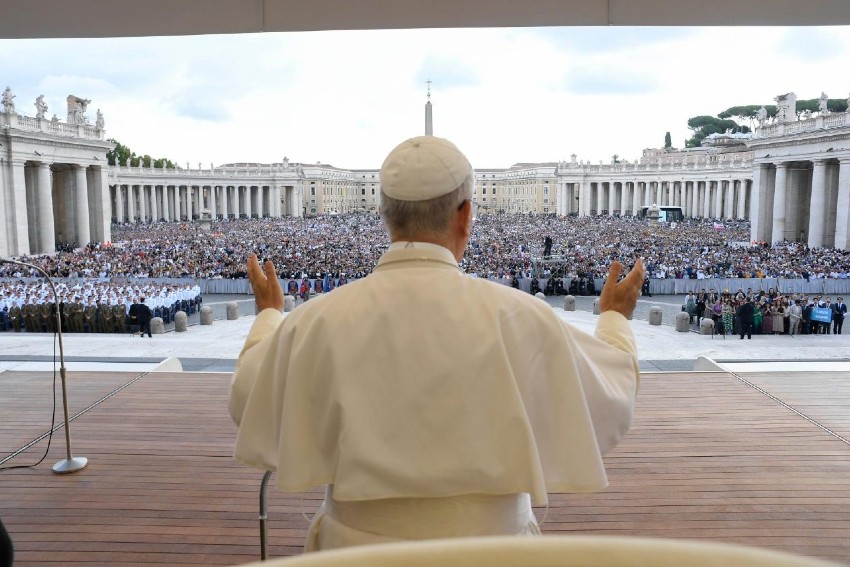

Pope Leo XIV will begin Lent 2026 with an historic procession on Rome’s Aventine Hill, one of the seven hills of the Eternal City
Letter #8, 2026, Tuesday, February 17: Lent, Repent…
Lent Begins Tomorrow, Ash Wednesday
We live in a fallen world.
We look forward to a promise: a world redeemed.
Yet, our world has already been redeemed.
But, evil persists, around us and in us — injustice, egoism, oppression, pride, cruelty, deception, murder, hatred, death.
In this context, what is our task?
The first preaching of St. Peter, in about 33 A.D., at the very beginning of the life of the Church — just after the crucifixion and resurrection of Jesus, and the descent of the Holy Spirit (the events that redeemed the world, and manifested that redemption in embryonic form) — began witha call to “repent,” a call to take up the task of individually removing the evil, the sin, which prevents the full visible emergence of the already accomplished redemption Christ accomplished, which will yet be fulfilled in a future time of justice and peace…
Thus St. Peter says to the crowds in Jerusalem, in his first, great homily:
“Repent therefore, and be converted, that your sins may be blotted out, so that times of refreshing may come from the presence of the Lord, and that He may send Jesus Christ, who was preached to you before, whom heaven must receive until the times of restoration of all things, which God has spoken by the mouth of all His holy prophets since the world began.” (Acts 3:19-21)
Again: “that He may send Jesus Christ, who was preached to you before, whom heaven must receive until the times of restoration of all things…”
***
So, our task in these ages since the coming of the Redeemer is to live in the prospect of the promise: to live so that the redemption may be made manifest in this world, in a coming time of peace.
That is: to repent, and to be converted….
Lent begins tomorrow…
***
Below:
— how Pope Leo will begin his Lenten fast, and,
— a document by Pope Leo with his advice on what we may do to live a good Lent.
—RM
Leo Begins Lent
The following paragraphs are drawn from a CNA (Catholic News Agency) report (link):
***
Pope Leo XIV will preside over the traditional Ash Wednesday procession and Mass on Rome’s Aventine Hill, an important place of Christian veneration and pilgrimage for more than 1,500 years.
For the Dominican and Benedictine religious orders, whose communities have had a significant historical presence on the Aventine, the Holy Father’s February 18 visit will be a special occasion to begin the Church’s liturgical season dedicated to prayer and fasting before Easter.
On the first day of the 40-day Lenten “Stations Churches” pilgrimage — formally instituted in the sixth century by Pope Gregory the Great and restored by Pope John XXIII in 1959 — the Pope leads a penitential procession from the Benedictine church of Sant’Anselmo to the nearby Dominican Basilica of Santa Sabina.
“To walk with Pope Leo on this pilgrimage from the nearby Sant’Anselmo church will be a sign, a symbol, for all of us of the spiritual work that’s taking place in our hearts in Lent,” Santa Sabina resident Father Patrick Briscoe, OP, told EWTN News. “We’ll all be on pilgrimage together.”
This year, Pope Leo will preside over a short afternoon prayer service at the Benedictine monastery and then celebrate the Ash Wednesday Mass at Santa Sabina, a fourth-century basilica that was gifted to St. Dominic and the Order of Preachers in 1219 by Pope Honorius III.
“The Pope himself imposes ashes on [the cardinals] during the Mass,” Briscoe added. “The cardinals stand in for the whole Church and they’re a sign of all of us joining and following the Pope’s lead.”
As part of the Lenten tradition, the Pope leads the procession through the main doors of Santa Sabina, which contains the oldest known artistic portrayal of Jesus Christ crucified.
“On the door we have a very important Christian symbol… It allows us to think of the meaning of Lent and to embrace the suffering of Christ,” Briscoe said.
— Kristina Millare
MESSAGE OF POPE LEO XIV
FOR LENT 2026 (link)
_________________________
Listening and Fasting:
Lent as a Time of Conversion
By Pope Leo XIV
Dear brothers and sisters,
Lent is a time in which the Church, guided by a sense of maternal care, invites us to place the mystery of God back in the center of our lives, in order to find renewal in our faith and keep our hearts from being consumed by the anxieties and distractions of daily life.
Every path towards conversion begins by allowing the word of God to touch our hearts and welcoming it with a docile spirit. There is a relationship between the word, our acceptance of it and the transformation it brings about. For this reason, the Lenten journey is a welcome opportunity to heed the voice of the Lord and renew our commitment to following Christ, accompanying him on the road to Jerusalem, where the mystery of his passion, death and resurrection will be fulfilled.
Listening
This year, I would first like to consider the importance of making room for the word through listening. The willingness to listen is the first way we demonstrate our desire to enter into relationship with someone.
In revealing himself to Moses in the burning bush, God himself teaches us that listening is one of his defining characteristics: “I have observed the misery of my people who are in Egypt; I have heard their cry” (Ex 3:7). Hearing the cry of the oppressed is the beginning of a story of liberation in which the Lord calls Moses, sending him to open a path of salvation for his children who have been reduced to slavery.
Our God is one who seeks to involve us. Even today he shares with us what is in his heart. Because of this, listening to the word in the liturgy teaches us to listen to the truth of reality. In the midst of the many voices present in our personal lives and in society, Sacred Scripture helps us to recognize and respond to the cry of those who are anguished and suffering. In order to foster this inner openness to listening, we must allow God to teach us how to listen as he does. We must recognize that “the condition of the poor is a cry that, throughout human history, constantly challenges our lives, societies, political and economic systems, and, not least, the Church.” [1]
Fasting
If Lent is a time for listening, fasting is a concrete way to prepare ourselves to receive the word of God. Abstaining from food is an ancient ascetic practice that is essential on the path of conversion. Precisely because it involves the body, fasting makes it easier to recognize what we “hunger” for and what we deem necessary for our sustenance. Moreover, it helps us to identify and order our “appetites,” keeping our hunger and thirst for justice alive and freeing us from complacency. Thus, it teaches us to pray and act responsibly towards our neighbor.
With spiritual insight, Saint Augustine helps us to understand the tension between the present moment and the future fulfilment that characterizes this custody of the heart. He observes that: “In the course of earthly life, it is incumbent upon men and women to hunger and thirst for justice, but to be satisfied belongs to the next life. Angels are satisfied with this bread, this food. The human race, on the other hand, hungers for it; we are all drawn to it in our desire. This reaching out in desire expands the soul and increases its capacity.” [2] Understood in this way, fasting not only permits us to govern our desire, purifying it and making it freer, but also to expand it, so that it is directed towards God and doing good.
However, in order to practice fasting in accordance with its evangelical character and avoid the temptation that leads to pride, it must be lived in faith and humility. It must be grounded in communion with the Lord, because “those who are unable to nourish themselves with the word of God do not fast properly.” [3] As a visible sign of our inner commitment to turn away from sin and evil with the help of grace, fasting must also include other forms of self-denial aimed at helping us to acquire a more sober lifestyle, since “austerity alone makes the Christian life strong and authentic.” [4]
In this regard, I would like to invite you to a very practical and frequently unappreciated form of abstinence: that of refraining from words that offend and hurt our neighbor. Let us begin by disarming our language, avoiding harsh words and rash judgement, refraining from slander and speaking ill of those who are not present and cannot defend themselves. Instead, let us strive to measure our words and cultivate kindness and respect in our families, among our friends, at work, on social media, in political debates, in the media and in Christian communities. In this way, words of hatred will give way to words of hope and peace.
Together
Finally, Lent emphasizes the communal aspect of listening to the word and fasting. The Bible itself underlines this dimension in multiple ways. For example, the Book of Nehemiah recounts how the people gathered to listen to the public reading of the Law, preparing to profess their faith and worship through fasting, so as to renew the covenant with God (cf. 9:1-3).
Likewise, our parishes, families, ecclesial groups and religious communities are called to undertake a shared journey during Lent, in which listening to the word of God, as well as to the cry of the poor and of the earth, becomes part of our community life, and fasting a foundation for sincere repentance. In this context, conversion refers not only to one’s conscience, but also to the quality of our relationships and dialogue. It means allowing ourselves to be challenged by reality and recognizing what truly guides our desires — both within our ecclesial communities and as regards humanity’s thirst for justice and reconciliation.
Dear friends, let us ask for the grace of a Lent that leads us to greater attentiveness to God and to the least among us. Let us ask for the strength that comes from the type of fasting that also extends to our use of language, so that hurtful words may diminish and give way to a greater space for the voice of others. Let us strive to make our communities places where the cry of those who suffer finds welcome, and listening opens paths towards liberation, making us ready and eager to contribute to building a civilization of love.
I impart my heartfelt blessing upon all of you and your Lenten journey.
From the Vatican, 5 February 2026, Memorial of Saint Agatha, Virgin and Martyr
—LEO PP. XIV
____________________________________________________
[1] Apostolic Exhortation Dilexi Te (4 October 2025), 9.
[2] Augustine The Usefulness of Fasting, 1, 1.
[3] Benedict XVI, Catechesis (9 March 2011).
[4] Paul VI, Catechesis (8 February 1978).
Copyright © Dicastery for Communication – Libreria Editrice Vaticana