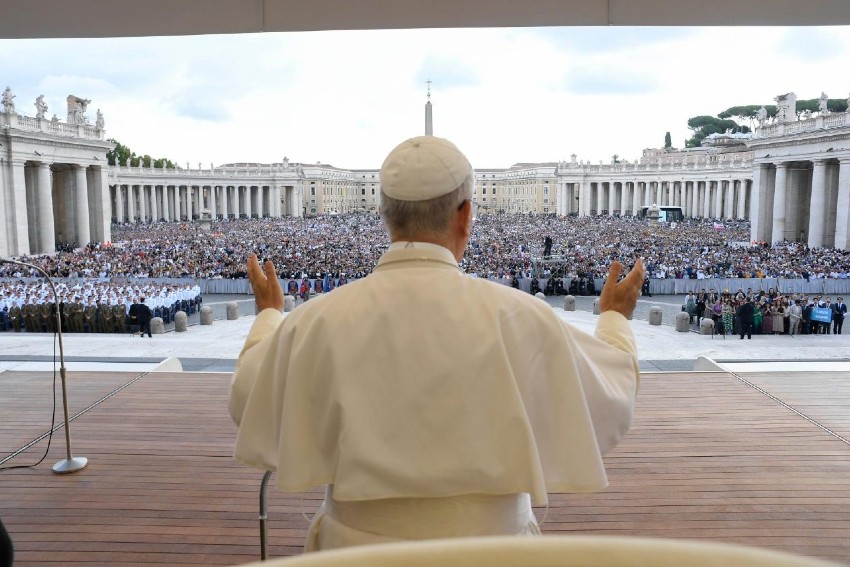
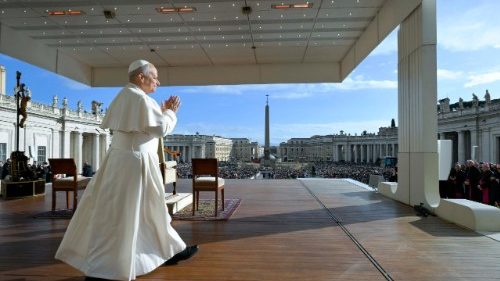
Pope Leo XIV this morning at his regular Wednesday General Audience in Rome. He spoke about the virtue of hope. He leaves Rome tomorrow for Turkey on his first Apostolic Journey as Pope outside of Italy
Letter #86, 2025, Wed, Nov 26: On hope
Vatican journalist Anna Artymiak today sent me this report on Pope Leo’s General Audience today in St. Peter’s Square, where he spoke about the virtue of hope.
The Pope also addressed the International Theological Commission (full text below).
“Only in a life conformed to the Gospel can we achieve adherence to the divine truth we profess, making our witness and the mission of the Church credible,” Leo told the theologians.
—RM

Polish journalist Anna Artymiak (who wrote the article below)
Pope Leo’s Wednesday Audience: “Hope makes us certain that the pilgrimage of existence will lead us home.”
By Anna Artymiak
Wednesday, November 26, 2025
A beautiful sunny, though a bit chilly, morning welcomed the pilgrims today who came into St. Peter’s Square for Pope Leo’s regular Wednesday General Audience. There were big crowds, as every week.
Leo XIV made his ride around the piazza starting 20 minutes before the start of the audience, blessing many babies and some children. One girl gave him a white rose. The enthusiasm is always great.
Before the General Audience, the Holy Father met members of the International Theological Commission and a delegation of the “Ave Maria University” from Florida.
Pope Leo then delivered a beautiful catechesis on the fact of life itself as a source of hope.
He noted that human beings “receive life as a gift: they do not ask for it, they do not choose it, they experience it in its mystery from the first to the last day.”
Speaking on hope, Leo then said: “Hope acts as the deep-seated drive that keeps us walking in difficulty, that prevents us from giving up in the fatigue of the journey” and it “makes us certain that the pilgrimage of existence will lead us home.”
He added: “Without hope, life risks appearing to be a parenthesis between two eternal nights, a brief pause between the before and the after of our journey on earth.”
The Pope warned that “there is a widespread sickness in the world: the lack of confidence in life,” almost “we have resigned ourselves to a negative fatalism, to renunciation.”
Therefore, continued the Pope, “life risks no longer representing a gift, but an unknown, almost a threat, from which to protect ourselves so as not to end up disappointed. For this reason, the courage to live and to generate life, to bear witness that God is the quintessential ‘lover of life,’ as the Book of Wisdom (11:26) affirms, is today a more urgent call than ever.”
Because of our freedom given by God “human relationships are also marked by contradiction, even to the point of fratricide. Cain perceives his brother Abel as a rival, a threat, and in his frustration, he feels unable to love him and respect him. Here we see jealousy, envy, and bloodshed (Gen 4:1-16).
“God’s logic, instead, is completely different. God always stays faithful to his plan of love and life; he does not tire of supporting humanity even when, following in Cain’s footsteps, it obeys the blind instinct of violence in war, discrimination, racism, and the many forms of slavery.”
The Pope spoke also about generating life, saying that being a mother and being a father “means to trust in the God of life and to promote humanity in all its expressions: first and foremost, in the wonderful adventure of motherhood and fatherhood, even in social contexts in which families struggle to bear the burden of daily life, and are often held back in their plans and dreams.”
In conclusion, Pope Leo invited the faithful to look to the Resurrection of Christ for our hope.
He said: “When life seems to have been extinguished, blocked, behold, the Risen Lord still passes by, until the end of time, and walks with us and for us. He is our hope.”
—Anna Artymiak

Here is the full text of what Pope Leo said at today’s General Audience (link):
Cycle of Catechesis – Jubilee 2025:
Jesus Christ Our Hope.
IV. The Resurrection of Christ and the Challenges of the Contemporary World.
6. Hoping in life in order to beget life.
Dear brothers and sisters, good morning and welcome!
The Pasch of Christ illuminates the mystery of life and allows us to look at it with hope.
This is not always easy or obvious.
Many lives, in every part of the world, appear laborious, painful, filled with problems and obstacles to be overcome.
Yet human beings receive life as a gift: they do not ask for it, they do not choose it, they experience it in its mystery from the first to the last day.
Life has its own extraordinary specificity: it is offered to us, we cannot give it to ourselves, but it must be constantly nurtured: it needs care to maintain, energize, protect and revive it.
One could say that the question about life is one of the most profound concerns of the human heart.
We entered life without having done anything to decide to do so.
The questions of all ages gush forth from this fact, like an overflowing river: Who are we? Where do we come from? Where are we going? What is the ultimate meaning of this journey?
Indeed, living invokes meaning, direction, hope.
And hope acts as the deep-seated drive that keeps us walking in difficulty, that prevents us from giving up in the fatigue of the journey, that makes us certain that the pilgrimage of existence will lead us home.
Without hope, life risks appearing to be a parenthesis between two eternal nights, a brief pause between the before and the after of our journey on earth.
To hope in life means instead to anticipate the destination, to believe as certain what we still cannot see or touch, to trust and to entrust ourselves to the love of a Father who created us because he wanted us with love, and wants us to be happy.
Dear friends, there is a widespread sickness in the world: the lack of confidence in life.
It is as if we have resigned ourselves to a negative fatalism, to renunciation.
Life risks no longer representing a gift, but an unknown, almost a threat from which to protect ourselves so as not to end up disappointed.
For this reason, the courage to live and to generate life, to bear witness that God is the quintessential “lover of life”, as the Book of Wisdom (11:26) affirms, is today a more urgent call than ever.
In the Gospel, Jesus constantly confirms his concern for healing the sick, restoring wounded bodies and spirits, and giving life back to the dead.
By doing so, the incarnate Son reveals the Father: he restores dignity to sinners, grants the forgiveness of sins, and includes everyone, especially the desperate, the excluded, those who are far from his promise of salvation.
Begotten by the Father, Christ is life and has generated life without reserve, to the point of giving his own, and he invites us too to give our lives.
To generate means to bring someone else to life.
The universe of the living has expanded via this law, which in the symphony of creatures experiences a wonderful “crescendo” culminating in the duet of man and woman: God created them in his own image and entrusted them with the mission of generating in his image, that is, for love and in love.
From the beginning, Sacred Scripture reveals to us that life, precisely in its highest form, the human form, receives the gift of freedom and becomes a tragedy. In this way, human relationships are also marked by contradiction, even to the point of fratricide.
Cain perceives his brother Abel as a rival, a threat, and in his frustration, he feels unable to love him and respect him.
Here we see jealousy, envy, and bloodshed (Gen 4:1-16).
God’s logic, instead, is completely different.
God always stays faithful to his plan of love and life; he does not tire of supporting humanity even when, following in Cain’s footsteps, it obeys the blind instinct of violence in war, discrimination, racism, and the many forms of slavery.
To generate, then, means to trust in the God of life and to promote humanity in all its expressions: first and foremost, in the wonderful adventure of motherhood and fatherhood, even in social contexts in which families struggle to bear the burden of daily life, and are often held back in their plans and dreams.
According to this same logic, to generate is to be committed to an economy based on solidarity, striving for a common good equally enjoyed by all, respecting and caring for creation, offering comfort through listening, presence, and concrete and selfless help.
Brothers and sisters, the Resurrection of Jesus Christ is the strength that supports us in this challenge, even when the darkness of evil obscures the heart and the mind.
When life seems to have been extinguished, obstructed, the Risen Lord still passes by, until the end of time, and walks with us and for us.
He is our hope.
____________________________
Special greetings
I extend a warm welcome to the English-speaking pilgrims and visitors taking part in today’s Audience, especially those coming from the United Kingdom, Ireland, the Netherlands, Norway, Nigeria, Uganda, Australia, New Zealand, Malaysia, the Philippines, Canada and the United States of America.
In a particular way, I greet the bishops and priests from England and Wales who are celebrating their fortieth, fiftieth and sixtieth anniversaries of priestly ordination.
I also greet the Eparchy of Keren in Eritrea, led by Bishop Kindane Yebio as it celebrates its thirtieth anniversary.
May the Lord always guide you in your witness of charity, harmony and peace.
In praying that all of you may experience an increase in the virtue of hope during this Jubilee Year, I invoke upon you, and your families, the joy and peace of our Lord Jesus Christ. God bless you!
________________________
Summary of the Holy Father’s words
Dear brothers and sisters, today, in our continuing catechesis on the Jubilee theme of “Christ our Hope,” we turn to consider a question that we all hold deep in our hearts: what is the meaning of life?
The scripture passage we just heard responds to this question — life is, first and foremost, a gift from God who has created us out of love.
One of the temptations prevelant today is a lack of trust in God’s goodness and love.
Perhaps we no longer experience life as a gift because we are weighed down by its burdens, but the Risen Christ reminds us that God is always faithful to his plan of love.
Trusting in God, we are invited to participate in this plan of life and of love by generating life.
For those of you living the vocation of married life, this means discovering the gift and adventure of motherhood and fatherhood, in which you are called to participate in bringing new lives into this world and preparing them for the life that is eternal.
Do not be afraid of this adventure, but prayerfully open yourselves to the gift of life, trusting in the God who we know loves us.
Copyright © Dicastery for Communication — Libreria Editrice Vaticana
Here is what the Pope said this morning when he met with members of the International Theological Commission (link):
ADDRESS OF HIS HOLINESS
POPE LEO XIV
TO
THE INTERNATIONAL THEOLOGICAL COMMISSION
Consistory Hall
Wednesday, November 26, 2024
In the name of the Father, and of the Son, and of the Holy Spirit.
Peace be with you!
Your Eminence,
Your Excellencies,
Dear Members of the International Theological Commission,
I am pleased to meet you for the first time—even though many of you are known—since the Lord Jesus called me to succeed the Blessed Apostle Peter on the Chair of the Church of Rome in the ministry of unity among all the Churches.
Your annual plenary session is a fitting occasion to thank all of you, and also those who have preceded you in this service.
The body of which you are a part was born from the call for renewal formulated by the Second Vatican Ecumenical Council.
Established in 1969 by Saint Paul VI, the International Theological Commission has carried out its work “with great diligence and prudence,” as Saint John Paul II emphasized in 1982, giving it a stable and definitive form (cf. M.p. Tredecim anni).
Renewing this appreciation, I thank you in particular for the timely publication of the document you offered to the Church on the occasion of the 1700th anniversary of the First Ecumenical Council of Nicaea: “Jesus Christ, Son of God, Savior.”
This is an authoritative text, which will certainly inspire further studies and the advancement of ecumenical dialogue.
Tomorrow, I will begin my first Apostolic Journey to Turkey and Lebanon, during which I will make a pilgrimage to İznik, ancient Nicaea, to commemorate that historic event and ask the Lord for the gift of unity and peace for his Church.
With full confidence in your generous commitment, I wish to encourage you to continue the mission entrusted to you by the Apostolic See.
Just as my venerable Predecessors followed with tenacity and foresight the path traced by Vatican II, so too I am concerned with discerning those “new things” that mark the path of the human family and doctrinal themes, “especially those that present new aspects” (Tredecim anni) in the life of the Church.
These are realities that urgently challenge us as the People of God to proclaim with creative fidelity the Good News given to the world “once and for all” (cf. Heb 9:12) by God our Father, through the Lord Jesus Christ.
He is the living Gospel of salvation: the witness we bear to him in every age is constantly renewed by the “immeasurable” outpouring of the Holy Spirit (cf. Jn 3:34).
It is the Paraclete, in fact, who enlightens minds and inflames our hearts with charity, thus transforming history according to God’s loving will.
From this perspective, the International Theological Commission has the task of offering insights, hermeneutics, and guidance to the Dicastery for the Doctrine of the Faith and the College of Bishops over which I preside, cooperating in the common understanding of the saving truth revealed in Christ Jesus.
In keeping with the ministry proper to theologians, who “by virtue of their own charism” participate “in the building up of the Body of Christ in unity and truth” (cf. Instruction Donum veritatis; 1 Tim 6:20; 2 Tim 1:12-14), your contributions can thus guide the Church’s mission in fidelity to the deposit of faith.
In this spirit, I urge you to treasure not only the indispensable rigor of theological method, but also three specific resources.
I refer, first of all, to the catholicity of our faith.
As Saint John Paul II noted, “coming from different nations and having to deal with the cultures of diverse peoples,” the members of the International Theological Commission “are better acquainted with new problems, which are like the new face of old problems, and are therefore better able to grasp the aspirations and mentalities of today’s people” (Tredecim anni).
Consequently, I hope that your reflections will be enriched by the many experiences of the local Churches.
Secondly, I would like to emphasize the importance—even more evident today than ever before—of inter- and trans-disciplinary dialogue with diverse fields of knowledge and expertise.
This too is a demanding and promising task of the International Theological Commission: to promote—as the Apostolic Constitution Veritatis gaudium calls for—”the placement and fermentation of all forms of knowledge within the context of Light and Life offered by the Wisdom that flows from God’s Revelation” (no. 4c).
Your commitment in this regard is not only useful but necessary to continue authentically and effectively in the evangelization of peoples and cultures.
Third, I invite you to imitate the passionate wisdom of Doctors of the Church such as Saint Augustine, Saint Bonaventure, Saint Thomas Aquinas, Saint Thérèse of Lisieux, and Saint John Henry Newman.
In them, theological study was always connected to prayer and spiritual experience, indispensable conditions for cultivating an understanding of Revelation, which cannot be reduced to a mere commentary on the formulas of faith.
Only in a life conformed to the Gospel can we achieve adherence to the divine truth we profess, making our witness and the mission of the Church credible.
As Pope Francis stated, “When I think of theology, light comes to mind […]. Theology carries out a hidden and humble work, so that the light of Christ and his Gospel may emerge” (Address to Participants in the International Congress on the Future of Theology, December 9, 2024).
The light of Christ, the light that is Christ himself (cf. Jn 8:12)!
Yes, Jesus Christ is the light of the world (cf. Jn 8:12): as the Second Vatican Council teaches, He is “the key, the center, and the goal of all human history.”
Therefore, the Church continues to proclaim that all things “find their ultimate foundation in Christ, who is the same yesterday, today, and forever” (Gaudium et Spes, 10).
As the science of faith, theology has first and foremost the task of admiring, then reflecting, and spreading the perennial and effective light of Christ in the ever-changing pace of our history.
Today, Pope Benedict XVI pointed out, “the excessive sectoralization of knowledge, the closure of the human sciences to metaphysics, and the difficulties of dialogue between the sciences and theology are detrimental not only to the development of knowledge, but also to the development of peoples, because, when this occurs, the vision of the entire good of man in its various dimensions is hindered” (Encyclical Letter Caritas in Veritate, 31).
Among these is certainly reason, but also “our feelings, our will, and our decisions” (Francis, Address to Participants in the International Congress on the Future of Theology, December 9, 2024), which together contribute to the development of diverse cultures.
Dearest friends, just as there is no faculty that faith does not illuminate, so there is no science that theology can ignore.
Through comprehensive study, you are therefore called to offer your valuable contribution to the discernment and resolution of the challenges facing both the Church and humanity as a whole.
Thank you, therefore, for the generous dedication with which you carry out your precious service.
Entrusting you to the Blessed Virgin Mary, Sedes Sapientiae [“Seat of Wisdom”], I impart my Blessing upon you all.
Thank you.
Copyright © Dicastery for Communication – Libreria Editrice Vaticana