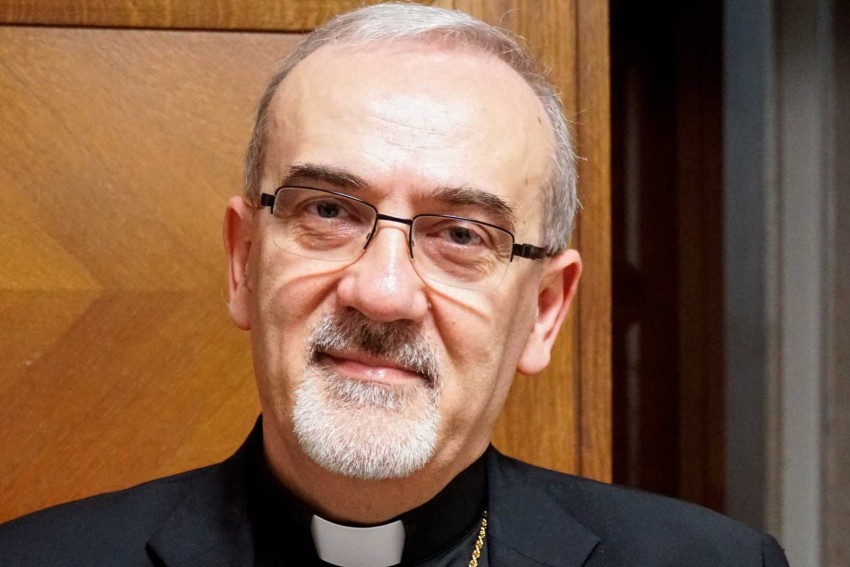

Maximino Caballero Ledo, a Spanish layman, is the Prefect of the Vatican’s Secretariat for the Economy
Letter #87, 2025, Wed, Nov 26: The status of Vatican finances… improving
Today Vatican journalist Anna Artymiak sent me this report on the Vatican’s finances, following the release today of the 2024 consolidated annual budget, which shows a small surplus, a marked improvement over previous years, in the Vatican’s finances.
Her report includes an interview with the Spanish layman who heads the Vatican’s Secretariat for the Economy, Maximino Caballero Ledo, who was appointed to his Pope by Pope Francis in 2020 (link).
This interview gives considerable, authoritative insight into what is happening with the Vatican’s income and expenses.
The situation seems to be improving…
—RM
Vatican showed modest positive balance in its 2024 consolidated financial statement of 1.6 million euros
By Anna Artymiak
Wednesday, November 26, 2025
The Secretariat for the Economy released today the Holy See financial report for 2024, for the last year of Pope Francis‘ pontificate. (link)
The Holy See announced a surplus of 1.6 million euros, significantly better than the deficit of 51.2 million euros in 2023.
Vatican News today published an interview with the Prefect of the Secretariat for the Economy, Maximino Caballero Ledo in which he stresses positive signs for the Holy See’s finances.
“The increase is due to the growth in donations, the positive results of hospital activities, and the progress recorded in property and commercial management.” Caballero said. (A full text of the interview is below.)
The Holy See’s financial report released contains the following information:
The structural deficit dropped significantly, from €83 to 44 million, representing a substantial reduction of nearly 50%.
This improvement was driven by a €79 million increase in revenues, mainly thanks to donations, and Hospital income, while expenses rose by €40 million.
This combination of rising revenues and controlled spending has enabled the Holy See to significantly reduce its deficit.
The vast majority of the Apostolic Mission’s resources are dedicated to supporting local churches and evangelization, communicating the message, maintaining a global presence, and charity.
The financial statements do not include the Vatican pension fund, which has mounting unfunded liabilities, and which led Pope Francis to publicly warn that the situation was worrisome.
The Pillar notes: “Last year, Pope Francis appointed Cardinal Kevin Farrell as the sole director of the Vatican’s pension fund, dismissing the fund’s board in the process.
That move came shortly after Francis informed the College of Cardinals that the fund faced “a serious prospective imbalance,” and that it was “not able to guarantee in the medium term the fulfillment of the pension obligation for future generations.”

Here is the Vatican News interview with Maximino Caballero Ledo, Prefect of the Vatican’s Secretariat for the Economy:
Caballero: ‘Positive signs for Holy See’s finances, now realism and prudence’ (link)
The Prefect of the Secretariat for the Economy, Maximino Caballero Ledo, explains the Holy See’s 2024 Financial Statements, saying they show “significant progress in consolidating the Holy See’s economic situation.”
By Vatican News
Maximino Caballero Ledo, the Prefect of the Secretariat for the Economy, spoke of a positive direction and encouraging signs in the Holy See’s financial situation, in an interview with Vatican News.
The Holy See published its 2024 Financial Statements on Wednesday, November 25.
In the interview, Mr. Caballero explained the origins of these “favourable dynamics,” while calling for prudence, realism, and continuity in order to consolidate these significant steps forward.
“It is not only a matter of maintaining budgetary balance,” he underscored, “but of strengthening the Holy See’s ability to make the best possible use of every contribution received,” so as to make the service to the mission of the universal Church “more solid and sustainable.”
Q: In 2024, the deficit in the Holy See’s budget was reduced by almost half, going from 83 to 44 million. Can you explain in more detail how this improvement was made possible?
Maximino Caballero Ledo: The improvement recorded in 2024—with the reduction of the structural operating deficit from 83.5 to 44.4 million euro—represents significant progress in consolidating the Holy See’s economic situation. This result was supported by an overall increase in revenues of almost 79 million euro compared with the previous year.
The increase is due to the growth in donations, the positive results of hospital activities, and the progress recorded in property and commercial management.
These favourable dynamics, together with prudent control of expenses and a constant effort to improve operational efficiency, have made it possible to substantially contain the deficit and point to an encouraging direction.
Despite the significant improvement achieved, an operating deficit of 44.4 million euro remains. We therefore continue with determination along the path toward full financial sustainability, turning this challenge into an opportunity for consolidation and growth, to be faced with continuity, realism and discipline, maintaining a balance between missionary commitment and responsible management of resources.
Q: Let us come to the offerings, which have increased significantly. In his interview with Elise Allen, Pope Leo said: “People make a lot of statements about the Vatican’s financial situation. It is not the crisis people have been led to believe… We will continue to work on this. The reform that Francis began, he made some very important decisions, things are certainly better than they were ten years ago, but this must continue.” Turning the narrative around, can we say that this year the budget seems to show that the Holy See’s mission has become more sustainable, with revenues increasingly aimed at maximizing the transformation of financial resources into social value and the concrete impact of the apostolic mission?
Caballero Ledo: The trend in offerings in 2024 is an encouraging sign. After years of slowdown, the fact that contributions have grown gives hope for a renewed participation of the faithful and of local Churches in the mission of the Holy See.
It is a positive fact, suggesting a climate of greater trust, while knowing that these dynamics can vary over time and always require prudence and realism in their interpretation.
The analysis of expenditure confirms, as has been the case for years, that the vast majority of resources are allocated directly to apostolic activities. This structure of the budget, stable over time, reflects the consistency between the priorities of the mission and the economic choices that make its realization possible, enhancing pastoral initiatives and supporting the most fragile ecclesial communities.
This is certainly a positive element, which encourages us to continue along this path with continuity, balance and an ever careful management of the resources available.
Q: As the report highlights, financial management has been particularly positive, generating positive results of 46 million euro. Do you think more and better can be done, moving beyond a logic that focuses only on reducing expenses, and giving greater emphasis instead to donations, fundraising, investments and enhancing assets?
Caballero Ledo: The result of financial activities in 2024 made an important contribution to improving the overall economic picture, allowing the year to close with a small surplus. It was a valuable support that helped to face a context still marked by significant pressures and offered concrete backing to activities linked to the Holy See’s mission.
It should be recalled that part of these results derives from extraordinary operations connected with the reallocation of the portfolio according to the new investment policy and the guidelines of the Investment Committee.
This was a necessary step to make management more consistent with the established criteria, but the capital gains generated in this phase cannot be replicated with the same intensity in subsequent years and reflect the natural volatility of financial activity.
For this reason, alongside prudence in managing expenses, it is essential to continue working on the revenue side: from donations to fundraising, from the enhancement of assets to investment management consistent with the criteria laid down.
The goal is not to pit the two dimensions against each other, but to consolidate progress made and gradually strengthen a more stable economic base. This is a process that requires continuity and realism, so that the resources available can effectively and responsibly support the activities of the Holy See.
Q: This year’s budget indicates a clearly positive step. Is full financial sustainability a realistic objective?
Caballero Ledo: The result for 2024, with an overall surplus of 1.6 million euro and such significant recovery compared with the previous year, is certainly a very positive sign. It indicates that the direction taken is encouraging, especially thanks to the reduction of the structural operating deficit.
Now the task is to consolidate the progress over time, because, as already mentioned, part of this improvement is due to non-recurring factors.
Moreover, financial sustainability is not only a possible objective, but a necessary condition for guaranteeing continuity for the Holy See’s mission. The apostolic work is by its nature broad and dynamic and therefore requires a stable economic base.
For this reason, we must continue to work on a careful and balanced redistribution of resources, ensuring that they are allocated ever more effectively to missionary priorities.
It is not only a matter of maintaining budgetary balance, but of strengthening the Holy See’s capacity to make the best possible use of every contribution received, making its presence at the service of the universal Church more solid and sustainable.