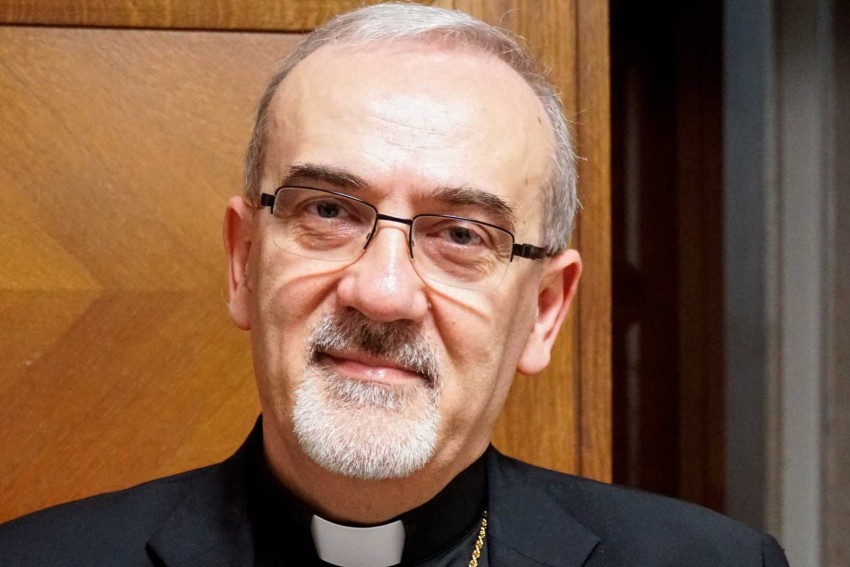

Professor John M. Rist. The brilliant Catholic British historian of theology contacted me about my letter on the “filioque” question and proposed that I read his essay on the role of St. Athanasius at the 1st Ecumenical Council of Nicaea…
Letter #88, 2025, Tuesday, November 25: Rist, #1
A British Catholic professor of historical theology, John Rist, born in 1936 and now age 89, fired off the following letter to me after my Letter #77, on Pope Leo’s recent letter concerning the Council of Nicaea in 325 A.D., when — as I have always believed — St. Athanasius confronted Arius and the early Arians, and defeated them with his clear, powerful arguments, giving us the victory of orthodoxy regarding the divinity of Jesus Christ in the 1st Ecumenical Council:
November 24, 2025
Dear Robert,
Since you are apparently perpetuating in this piece [he is referring to my Letter #77, 2025, Monday, November 24: The Creed (link)] some traditional mistakes about Nicaea, especially about what was almost the non-role of Athanasius, I attach a relevant paper on the subject I was asked to write for a Romanian Orthodox journal.
Best, JOHN RIST
***
I then read Prof. Rist’s paper, and found it fascinating.
And I felt that… I ought to share the paper with my readers, despite the fact that it is very long, and inevitably will take 3 or 4, or more, letters to email to you the entire text.
So I have decided to send it out in pieces, especially because Peter Anderson, another thoughtful Catholic writer now in his 80s, thinks Pope Leo may move on the “filioque” (“and from the Son”) question, in order to reconstitute the original, united Catholic Church, which united Church was shattered in 1054, in the “Great Schism,” which saw the Pope of Rome and the Patriarch of Constantinople mutually excommunicate each other, partly due to disagreements about the appropriateness of the “filioque” addition to the Creed.
So, in the interest of a return to full reunion between Catholics and Orthodox, I will now serialize this long essay by the estimable Prof. Rist, on the question of what actually happened at the 1st Ecumenical Council in Nicaea in 325 A.D., under the rule of the Emperor Constantine.
I hope this may be a contribution to the final goal: to overcome and reverse the “Great Schism,” and reunite the Christian world, divided for nearly 1,000 years.
Here, and in other letters over the coming days, is Rist’s compelling, complicated, illuminating discussion of Athanasius and Arius at the 1st Ecumenical Council.
—RM
POLITICS AND THEOLOGY AT NICAEA. CONSTANTINE, OSSIUS AND EUSEBIUS OF NICOMEDIA
In
Mitropolia Moldovei și Bucovinei
TEOLOGIE ȘI VIAȚĂ
REVISTĂ DE GÂNDIRE ȘI SPIRITUALITATE CREȘTINĂ
1700 YEARS SINCE THE GREAT COUNCIL OF NICAEA (AD 325)
Edited by Marius Portaru
Tipāritā cu binecuvântarea înaltpreasfințitului
Mitropolitul Moldovei şi Bucovinei
SERIE NOUÁ – ANUL XXXV (XCXI), Nr. 1-4,
IANUARIE-APRILIIE, 2025
By John M. RIST
Emeritus Professor of Classics and Philosophy at The University of Toronto
Note:
John Michael Rist, Fellowship of the Royal Society of Canada (FRSC), (born 1936) is a British scholar of ancient philosophy, classics, and early Christian philosophy and theology, known mainly for his contributions to the history of metaphysics and ethics. He is the author of monographs on Plato, Aristotle, the Stoics, Epicurus, Plotinus, the dating of the Gospels, and Augustine. Rist is Professor of Classics Emeritus at the University of Toronto, and part-time Visiting Professor at the Institutum Patristicum Augustinianum in Rome, held the Father Kurt Pritzl, O.P., Chair in Philosophy at the Catholic University of America in Washington, D.C. (from 2011 to 2017), and is a life member of Clare Hall, Cambridge University. During his lengthy academic career he has been Regius Professor of Classics at the University of Aberdeen (1980-1983), Professor of Classics and Philosophy at the University of Toronto (1983–1996), and the Lady Davis Visiting Professor in Philosophy at the Hebrew University of Jerusalem (1995).
His work focuses in the fields of ancient philosophy and historical theology.
His work has been important in the fields of ancient philosophy and historical theology for two main reasons. First, Rist is noted for a level of conceptual reading comprehension in ancient texts that is exceptionally high; he thereby produced studies marked by “acute observations,” singular “insights,” and “valuable interpretations.” Second, Rist’s work executes meticulous scholarship and detailed discussion of problems while engaging large philosophical and theological themes, setting both within their relevant historical contexts.
Rist is a convert to Catholicism from agnosticism. As he explained in a 1997 article, after studying Plato and Plotinus he became convinced that the notion of an intrinsically evil act requires an unchanging standard for morality (cf. the Platonic Form of Justice), and that this transcendent standard must exist in a divine mind (cf. Plotinus’ second divine hypostasis, νοῦς). Subsequently, he became convinced that a divine mind that was absolutely good would intervene in human history out of concern for individual human beings; he thus began to move beyond neo-Platonism and become interested in Christianity. A study of the Gospels of Matthew and Mark convinced him that the compilation of Matthew was to be dated before 70 A.D./C.E., and so he became convinced that “the full range of Christian beliefs must go back to the very earliest followers of Jesus, and in all probability to Jesus himself. The solution that either Jesus was a lunatic or his earliest followers were all blatant liars again seemed the only alternative possibility if their claims were false…. I had to decide only whether the totality of Jesus’ recorded behavior looked like that of a madman; it was not difficult to see that it did not.” By further research into Patristics, and through reading John Henry Newman, he became convinced that the present-day Catholic Church is in continuity with that of the apostles.
_________________________________
Page 8
POLITICS AND THEOLOGY AT NICAEA.
CONSTANTINE, OSSIUS AND EUSEBIUS
OF NICOMEDIA
John M. Rist
Emeritus Professor of Classics and Philosophy
at the University of Toronto
Abstract
This paper aims to demonstrate what actually happened (rather than what is often assumed to have happened) at the Council of Nicaea. That involves rejecting the view that what happened was that a well-established ‘orthodoxy’ was challenged by Arius, an obvious heretic in the eyes of almost everyone. Rather, what happened at the Council was that orthodoxy was at least in part established in a rejection of various types of rather popular subordinationism. It will also be shown that the widespread belief that Athanasius played a major role at the Council (rather than after it) is mistaken and that the chief conciliar ‘players’ were Ossius, Alexander, Arius, Eusebius of Nicomedia and the Emperor Constantine himself. In the course of this demonstration, the ambiguity of the word ‘homoousios’ will be an important theme.
Keywords: homoousios, subordinationism, homoiousios, imperial religion, Arianism, heresy
***
Constantine was far from the first Roman emperor to plan for the religious unification of his Empire: such aspirations are already visible under Decius, whose persecution of Christians in 248 – the first Empire-wide project of this sort, so quite different from the pogroms of earlier times – was part of a wider campaign to promote religious uniformity. Aurelian had hoped that Sol Invictus would serve the same purpose, while Diocletian and his colleagues in the Tetrarchy wanted to eliminate religions which might seem to counter the needs of society – such as military service – or to bring down the wrath of the gods: hence his onslaught in 303 on Christians and before that on Manicheans.
By presenting himself and his chosen ally Maximian as sons respectively of Jupiter and Hercules, Diocletian attempted to base his rule on divine right, perhaps hoping thus to distract his subjects from the military power which underlay his throne. This
____________________
Page 9
attempt to authorize a single religion incarnate in the Emperor himself was soon to fall apart, not least, perhaps, because the gods assigned as Imperial protectors might seem to have limited and merely conventional appeal. Judaism having long given up any claim to proselytize, a by now vibrant Christianity might seem a plausible international religion in having substantial numbers of adherents worldwide.
It is not immediately obvious why religious uniformity had taken on such political importance in the late third and early fourth centuries. But though none of the other cults posed any great threat to the Empire, and Christians vehemently proclaimed that they were committed to obedience to the state (even those who refused to fight under the pagan standards of the legions regularly praying for the success of the Imperial armies), in the year 303 when Diocletian decided on persecution he knew that many intellectuals of his day considered Christianity to be a step too far in a repudiation of the old ways, the old gods and the beliefs which had made Rome great. These intellectuals included some very close to the court such as Sossianus Hierocles, governor of Bithynia, and even the great Neoplatonist Porphyry(1).
For, despite Diocletian’s efforts, the Empire was still far from secure, and its rulers were nervous; in the latter half of the third century, it had faced existential threats, from which it was only delivered – despite such terrifying failures as the capture and humiliation of Valerian by the Persians in 260 – by the exertions of an army led for the most part by commanders – often subsequently emperors – from the Balkans: of these Diocletian and his colleagues were the current exemplars. That army posed a threat to its ruler from ambitious subordinates, and now that even the limited counter-authority of the Senate, as defined long ago by Augustus, had almost vanished, the inference that late third-century emperors
_________________________________________
1 The hostility of Hierocles and Porphyry certainly reached the point of calling for the severe punishment of Christians. Their charges were traditional enough, but in the earlier days of Celsus and Galen Christians were a small minority who could be easily ignored as ‘mere nutters’. By Diocletian’s time, however, the numbers had greatly increased, and a threat could more easily be perceived. For helpful discussion, see E. DIGESER, The Making of a Christian Empire: Lactantius and Rome, Cornell University Press, Ithaca, 2000, esp. pp. 91-114.
_______________
Page 10
saw some sort of imperial religion as a restraint on military adventurism is attractive(2).
Thus, after the Tetrarchy of Diocletian failed, we come – eventually – to the sole rule of Constantine, the religious question still looming as to who besides Christians should be admitted to Constantine’s ‘big tent’? Porphyry, the intellectual arch-enemy of Christianity(3), had allowed that Jesus was admirable and perhaps even a ‘divine’ man in some sense, though his crass followers took him to be not only divine but somehow the Supreme God. In purely political terms Constantine might perhaps come to think not only that the worldwide network of Christian bishops could be especially helpful as a replacement for the auctoritas of the now enfeebled Senate, but also that Porphyry was right in holding that the more enlightened admirers of Jesus had much in common with pagan ‘monotheists’(4): those, that is, who believed in one ‘master- God’ while allowing for the existence of subordinate and dependent divinities. In 311, when ending persecution, the dying Galerius, in effect, had accepted Christianity as a religio licita, as Judaism had long been: Christians, he seems to have supposed, could be invited into a non-Christian ‘big tent’ and so coopted into some new form of Imperial ideology. But could it be the other way round? Could pagans be coopted into a Christian Imperial ideology? Constantine seems to have come to think that some of them at least could be, provided Christianity were not too narrowly defined.
Though Constantine’s mother was Christian, in his earlier life he probably knew little about Christianity. His father Constantius (and presumably Constantine himself in his youth) worshipped Sol Invictus, the unconquered Sun, but Constantius, seemingly finding Christianity at least tolerable, evaded most of the persecuting to which under Diocletian he was officially committed.
______________________________
2 This has been suggested by H.A. DRAKE, Constantine and the Bishops: The Politics of Intolerance, John Hopkins University Press, Baltimore and London, 2000, p. 57.
3 See PORPHYRY, Philosophy from Oracles, fr. 345a, ed. Andrew SMITH, Porphyrii Philosophi Fragmenta: Fragmenta Arabica David Wasserstein Interpretante, B. G. Teubner, Leipzig, 1993.
4 As have many others, I too hesitate over the term ‘pagans’; it is anachronistic before ‘Christian times’, carrying something of the flavour of ‘back-woodsmen’: I have retained it for want of a better term.
__________________________
Page 11
Nevertheless, for Constantius’ son to adopt it himself so soon after it had been persecuted was a big step, which Constantine may have finessed in the first instance by introducing Christ as head of a still largely ‘pagan’ pantheon, in which the Sun (still long to be commemorated on his coinage) continued to play a prominent part.
It is plausibly supposed that Bishop Ossius of Cordoba – apparently referred to later by the anti-Constantinian historian Eunapius as ‘a Spanish charlatan’ but, in fact, a ‘confessor’ in Maximian’s persecution and prominent at the important Spanish Council of Elvira in 305 or 306 – was one of those who pointed Constantine towards Christianity. Thus he positioned himself eventually to become some sort of court-based and trusted minister of religious affairs for the Emperor(5).
There were other influential Christians in Constantine’s more youthful entourage. A notable case in point was the African rhetorician Lactantius, who had been working in Nicomedia when Diocletian took his decision to persecute, but by 310 was at Constantine’s court in Trier where he dedicated his Divine Institutes to the Emperor, at some point becoming tutor to his son Crispus. Lactantius’ strange (if not heretical) version of a largely non-sacramental Christianity enabled him to argue that Constantine should follow a course of leniency towards pagans: the ‘monotheists’ among them being natural allies of Christianity, if not eventual converts.
Thus Constantine, who had to fight his way to universal authority in the Empire, was in a position both gradually to learn more about Christianity and to see it as the unifying force which his rivals could not deploy – though Maxentius (defeated at the Milvian Bridge in 312) had already ended the persecution of Christians in his territories and defined Christianity as a ‘tolerated religion’ (though without restitution of property until 311(6) some years before Constantine acted similarly. And we have noticed that even Galerius, one of the most energetic of the persecutors – indeed often credited with urging Diocletian to persecute in the
____________________________
5 So T.D.BARNES, Constantine and Eusebius, Harvard University Press, Cambridge MA, 1981, p. 43; cf. F. PASCHOUD, ‘Zosime 2.29 et la version païenne de la conversion de Constantin’, in Historia 20 (1971), pp. 338-353.
6 See BARNES, Constantine and Eusebius, p. 38 and n. 98.
________________________
Page 12
first place – had recognised by 311 that persecution had failed. So long as Christians prayed for the Roman state and for the safety of the emperor, their God was to be ‘enrolled in the Roman pantheon’(7).
Constantine converted, and the battle of the Milvian bridge was won under Christian auspices, following his vision of the Cross, which modern scholars may dismiss as a solar halo but which Constantine and his clerical entourage, Ossius among them, accepted as a sign from God. The Christian sign on his soldiers’ shields clearly invoked the help of Christ, though this does not show that, as yet, Christ had entirely displaced other gods from Constantine’s lingering pantheon.
Whatever his political motives (and any more personal which we cannot now recover – nor yet the kind of Christianity which he now adopted), after the battle at the Milvian Bridge Constantine took an immediate further step in line with his newly professed faith when in a joint letter with the Eastern Emperor Licinius, written in Milan in 313, he publicized his decision to tolerate – and by implication to promote – Christianity throughout the Roman world. Thus an important question arises: although as Emperor he was some sort of Christian (though the letter makes no specific mention of Christ as God and contents itself – perhaps as a tactical concession to the more disconsolate pagans – with referring to God, in Lactantian-sounding language, as the Summa Divinitas(8), was he already thinking in ‘big tent’ terms, such that even some pagans could be included in the new ‘synthesis’? Certainly, he rejected the option of banning paganism altogether; this was only to come about nearly a century later, and in a very different social climate.
Our immediate concern is less with pagans (though these should not be forgotten) than with Constantine’s hoped-for relationship with his new co-religionists. That, not the details of the theology of Arius, Alexander, Ossius or anyone else being the chief concern of this paper, I start by drawing attention to an action of the Emperor shortly after his ‘conversion’ (and long
7 So DIGESER, The Making of a Christian Empire, p. 56.
8 Cf. DRAKE, Constantine and the Bishops, p. 243. DIGESER, The Making of a Christian Empire, p. 68, notes the frequent appearance of the phrase Summus Deus in Lactantius’ writing: the bland language of Constantine’s letter from Milan.
_____________________________
Page 13
before the Council of Nicaea) which sheds light on his immediate and continuing intentions: in 314 he instructed the Roman ‘pope’ Miltiades to arrange a Council at Arles to sort out a dispute in the Church of Carthage, and on learning that the ‘Donatists’ there not only disobeyed the Council’s instructions but resorted to vio- lence, in 317 he ordered that punitive measures be taken against them. If Christianity was to be tolerated, even encouraged, it was clear that it must be unified, at least on basics.
***
With that introductory background clarified, we turn to our more immediate topic: the Council of Nicaea and the policies Constantine would have it adopt. By 324, having finally defeated Licinius and so gained control of the entire Empire, he immediately set about not only reversing the policies of his predecessor in the East but pursuing his own programme. It seems that Licinius had banned councils of bishops, acting – according to Eusebius of Caesarea – on the advice of Eusebius of Nicomedia, a prelate who normally managed to stay close to the centre of power9. Constantine, now sole Emperor, soon reversed that ban: the pursuit of a united imperial religion being high on his immediate agenda and a Council, the means of achieving it. As we shall see, Eusebius knew that his position at Nicomedia, de facto capital of the East, would enable him to influence the new Emperor as he apparently had the old.
Though Councils of bishops were no novelty in 324 – in 268 a significant one at Antioch had excommunicated Paul of Samosata – the Council now proposed by Constantine was for the first
_________________________
9 BARNES, Constantine and Eusebius, p. 70, notes the probable political significance of Eusebius’ transference from the bishopric of Berytus to Nicomedia, Licinius’ capital, noting also that he was probably related to Julius Julianus, Licinius’ praetorian prefect from 315 to 324 and that he had won the favour of Licinius’ wife (and Constantine’s sister) Constantia. Of course, when Licinius turned anti-Christian again in 323, the friendship must have become embarrassing for Eusebius; however, he was able to mend fences with Constantine soon enough. Indeed, when Licinius was defeated, Eusebius accompanied Constantia to a meeting with Constantine to ask that Licinius’ life be spared (ibid., p. 74). He was thus already in a position to attract the attention of the new sole ruler of the Roman world. Significantly, bishop Alexander was unhappy about his translation to Nicomedia (OPITZ, Urkunde 4b).
__________________________
Page 14
time to be ecumenical (albeit few Westerners would attend), the theological quarrel between Arius and his bishop Alexander giving the Emperor the chance to show his hand. Arius, who held rather old-fashioned views about the importance of charismatic teachers rather than bishops, was a priest in an Alexandria where parish priests still enjoyed considerable independence from episcopal control. With the dispute between bishop and priest about the relationship between the Father and the Son already dividing Eastern bishops, the Emperor determined to intervene to ensure theological unity.
Arius had brought into the open a division of opinion among Christians which amounted to a basic uncertainty about their belief and which had been simmering for decades, indeed from apostolic times. The best approach to it might seem to be the opening words of St John’s Gospel where we read, ‘In the beginning was the Word and the Word was with (pros) God (literally, ‘the God’) and the Word was ‘god’ (theos: no article)10. A seemingly obvious reading of the Greek suggests some dependence or subordination of the ‘Son’ to the ‘Father’11 – the very words ‘Son’ and ‘Father’ seeming to confirm that conclusion – and so the text was read by many; indeed it is hard to find any pre-Nicene writer, more especially in the East, who does not display at least a mini- mal tendency towards subordinationism and (as I shall suggest) the same tendency can probably be more widely identified at the time of Nicaea itself.
It might seem strange that a dispute about the relationship between the Father and the Son broke out in Alexandria, where a
____________________________
10 Since the time of Ulrich von Wilamowitz-Moellendorf (more than two hundred years ago), we have known that the word theos was originally an adjective (so used predicatively) proclaiming not that God is a or b or c, but that A or B or C is god/divine. If we convert the adjective (like other Greek adjectives) into a noun by adding the article, we can recognise that ho Theos could be intended to refer to ‘God’, while theos without an article would mean ‘divine’ / godlike, etc. C. LUIBHÉID, Eusebius of Caesarea and the Arian Crisis, Irish Academic Press, Dublin, 1978, pp. 69, 99, etc. is right to emphasise the importance of ‘God with the definite article’ in the Arian debate.
11 R.P.C. HANSON, The Search for the Christian Doctrine of God: The Arian Controversy 318-381, T.&T. Clark, Edinburgh, 1988, p. 64, uses the helpful expression ‘graded Godhead’: that being appropriate for a number of both Christian and philosophical accounts of ‘Divinity’.
___________________________
Page 15
long tradition of subordinationism – in varying forms and going back at least to Origen – was particularly strong and which emphasised the Father (rather than the Trinity) as God. Thus, when Arius’ views became public knowledge, he seems to have expected that the bishop would at least be sympathetic, and Bishop Alexander at first seemed puzzled whether he should appear to renounce a significant theological tradition of his own diocese(12). For when, trying to explain the Trinity, he was accused by Arius of Sabellianism (a Libyan form of Monarchianism which gave little weight to the distinction between the divine Persons), he hesitated before rejecting the criticism, though soon concluding that Arius was seriously misguided, being especially incensed at the charge that he was teaching two ungenerated principles.
For where others had perhaps not worked out the details of ‘subordinationism’ – especially the nature of Christ’s ‘begetting’ – Arius had come up with a radical resolution and was gathering support, first from a number of Palestinian and Syrian bishops such as Eusebius of Caesarea and Paulinus of Tyre, then from the more powerful Eusebius of Nicomedia and his Bithynian colleagues who, though far from mere followers of Arius, agreed that some at least of his concerns were legitimate. Eusebius soon set about organising a pro-Arian campaign while, as bishop of the imperial see of Nicomedia and former adviser of Licinius, himself increasingly coming to the notice of the Emperor(13).
12 Cf. SOZOMEN, Historia ecclesiastica 1, 15: ‘While the argument appeared evenly balanced, Alexander seemed to incline first to one party, then to the other’. Citing Manlio SIMONETTI, Studi sull’Arianesimo, Editrice Studium, Rome, 1965, pp. 116-120, HANSON, The Search, p. 143, notes the Origenist material in Alexander himself – not least on the ‘origin’ of the Son – to be not without a trace of subordinationism. ‘Origenists’, of course, came in many flavours.
13 At the outbreak of his quarrel with Alexander, and when he had been exiled from Alexandria, Arius wrote to Eusebius, who backed him and urged others, probably including Eusebius of Caesarea, to do likewise (OPITZ, Urkunde 1). In his letter, he appeals to Eusebius as a fellow Lucianist, which might imply that both were pupils of the popular teacher Lucian of Antioch (PHILOSTORGIUS, Historia ecclesiastica 2, 13; OPITZ, Urkunde 1, 5), though Williams casts doubt on this, suggesting that Arius’ remark might be mere captatio benevolentiae (cf. Rowan WILLIAMS, Arius, SCM Press, London, 2001, pp. 30-31. It is certain, however, that various ‘Lucianists’ became (sometimes hesitant) supporters of Arius.
______________________
Page 16
The growing dispute and accompanying divisiveness that Arius caused provided an excellent opportunity for Constantine to reveal the relationship he had in mind between himself and the Church. How well at this stage he understood the seriousness of the theological matters in dispute remains uncertain. When, in 324, being probably concerned more with problems of public order than with heresy, he sent Ossius to Alexandria with a letter to Alexander and Arius, his grasp of the problem seems to have been wanting, for he told the disputants that to quarrel over comparative trivia is futile. Inevitably, Ossius would fail to get either party to accept that estimate(14).
That said, Ossius’ visit revealed two important realities: first, he disciplined a certain Colluthus, a priest of Alexandria who, like Arius, seemed to regard himself as a sort of sub-bishop. Ossius’ handling of this situation, while acting as Constantine’s representative in the city, shows his closeness to the Emperor and his resulting authority. His discussions with Alexander seem to have had a second effect: he had come to Alexandria as a sup- posedly impartial representative of the Emperor, but while in the city he seems to have been persuaded by Alexander that his com- plaint against Arius was entirely justified and that his actions against him were in the best interests of a unified Church(15).
What was the core of Arius’ position? He insisted this was scriptural and orthodox, his dispute with Alexander being about what orthodoxy actually is on the fundamental problem of the relationship, still underdetermined, between the Father and the Son. In a letter to Eusebius of Nicomedia (Opitz, Urkunde 1), Arius pointed to the Father as unbegotten and the Son as begotten, concluding that the Son derives from what is not and is therefore a creature different in kind from all other creatures: that is, He was created ex nihilo like other ‘creatures’, albeit ‘earlier’, and there
____________________
14 EUSEBIUS, Vita Constantini 2, 63-73 and SOCRATES, Historia ecclesiastica 1, 7, 1 tell us that the Emperor’s messenger was Ossius, who, as we have seen, had already been employed by Constantine in his efforts in 312 to bring order to the factional church in Africa. We should note that Calcidius’ commentary on Plato’s Timaeus is dedicated to Ossius (or so John Dillon and I have argued): a text which finds echoes in Constantine’s Speech to the Assembly of the Saints (cf. BARNES, Constantine, p. 74).
15 So BARNES, Constantine, p. 43.
_______________
Page 17
was a ‘time in which He was not’. This last claim was particularly bold – Origen had remarked that only a fool would make it – and it drew upon its author the reputation of being a ‘logic-chopper’(16). It embarrassed Eusebius of Caesarea, who tried to maintain in a letter to bishop Alexander (Urkunde 7) that this was not Arius’ considered view, meanwhile covering his own back in a letter to Euphration of Balanea in which he denied that there was a time when the Son was not (Opitz, Urkunde 3).
Before the Council, Eusebius of Caesarea’s position was that the Son is created by God’s will, similar in every respect and so an image of the living God (Demonstratio Evangelica 4, 3, 7; 5, 4, 12). That might look like positions later labelled homoi-ousian orhomoian: to which we shall return and with which I shall suggest that the Emperor had some sympathy(17). As for Eusebius of Nicomedia, he contented himself with saying that the origins of the Son are inexpressible and incomprehensible (Urkunde 8), though His dependence is clear. Yet he agreed emphatically that the Son cannot derive from the same substance (ousia) as the Father, since that would make him a second ‘unbegotten’. It is thus understandable that he thought Arius very much deserved a hearing.
***
What exactly did Constantine want from his new Council at Nicaea? How far did he rely on Ossius? How far did the majority of the assembled bishops themselves agree on what precisely should be proclaimed as a Creed which would secure that uniformity
___________________
16 Manlio SIMONETTI, ‘Su due presunte interpolazioni in una lettera di Ario’, in Studi sull’ Arianesimo, rightly rejects the idea that the words ‘from what is not’ are a later interpolation. That the Son is a creature had a long past, in Alexandria and elsewhere. LUIBHÉID, Eusebius, p. 116, notes its appearance in Theognostus; for further discussion (and of the complex relationship of Theognostus with Origen), see HANSON, The Search, p. 77. SOCRATES, Historia ecclesiastica 1, 5 (cf. SOZOMEN, Historia ecclesiastica 1, 15) refers to Arius as an able logician and ‘fond of argument’, but there is no real evidence that he was trained as a logician, let alone (as is sometimes said) as an Aristotelian logician. Untrained individuals can be logically smart, and Arius’ deduction that the Son must be derived from nothing (other alternatives having been ruled out) is hardly strikingly professional! HANSON, The Search, p. 85, rightly speaks of arguments ‘commonplace by his [Arius’] day in theological discussion’.
17 For helpful comment on Eusebius’ position, see LUIBHÉID, Eusebius, pp. 28-41.
_____________________
Page 18
of belief which they all desired? It was certainly appropriate for a new Christian Empire, soon to have a new and idol-free capital to be named Constantinople, that a new Creed be developed, in purpose different from the many creeds which preceded it: indeed which inter alia might diminish the authority of those more local creeds. The assembled bishops certainly shared Constantine’s view that Christianity was to be Empire-wide and uniform, but what did uniformity mean, and how eventually was it to be enforced, not least on ‘deviant’ bishops?
We need to keep in mind that just as the ‘Arians’ were divided into more extreme and more moderate factions, so supporters of ‘orthodoxy’ did not all agree on what orthodoxy should be, some of the anti-Arians (as Marcellus of Ancyra and probably Eustathius of Antioch) seeming more ‘Sabellian’ than others. Again it should be emphasised that the Council of Nicaea was not called to defend ‘orthodoxy’ but to determine what orthodoxy is; orthodoxy was in the making, and the different factions – including those who supported Alexander and whose views would eventually be hailed as orthodox – were aware that they had yet to be securely recognised as such.
The Creed of Nicaea – with those synodal documents which followed in quick succession throughout the fourth century – was designed to ensure the orthodoxy of bishops, not of those (as were most earlier creeds) seeking to enter the Church by going down into the waters of baptism. It was intended to ensure that bishops taught the one faith without deviation: one Empire, one faith. One leader? That would depend on the still-uncertain matter of the relationship between the Emperor – ‘bishop’ of those outside, i.e. pagans, as Constantine was to describe himself (Eusebius, Vita Constantini 4, 24) – and the bishops of the already baptised. The number of Christians at this time is much disputed, but all agree that, as yet and for many years to come, the baptised were far fewer than the pagans.
(to be continued)