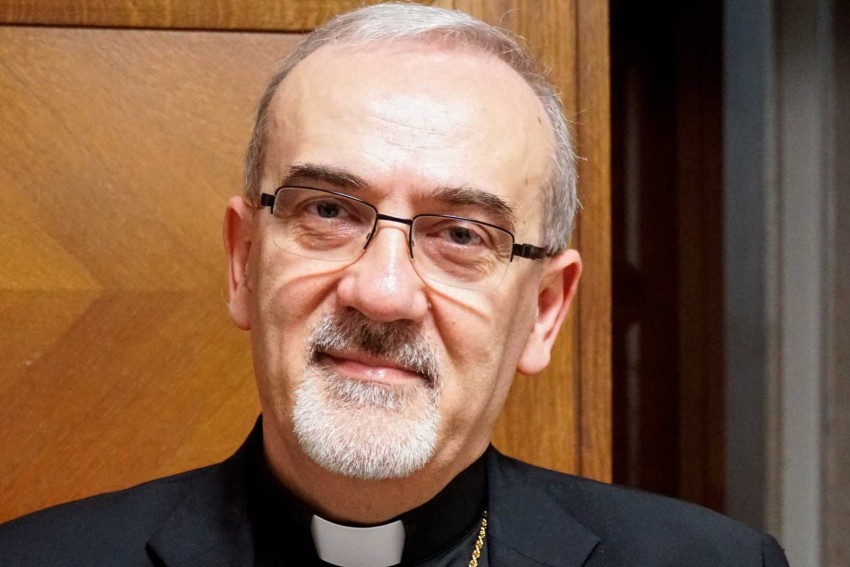

Professor John M. Rist. The brilliant British Catholic historian emailed me about my letter on the “filioque” question and proposed that I read his essay on the role of St. Athanasius at the 1st Ecumenical Council of Nicaea… I decided to send his paper out to you. This is the last of three parts… sent on the very day that Pope Leo XIV has visited Nicaea, 1,700 years after the events recounted in this essay by Rist…
Letter #91, 2025, Friday, November 28: Rist, #3
November 24, 2025
Dear Robert,
Since you are apparently perpetuating in this piece [he is referring to my Letter #77, 2025, Monday, November 24: The Creed] some traditional mistakes about Nicaea, especially about what was almost the non-role of Athanasius, I attach a relevant paper on the subject I was asked to write for a Romanian Orthodox journal.
Best, JOHN RIST
***
After receiving this letter from Prof. John Rist, I decided to send out the “relevant paper” by Prof. Rist, in three parts.
I decided this especially because Peter Anderson, another thoughtful Catholic writer now in his 80s, thinks Pope Leo may move on the “filioque” (“and from the Son”) question, in order to reconstitute the original, united Catholic Church, which united Church was shattered in 1054, in the “Great Schism,” which saw the Pope of Rome and the Patriarch of Constantinople mutually excommunicate each other, partly due to disagreements about the appropriateness of the “filioque” addition to the Creed.
So, in the interest of a return to full reunion between Catholics and Orthodox, I will now serialize this long essay by Prof. Rist, on the question of what actually happened at the 1st Ecumenical Council in Nicaea in 325 A.D., under the rule of the Emperor Constantine.
I hope this may be a contribution to the final goal: to overcome and reverse the “Great Schism,” and reunite the Christian world, divided for nearly 1,000 years.
Here, is the 3rd and final part of Rist’s compelling, complicated, illuminating discussion of St. Athanasius and Arius at the 1st Ecumenical Council in 325 A.D.
[Note: Arius was a presbyter (priest), not a deacon, at the time the Arian controversy began. He was in charge of the Baucalis district church in Alexandria, Egypt. Earlier in his life, Arius had been ordained a deacon by Bishop Peter of Alexandria, but was later excommunicated during the Meletian schism. He was later reconciled to the Church and ordained as a priest (presbyter) by Achillas, Peter’s successor. His conflict with BishopAlexander, who succeeded Achillas as bishop, is what led to the theological dispute that resulted in the Council of Nicaea in 325 CE, where Arianism was condemned as heresy.]
–RM
Part #3
(Continued from Rist, #2, sent yesterday)
POLITICS AND THEOLOGY AT NICAEA.
CONSTANTINE, OSSIUS AND EUSEBIUS OF NICOMEDIA
By John M. Rist
Emeritus Professor of Classics and Philosophy
at the University of Toronto
Page 30
Despite the insistence on homoousios at the Council, for some time after even Athanasius preferred the perhaps more dangerous – but less ambiguous – periphrasis ‘like in substance’ (homoios kat’ousian), and after Constantine’s death that might be enough, either because it might no longer seem necessary to tolerate ambiguity or because the Emperor’s word was no longer so fashionable.
Perhaps it was, in part, because Ossius and his supporters knew
________________________
Page 31
or at least suspected that the Emperor determined on homoousios because it was ambiguous that they added what they regarded as necessary explanatory language.
During Constantine’s lifetime, homo-ousios might indeed (if one so wished) be read as homoi-ousios: this being the price to be paid for the agreement Ossius had achieved.
With the Emperor entombed in his Church of the Holy Apostles in his city of Constantinople, it might be safer from an ‘orthodox’ point of view to stay with ‘likeness in ousia’ which might be considered ‘orthodox’ provided the word hypostasis is left aside.
Alexander’s pre-conciliar ‘like the hypostasis of the Father’ should be ‘interpreted’ as ‘similar (i.e. identical) to the Father in substance’ (homoios kat’ousian).
***
Events after the Council shed further interesting light on Constantine’s intent in insisting on the word homo-ousios, for although the party of Ossius appeared to have been victorious, their fortunes quickly changed.
In 326, with the Council concluded, it seems that Ossius – perhaps angered by Constantine’s execution of his son Crispus over a sexual misdemeanor the details of which it is now impossible to retrieve – left the court and returned to Spain(50), giving Eusebius of Nicomedia, bishop of the still de facto capital of the now united Empire(51), his chance to replace him as Constantine’s theological adviser.
But that was for the future; in 326, Eusebius (and Theognis) were still in exile for refusing to sign the condemnation of Arius.
It is easy to see why Constantine insisted (at least when convenient) on obedience to Council decisions, his overarching aim being to ensure uniformity of religion in the Empire.
That said, the enemies of Ossius and Alexander persisted, and at a further Council at Antioch in 327 – apparently orchestrated by Eusebius of Caesarea – retribution struck down Eustathius of Antioch, a leading opponent of Arius at Nicaea who continued his attacks on the ‘Arians’, not least by demolishing the Arian interpretation of
50 So V.C. DECLERCQ, Ossius of Cordova: A Contribution to the History of the Constantinian Period, Catholic University of America Press, Washington, 1954, p. 282.
51 SOCRATES, Historia ecclesiastica 1, 6, with the comments of DRAKE, Constantine, p. 261.
___________________________
Page 32
one of their favourite proof-texts (Prov 8:22; cf. Col 1:15). Eusthathius was accused of various moral offences – as we have noticed, Constantine was a stickler on such matters – as well as of being critical of the Emperor’s mother Helena. He was replaced by Paulinus of Tyre. With him, or soon after, were deposed Asclepas of Gaza (Athanasius, Apologia contra Arianos 45, 2) and other members of the party of Ossius.
Times being thus a-changing, Eusebius of Nicomedia, Theognis and even Arius could hope for rehabilitation.
In November 327 (Opitz, Urkunde 29), Constantine summoned Arius to Nicomedia, examined him in person and declared him orthodox, suggesting that he favoured a very open-ended definition of the meaning of homoousios and of the new ‘orthodoxy’ more generally(52).
Despite his preferred policy of insisting on strict obedience to conciliar decisions, he referred the matter of Arius’ orthodoxy to a further Council, which opened in December of the same year – this time (informatively?) in the still exiled Eusebius’ see of Nicomedia. Again, he attended in person.
The bishops assembled urged that all the plaintiffs – Eusebius, Theognis and Arius himself – be readmitted to the Church, and Constantine, seeking harmony, agreed.
But the elusive unity which he sought was still not forthcoming, with Alexander refusing to accept the re-admission of Arius in Alexandria.
Conveniently for Constantine, this awkward bishop soon passed away.
But the game was not over: he was hastily – some said over-hastily – replaced on June 8, 328 by Athanasius.
The new bishop of Alexandria followed the policy of his predecessor in refusing to readmit Arius, and Eusebius of Nicomedia, now happily returned to his imperial see, intervened on Arius’ behalf and secured the Emperor’s support: indication that he was already beginning to assume the ministerial (but now more ‘ecumenical’) role earlier played by Ossius.
But while Arius still remained in exile (presumably in Libya), Athanasius, as a result of his continuing ‘obstinacy’, had to appear before the Emperor on various
52 RUFINUS’ comment, Historia ecclesiastica 1, 11, that the dying Constantia had an Arian chaplain and through him encouraged the Emperor to reconsider the case of Arius should not be too readily dismissed as inflated. Constantia, we recall, was close to Eusebius of Nicomedia when she was married to Licinius.
_______________________
Page 33
charges relating to his election in Alexandria, as well as to his alleged use of violence against the partisans of Melitius who were supporting a rival claimant to that see.
Though he cleared himself of all charges and returned to Alexandria in early 332, Athanasius’ troubles were far from over: further charges, including an alleged murder (of a man who turned out to be still alive), were brought against him.
The struggle for Constantine to make up his mind in the ‘right’ direction – or to show what he had always wanted but in which he had been thwarted by Ossius – continued, and Athanasius’ opponents now included not only Eusebius of Nicomedia, along with Eusebius of Caesarea and Theognis of Nicaea (the usual suspects), but also two Western figures who were to play a prominent role in battles over Arianism in succeeding decades: Ursacius of Singidunum and Valens of Mursia(53).
The ‘Arian’ dispute was spreading beyond the East, and at a further Council in Tyre in 335, Athanasius was deposed and excommunicated, not on doctrinal grounds but again because of his alleged violent behaviour against opponents, largely Melitians, in Alexandria.
Athanasius still refused to submit and travelled to Constantinople to plead his cause, but to no avail, further charges (including treasonably delaying corn-ships sailing from Alexandria to Constantinople) being brought against him.
Finally, Constantine told him that if he defied his emperor and prevented those who so wished (i.e. Arius) from being members of the Church, his deposition would be enforced(54).
And soon, though not deposed, he was exiled to Trier, the lesser penalty surely because the Emperor still hoped to include the surviving members of the ‘party of Ossius’ in the ‘big tent’, and because he was still of his opinion that theological trivia such as were dividing Alexander – and now Athanasius – from Arius should not stand in the way.
But with Ossius gone and Eusebius of Nicomedia ready with advice, it was only to be expected that Constantine’s apparent earlier
53 ATHANASIUS, Apologia contra Arianos 87, 1. For details, see T.D. BARNES, Athanasius and Constantius: Theology and Politics in the Constantinian Empire, Harvard University Press, Cambridge MA, 1993, pp. 20-24.
54 ATHANASIUS, Apologia secunda contra Arianos 59, 4.
_______________________
Page 34
orthodoxy’ would tend to yield to more obviously ‘Arianizing’ persuasion.
Arius now grew restive, threatening to establish an alternative church unless he was rehabilitated and readmitted in Alexandria. This was a step too far, and Constantine’s patience appears again to have run out.
Two letters reached Alexandria, one to Arius in person, the other a circular. In the latter, a furious Constantine compared Arius to Porphyry – not, of course, as influenced philosophically by Porphyry, but as an enemy of Christianity – and ordered that his books be similarly burned – which action has contributed substantially to our limited knowledge of both of them.
Constantine noted that Arius’ view that the Son’s hypostasis was different from the Father’s merely repeated what had been anathematised at Nicaea: Father and Son had (in some sense) ‘one ousia’: hence Arius was outside the Church, and harsh penalties were prescribed for those, whether lay or clerical, who supported him.
Yet still, Constantine left the door open, again telling Arius that he could come back to court to defend himself.
But things were only to get worse for the ‘party of Ossius’ (now the party of Athanasius).
In 336, Constantine was induced to act firmly against Marcellus who had continued to lash out not only at Arius but at his leading supporters, claiming that many of them were disciples of Origen who had corrupted theology with nonsense derived from pagan philosophy.
In a letter to the Emperor defending his conduct, Marcellus observed that in their writings one could find references to a ‘first and second God’: that might sound like Origen the ‘Platonist’ – or even the pagan Middle Platonist Numenius of Apamea.
Such language, now certainly incriminating Eusebius of Nicomedia, proved a step too far in the anti-Arian direction for ‘big tent’ theology.
In July 336, Constantine summoned a new Council in his new capital of Constantinople which, contrary to the wishes of its bishop, confirmed the orthodoxy of Arius who, personally questioned again by Constantine, now swore on oath that he accepted the decrees of Nicaea.
That was either blatant perjury or – more probably – indication that he and Constantine both knew that homoousios was not always to be read in line with the theology of Ossius and Alexander. The case of Arius settled, the Council went on to replace Marcellus as bishop of Ancyra by
_______________________
Page 35
a certain Basil (not the saint but a future leader of a party which might have included Constantine): clear indication that the ‘big tent’ was still intended to include Arius and that trouble-makers like Marcellus were to be excluded.
However, Arius’ personal triumph was short-lived, despite Eusebius of Nicomedia and his supporters determining to compel the unwilling bishop of Constantinople to communicate with him.
For though details of what happened next are disputed, it is clear that they were thwarted.
On the way to their chosen church, Arius died (to the often delight of succeeding generations) from a hemorrhage in a public lavatory, but if he himself ‘went down the tubes’, neither his ideas nor the power of the party of Eusebius of Nicomedia went with him.
According to Athanasius(55), Eusebius conducted Arius’ funeral, though whether he died in communion with the Church or whether, as Williams suggests(56), Constantine was too ‘shocked’ (or horrified) at the manner of his demise, is uncertain.
Athanasius, however, remained in exile in Trier until June 337 when, with a second division of the empire after Constantine’s death, his son Constantius, now ruler of the East, allowed him, as all other exiled bishops, to return to his see.
But the final mind of Constantine cannot be inferred from the future troubled relationship between Athanasius and the new Eastern Emperor.
That said – and contrary to the rules for bishops now established at Nicaea – in the new reign, Eusebius was almost immediately transferred from Nicomedia to Constantinople, the new Eastern capital, and retained this influential position until his death, probably in 341.
His final role as the preferred theological adviser to Constantine continuing under Constantius was a clear indication that the open-ended, indeed rather more ‘Arian’ interpretation of Nicaea was now the dominant Imperial ideology.
For if Constantine thought that his ‘big tent’ could include Ossius as well as Eusebius of Nicomedia and with them Arius himself, history had proved him wrong.
In effect, the arrival of Constantius ensured that ‘moderate’ ‘Arians’ – and eventually extremists – were in theological charge, albeit at first only of the Eastern part of the Empire. The position of
55 Ad Serapionem 4.
56 WILLIAMS, Arius, p. 81.
______________________
Page 36
Athanasius and the vast majority of the Egyptian Church found little support among Easterners but much more in the West.
***
Though towards the end of his life Constantine retained some sympathy for Athanasius, despite the imperial mix of toleration and furious impatience towards Arius, his latter-day attitude to Eusebius of Nicomedia in particular indicates that whereas he had earlier appeared to endorse Ossius’ understanding of homo-ousios, he was now revealing more clearly his preference for a looser interpretation – or interpretations.
Thus, the ‘big tent’ remained open at the end of his reign, with Constantine revealing, as would his son, either that he had always wanted the ‘Arians’ inside – the more likely explanation – or that he had changed his mind (perhaps suspecting he had been misled).
However, his mind had not entirely changed in that he was happy to exile Athanasius but not to remove him from his see, thus suggesting that he wanted to include not only ‘Arians’ (of whatever stripe) but also the ‘party of Ossius’ in the ‘big tent’.
Yet it was Eusebius of Nicomedia who was present to baptise him on his death-bed when, with no more sins to commit, it was safe to be a baptised Christian without needing to risk losing the support of bishops who (perhaps like Ossius) might be offended by his execution of members of his own family.
Three of his sons, however, continued the same sort of good work when they divided his domains among themselves soon after his death.
As for the interpretation of the Creed agreed at Nicaea, for a while it seemed to be chacun à son goût [“each according to his own taste”] until a more radical ‘Arianism’ claimed that the Son was substantially ‘unlike’ the Father.
Constantine wanted the party of Ossius to remain inside the tent, but refused to allow them to exclude others, either more nuanced supporters of Arius like Eusebius of Caesarea or those more extreme.
He never gave up on the word homoousios itself; its ambiguity suited his purposes.
But ambiguity could never be acceptable to the party of Ossius, Eusebius of Nicomedia, or Arians of whatever stripe – nor, as would turn out, to his son Constantius.
***
It has been widely recognised that after Nicaea, not only homoousios but the Council itself was hardly mentioned for many
_______________________
Page 37
years, nor did the new creed immediately affect the formulation of local creeds, designed as preparation for baptism.
Nor in the turbulent forties did Athanasius draw attention to homoousios, preferring, as we have noticed, to refer to the Son as ‘like the Father in all respects’, or ‘like the Father in substance’(57).
Not that Arius was given much credit even by the far from Athanasian bishops at the so-called ‘Dedication Council’ at Antioch in 341.
These went out of their way to point out that, as bishops, they were not partisans of the views of a mere presbyter and to condemn any suggestion that there was a time when the Son was not.
Without mentioning Nicaea, however, they produced several creeds – and notably the second so-called Dedication Creed, the contents of which differed substantially from the Nicene version, which it seems it was intended to replace. It is often supposed to reflect much of the thinking of Origen and Eusebius of Caesarea(58), and may also indicate something like the non-Arian but also non-Nicene position of Eusebius (once of Nicomedia, now of Constantinople) who attended its early sessions but died before it was completed.
Gradually, a clear difference of opinion seemed to be arising between most Western and most Eastern bishops over ‘Arian’ issues.
The Western Emperor Constans, encouraged by Pope Julius – now a long-time supporter of an Athanasius in 339 again ejected from his see by the ‘Eusebians’, then betaking himself to Rome – was persuaded that a special Council was needed to heal the rift and undo the sentence on Athanasius approved at the Council of Tyre.
This was scheduled for Serdica in 343, and the entirely novel claim of ‘pope’ Julius that as bishop of Rome he could override the decisions of an Eastern Council, i.e. that of Tyre, received short shrift from the Easterners.
In the event, the Council descended into farce, and though neither of the Western leaders – Ossius (again) and the local bishop Protogenes – mentioned the Great Council or its Creed, Ossius must have recognised that his position was very different
57 Cf. KELLY, Creeds, pp. 257-258.
58 So HANSON, The Search, p. 290.
____________________
Page 38
from – and much weaker than – at Nicaea. He could no longer rely on full Imperial support; indeed, the Eastern Augustus, Constantius, was largely hostile. The Westerners were reduced to hurling abuse at the opponents (as they supposed) of Nicaea who had found in a victory of Constantius over the Persians an excuse to withdraw to Philippopolis. From there, they retaliated in a ferocious kind, excommunicating their opponents and excoriating Athanasius, Marcellus and several more of the ‘party of Ossius’, including Ossius himself(59).
Despite such goings-on, neglect or even ignorance of Nicaea was still quite widespread in the West: Hilary of Poitiers tells us that he had no knowledge of the Council until the 350s(60), and he would not have been alone.
By the time he learned of Nicaea and its upshot, we have more or less reached the upheaval for the entire Church caused by the so-called ‘Blasphemy’ Council of Sirmium in 357 (to be followed by ideologically similar Councils at Arles and Milan) where, under the patronage of Constantius – by now sole ruler of the Empire – an extreme anti-Nicene document was drawn up by those veteran Arians, Ursacius and Valens.
Constantius proceeded to impose it.
For the first time, there were no anti-Arian anathemas.
Now, words denoting substance (ousia), including homoousios, were forbidden as non-Scriptural, for the origin of the Son is a mystery, all attempts to explain it foolish.
This might be read as a return to pre-Nicene uncertainty, or to the position of Eusebius of Nicomedia, but there is a new (or rather revised) emphasis: what matters is that the Father is greater than the Son whom he has ‘begotten’, that the Son is therefore wholly unlike the Father and hence – significantly but unexpectedly homoi-ousios (similar in substance) as well as homo-ousios is proscribed.
In view of the comparative lack of open reference to homoi-ousios in earlier debates, we should ask why the ‘neo-Arians’ – in some ways more radical than Arius if less so in others – were now intent on banning it.
59 For a detailed recent account, see BARNES, Athanasius and Constantius, pp. 72-77.
60 So BARNES, Augustine and Nicene Theology, pp. 59-61.
___________________
Page 39
A plausible answer is not far to seek: at Nicaea itself, many of the bishops who subscribed to homo-ousios probably interpreted it – pace the party of Ossius – as indicating, not that the Son is identical with the Father in substance, but that he is similar (or very similar) in substance.
I have suggested that Constantine, too, appreciated the ambiguity of the disputed term as allowing both Ossius and those who were in effect homoi-ousians to enter his ‘big tent’.
And it was just such a group of similar-minded Eastern bishops who, in large numbers, recognised in the ‘blasphemous’ document of Sirmium not the now ambiguous homo-ousios but the clear denial of substantial similarity in any form between Father and Son as taught by the ‘neo-Arians’ — Aetius and Eunomius of Cyzicus.
Put otherwise, a large number of bishops (led by Basil, successor to Marcellus at Ancyra) now saw the disputes about substance in a sharpened light as: Is the Son like the Father in substance at all?
Earlier, such focus had been obscured by what might be read only as a claim that the Son is ‘similar’ (but not identical) in substance to the Father.
The teachings of Aetius and Eunomius thus brought out very clearly the difficulties faced by the party of Ossius (who at an advanced age was picked out for humiliation and pressured by the neo-Arians to sign the ‘Blasphemy’: which act he repudiated as soon as he could).
According to the new teachers, the primary difference between the Father and the Son is that the Father is unbegotten and the Son begotten: which formula – originally designed to teach that it is false to claim there was a time when He was not and so to emphasise that the Son is not ‘made’ like the rest of creation – had as yet hardly been thought through.
We should remember that Arius took an extreme view of the matter, essentially agreeing with the ‘neo-Arian’ position, for he had always held that in the case of God, to be begotten implies ontological inferiority(61).
For the radical neo-Arians at the ‘Blasphemy’ Council and later, ‘substance’ language in general is either wholly undesirable or too ambiguous, and much better abandoned. They, of course, had a point in claiming that though the Son is not ‘made’, the
61 See especially the discussion of KELLY, Creeds, p. 233.
______________________
Page 40
words ‘unbegotten’ and ‘begotten’ suggest a significant difference of substance and therefore His subordination, even though it be conceded that such subordination still allows His generation to be ‘before all ages’.
For if the Son were – as the party of Ossius and now of Athanasius held – absolutely identical in substance, then (they might claim) we could as well say not only that there are two ‘unbegottens’ but that the Son was unbegotten and the Father begotten, which would seem absurd.
Alexander himself had recognised this problem even in pre-Nicene times, an otherwise unidentified presbyter named George having written to him urging that a son has to become a son(62).
That said, it is clear that the problem the party of Ossius failed to come to grips with could not be solved so long as the words ousia (substance) and hypostasis (also substance, but allowing for subordination, as in Plotinus, Origen and others) could be treated as synonyms.
This would eventually be realised when the ‘orthodox’ separated them, treating of one ousia and three hypostaseis, thus linking hypostasis – now become little more than a term of art – not with substance but with what the Westerners thought of as non-identifiable Persons.
It might still be objected that the Eastern use of hypostasis for Person ‘metaphysicized’ at least the humanity of Christ, but that is ‘another story’ and cannot be detailed here.
What can be said is that the Anomoian version of Arianism compelled the now ‘orthodox’ to be more avowedly precise – certainly than Constantine would have wished – in separating ousia from hypostasis.
The long-term effect of their intervention was the substitution (as Alexander in the beginning seems to have struggled to express it) of a theology whereby ‘God’ in the strict sense applies to the Father only by a revised version where it is understood as referring to the Trinity of consubstantial Father, Son and Holy Spirit.
***
I began this discussion by explaining that Constantine shared with several of his predecessors the goal of establishing one theologically unified religion – in his case, Christianity – for the entire
62 OPITZ, Urkunde 12, 19.3-5.
_______________________
Page 41
Empire: there was to be a ‘big tent’ in which monotheistically-minded pagans (perhaps viewed as fellow-travellers) might be included.
Originally, Constantine seems to have been persuaded that the theology of the ‘party of Ossius’ would best serve his turn, especially if expressed through what he found the conveniently flexible term homoousios.
Some sixty years later, his wish for unity was more or less achieved, and a reformed version of the views of the party of Ossius prevailed, now admitting openly what Alexander at least implicitly pointed to: that the Christian God is not Father alone, but Trinity.
But Constantine did not live to see religious uniformity; indeed, in later life, he may have convinced himself (or been convinced by Eusebius of Nicomedia and his ‘party’) that homo-ousios is not flexible enough to bring in all dissenters.
The desired unified religion was more or less achieved at Constantinople in 381, but while disagreements about the substance of Christ were more or less settled there, disagreements about his Person, whether single or double, soon meant that the search for unity must begin again – and this time no patch-up was achieved and the Monophysite and Nestorian Churches went their own ways.
Hence, the successors of Constantine from Theodosius on (not to speak of later generations of bishops) no longer needing (or heeding) the advice of such astute political animals as Ossius and Eusebius of Nicomedia, found it easier to resort to plain old-fashioned persecution – though the success of that too remained incomplete.
By the end of the fourth century the ‘big tent’ policy was discredited, with ‘pagans’ – the term ‘pagan’ is now more suitable as non-Christians were increasingly viewed as pagani or ‘peasants’ (in the London slang sense of the word) – increasingly only to be found in the remoter countryside where they were often harassed.
The great temple of Serapis in Alexandria, one of the wonders of the ancient world, was destroyed by Christian rioters in 391.
In 415 in the same city, the Neoplatonic philosopher Hypatia was stripped (of course) and hacked to death by a gang of monks, with the probable complicity of the Archbishop. As for the Christians,
_______________________
Page 42
after the already murderous battles between the partisans of the various creeds in the fourth century, Priscillian of Avila was the first bishop to be formally executed for heresy in 385: a solution to the deviance problem endorsed by many and epitomised by the bishop who at the Council of Chalcedon was heard to yell, ‘Cut in half the man who divides the Christ’. It was the end for Constantine’s ‘big tent’(63)!
63 Much of this essay is dependent on great scholars of the past, especially H.G. Opitz and E. Schwartz. A thesis defended at the University of Durham, ‘An Examination of the Role of Ossius, bishop of Cordoba, in the Arian Controversy’, by D.J. McLay should be commended for drawing more attention to the too neglected Spanish bishop’s activities during, before and after Nicaea, while at same time avoiding the papalist and moralising (indeed at times virtue-signaling) manner of DECLERCQ, Ossius of Cordova. And it is encouraging to be reminded of the Elephant in the Room (i.e. Constantine) by DRAKE, ‘The Elephant in the Room’.
For up-to-date historical (and especially chronological) comment on the age of Constantine I have relied heavily (as is apparent) on the magisterial work of my former colleague in Toronto, Timothy Barnes, whose ‘problem’ (as the master of masters in Roman history, Sir Ronald Syme, acknowledged), was that ‘he is just so damned accurate’.
More generally, I have profited from the helpful and encouraging comments of Aidan Nichols, O.P., Antonio Malo and Sarah Byers. The whole text (in more than one version) has been ‘woman-handled’ by Anna Rist; hence, no mean increase in clarity.
(End, essay by Prof. John Rist on the 1st Ecumenical Council of Nicaea in 325 A.D.)