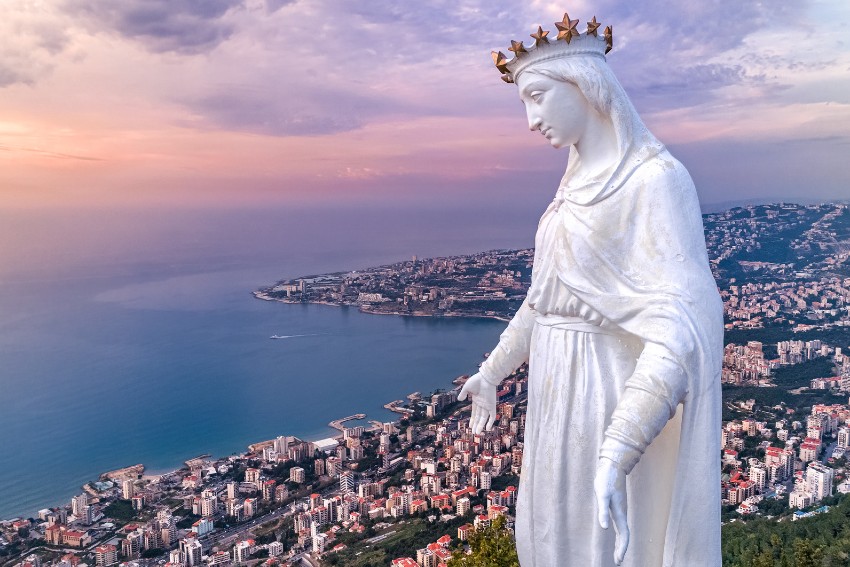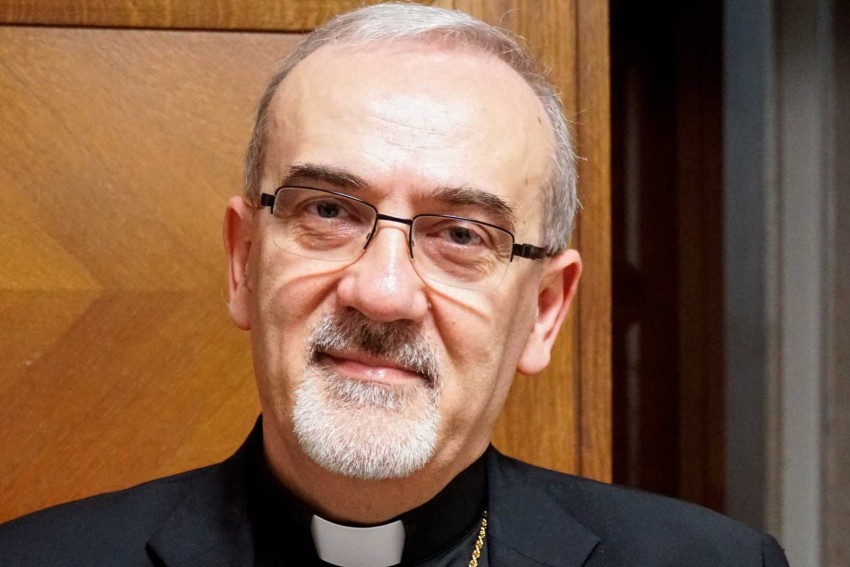

Pope Leo, reading his final farewell message to the Lebanese people as he left Lebanon today, following a 3-day visit which included a 5-minute prayer at the tomb of St. Charbel (below)


The Pope visited the De La Croix hospital on his last morning in Lebanon. He made his remarks to the staff and patients in fluent French

Pope Leo as he waved farewell to Lebanon today. He left from Beirut airport for Rome
***
Letter #96, 2025, Tuesday, December 2: Day #6 of Pope Leo’s 1st Papal Trip to Turkey and Lebanon
The Pope today visited the sick, celebrated Mass, and said farewell to Lebanon, the Land of the Tall Cedars.
His message: “May the peace of the Lord be with you now and forever.”
And: “I pray that this land of the Levant may always be illuminated by faith in Jesus Christ.”
Below, a report from Polish journalist Anna Artymiak on the events of this final day of the Pope’s apostolic visit to Turkey and Lebanon.
***
Pilgrimage to Lebanon
If anyone would like to travel on a pilgrimage with Inside the Vatican Pilgrimages to Lebanon, to the tomb of St. Charbel — and to meet Father Louis, if he is well — we will be making a pilgrimage to the tomb in September of 2026. Please consider joining. Information here and by clicking the tabs below.
***
Below, Anna Artymiak‘s account of Pope Leo‘s day.
—RM
***
Note: If you would like to subscribe to this letter, or add a friend as a subscriber, you may do so here.
Polish Vaticanist Anna Artymiak, who has in recent days been following the Pope’s trip to Turkey and Lebanon, filed the following report:
Day #6, December 2: “Lebanon, stand up!”
By Anna Artymiak
Tuesday, December 2, 2025
Part 1 — Visit to the Staff and Patients of the De La Croix Hospital
“We cannot conceive of a society that races ahead at full speed, clinging to false myths of well-being.”
BEIRUT — Pope Leo XIV concluded his first international journey Tuesday, spending the final day of his apostolic visit to Lebanon under clear, sunny skies.
For three days, Lebanon seemed able to set aside its suffering and recover a sense of hope for the future.
Leo’s remarks throughout the trip were marked by the tenderness and compassion that have become hallmarks of his pontificate.
The Holy Father left the apostolic nunciature in Beirut at 8 a.m. local time, gifting the residence a chalice.
He then traveled by white Toyota to Jal el Dib, about 5.6 miles north of the capital, for a visit to the staff and patients of the “De la Croix” (“Of the Cross”) Psychiatric Hospital.
There he met with the Franciscan Sisters of the Holy Cross and the people they serve — an encounter that proved to be the most moving moment of his first apostolic journey.
Crowds lined the streets waving small Vatican flags, some tossing flowers as the convoy passed.
Armed soldiers maintaining security formed a sharp contrast to the joyful atmosphere.
Church bells rang, and street poles were decorated with Lebanese and Vatican flags.
Portraits of Leo XIV appeared in many places.
Even in narrow streets, where people pressed in close, the Pope could feel the deep affection of the Lebanese.
At the hospital, the joy seemed endless.
The mother superior, speaking in Arabic, was visibly moved and struggled to deliver her prepared remarks.
She emphasized that the hospital is “a place that does not choose its patients, but lovingly embraces those no one else has chosen.”
Here, she said, live “forgotten souls, burdened by their loneliness… faces unseen in the media, unheard from pulpits.”
She asked Pope Leo to consider the canonization of the hospital’s founder, Blessed Father Jacques, beatified in 2008 by Pope Benedict XVI.
The hospital is organized into various departments, including one dedicated to treating young people with drug dependence.
Some patients have no relatives to care for them.
The hospital faces a chronic lack of funds, worsened after the Beirut port explosion.
The daily cost of caring for one patient is $70, but the sisters receive only $15.
In this context, the mother superior described their work as “a daily miracle.”
“How do we carry on, without support, yet open our doors ever wider each time the world’s doors close to those who seek refuge?” she asked. “Neither science… nor worldly economics… nor human logic can explain it. Only Heaven holds the answer. It is Abouna Yaacoub’s great miracle. We live from the widow’s mite, yet we lack nothing; for God turns the offerings of our benefactors into an overflow of love, just as Christ multiplied the five loaves and the two fish. The miracle is renewed, and the hungry are fed.”
Two elderly patients then spoke on behalf of all those in care—one woman in French, and one man in English.
The Pope greeted those present in Arabic, a gesture that visibly moved many. He then continued in a fluent French, the European langauge most widely spoken in Lebanon, because it was for decades administered by France.
“I wanted to come because Jesus dwells in this place: in you who are ill, and in you who care for the ailing—the Sisters, the doctors, all the healthcare workers and staff,” Leo XIV said, assuring them of his daily prayers.
He recalled the founder of the hospital and the congregation, Blessed Father Jacques, “a tireless apostle of charity remembered for the holiness he showed especially through his love for the poorest and the suffering.”
The Pope praised the staff’s skilled and compassionate work as “a tangible sign of the merciful love of Christ.”
“You are like the Good Samaritan,” he said, “who stops beside the wounded man and cares for him, lifting him up and tending to his wounds.”
Acknowledging the challenges the personnel face, Leo XIV encouraged them “not to lose the joy of this mission,” adding, “Despite the difficulties, keep before your eyes the good you are able to accomplish. In God’s eyes, it is a great work.”
The Pope said the hospital stands as “a clear reminder to all,” criticizing society’s growing lack of sensitivity toward the vulnerable. “We cannot forget those who are most fragile,” he said. “We cannot conceive of a society that races ahead at full speed, clinging to the false myths of well-being while ignoring so many situations of poverty and vulnerability.”
He emphasized that Christians in particular “are called to care for the poor. The Gospel itself asks this of us. The cry of the poor, echoed throughout Scripture, challenges us.”
Turning again to the patients, he said: “Dear brothers and sisters who are burdened by illness, I remind you that you are close to the heart of God our Father. He holds you in the palm of his hand; he accompanies you with love; and he offers you his tenderness through the hands and smiles of those who care for you.”
After the blessing, the crowd chanted, “We love you!”
The Pope then visited the children’s ward to meet privately with 58 young patients, nearly half of whom have no families.
Before leaving, he presented the hospital with a statue of St. Joseph holding the Child Jesus, Salvator Mundi.
The mother superior offered him an icon of their founder.
Part 2 — Silent Prayer at the Beirut Port Explosion Site
After meeting the patients and staff, Leo XIV traveled to the site of the 2020 Beirut port explosion for another deeply emotional moment.
He prayed silently at the monument to the victims, laid red roses, and met families who held photographs of loved ones killed on August 4, 2020.
More than 200 people died, 7,000 were injured, and an estimated 300,000 lost their homes.
The explosion was caused by ammonium nitrate confiscated in 2014 from the abandoned cargo ship MV Rhosus and improperly stored in the port.
A minor blast was followed by a massive one, considered among the most powerful non-nuclear explosions in history.
The U.S. Geological Survey registered it as a seismic event of magnitude 3.3.
Families of the victims continue to await answers from authorities.
***
Part 3 — Holy Mass at the Beirut Waterfront
“We must unite our efforts so that this land can return to its former glory.”
BEIRUT — “Lebanon, stand up! Be a home of justice and fraternity! Be a prophetic sign of peace for the whole of the Levant!”
Pope Leo XIV used these words during his homily at a Mass celebrated this morning at the Beirut Waterfront, his final major event before departing the country.
Before the liturgy, the Holy Father toured the gathering in the popemobile, greeting thousands who had assembled on the shoreline.
With the Catholic Church having begun the Advent season, the liturgical vestments were violet. The Mass for peace and justice was celebrated in French, with the first reading proclaimed in English, the responsorial psalm in French, and the Gospel in Arabic.
In his homily, Leo XIV spoke with compassion about the heavy burdens carried by the Lebanese people.
“Praise does not always find a place within us,” he said. “Weighed down by the struggles of life, worried about the many problems around us, paralyzed by powerlessness before evil and oppressed by difficult circumstances, we can be inclined to resignation and lamentation.”
He urged the faithful to cultivate “an attitude of praise and gratitude,” reminding them that they are “the recipients of a rare beauty with which the Lord has adorned your land,” even as they are “victims of how evil, in its various forms, can obscure this splendor.”
The Pope again invoked Lebanon’s natural beauty — celebrated even in Scripture — and contrasted it with the deep wounds the nation continues to endure, including the 2020 Beirut port explosion whose site he had visited earlier in the day. This beauty, he said, is overshadowed by poverty, suffering and “a fragile and often unstable political context,” as well as a dramatic economic crisis and episodes of violence that have “reawakened ancient fears.”
“In such a scenario,” he said, “gratitude easily gives way to disillusionment. Songs of praise find no place in a desolate heart, and hope dries up under the weight of uncertainty.”
Yet the Pope encouraged the people to “find the small shining lights in the heart of the night,” opening themselves to gratitude as a way of renewing commitment to one another and to the country.
Reflecting on the day’s Gospel, he said Jesus gives thanks to the Father not for spectacular deeds, but because God reveals his greatness “to the little ones and the humble — those who do not attract attention, those who seem to count for little or nothing and whose voices are often unheard.”
This, Leo XIV said, is “a small sign of hope that promises rebirth when everything else seems to be dying.”
He urged Lebanese Christians to develop “eyes capable of recognizing the small shoot that grows even in painful times.”
The Pope praised the richness of Lebanon’s Christian life: strong family-based faith, the educational mission of Christian schools, the service of parishes and congregations, the dedication of priests and religious, and the charitable witness of laypeople.
But gratitude alone is not enough, he warned.
“It must lead to a transformation of the heart, a conversion of life,” calling all to “live in the light of faith” and not be discouraged by financial hardship, violence, the idolatry of money or the spread of evil.
In the presence of government authorities, Leo XIV issued a firm appeal:
“We must unite our efforts so that this land can return to its former glory.”
The only way forward, he said, is “by disarming our hearts.”
“Let us cast off the armor of ethnic and political divisions,” he continued. “Let us open our religious communities to mutual encounter and reawaken in our hearts the dream of a united Lebanon — a Lebanon where peace and justice reign, where all recognize each other as brothers and sisters.”
Quoting the prophet Isaiah — “The wolf shall live with the lamb… the calf and the lion shall graze together” — he entrusted this “dream” to the people, saying it was God’s dream for Lebanon as well.
“I pray that this land of the Levant may always be illuminated by faith in Jesus Christ,” he said.
The congregation listened in silence and with deep attentiveness.
At the end of the Mass, the Pope gifted a chalice and then delivered a surprise appeal in English — a message directed to the entire Middle East.
“I wanted to come as a pilgrim of hope to the Middle East, imploring God for peace for this beloved land, marked by instability, wars and suffering,” he said, urging people to reject despair and to commit themselves to coexistence and fraternity.
“Be artisans of peace, heralds of peace, witnesses of peace!”
The Pope said the Middle East “needs new approaches” to overcome revenge, violence and political, social and religious divisions.
“We need to change course,” he said. “We need to educate our hearts for peace.”
He shared that he prayed not only for the peoples of the Middle East, but also for political reconciliation in Guinea-Bissau and for the victims of a fire in Hong Kong.
Leo XIV appealed once more to leaders across the region:
“Listen to the cry of your peoples who are calling for peace!”
He urged all to choose life, the common good and the integral development of every person.
“To the people of the Levant,” he said, “I repeat: have courage!”
Before leaving the altar, the Pope spent a long moment in silent personal prayer before an icon of the Virgin Mary, while the faithful expressed their joy at his presence.
He greeted many individuals, including firefighters, soldiers and members of the security team who had served him throughout the visit.
***
Part 4 – Farewell Ceremony
The final day of Pope Leo XIV’s visit closed a trip marked by joy, gratitude and a clear message from the Holy See.
For many around the world, the visit offered a rare glimpse of Lebanon’s cultural and spiritual richness — a side often overshadowed by crisis.
Even days before the trip, the stop in Beirut had seemed uncertain.
But the Pope’s presence reshaped global headlines, placing Lebanon back in the news for hopeful reasons.
Leo XIV arrived as a messenger of peace and encouragement, urging the country to view itself from a new perspective.
During the farewell ceremony, President Joseph Aoun thanked the pontiff for his message.
“You came to Lebanon bearing a message of peace, calling for reconciliation, and affirming that this nation, small in its size, great in its message, remains a model of coexistence and of the human values that unite rather than divide,” Aoun said. “In your words and encounters with the sons and daughters of this country, we felt your love for Lebanon and your desire to see it remain a homeland of dialogue, openness, freedom and dignity.”
The president added that Leo XIV was not merely an “honored guest,” but “a father who brought us comfort, and reminded us that the world has not forgotten Lebanon.”
Before his departure, the Pope delivered the final address of his first Apostolic Journey. “Departing is often more difficult than arriving,” he said, adding that “the spirit of encounter is contagious.”
He praised the Lebanese people, noting that “in Lebanon, people enjoy coming together rather than being isolated.”
“While arriving in your country meant gently entering into your culture, leaving this land means carrying you in my heart,” he continued. He emphasized that “we are not leaving each other; rather, having met, we will move forward together,” expressing hope that the entire Middle East would embrace a “spirit of fraternity and commitment to peace,” even among those who “currently consider themselves enemies.”
Leo XIV also recalled the wishes of Pope Francis, who long hoped to visit Lebanon.
“In reality, he is with us,” Leo said, “walking with us alongside other witnesses to the Gospel who await us in God’s eternal embrace. We are heirs to what they believed — to their faith, hope and love.”
The Pope spoke of the spiritual dimension of his visit, including the shared veneration of the Blessed Virgin Mary among Christians and Muslims, and his prayer at the tomb of St. Charbel. “Your history is a valuable source of nourishment that can sustain you on the difficult journey toward the future,” he said.
He also referred to his brief stop at the site of the 2020 Beirut port explosion.
“I was deeply moved by my visit to the Port of Beirut, where an explosion devastated the area and many lives,” he said. “I prayed for all the victims, and I carry with me the pain — and the thirst for truth and justice — of so many families, of an entire country.”
“You are as strong as the cedars that populate your beautiful mountains, and as fruitful as the olive trees that grow in the plains and near the sea,” he told the nation, drawing a grateful smile from the president.
In his farewell, Leo XIV acknowledged the regions he could not visit, including Tripoli, Tyre, Sidon and parts of the south facing conflict and uncertainty.
Once more, he appealed for peace: “May the attacks and hostilities cease. We must recognize that armed struggle brings no benefit. While weapons are lethal, negotiation, mediation and dialogue are constructive. Let us choose peace as a way, not only as a goal.”
He cited St. John Paul II, who famously called Lebanon a “message.”
The Pope, smiling and relaxed, was accompanied to the aircraft by the president and first lady.
As he boarded, people waiting on the tarmac called out in English, “We love you, Pope!”
Under a bright Lebanese sun, Leo XIV departed aboard Shepherd One — an ITA Airways A320neo — at 1:48 p.m. local time. Arrival in Rome was scheduled for 4:10 p.m., according to the Holy See Press Office.
As is tradition, the Holy Father sent a telegram to the president upon departure:
“Returning to Rome at the conclusion of my Apostolic Journey, I wish to express once again my deep sense of gratitude to Your Excellency, the authorities and the people of Lebanon, for the warm welcome and kind hospitality shown during my visit. Assuring you of my continued prayers for the peace, unity and prosperity of the nation, I cordially invoke upon all of you an abundance of Divine blessings. — Leo PP. XIV.”
Lebanese media provided extensive live coverage throughout the visit, including helicopter footage and scenes along the routes, giving those unable to attend a vivid sense of the atmosphere of these historic days.
[End, report on Pope Leo’s last full day in Lebanon by Anna Artymiak]