“I believe in the Holy Spirit, the lord the Giver of Life, Who proceeds from the Father”
By Robert Wiesner
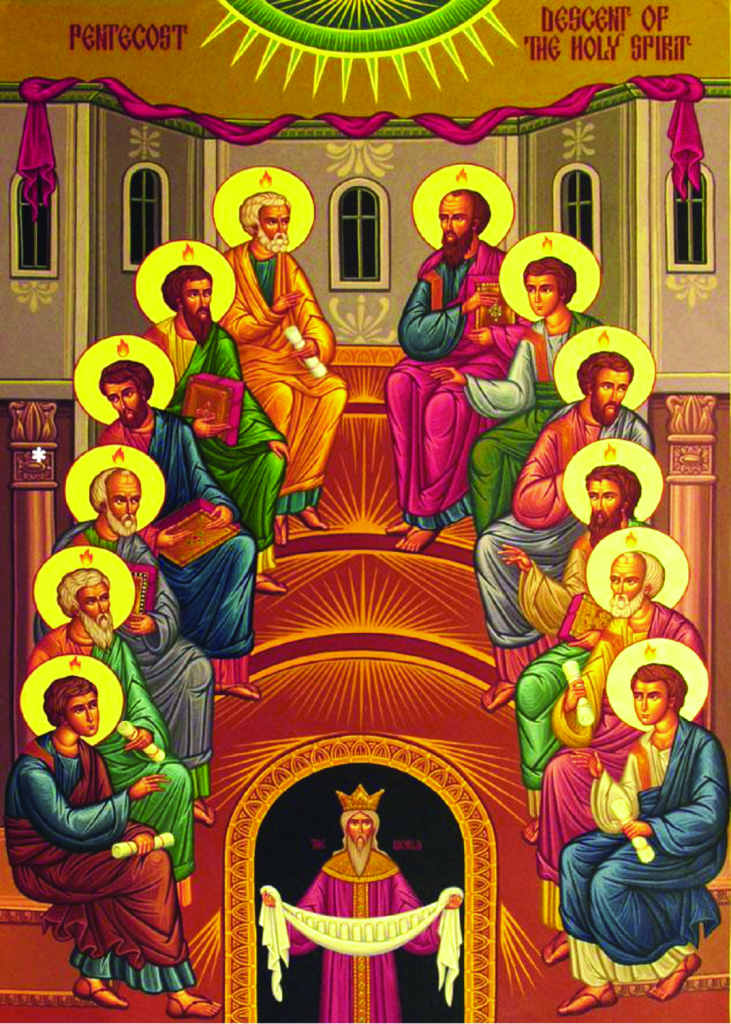
Thus begins the answer to Macedonianism, laid down by the Fathers of the Council of Constantinople in the year 381. The gathered bishops of course were aware of the existence of the Third Person of the Trinity, but little doctrinal thinking had fleshed out the character of the Holy Spirit. Saint Basil the Great had penned On the Holy Spirit some years before the Council, building upon the previous thought of Saint Athanasius; Basil had already noticed some problems with the followers of Macedonius. But serious thinking about the Spirit’s place in the Trinity was still in its doctrinal infancy. The events of Pentecost in Jerusalem still awaited serious official clarification.
The Holy Spirit is first encountered as early as the second verse of Genesis: “The Spirit of God was brooding over the face of the water.” Much like a hen concerned with her eggs, the Holy Spirit hovered over the waters, in anticipation of the Christian offspring of God to be born again in the waters of Baptism. Like infants of all kinds, though, some further preparation was necessary for the new Christian hatchlings to achieve their full stature as mature, functioning, grown-up children of God.
The Acts of the Apostles tells us that prior to Pentecost, the Holy Spirit was not yet known, since Christ had not yet been glorified. With the Ascension, Creation and Redemption were accomplished, bringing to fulfillment the special operations of the Father and the Son. The sending of the Holy Spirit inaugurated the Sanctifying (or rather the re-Sanctifying) of the created world, bringing humanity back to the original innocence of Eden.
The promise given to the Jews was now to be extended by the great commission given to the apostles; they were commanded to preach the truth first in Jerusalem and Judea, and then to Samaria and the greater world beyond — in fact, to all nations. As a sign of the mission to come, the Holy Spirit bestowed a special gift upon the Apostles, a sort of instantaneous translation whereby all the peoples of the earth were able to immediately apprehend the teachings offered on that momentous day. The first fruits of the Spirit were impressive: some three thousand souls were added to the believers by that marvelous outpouring of God’s grace.
Pentecost has long been seen as the reversal of one particular manifestation of sin in the world. The babble inaugurated by building a tower to reach heaven was reversed; the human pride behind that doomed effort, and the ensuing misunderstanding between peoples, was destroyed.
The true path to heaven was revealed to be the work of God through the power of the Holy Spirit in human history. Human efforts to achieve heaven on earth without recourse to divinity are clearly revealed in their futility, while it is made clear that the workings of God’s Holy Spirit can bring about the most dramatic results.
Alas, much of humanity still labors under the delusion that human institutions can, by themselves, achieve a sort of earthly paradise. A great many deluded visionaries are still seeking to erect their own towers of Babel, by political, philosophical, social or religious means, causing vast destruction and misery to many millions.
The obvious conclusion is that the work of the Holy Spirit is not yet finished and the task of leading fallible human beings to appreciate divine wisdom and guidance has some distance yet to travel.
As the work of the Holy Spirit continues, perhaps it is well to keep in mind through all our modern turmoil that the finest fruits of the Holy Spirit are yet to be seen.