Their interpretation can be confusing, says the DDF, and detrimental to ecumenism
By Hannah Brockhaus (CNA)/ITV staff

Pope Leo celebrates Mass November 3 with an image of Mary in the background. (photo: Grzegorz Galazka)
The Vatican’s doctrinal office said Tuesday the titles of “Co-Redemptrix” and “Mediatrix” are not appropriate ways to describe Mary’s participation in salvation.
In Mater Populi Fidelis (“The Mother of the Faithful People of God”), the Dicastery for the Doctrine of the Faith (DDF) said when an expression requires frequent explanation to maintain the correct meaning, it becomes unhelpful.
“In this case, the expression ‘Co-Redemptrix’ does not help extol Mary as the first and foremost collaborator in the work of Redemption and grace, for it carries the risk of eclipsing the exclusive role of Jesus Christ,” according to the doctrinal note, released November 4.
Pope John Paul II publicly called Mary “Co-Redemptrix” several times, but after he stopped using the term publicly in the mid-1990s, his successors, Pope Benedict XVI and Pope Francis, expressed skepticism about it, fearing it could create confusion about Christ’s sole redemptive role.
Pope Leo XIV approved the document — signed by DDF prefect Cardinal Víctor Manuel Fernández — on October 7.
Mary’s contribution to human salvation, specifically the title of “Co-Redemptrix” (“Co-Redeemer”) has been a point of theological debate for decades — with proponents calling for Mary’s role in redemption to be declared a dogma but critics saying it exaggerates her importance and could damage efforts for unity with other Christian denominations.
In a preface to the note, Cardinal Fernández wrote that the document responds to questions the dicastery received in recent decades about Marian devotion and certain Marian titles, and clarifies which are acceptable.
“This text also aims to deepen the proper foundations of Marian devotion by specifying Mary’s place in her relationship with believers in light of the Mystery of Christ as the sole Mediator and Redeemer. This entails a profound fidelity to Catholic identity while also requiring a particular ecumenical effort,” Cardinal Fernández wrote.
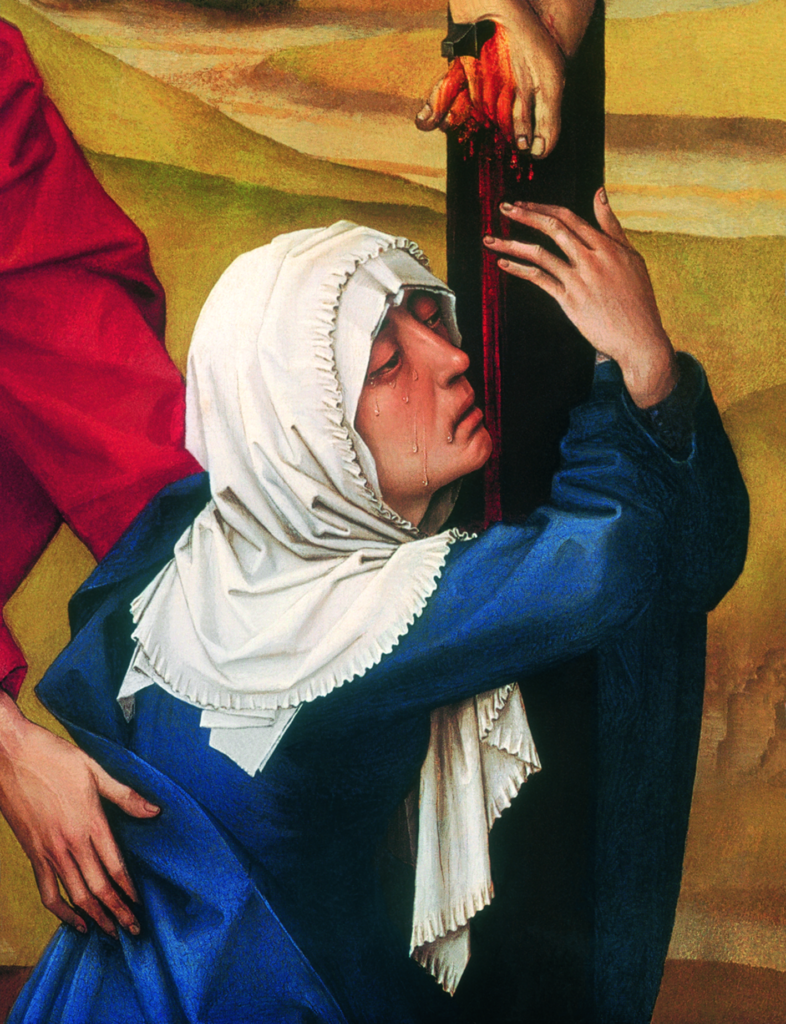
Detail from the Crucifixion triptych by Rogier van der Weyden, in the Kunsthistorisches Museum, Vienna, Austria.
In addition to “Co-Redemptrix,” the document also addressed at length the Marian title “Mediatrix” or “Mediatrix of All Graces,” analyzing related Church teaching on Mary’s role as intercessor.
The DDF concluded that, “some titles, such as ‘Mediatrix of All Graces,’ have limits that do not favor a correct understanding of Mary’s unique place.”
The dicastery encouraged the use of other expressions for Mary, specifically titles referring to her motherhood, including “Mother of God” and “Mother of the Faithful People of God.”
“She is the Mother who gave the world the Author of Redemption and of Grace, who stood firm at the foot of the cross (cf. John 19:25), suffering alongside her Son and offering the pain of her maternal heart pierced by the sword (cf. Luke 2:35),” the document said. “From the Incarnation to the cross and the Resurrection, she was united to Christ in a way that is unique and that far surpasses any other believer.”
Emphasizing that Mary was saved by her Son, Jesus Christ, “in a particular and anticipatory way,” the document explained that “Mary’s incomparable greatness lies in what she has received and in her trusting readiness to allow herself to be overtaken by the Spirit.”
It warned that, “when we strive to attribute active roles to her that are parallel to those of Christ, we move away from the incomparable beauty that is uniquely hers.”
Bishop Schneider’s Response: The Ordinary Magisterium of centuries could not have “led the faithful astray”
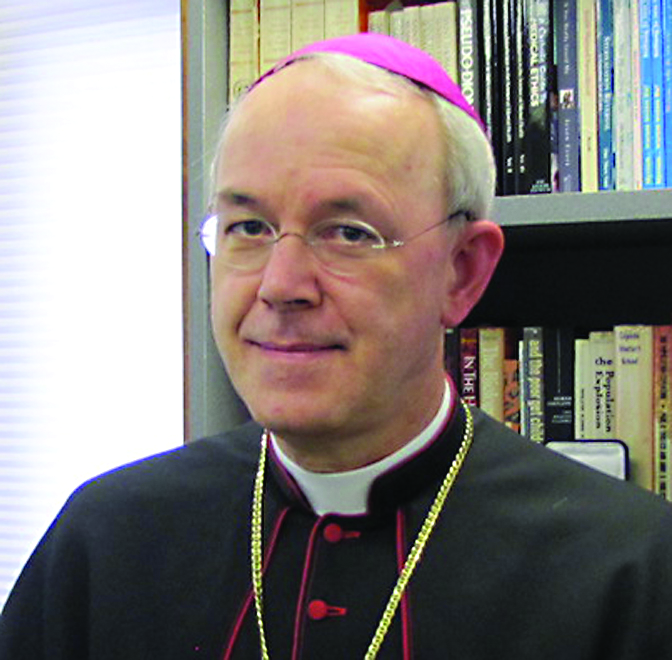
Athanasius Schneider, bishop of Astana, Kazakhstan
The bishop of Astana, Kazakhstan, Bishop Athanasius Schneider, came out November 10 with a public response to the Vatican’s “doctrinal note” on certain titles of Mary. The essay, published on the Substack blog of Vatican journalist Diane Montagna, was critical of the Vatican document.
Basing his defense of the titles of popular piety called “inappropriate” in the document, particularly “Mediatrix of All Graces” and “Co-Redemptrix,” Bishop Schneider appealed to both the Ordinary Magisterium as expressed over several centuries by Popes, saints and Doctors of the Church, as well as the sensus fidei — the sense of faith of the faithful. His conclusion: “…it cannot be maintained that the Ordinary Magisterium, along with Saints and Doctors of the Church over so many centuries, could have led the faithful astray through a consistently inappropriate use of these Marian titles.”
“Therefore,” he went on to say, “by adhering to the traditional teaching of the Ordinary Magisterium regarding Co-redemption and Mediation, and by recognizing the legitimacy of the titles ‘Co-Redemptrix’ and ‘Mediatrix of All Graces,’ the faithful do not depart from the right path of faith nor from a sound and well-informed piety toward Christ and His Mother.”
Going back to the early Church, Bishop Schneider cited St. Irenaeus who, he noted, “laid the essential groundwork for the Marian doctrines of Co-redemption and Mediation.” He quoted Irenaeus’ tract Against Heresies that “Mary, by yielding obedience, became the cause of salvation, both to herself and the whole human race.”
He then went on to single out Pope Leo XIII, among many Popes who spoke on the subject, saying “the encyclical Adjutricem Populi of Pope Leo XIII, in which he refers to Our Lady as a cooperator in the work of redemption and as the dispenser of the grace that flows from it. He writes: ‘She who was so intimately associated with the mystery of human salvation is just as closely associated with the distribution of the graces which for all time will flow from the Redemption.’” Another Pope cited by Bishop Schneider is Pope Pius X, of whom he says, “Pope St. Pius X offered a succinct theological exposition of Co-redemption in his encyclical Ad Diem Illum, teaching that by reason of her divine motherhood, Mary merits in charity what Christ alone, as God, merits for us in strict justice—namely, our redemption—and that she is the dispenser of all graces.”

In 1921, Pope Benedict XV, responding to petitions from the bishops of Belgium, established the May 21 feast day of “Mary Mediatrix of All Graces” for that country. The feast was eliminated in 1961
Pope Benedict XV expressed a similar conclusion, said Bishop Schneider, when he taught that “By uniting herself to the Passion and death of her Son, she suffered as if to death … to appease the divine justice, as far as it was in her power, she sacrificed her Son — so that it may rightly be said that she, together with Christ, redeemed the human race.”
“This,” said Bishop Schneider, “is the equivalent of the title of ‘Co-Redemptrix.’”
Continuing down the list of Popes who expounded on the subject of Mary’s role in the economy of salvation, Pope Pius XI, said the bishop, discussed the title “Co-Redemptrix” explicitly in these terms: “By necessity, the Redeemer could not but associate his Mother in his work. For this reason, we invoke her under the title of Co-Redemptrix. She gave us the Savior, she accompanied him in the work of Redemption as far as the Cross itself, sharing with him the sorrows of the agony and of the death in which Jesus consummated the Redemption of mankind.”
Likewise, emphasized Bishop Schneider, “In his en-cyclical Mediator Dei, Pope Pius XII emphasizes the universality of Mary’s role as dispenser of grace, saying: ‘She gives us her Son and with Him all the help we need, for God “wished us to have everything through Mary” (Saint Bernard).’”
Among the more modern Popes, Bishop Schneider affirmed, St. John Paul II repeatedly used the titles “Co-Redemptrix” and “Mediatrix of All Graces,” and Pope Benedict XVI stated, “There is no fruit of grace in the history of salvation that does not have as its necessary instrument the mediation of Our Lady.”
He concludes, “The term Co-Redemptrix, which by itself denotes a simple cooperation in the Redemption of Jesus Christ, has, for several centuries, in theological language and in the teaching of the Ordinary Magisterium, carried the specific meaning of a secondary and dependent cooperation. Consequently, its use poses no serious difficulty, provided it is accompanied by clarifying expressions that emphasize Mary’s role as secondary and dependent in this cooperation.”
—ITV staff