“The blanket bombing has stopped,” says Latin Patriarch of Jerusalem Cardinal Pierbattista Pizzaballa, but “ordinary life has changed very little”
By Andrea Tornielli and Francesco Sabatinelli (Vatican News)
Gaza remained under Israeli bombardment as of late November — despite the fact that the implementation of the peace plan orchestrated by the US officially “took effect” October 10. Now winter is upon the region.
After the Security Council’s adoption of the peace plan resolution November 17, the United Nations has committed itself to pressing forward and “translating diplomatic momentum into concrete and urgent measures on the ground.” These concrete actions must become a turning point for Palestinians exhausted by war and devastation.
Speaking to Vatican News November 19, Cardinal Pierbattista Pizzaballa, 60, the Latin Patriarch of Jerusalem, urged the international community to take the necessary steps to implement solutions that might bring relief to a people who are reeling from two years of bombings and now suffering the harsh winter conditions.
Your Eminence, the UN Security Council — Russia and China abstaining — has voted in favor of the Gaza peace plan proposed by U.S. President Trump. The State of Palestine approves the plan, while Hamas says it will not disarm under those conditions. How do you see the current situation?
The UN’s decision does not change anything on the ground, but it is nonetheless a recognition by the international community. Like all plans, it can never be perfect, but it is what we have. It is the only plan that has so far halted the expansion of the war and can offer at least a glimmer of hope for the Palestinian population—and not just for them.
So, we might say the UN vote is a sort of general endorsement by the international community that, while it changes nothing materially, is still important from an ideal and political standpoint. As for daily life in the region and the plan’s concrete implementation, from the outset we knew that the various points of the Trump plan would be — and will remain — very difficult to carry out.
We know Hamas has no intention of handing over its weapons. I think Israel also has little desire to withdraw entirely from the Strip. Both parties were required to accept this plan, but they face very real obstacles. Persistence is needed. The United States, together with Arab countries and Turkey, are the only ones capable of driving progress, because goodwill alone is not enough at this moment. Political courage is also needed to create solutions that can gradually lead to clearer prospects.
Recently, Gaza has fallen out of the media spotlight. Yet alarming reports continue to arrive from the Strip about the people’s suffering, worsened by bad weather, rain, and mud…What is the situation?
Ordinary life has changed very little. The only difference — thanks be to God and to those who secured it — is the end of the blanket bombing. Aid is entering more regularly than before, and more reliably, but still far from sufficient given the needs for medicine, hospitals, tents, blankets — especially with winter arriving. Water is needed — of course — but in Gaza “water” often means mud in an already dire situation.
There are no schools; hospitals are only partially operational; everything needs to be rebuilt. We are still in phase one: clearing rubble, uncovering and burying the dead still beneath it, and preparing even a minimal reconstruction plan—which also requires a governance that does not yet exist and whose form is unknown.
Alarming news also continues to come from the West Bank, especially with ongoing settler violence against Palestinian families. What can you tell us about the situation there? What should — or could — the international community do?
The situation in the Territories is worsening every day. I have photos from yet another attack on our Christian village of Taybeh: homes and cars vandalized, windows smashed, tires slashed. What happened last night in Taybeh — serious as it is — happens daily in many Palestinian villages. A few days ago, I received a request for help from the village of Aboud — quite isolated — not only from the parish but from the entire community, including the mayor, because they simply do not know whom to turn to.
This sense of helplessness intensifies the weight of the situation: it seems there is no one to appeal to, no one to ask for justice. True, there have recently been some clashes between settlers and the army trying to restore order, but these are rare episodes. Most of the time, one witnesses a total lack of respect for the law — any law — and for human rights. Our fear is that the situation will continue and worsen.
What can the international community do? It must speak out! Gaza was rightly discussed at length, though sadly now less so; but the situation in the Territories requires attention as well. Many countries have recently recognized Palestine as a state — symbolically, since it does not yet exist. But now they must go further and outline the conditions and steps required. One cannot speak of a political process while these aggressions and hardships continue.
Your Eminence, you recently appealed for the resumption of pilgrimages to the Holy Land, which remain suspended—with serious consequences for the Palestinian economy, especially for Christians. Can you speak on this?

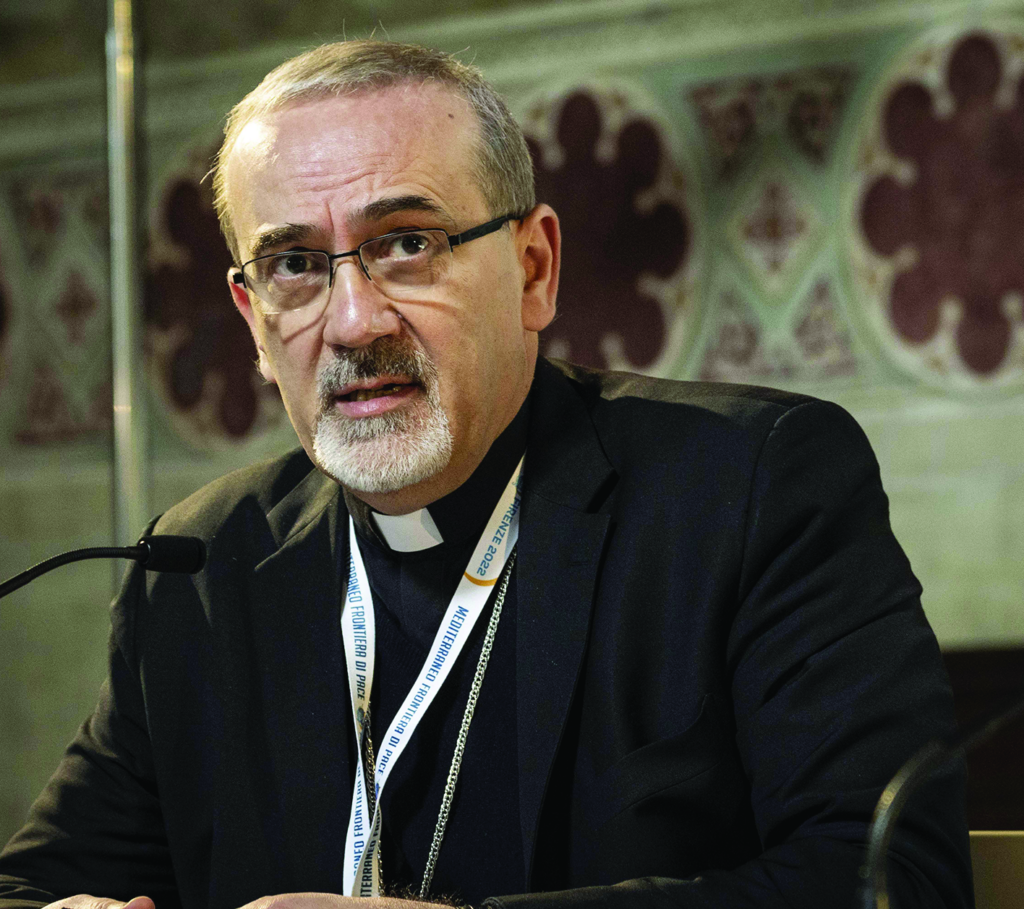
Latin Patriarch of Jerusalem Pizzaballa urges the international community to take the necessary steps to implement solutions that might bring relief to a people who are reeling from two years of bombings.
Absolutely! We speak of Gaza and the West Bank, but those areas are generally not part of pilgrims’ ordinary itineraries. The Bethlehem area — which is so important for pilgrims — needs their presence, and pilgrimages are safe now. With the ceasefire, not only have the bombings in Gaza stopped, but also missile attacks from Yemen. There are no more alarms. It is safe to make a pilgrimage now.
The few who have come have seen this for themselves. I repeat: the universal Church has been very close to us these years through prayer and concrete solidarity.
But now a new phase is needed: concrete help shown also through physical presence. This does not bring only spiritual benefit to the pilgrim. It also brings smiles to the many families who need not only financial help, but to see their Christian brothers and sisters present in the Holy Land.
We still have before our eyes the terrible images of Hamas’ hostages in the tunnels. Yet we also hear new reports — without images — telling us that since 7 October, 98 Palestinian detainees have died in Israeli prisons. How do you respond to these figures?
They are alarming. Several newspapers, including in Israel and the Holy Land, have reported on this—though few, to be honest.
In general, a climate of violence pervades everything, including how people think.
I have often said that we have been invaded by hatred, which is not only a sentiment but turns into action and becomes a way of relating to others.
I do not have precise documentation; I rely on what has been reported. But yes, many have died in prison — and we know these are not Swedish prisons.
Pope, Palestinian President Abbas Meet at Vatican

Pope Leo and President Abbas exchange
gifts at the Vatican (photo: Vatican Media)
On November 6, Pope Leo met with Mahmoud Abbas, President of the State of Palestine, at the Vatican, and discussed the “urgent need to provide assistance to the civilian population in Gaza” as well as ending the conflict “by pursuing a two-state solution.”
It was the first time the Pope and Abbas had met in person, though they had spoken by phone previously.
The day before his meeting with Pope Leo, President Abbas had visited the Basilica of St Mary Major to pay his respects at Pope Francis’ tomb. Speaking to journalists on the church steps, President Abbas said:
“I came to see Pope Francis because I cannot forget what he did for Palestine and for the Palestinian people, and I cannot forget that he recognized Palestine without anyone having to ask him to do so.”
President Abbas’ visit to the Vatican also marked the 10th anniversary of the signing of the “Comprehensive Agreement between the Holy See and the State of Palestine.”
The text, signed on June 26, 2015, expresses both parties’ commitment to Palestinian self-determination and the two-state solution.
— Joseph Tulloch (Vatican News)