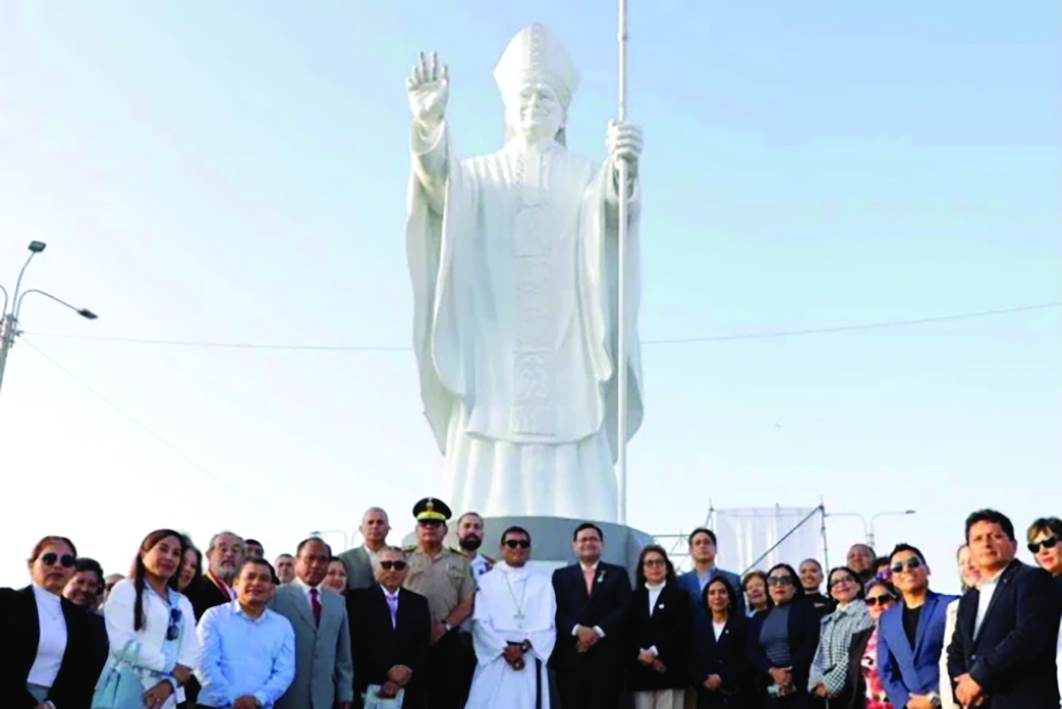
Interview with the first bishop to be consecrated by Pope Leo, Polish Archbishop Miroslaw Wachowski, new papal nuncio to Iraq. He was consecrated on October 26 in Rome
By Anna Artymiak
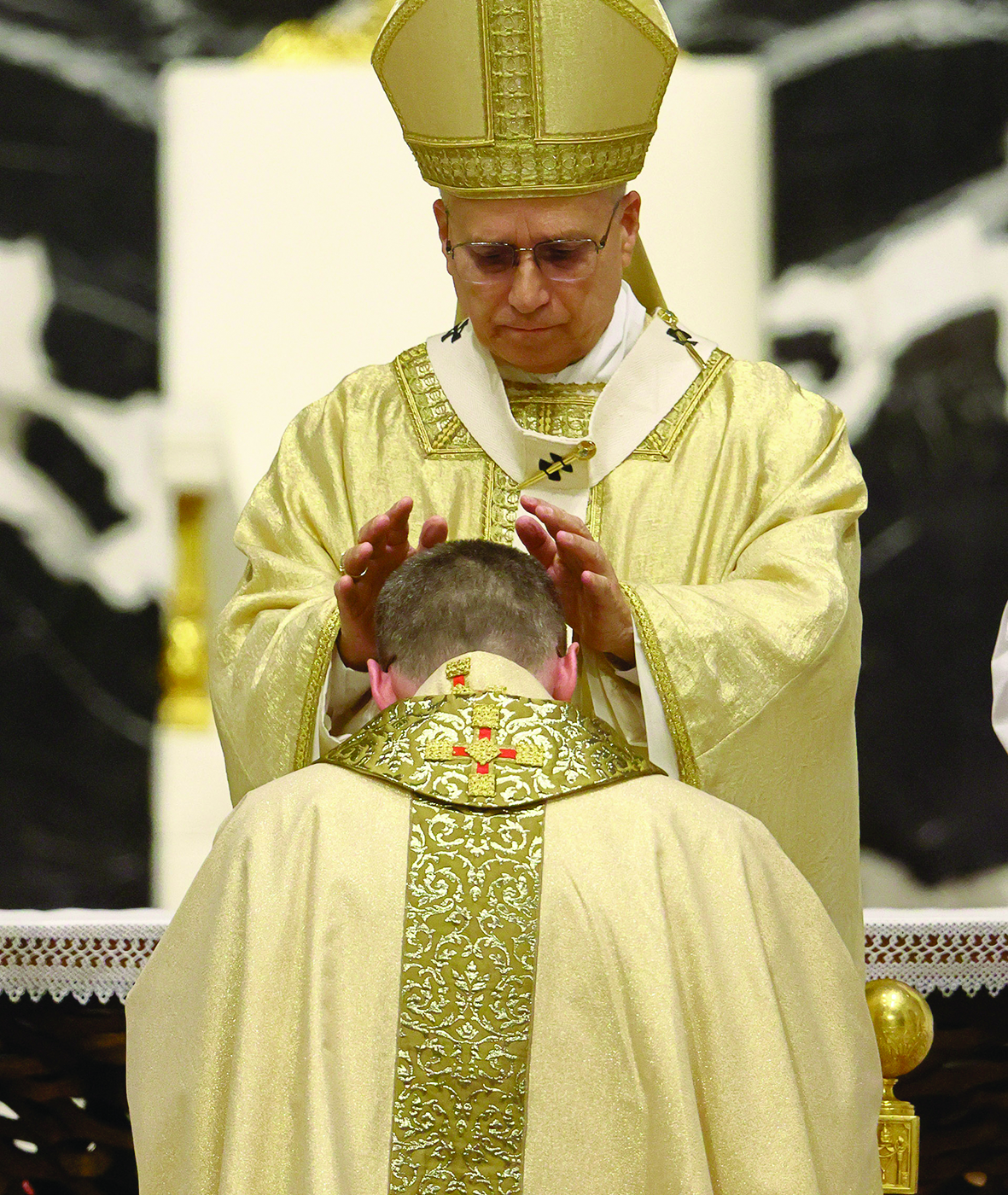

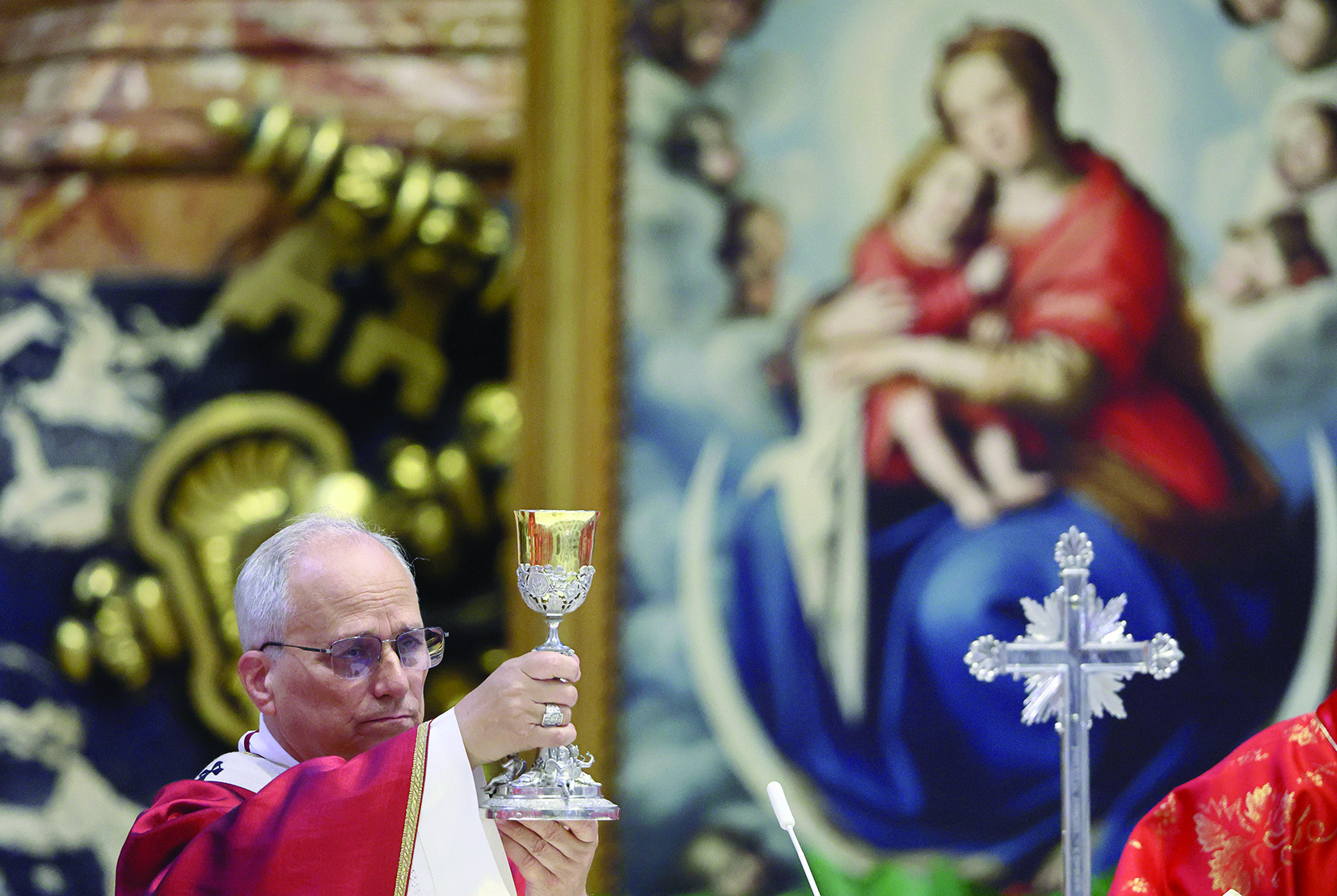
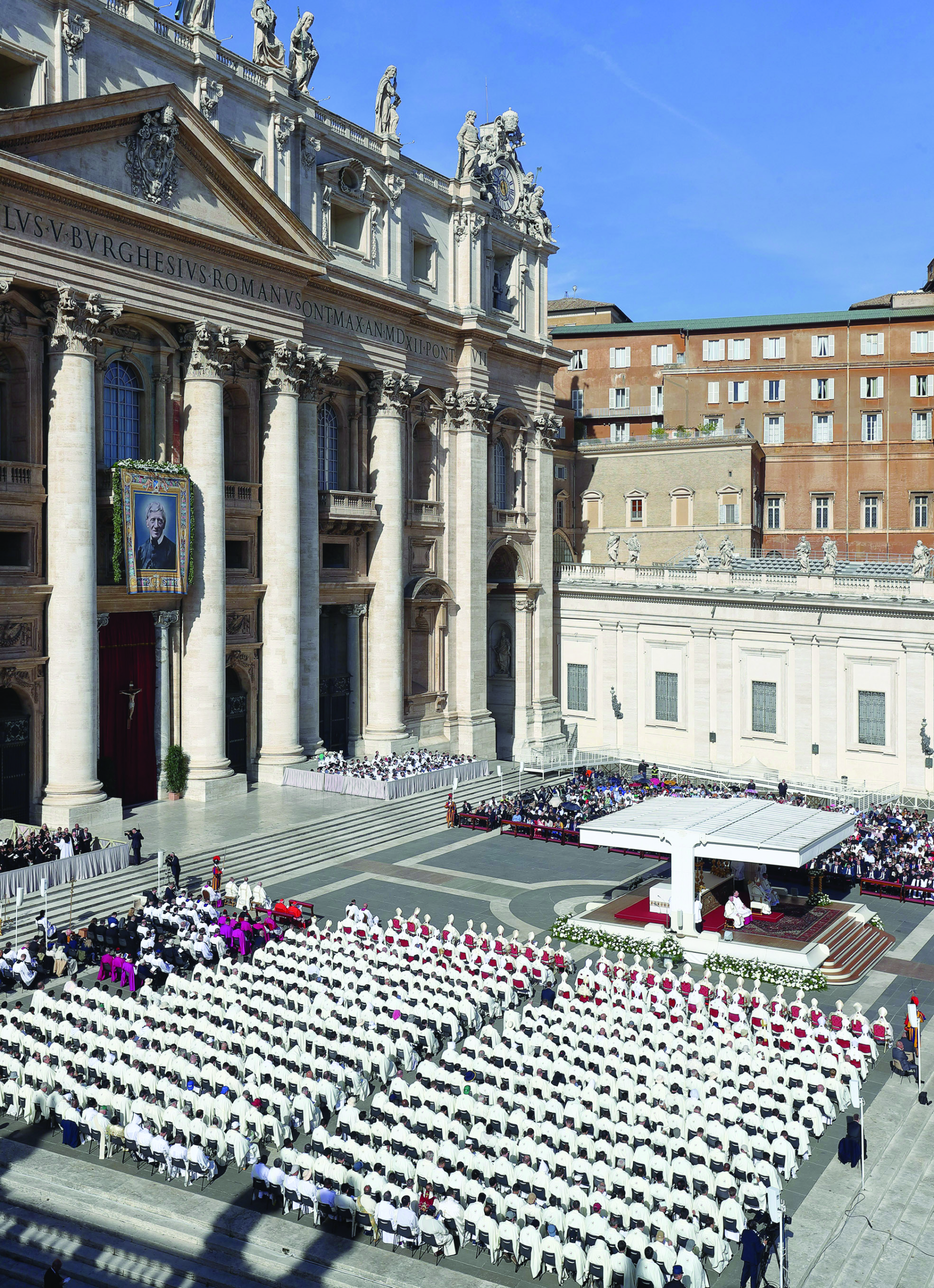
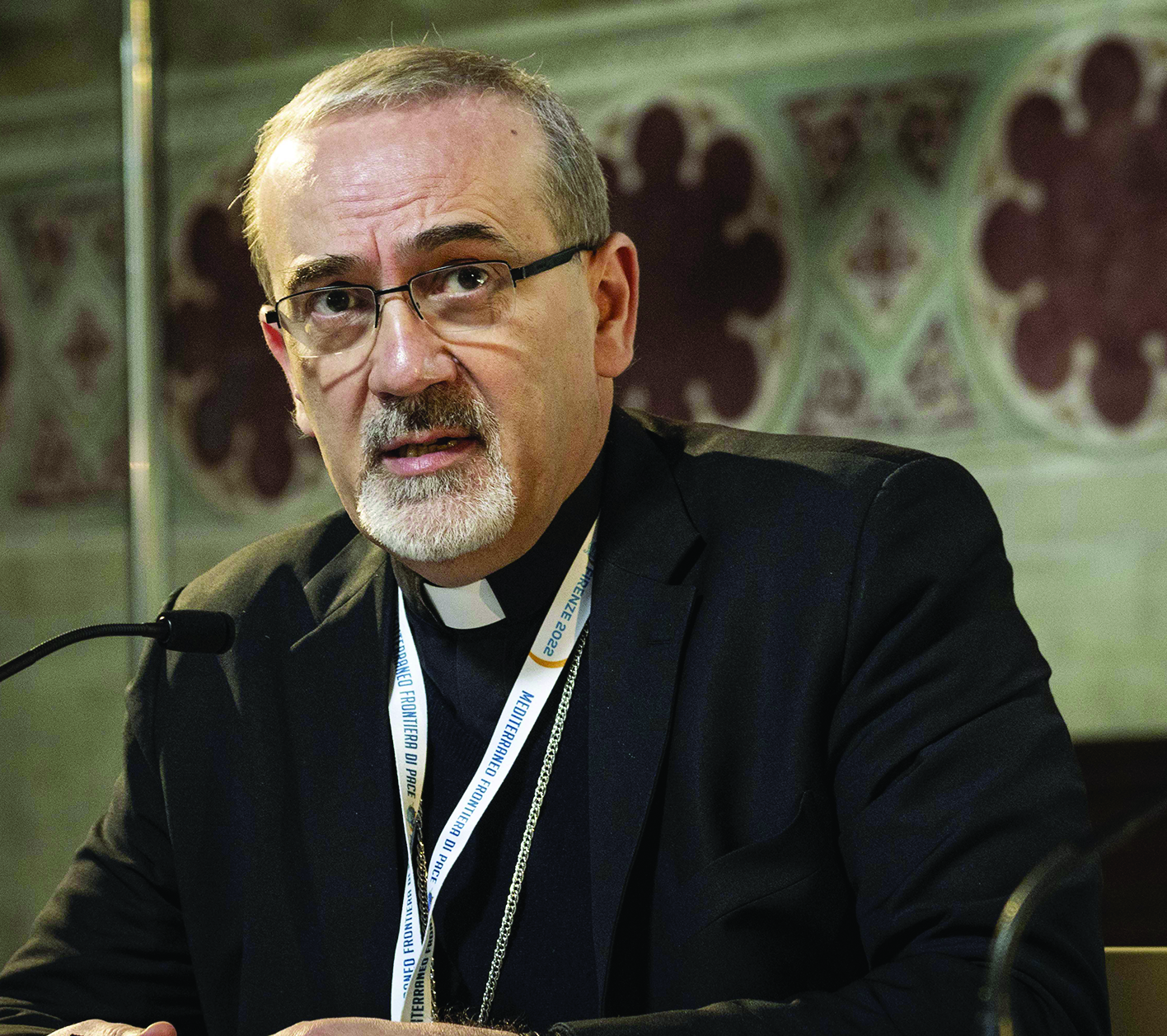
On October 26, Pope Leo XIV in St. Peter’s Basilica carried out the episcopal consecration of Miroslaw Stanisław Wachowski, whom Leo had appointed in September as his papal nuncio to Iraq (Photos – Grzegorz Galazka)
On September 18, Pope Leo chose a Polish priest and Vatican diplomat, Father Miroslaw Stanisław Wachowski, 55, to be his new Apostolic Nuncio to Iraq. Five weeks later, on October 26, 2025, Leo consecrated Wachowski as an archbishop: the 1st bishop Leo has consecrated. Wachowski had served in the important position of Undersecretary of the Dicastery for Relations with States since 2019. Archbishop Wachowski’s episcopal motto is “Gloria Deo Pax Hominibus” (“Glory to God, Peace to Men”), a phrase described by Pope Leo XIV in his homily at Wachowski’s episcopal consecration as a “program for life,” seeking so that God’s glory may always shine more brightly by bringing men to live together in peace.
“This is the profound meaning of every Christian vocation, and in a particular way of the episcopal vocation: to make visible, through one’s own life, the praise of God and His desire to reconcile the world to Himself,” Pope Leo said.
Inside the Vatican’s Anna Artymiak, interviewed the new archbishop in Rome.—The Editor
All of Pope Leo’s “first” decisions and actions are being viewed with special attention, as the figure of Robert Prevost still remains little known.
On the last Sunday of October, October 26, the Holy Father, for the first time in his life, ordained a bishop: Msgr. Mirosław Stanisław Wachowski, appointed Apostolic nuncio to Iraq on September 18 after 6 years in the Vatican Secretariat of State as Undersecretary for Relations with States, where he was right hand collaborator to Archbishop Paul Gallagher, Secretary for Relations with States. (In Peru, Bishop Prevost did not have occasion to ordain a bishop personally, he was only a co-consecrator.)
For this reason, Wachowski’s ordination was in the media spotlight, with more than the usual number of photographers accredited for the event. Also, the new nuncio to Iraq is highly respected by the Ambassadors accredited to the Holy See, who appreciate him as “a great diplomat.”
Leo XIV, personally ordaining Wachowski, gave a signal of respect for him and his new mission. The new nuncio sees in it “a signal about how important the Church in Iraq is to the Pope, the Church in the Middle East, where Christians do not always live in easy circumstances.” Leo XIV pronounced a very personal, poetic and yet, at the same time, focused homily, on the role of the bishop — so this homily, behind the Vatican scenes, is now being regarded as the second in importance, after Leo’s inaugural Mass homily on May 18, in order to understand Leo’s vision.Archbishop Wachowski, before starting his first diplomatic mission as Apostolic nuncio on November 27 — the same day Leo XIV began his first Apostolic Journey — went to Poland to celebrate his first Mass as a bishop at the Cathedral of Ełk, his native diocese, and in Pisz, at his home town parish. There is another close connection between Pope Leo and Archbishop Wachowski — his 55th birthday was on May 8 — the day of Leo’s election.
Anna Artymiak: Let’s begin with your vocation…
Archbishop Mirosłav Wachowski: When it comes to vocation, it’s interesting that I didn’t have a vocation that arose in my early youth. When I was in high school, I didn’t think about it at all at first. I became an altar boy thanks to my friend, who got me involved in Oasis, and at the altar when I was in the fifth level of technical school. That’s how he attracted me.
And it was so surprising that God chose me, someone who was not involved in Church activities, and only at the last moment. My friend, who later became a father and did not go to seminary, and I, decided to go on a vocational retreat to the seminary organized by the Hosianum, by the Seminary of the Archdiocese of Warmia. It was organized in Dobre Miasto. But in those days, there weren’t many cell phones. It was the 1990s. We arrived in Dobre Miasto in the evening, knocked on the door of the seminary, and the spiritual father opened it and said, “But I told everyone that we canceled the vocation retreat.” It’s quite a distance from Pisz to Dobre Miasto. So what now?
The spiritual father thought for a moment and said, “Listen, there are Verbists nearby, and I know they are having a retreat at the same time, so go to the Verbists.” So we went to the Verbists [Divine Word Missionaries]. I became friends with the Verbists. Indeed, the atmosphere at this retreat was very good.
Later, I went to their prayer meetings once or twice. A group of young people formed, who were preparing for their high school exams, and some of them decided to join the Verbists’ seminary. When I later told them that I had decided to attend the diocesan seminary, they tried to dissuade me, saying, “What, you’re going to the diocesan seminary? No, no, it’s not worth it, it’s not worth it.” But interestingly, these were friends with whom we used to meet, who were not even Verbists yet. The Divine Word Missionaries themselves always treated me with great respect, saying, “It’s great that you’ve decided to go to seminary.” However, God works in mysterious ways, because I did not become a missionary. But later, in the priesthood, He called me to work in Vatican diplomacy, which means working all over the world. I do not work in my homeland, but I serve God in the universal Church, wherever He wants to send me.
And so it happened that the first place I served was Senegal, a country where missionaries also work. My first experience with diplomacy was an internship in Guinea — in Conakry, the capital. Guinea is also very much a mission country.
As for the decision to become a priest, I didn’t have some spectacular calling where I suddenly heard a voice saying, “Go.” I simply had doubts about what to do in life, whether to continue what I was doing. I studied at a technical school specializing in forestry, so the natural path was to go to college and study the same subject. I was even preparing for college entrance exams. But a doubt about this path was somewhere inside me. And a certainty arose in my heart — of course no one can be 100% sure — but it was after the night vigil before Easter Sunday, when I was in fourth level. After the Holy Saturday liturgy, there was an exposition of the Blessed Sacrament, and I spent the whole night in the church keeping vigil. I left with the conviction that yes, I had to at least try pursuing a vocation, and we would see if the Lord would confirm it.
How did your family react? Was it the first vocation in the family?
Yes. I had two sisters; I am the only man in the family. So when I told my family that I was going to seminary, my mother burst into tears. My father, on the other hand, took me aside and said, “Come on, let’s go to the forest. I have a tree to cut down or something,” and he asked me, “Have you thought this through? You’re my only son. The family name will die out.” That’s how my father explained it to me. And I said, “Dad, I’m going to seminary anyway, despite that.” And so I saw that he couldn’t quite come to terms with this idea, until I came home after the rite of investiture (in Poland, on the third level of 6-year formation). When :I came home and he saw me in my cassock, he said: “Now you mustn’t think about leaving.” So you can see that he had thought it all through somehow. My dad died a month after my ordination. He was at my ordination, on June 15, 1996, and he was at my first Mass, and a month later he had an accident and sadly passed away.
As for my mother, when she accompanied me to the train station, she naturally burst into tears when she said goodbye to me. But then I came home for All Saints’ Day, and she herself — at least that’s what she told me — said (to herself): “You’re stupid! Look, he’s smiling, he’s happy, you can see that he likes it, you can see that he’s enjoying it, so why are you crying?” And from then on, she really didn’t have a problem with it. My mother was like that: she really wanted what was best for her children. If we were happy, she was happy too.
Pope Leo noted you grew up in a country family…
My parents had a farm, a small one, about 10 hectares, but we had all the animals, we cultivated the land, so I really grew up in the country. My dad worked as a laborer in Pisz. We ran the farm almost until I became a priest.
And what the Holy Father said in his homily really struck a chord with me. Sometimes I had to get up early because there was work to be done.
And, of course, the faithfulness that the Holy Father spoke about is something natural, because when you have a farm, you have to make sure that the animals are fed and watered on time. And this is a natural rhythm, in which there are no days off, because it has to be done every day. That’s why I think it has definitely stayed with me after all these years. The farm was located outside the village, and the Piska Forest begins literally at the edge of the farm. We went to church every Sunday, on foot, of course. One of the memories I remember most is always walking to the midnight Mass.
It was often in winter, when there was still snow. It was an amazing feeling to see people and families coming out of individual houses scattered somewhere in the fields and coming together to go to church for Mass. It is a childhood memory that is deeply ingrained in me and which, unfortunately, I now miss a little.
How do you remember the election of John Paul II?
I was a young boy at the time, born in 1970, so I remember the news reports that broke the story. What struck me was how dry the news was: “Today, a new Pope has been elected, Cardinal Karol Wojtyła from Krakow” — full stop, and that was pretty much all there was to it.
However, it was an incredible experience for all of us at home, a surprise: what would happen now that a Polish Pope had been elected? Of course, there was also great joy at Mass, and the priests commented on it.
As I said, I was born in 1970, so I entered adult life with John Paul II, and my priestly life was with John Paul II. When I was in the seminary, John Paul II also came to Ełk, so we had a meeting with him. My priesthood was always lived with him.
I would also like to share a personal reflection. It is customary for those who graduate from the Pontifical Ecclesiastical Academy to meet with the Holy Father before leaving for their first post. I entered the diplomatic service in 2004, and we were the last class to be sent to the diplomatic service by Saint John Paul II. This is something that is very close to my heart. I feel that he sent me to work in diplomacy. My mother always tells me that she asks Saint John Paul II to intercede for me, “because I know how close you were to him.” Now Pope Leo is sending me to Iraq as a nuncio, so this is another mission.
Was your appointment as nuncio to Iraq a surprise?
I have always believed that the most beautiful gift God gave me was calling me to be a priest, and that is how I felt. I believed that there was nothing more beautiful than being able to celebrate Holy Mass.
And when I celebrate Holy Mass for the community of Mother Teresa’s sisters, who are here in the Vatican, there is always an inscription in the sacristy: “Priest, priest of God, celebrate this Holy Mass as if it were your first Holy Mass, your last Holy Mass, your only Holy Mass.” And I think that this is something that speaks to me very strongly, and I feel that this is something that is closest to my heart, something that I have always cared about most.
I have always said that I was always surprised by the tasks that God set before me through the Church, because I did not consider myself the most suitable person for them. But for some reason, God chooses me for them. Here, I always thought to myself when I said, “Lord God, you see that I don’t have any special talents, why are you calling me to this?” And God always answered me with the words of St. Paul: “My grace is sufficient for you. Power is made perfect in weakness.”
Can you explain your bishop’s motto?
It refers to Christmas: “Glory to God in the highest, and on earth peace to people of good will.” That is the whole text. However, I only took these elements: glory to God, peace to people. Why? Because it refers to my name when it comes to the element of peace. That is, peace, which is inscribed in my name. And I feel it as part of my proclamation of peace. As for glory to God, it is because God is first in all of this. Without God, nothing can exist, and besides, I would like God to be the first in my life. Everything flows from Him, including my being a priest, my service in Vatican diplomacy, and also this proclamation of peace. For it is the peace of Christ that I convey, because it is not just peace that I want to proclaim and promote, because it is not peace brought about by human power or by my own merits, but what God gives.
In his homily, the Holy Father pointed out beautiful qualities of Your character. Many appreciate Your great culture and human warmth, Your kindness toward all, even the simplest people. Also the fact that You concelebrate Thursday Mass often at the tomb of St. John Paul II. How can one keep one’s humanity in today’s world and in such an important position?
For Polish priests it is obvious that you say the Mass daily. I think that what the Holy Father also mentioned in his homily was that someone who grows up on a farm gets up early in the morning. I also get up early in the morning and always start my day with prayer and Holy Mass, because all our work, our efforts, our actions, if they are not based on God, if we do not draw strength from Him, will really bring little result. However, if we truly draw this strength from God, it is He who works through us, we become instruments in His hands, and then we can really do something good, because it is not us who do it, but He who does it with our hands.
That is why I attended Mass at the tomb of John Paul II. I celebrate Mass every day, preferably in the morning, unless my pastoral dut ies require me to serve at other times. However, I always try to start the day with prayer and Mass. It gives me strength for the rest of the day.
As for the comment about my interactions with people, Jesus was like that. Jesus always reached out to everyone, never seeking time for Himself, but always devoted to those who needed Him. And we are supposed to follow His example. We are His disciples; we are to follow in His footsteps. I don’t know if I am succeeding, but at least I am trying.
In 2023, the 45th anniversary of Karol Wojtyła’s election in 1978, I asked Cardinal Pietro Parolin for a comment. He told me we do not realize how much John Paul II helped the cause of peace…
I will mention one detail, because it is well known. John Paul II was already ill at that time. Journalists were speculating about whether the Holy Father would resign, or whether he should be asked to resign. Then the situation in Iraq became tense, everyone started talking about war, and the Holy Father came out for the Angelus and said some profound words about belonging to a generation that had survived war and saying: “Never again war!”
And suddenly everyone starts coming to Rome, to see this ailing pope, and then suddenly representatives of the United States and the great European countries and Iraq itself arrive. Suddenly it turns out that the voice of the pope, even this ailing pope, is so important, has such a great impact on the world.
Your Excellency will now continue this mission…
This is also part of my name, as I am Mirosław, after all: one who praises, proclaims, and spreads peace. This is also part of who I am. [Editor’s note: “Miroslav” is a Slavic male name combining the elements mir (peace, world) and slava (glory, fame), common in Slavic countries like Poland, Czechia, and Croatia. It means “Peaceful glory” or “Glorious peace,” or “Famous for peace.”]
Your grandfather chose the name?
Yes, my grandfather. My parents wanted to name me Marek, but my grandfather said no, it had to be Mirosław, so that it would be a Polish name. My grandfather wanted it to be typically Polish, and since I was born on my grandfather’s name day, grandfather Stanisław, my parents had to give in. My grandfather considered my birth on his birthday to be a gift to him.
How do you remember the election of Leo XIV?
At work. I was in the office. I prayed, of course, as we all prayed for the election of the Holy Father, that God would give us a shepherd after His own heart and one that the Church needs in our times. However, I added my own private prayer that the election of the Pope would take place on my birthday, May 8, and so it happened. Although some people emphasized that I meant I could have a day off from work (on my birthday). And now I can answer that I will not benefit from this, because there is no day off on the day of the election in the nunciatures. Usually, in nunciatures, days off are according to the country’s calendar. I will celebrate my birthday while celebrating the anniversary of the Pope’s election for as many years as God grants me or the Pope.
What is the specific nature of the nuncio’s work? We often look at it from a rather secular perspective. But a nuncio’s work is not politics.

As far as the nuncio’s mission is concerned, he is always sent both to the local Church and to the country in question. This means that he has a relationship with the local Church, which is about maintaining communion between Rome and the Church around the world. And the nuncio is a sign of the Holy Father’s presence in that country, a sign of his concern for the local Church. Hence, this ecclesiastical mission is very important, not only the diplomatic one. On the other hand, there is the second aspect: that the nuncio is accredited to the government of a given country, and therefore also fulfills his mission as a diplomat there.
It is difficult to say what percentage of our mission is a mission to the Church and what percentage is a mission to the state, but it is often the case that it is more of a Church mission than a diplomatic one.
After being named nuncio to Iraq, you were then made an archbishop. Why?
I can tell you what Catholics often expect from the Holy Father’s representative: that he also preside over liturgies. And if he is to preside over liturgies, he should be a bishop. That is why, I think, the choice is always made to have bishops as nuncios.