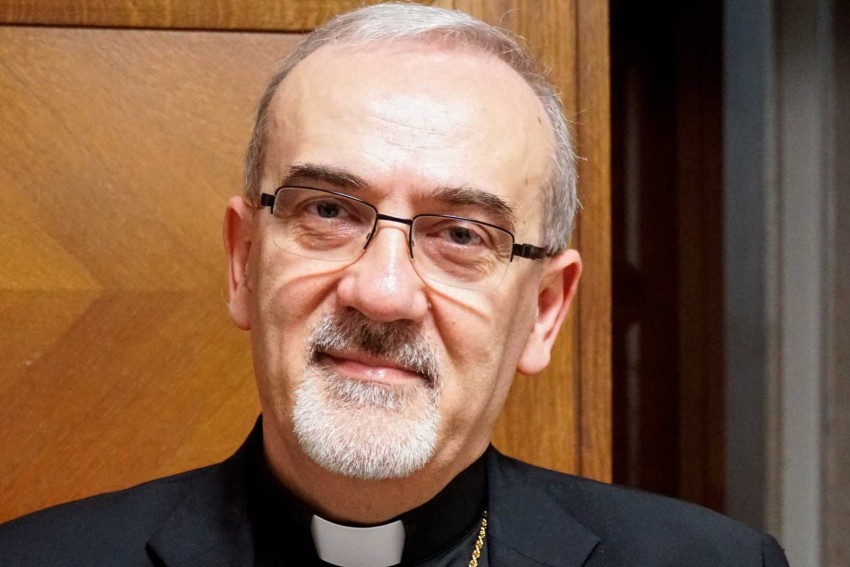
Archbishop Carlo Maria Viganò, 83, has been judged by the Vatican guilty of the ecclesiastical crime of schism, incurring the penalty of latae sententiae excommunication from the Catholic Church.
Here below is the full text of the brief communiqué published on Friday, July 5, by the Vatican Press Office (link).
Note: The decision was taken the day before, on July 4, 2024 — a national holiday in the United States (Independence Day, celebrating the signing of the Declaration of Independence in 1776). Viganò was the nuncio (ambassador) of the Holy See to the United States — one of the most prestigious posts in the Vatican’s global diplomatic service — from October, 2011, until April, 2016, under both Pope Benedict XVI (2011-2013) and Pope Francis (2013-2016). Some are seeing the choice of this date to vote on the archbishop’s case as more than a coincidence. —RM
***
PRESS RELEASE
OF THE DICASTERY FOR THE DOCTRINE OF THE FAITH
On 4 July 2024, the Congress of the Dicastery for the Doctrine of the Faith met to conclude the extrajudicial penal process referred to in canon 1720 CIC against the Most Reverend Carlo Maria Viganò, titular Archbishop of Ulpiana, accused of the reserved delict of schism (canons 751 and 1364 CIC; art. 2 SST).
His public statements manifesting his refusal to recognize and submit to the Supreme Pontiff, his rejection of communion with the members of the Church subject to him, and of the legitimacy and magisterial authority of the Second Vatican Council are well known.
At the conclusion of the penal process, the Most Reverend Carlo Maria Viganò was found guilty of the reserved delict of schism.
The Dicastery declared the latae sententiae excommunication in accordance with canon 1364 § 1 CIC.
The lifting of the censure in these cases is reserved to the Apostolic See.
This decision was communicated to the Most Reverend Viganò on 5 July 2024.
–July 5, 2024
***
“Let us pray for one another”
I have no extended comment to make on this action at this time.
It is a matter for prayer and reflection. There will be time to write more in the future.
The essence of the matter, briefly: there is now, officially, a new division — a new schism — in the Church.
This is clear from the text above, emanated by an office of the Holy See: it judges this 83-year-old Italian prelate, Viganò, who had worked for the Church from the mid-1960s until 2016 (50 years, half a century), to be “in schism.”
To be “in schism” is to be divided, separated, cut off…
All schisms in the Church…
… all separations in, or all cases of “being cut off” from, the Church…
… (even if they may derive from a battle over the true teaching, the depositum fidei — the deposit of the faith — where there is a need to discern the truth and clarify it so that “right belief” — orthodoxy — may be restored)…
…are painful, and cause sorrow…
…and such divisions (even if they may be necessary to clarify the truth) cry out for a way to be found, a grace to be received, to restore unity and communion…
…lest the schism deepen, grow, intensify, and cause much confusion…
…and cause, in many, the loss of faith in the crucified and risen savior, Jesus Christ…
…and cause, in many, the loss of charity for one’s brothers and sisters with whom communion has been broken…
…as has regrettably happened too often in our past.
Hence the need for prayer, always prayer… without ceasing…
I did reach out to the archbishop, with a brief message:
“As your friend, I pray for you… The battle is spiritual. May the Holy Spirit bring comfort, wisdom, prudence and courage.”
He answered:
“Grazie. Oremus ad invicem.”
(“Thank you. Let us pray for one another.”)
***
Here, for the record, are six passages from the Code of Canon Law referred to in this judgment, so that each reader may have the texts needed to be able to better understand this judgment.
***
1) Canon 1720 of the Code of Canon Law (link):
THE DEVELOPMENT OF THE PROCESS
Can. 1720 If the ordinary thinks that the matter must proceed by way of extrajudicial decree:
1/ he is to inform the accused of the accusation and the proofs, giving an opportunity for self-defense, unless the accused neglected to appear after being properly summoned;
2/ he is to weigh carefully all the proofs and arguments with two assessors;
3/ if the delict is certainly established and a criminal action is not extinguished, he is to issue a decree according to the norm of cann. 1342-1350, setting forth the reasons in law and in fact at least briefly.
***
2) Canons 1342-1350 (link)
Can. 1342— § 1. Whenever there are just reasons against the use of a judicial procedure, a penalty can be imposed or declared by means of an extra-judicial decree, observing canon 1720, especially in what concerns the right of defence and the moral certainty in the mind of the one issuing the decree, in accordance with the provision of can. 1608. Penal remedies and penances may in any case whatever be applied by a decree.
§ 2. Perpetual penalties cannot be imposed or declared by means of a decree; nor can penalties which the law or precept establishing them forbids to be applied by decree.
§ 3. What the law or decree says of a judge in regard to the imposition or declaration of a penalty in a trial is to be applied also to a Superior who imposes or declares a penalty by an extra-judicial decree, unless it is otherwise clear, or unless there is question of provisions which concern only procedural matters.
Can. 1343— If a law or precept grants the judge the faculty to apply or not to apply a penalty, he is, without prejudice to the provision of can. 1326 § 3, to determine the matter according to his own conscience and prudence, and in accordance with what the restoration of justice, the reform of the offender and the repair of scandal require; in such cases the judge may also, if appropriate, modify the penalty or in its place impose a penance.
Can. 1344— Even though the law may use obligatory words, the judge may, according to his own conscience and prudence:
1° defer the imposition of the penalty to a more opportune time, if it is foreseen that greater evils may arise from a too hasty punishment of the offender, unless there is an urgent need to repair scandal;
2° abstain from imposing the penalty or substitute a milder penalty or a penance, if the offender has repented, as well as having repaired any scandal and harm caused, or if the offender has been or foreseeably will be sufficiently punished by the civil authority;
3° may suspend the obligation of observing an expiatory penalty, if the person is a first-offender after a hitherto blameless life, and there is no urgent need to repair scandal; this is, however, to be done in such a way that if the person again commits an offence within a time laid down by the judge, then that person must pay the penalty for both offences, unless in the meanwhile the time for prescription of a penal action in respect of the former offence has expired.
Can. 1345— Whenever the offender had only an imperfect use of reason, or committed the offence out of necessity or grave fear or in the heat of passion or, without prejudice to the provision of can. 1326 § 1 n. 4, with a mind disturbed by drunkenness or a similar cause, the judge can refrain from inflicting any punishment if he considers that the person’s reform may be better accomplished in some other way; the offender, however, must be punished if there is no other way to provide for the restoration of justice and the repair of any scandal that may have been caused.
Can. 1346— § 1. Ordinarily there are as many penalties as there are offences.
§ 2. Nevertheless, whenever the offender has committed a number of offences and the sum of penalties which should be imposed seems excessive, it is left to the prudent decision of the judge to moderate the penalties in an equitable fashion, and to place the offender under vigilance.
Can. 1347— § 1. A censure cannot validly be imposed unless the offender has beforehand received at least one warning to purge the contempt, and has been allowed suitable time to do so.
§ 2. The offender is said to have purged the contempt if he or she has truly repented of the offence and has made suitable reparation for the scandal and harm, or at least seriously promised to make it.
Can. 1348— When the person has been found not guilty of an accusation, or where no penalty has been imposed, the Ordinary may provide for the person’s welfare and for the common good by opportune warnings or other solicitous means, and even, if the case calls for it, by the use of penal remedies.
Can. 1349— If a penalty is indeterminate, and if the law does not provide otherwise, the judge in determining the penalties is to choose those which are proportionate to the scandal caused and the gravity of the harm; he is not however to impose graver penalties, unless the seriousness of the case really demands it. He may not impose penalties which are perpetual.
Can. 1350— § 1. In imposing penalties on a cleric, except in the case of dismissal from the clerical state, care must always be taken that he does not lack what is necessary for his worthy support.
§ 2. If a person is truly in need because he has been dismissed from the clerical state, the Ordinary is to provide in the best way possible, but not by the conferral of an office, ministry or function.
***
3) Canon 751 (link)
Can. 751 Heresy is the obstinate denial or obstinate doubt after the reception of baptism of some truth which is to be believed by divine and Catholic faith; apostasy is the total repudiation of the Christian faith; schism is the refusal of submission to the Supreme Pontiff or of communion with the members of the Church subject to him.
***
4) Canon 1364 (link)
Can. 1364— § 1. An apostate from the faith, a heretic or a schismatic incurs a latae sententiae excommunication, without prejudice to the provision of can. 194 § 1 n. 2; he or she may also be punished with the penalties mentioned in can. 1336 §§ 2-4.
§ 2. If a long-standing contempt or the gravity of scandal calls for it, other penalties may be added, not excluding dismissal from the clerical state.
***
5) Canon 194 § 1 n. 2 (link)
Can. 194 §1. The following are removed from an ecclesiastical office by the law itself:
1/ a person who has lost the clerical state;
2/ a person who has publicly defected from the Catholic faith or from the communion of the Church;
3/ a cleric who has attempted marriage even if only civilly.
§2. The removal mentioned in nn. 2 and 3 can be enforced only if it is established by the declaration of a competent authority.
***
6) Canon 1336 §§ 2-4 (link)
EXPIATORY PENALTIES
Can. 1336— § 1. Expiatory penalties can affect the offender either for ever or for a determined or an indeterminate period. Apart from others which the law may perhaps establish, they are those enumerated in §§ 2-5.
§ 2. An order:
1° to reside in a certain place or territory;
2° to pay a fine or a sum of money for the Church’s purposes, in accordance with the guidelines established by the Episcopal Conference.
§ 3. A prohibition:
1° against residing in a certain place or territory;
2° against exercising, everywhere or inside or outside a specified place or territory, all or some offices, duties, ministries or functions, or only certain tasks attaching to offices or duties;
3° against performing all or some acts of the power of order;
4° against performing all or some acts of the power of governance;
5° against exercising any right or privilege or using insignia or titles;
6° against enjoying an active or passive voice in canonical elections or taking part with a right to vote in ecclesial councils or colleges;
7° against wearing ecclesiastical or religious dress.
§ 4. A deprivation:
1° of all or some offices, duties, ministries or functions, or only of certain functions attaching to offices or duties;
2° of the faculty of hearing confessions or of preaching;
3° of a delegated power of governance;
4° of some right or privilege or insignia or title;
5° of all ecclesiastical remuneration or part of it, in accordance with the guidelines established by the Episcopal Conference, without prejudice to the provision of can. 1350 § 1.
§ 5. Dismissal from the clerical state.
***
The meaning of latae sententiae excommunication
And here, from the Catholic Encyclopedia (link) is a definition of latae sententiae excommunication, just mentioned above in Canon 1364as the penalty that a schismatic incurs (the bold-facing is my own):
General notions and historical summary
Excommunication (Latin ex, out of, and communio or communicatio, communion — exclusion from the communion), the principal and severest censure, is a medicinal, spiritual penalty that deprives the guilty Christian of all participation in the common blessings of ecclesiastical society.
Being a penalty, it supposes guilt; and being the most serious penalty that the Church can inflict, it naturally supposes a very grave offence.
It is also a medicinal rather than a vindictive penalty, being intended, not so much to punish the culprit, as to correct him and bring him back to the path of righteousness.
It necessarily, therefore, contemplates the future, either to prevent the recurrence of certain culpable acts that have grievous external consequences, or, more especially, to induce the delinquent to satisfy the obligations incurred by his offence.
Its object and its effect are loss of communion, i.e. of the spiritual benefits shared by all the members of Christian society; hence, it can affect only those who by baptism have been admitted to that society.
Undoubtedly there can and do exist other penal measures which entail the loss of certain fixed rights; among them are other censures, e.g. suspension for clerics, interdict for clerics and laymen, irregularity ex delicto, etc.
Excommunication, however, is clearly distinguished from these penalties in that it is the privation of all rights resulting from the social status of the Christian as such.
The excommunicated person, it is true, does not cease to be a Christian, since his baptism can never be effaced; he can, however, be considered as an exile from Christian society and as non-existent, for a time at least, in the sight of ecclesiastical authority.
But such exile can have an end (and the Church desires it), as soon as the offender has given suitable satisfaction.
Meanwhile, his status before the Church is that of a stranger.
He may not participate in public worship nor receive the Body of Christ or any of the sacraments.
Moreover, if he be a cleric, he is forbidden to administer a sacred rite or to exercise an act of spiritual authority.
[End, passage from the Catholic Encyclopedia on the meaning of excommunication, the penalty for the crime of schism]
Note to readers:
Several things you might be interested in as the present crisis in the Church intensifies:
Note: If you would like to support this letter, you may donate here.
If you would like to subscribe to Inside the Vatican, click here.
If you are interested in traveling with us on pilgrimage, click here.
If you are interested in joining our Locals community, click here and then here.