A practice inaugurated by Pope John Paul II in 1994, all new bishops attend a week-long training course at the Vatican, covering everything from canon law to crisis management to social media use.
By Anna Artymiak
Inside the Vatican correspondent Anna Artymiak interviewed one of these “baby bishops,” as they are sometimes called – Bishop Ralph O’Donnell, the new bishop of Jefferson City, Missouri.

The Diocese of Jefferson City, Missouri announced the appointment of Fr. Ralph O’Donnell as its newly ordained Bishop as of October 28, 2025.
Your Excellency, you are one of the first bishops appointed by Pope Leo. Could you introduce yourself to our readers, and tell us about your vocation?
Sure. I was ordained in 1997. So I’ve been a priest for 28 years, and I’m from the Midwest of the United States — the archdiocese of Omaha, Nebraska. I’ve been a parish priest, diocesan vocations director, director of the permanent diaconate, parish pastor again, then vice rector at a college seminary, five years as executive director of the Committee on Clergy, Consecrated Life and Vocations, for the USCCB. The past six years, I was again pastor of a city parish, St. Margaret Mary.
How did you learn about your episcopal appointment and what made you accept when so many priests refuse?
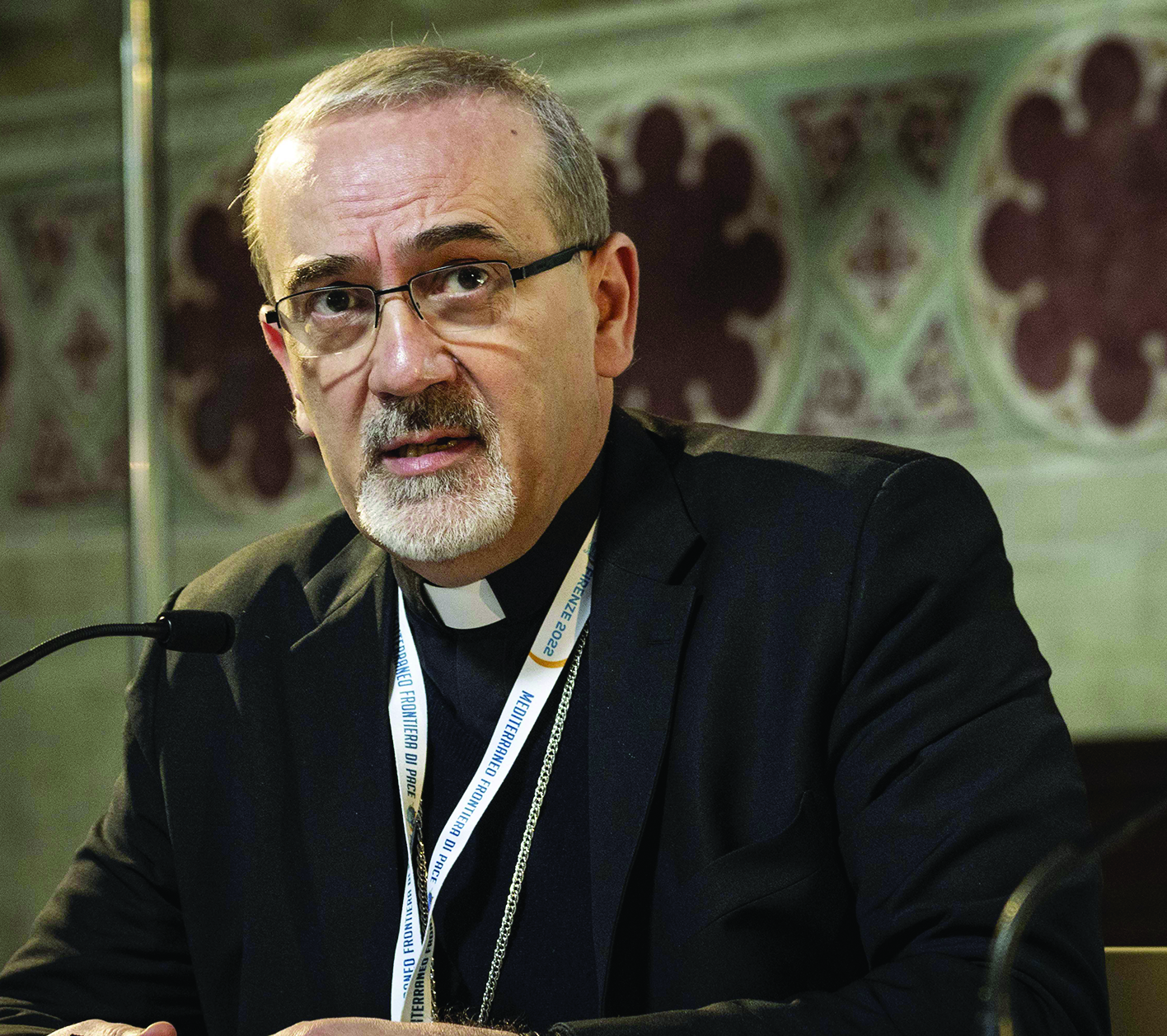
The nuncio for the United States, Cardinal Christophe Pierre, called and informed me that Pope Leo had appointed me the 5th bishop of Jefferson City, Missouri, and asked if I would accept.
I knew of the diocese because it is in my region, and I, when he said the name “Jefferson City,” I said “Missouri,” and he said, “You know of it?” and I said “Yes, because of my work at the seminary” — that was one of the dioceses that sent students to the seminary where I worked. And I prayerfully — in that moment, you’re just aware of your own limits — but I also thought of the Holy Father and his generosity in service, as the whole world watched in May, when he came to the loggia and greeted us, and I was inspired to follow in that sense of service.
I think throughout our history, the Church’s history, there have always been challenges for the Church, and so we rely on God’s grace to help us respond with a spirit of humility and service.
Can you tell us a little bit about your motto and code of arms?
We’re still working on that, but my motto is “To serve the Lord with gladness,” from the psalm, and the crest itself has symbols of water — a stream of water through the center, which represents my home diocese, Omaha, which is on the Missouri River, and Jefferson City, the diocese where I will serve as bishop, also on the Missouri River.
The upper portion has the chi ro with the alpha and the omega as a symbol of Christ’s being the beginning and end, the “all” that we do, and the lower portion has the lily, the fleur-de-lis — my childhood parish was Our Lady of Lourdes — and this serves as a way of honoring Our Blessed Mother. I’ve also asked that the fleur-de-lis be stylized in a manner similar to Pope Leo’s, because he is the one who has appointed me.
How do you remember May 8, the election of the Holy Father?
Oh, it was wonderful. I was at a luncheon with at least 300 people in a large dining room, and they put it on the live screens, and we were with our newly appointed archbishop at the luncheon. We were all excited because we had heard that there was a pope elected, and then to find that he has been in the missions of Peru for so many years, but was a native of Chicago, and his kindness and warmth as he looked at all of us for the first time…it was beautiful to see.
You were soon in Rome after the election and could see him personally.
Yes, I was at a general audience with a group of pilgrims from the United States for the Jubilee of Hope, and saw him from St. Peter’s Square, and he spoke beautifully of the Good Samaritan, and how Christ cares for us as, you know, individually as the Good Samaritan in the parable, and that we as a church must care for those who have experienced difficulty in this life, like the one who fell in with robbers. And of course, I had no idea that I would be returning to Rome for New Bishop’s School in September.
Before asking about the Bishop’s School, you said your experience was very much focused on vocations. What will you take from that in your new role as bishop?
I think the Lord continues to call as he has ever called those to vocations within the Church, priesthood, religious life, and the dedicated single state, as disciples. As a bishop, I would hope to help people recognize the voice of the Lord calling to follow Him. Our world is very busy, and there are many voices to discern, but the Lord’s call is special in that it’s always with the desire for us to grow closer to Him through the gift of whatever vocation is ours.

12 of the 13 new American bishops who attended 2025 “Bishop School” in Rome pose on the roof of the Pontifical North American College in Rome September 10. Bishop O’Donnell is fourth from left. (CNS)
Can you tell us a few words about how New Bishop’s School works?
Among the 192 bishop-designates, there were three of us that would be ordained in the next month and a half. Each day we had a number of lectures given by Prefects of the Dicasteries or their secretaries that ranged on topics of spirituality, administration and theology. Then we would have a period of questions and answers after each speaker, and also we would break into small groups of probably seven to maybe 18 bishops within our language group.
That was a very powerful experience, in that we had the opportunity to meet bishops from all parts of the world and discuss the topics that were presented and how they might apply to our individual dioceses.
The core moment of your course was personal — meeting with Pope Leo.
He met with us at the Synod Hall. He presented a beautiful conference talk to us and then gave an opportunity to dialogue with the bishops. And then he stayed for each one of us to be introduced one-on-one, which was a real blessing.
May I ask you what was the most important from what Pope Leo told you?

Pope Leo addresses the new bishops at this year’s “Bishop School’ —the first of his pontificate. (Vatican Media)
He stressed that our call as a bishop is for the Church, for us to serve the cause of the Gospel, and that we are being sent as servants of faith. Again, this was inspiring because he is such a witness of that personally as the successor of Saint Peter. He also was very practical in speaking of charisms that are well suited to a bishop in living out our life as followers of the Lord.
You were also part of the inauguration of the new Borgo Laudato si’ in these beautiful gardens of Castel Gandolfo.
Yes, I also had the privilege while in Rome to attend the inauguration of the new Borgo Laudato Si’. That important project started by Pope Francis involves a director who I have known from my years of ministry in the United States, and so was invited to attend. It was remarkable to see the good work that has been initiated to help raise the consciousness of the world for the importance of sustainability and the ennoblement of the human person with the dignity of labor.
Having been a part, as a parish priest, in efforts to be mindful of the environment, it was incredible to see this good work advance in such a remarkable way as this new center.
The date chosen for your episcopal ordination was October 28…
Yes, the Feast of Saint Simon and Jude. And I had the opportunity to visit Saint Joseph’s Chapel in Saint Peter’s Basilica and pray with Saint Simon and Jude — asking their intercession that I might worthily serve the Diocese of Jefferson City. My mother also has a great devotion to Saint Jude, which she reminded me of when I told her the date.
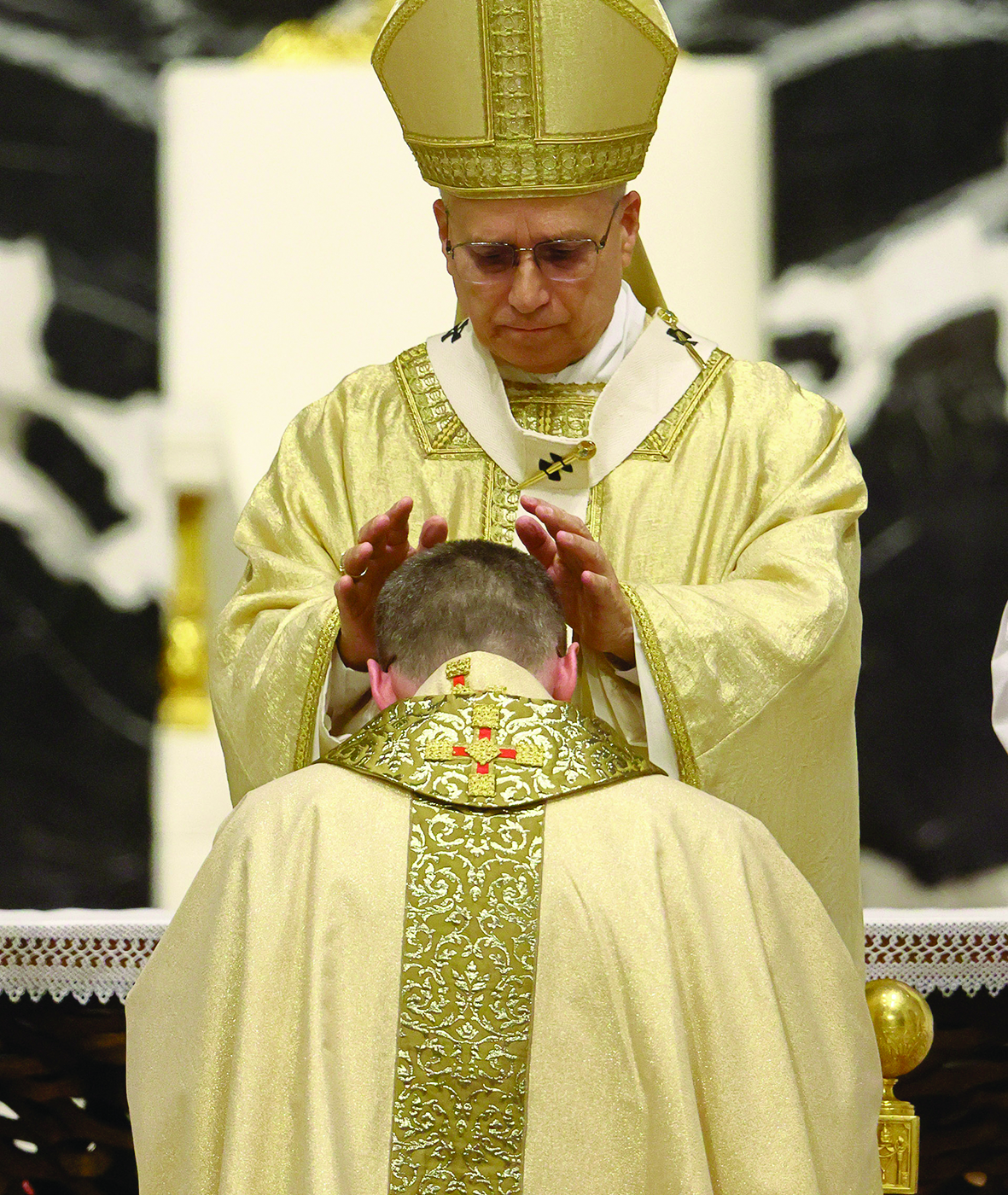
The Archbishop of Saint Louis, and then my Archbishop from Omaha, and my predecessor, the Archbishop of Kansas City, Kansas were the consecrators.