By Lucy Gordan

“The Deposition” or “Strozzi Altarpiece.” (Photo: Courtesy of the Ministero della Cultura-Direzione regionale Musei nazionali Toscana-Museo di San Marco).

Probably a self-portrait of Fra Angelico in the “Strozzi Altarpiece”
A blockbuster exhibition celebrating Fra Angelico (c.1395-1455), better known as “Beato (Blessed) Angelico,” is on display until January 25, 2026 at two locations in Florence. Palazzo Strozzi, a Renaissance palace, since 2006 has been the location of the city’s major temporary art exhibitions; the San Marco Museum is the former Dominican convent where this friar-painter, the founding father of Renaissance art in Florence, lived and worked. Today it’s home to the world’s largest collection of his frescoes and of his paintings, these all displayed in their own newly-opened room.
A word about Fra Angelico: Born near Fiesole, a few miles uphill from Florence, he joined the Dominican Order there in 1407. The first payments he received as an artist date to January/February 1418 for paintings, now lost, in Fiesole’s church of Santo Stefano del Ponte. Two decades later, in 1436, when the new Dominican Convent of San Marco in Florence, commissioned by Cosimo de’ Medici, was completed, Fra Angelico was one of the friars who moved there. It remained his home for the rest of his life except for the decade 1445-1455, when he worked for Popes Eugenius IV (r. 1431-1447) and Nicholas V (r.1447-1455) in the Vatican, with a brief interlude in 1447 when he painted some frescoes for the cathedral in Orvieto.

‘Franciscan Triptych.’ (Photo: Courtesy of the Ministero della Cultura-Opificio delle Pietre Dure)
At the time of his death on February 18, 1455 he was frescoing Pope Nicholas’s small private Chapel, depicting in bright colors and with gold leaf decorations the lives of St. Stephen and St. Lawrence in the Vatican. It’s his only surviving work in the Vatican and in Rome. He died at the Dominican Convent next door to the Church of Santa Maria sopra Minerva; he’s buried there. The words chiseled on his grave say:
“When you praise me, don’t say that I am a famous painter. Instead say that for love of Jesus I gave everything I had to the poor. The things that seem to be important on Earth are not the things that are important in Heaven. I am brother John, from Florence, the flower of Tuscany.”
To return to the exhibition, as the press release explains, the construction of San Marco “represents a crossroads of religious devotion, culture and political power in 15th-century Florence” — for Fra Angelico’s artistic vision was deeply rooted in religious devotion. Moreover, Cosimo the Elder de’ Medici (1389-1464), the omnipotent banker/politician as well as lover of the arts, who’d commissioned the architect Michelozzo to build the complex, thereby became the devoted patron of its artist-in-residence Fra Angelico.
“Fra Angelico” is curated by Carl Bradon Strehlke, Curator Emeritus of the Philadelphia Museum of Art, with Stefano Casciu, the Regional Director of Tuscany’s National Museums, and Angelo Tartuferi, the former Director of the recently-reopened San Marco Museum. It marks the first major exhibition in Florence dedicated to the artist exactly 70 years after 1955’s monographic show. Thus, a once-in-a-lifetime experience!

Last Judgment (Photo: Courtesy of the Ministero della Cultura, Direzione regionale Musei nazionali Toscana, Museo di San Marco).
The more than 140 works-of-art, which include paintings, drawings, sculptures and illuminated manuscripts, are on loan from some 70 leading museums and cultural institutions. Among them are the Louvre, the Gemäldegalerie in Berlin, the Metropolitan, the National Gallery in Washington D.C., the Vatican Museums, the Alte Pinakothek in Munich, the Rijksmuseum in Amsterdam, and numerous libraries, churches and collections in Italy and internationally.
During the four years of “Fra Angelico”’s preparation, several of the paintings were meticulously restored and many of the altarpieces that had been disassembled by Napoleon and dispersed over 200 years ago were reunited for the first time. It’s an undertaking that makes “Fra Angelico” truly a unique and unrepeatable exhibition.
All the works explore Fra Angelico’s artistic development, the influence of Giotto’s frescoes of St. Francis in Assisi, which Fra Angelico certainly would have seen, and his relation to other contemporary painters such as Lorenzo Monaco, Masaccio, Filippo Lippi and Jan van Eyck, who introduced him to the Flemish practice of depicting detail, as well as to sculptors like Lorenzo Ghiberti, Michelozzo and Luca Della Robbia.
Renowned for his unmistakable style of harmony, light and spirituality, evolving from a late Gothic legacy of gold-leaf backgrounds and one-dimensionality, while embracing the principles of the emerging Renaissance: three-dimensionality, greater detail, chiaroscuro, and anatomical accuracy, Fra Angelico created paintings celebrated for their mastery of perspectival space and light.
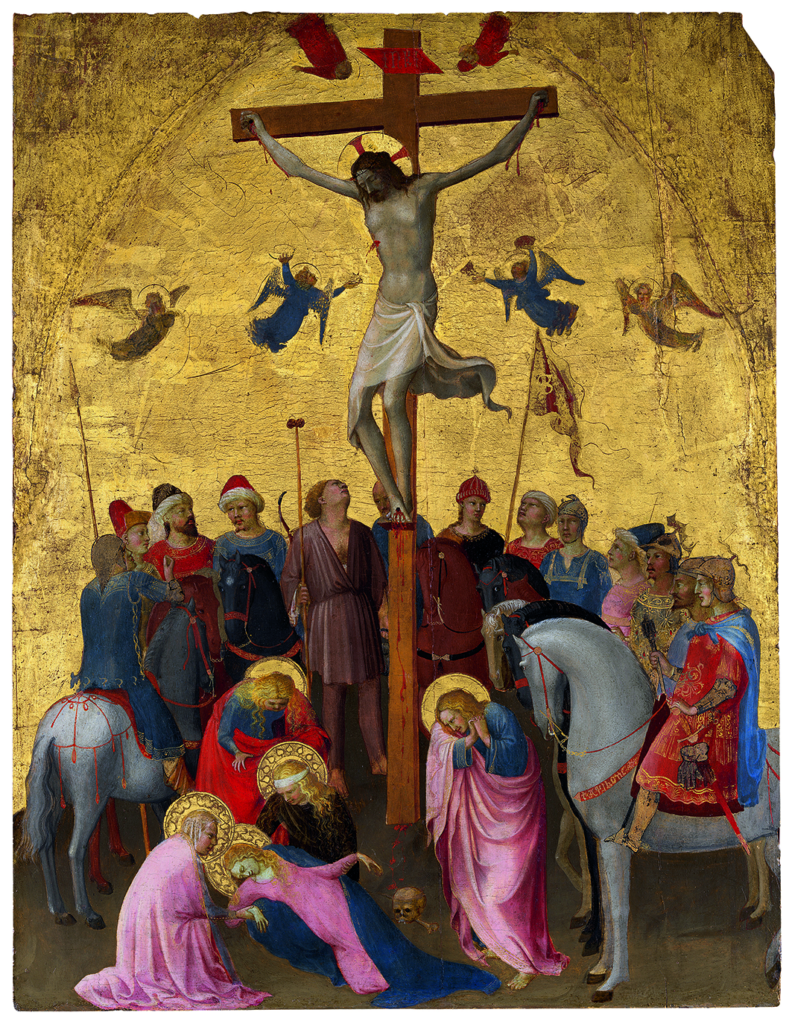
Crucifixion (Photo: The Metropolitan Museum of Art, New York).
At Palazzo Strozzi the exhibition is divided into eight sections: Santa Trinità, The New Language, San Marco, The Silhouetted Crucifix, Holy Faces, The Great Commissions, Rome and the Medici. Fra Angelico’s masterpieces explore his artistic development, his innovations, his extraordinary attention to detail and his influence on and collaborations with other artists, as well as his relationship with Cosimo de’ Medici and with numerous Florentine institutions, both religious and lay. One innovation — a turning point in Italian painting — are his early examples of the “Sacra Conversazione” where he’s painted the Virgin and saints in a unified space or scene, thus no longer separated by frames. One example here is the “San Marco Altarpiece,” the star of the exhibition, along with the “Deposition” or “Strozzi Altarpiece” in the first room. Other highlights are “The Franciscan Triptych” whose central Madonna and Child are the exhibition’s logo, on loan from the San Marco Museum; “The Last Judgment,” the upper panel of an altar piece, also on loan from the San Marco Museum; “The Reliquary Tabernacles of Santa Maria Novella” on loan from Boston’s Isabella Stewart Gardiner Museum; and ”The Crucifixion” on loan from the Met, possibly Fra Angelico’s only signed work, to name but a few.
The “San Marco altarpiece”, commissioned by Cosimo de’ Medici and his brother Lorenzo and painted between 1438 and 1442, was dismantled in 1678-79, much earlier than the other reassembled altarpieces on display. It was exceptionally and miraculously reassembled for this exhibition with 17 of its the 18 known surviving elements, now in nine different museums. Its main panel depicts the enthroned Virgin and Child surrounded by angels and saints, in a new square format; its nine predella panels narrates the legend of the Medici patron sants, Cosmas and Damian.

The central panel of the San Marco altarpiece (Courtesy of the Ministero della Cultura-Opificio delle Pietre Dure)
Instead, the San Marco Museum is the exhibition’s spiritual home. Here, the painter’s frescoes, around 50 in number, laid the foundations of the Florentine Renaissance, in which spirituality and artistic vision coalesce. They’re immediately visible in the overdoors of the cloister and in the Chapter House, and then upstairs in the corridors of the friars’ dormitory and in each one of their cells. Each different, all of them were painted by Fra Angelico himself or under his direct supervision.
At the top of the stairs leading to the dormitory is Fra Angelico’s Annunciation, one of the iconic images of Renaissance art and certainly one of his best-known works.
This Annunciation isn’t Fra Angelico’s first painting on that theme nor his only one in the convent. This fresco wasn’t intended just for esthetic purposes. Running across the loggia at the bottom of the fresco there’s an inscription that instructs the viewer: Virginis Intacte Cum Veneris Ante Figuram Preter evndo Cave Sileatvr Ave. It means that, when you stand before the image of the Ever-Virgin, take care that you don’t neglect to say an Ave, thus a reminder for the monks to pray.
His other frescoes, also intended for contemplation by the friars, depict religious scenes primarily from Christ’s life and the New Testament. The Museum’s galleries, besides the Fra Angelico Room, contain other works of exceptional historical value: the “Last Supper” by Ghirlandaio, panel paintings by Uccello and Fra Bartolomeo, as well as glazed terracotta sculpture by the Della Robbia family.
To book tickets in advance, click on www.palazzostrozzi.org for the exhibition located in Palazzo Strozzi, open daily from 10 AM to 8 PM, on Thursday until 11 PM.
To book the San Marco Museum, click on www.ticketsflorence.com, open Tuesday-Friday 8:15 AM to 1:45 PM, Saturday 8:15 AM to 6:50 PM, Sunday 8:15 AM to 7 PM, closed Monday. The splendid catalog, in separate Italian and English editions, costs 80 euros.

Fresco of The Annunciation in the Convent of San Marco (Photo: Courtesy of the Ministero dela Cultura-Direzione regionale Musei nazionali Toscana-Museo di San Marco)
Nota bene: Fra Angelico, whose favorite subjects were the Madonna and Child and the Annunciation, was not only appreciated by Cosimo de’ Medici and his fellow contemporary artists. A little more than a century after his death, the author and fellow-painter Giorgio Vasari, who wrote the Lives of the Artists said the friar had a “rare and perfect talent… It is impossible to think of enough good things to say about this holy father, who was so humble and modest in everything that he did and said, and whose pictures were painted with such cleverness and holy faith.”
Thus, he has been called “Beato Angelico” for centuries because it was thought that he’d been blessed by God to have been such a holy man and to have had such a unique talent. However, it wasn’t until October 3, 1982 that St. John Paul II officially “conferred beatification.” In 1984 he made him the patron of Catholic artists. This means that the friar is now on this way to being made a saint.