Leo XIII condemned it; how will Leo XIV approach it?
By Aurelio Porfiri
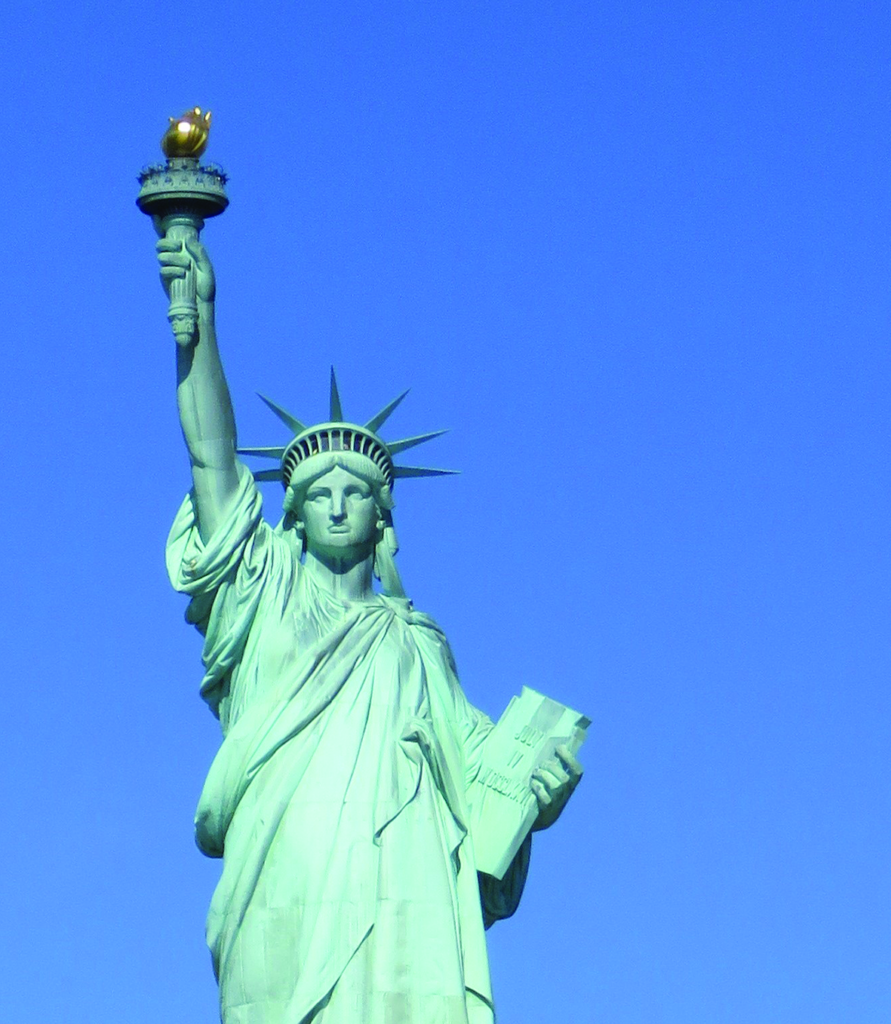
The Statue of Liberty in New York harbor, donated by the French in 1884.
At the election of the new American Pontiff, many were struck by his choice of name: Leo XIV.
Pope Leo XIII (r. 1878-1903)
Indeed, the significance of the name and nationality of the Pontiff cannot be underestimated. The reference to Leo XIII (1810–1903) is certainly evocative — first of the social question that Leo XIII addressed with the very important encyclical Rerum Novarum (1891). But another fundamental document of Leo XIII could hardly have gone unnoticed: the Apostolic Letter Testem Benevolentiae (1899), addressed to the Cardinal of Baltimore, James Gibbons — a document in which the Pope condemns the doctrines that are summed up under the name “Americanism.”
In an article published in French in the traditionalist-oriented magazine Courrier de Rome in September 2014, the scholar Cristina Siccardi identifies five main points of Americanism condemned in this Letter:
- Adaptation of discipline and dogma to “modern needs”;
- Emphasis on individual freedom and on the consequent action of the Holy Spirit;
- Natural virtues valued above supernatural ones;
- Active virtues valued above passive ones, contempt for contemplation;
- As a consequence of the previous point, little regard for religious life.
These issues are not just things of the past, but also resonate today as an American Pontiff must deal with the enormous contradictions evident in the America of Donald J. Trump. And here the reflections offered by Leo XIII more than 100 years ago can be of great help.
We are all certainly aware of the achievements, especially in the technological and scientific fields, of American entrepreneurs and scholars — a precious heritage for this country and the whole of humanity.
But, certainly, it is not out of place to try to understand the mens — the “mind” or mentality — that governs and directs this technological and scientific potential. In this, Leo XIII can certainly be of help to Leo XIV, and to all of us.
Indeed, not a few thinkers have warned of the dangers of development guided solely by profit and not by ethical values. A phrase that struck me greatly in my adolescence said that “we must not be blindly against progress, but be against blind progress.” The new challenges posed by artificial intelligence, often mentioned by Leo XIV, make us reflect deeply on the primacy that Americanism, as a mentality, gives to “doing” rather than to “being.” In this case, physics precedes metaphysics, reflection on the consequences of one’s actions.
But to return to Leo XIII, we cannot forget that before Testem Benevolentiae, he had already issued in 1895 an encyclical letter called Longinqua Oceani. In it, the Pope addresses the US, a country that was destined to become a world power, and at one point makes a pivotal observation, especially when read in the light of the previous 1899 Letter:
“As regards civil affairs, experience has shown how important it is that the citizens should be upright and virtuous. In a free State, unless justice be generally cultivated, unless the people be repeatedly and diligently urged to observe the precepts and laws of the Gospel, liberty itself may be pernicious.”
This is a key concept: Freedom, when absolute and not tied to its necessary derivation from a divine order, can become a form of dictatorship when, in the name of “rights,” people are forced to censor themselves in their free capacity for speech and expression.

Pope Gregory XVI (r. 1831-1846)
It is certainly in this sense that we must read an encyclical (later much vilified) of a predecessor of Leo XIII, Gregory XVI (1765–1846), Mirari Vos, issued in the year 1832, and including these important paragraphs:
“From this most corrupt source of indifferentism flows that absurd and erroneous maxim, or rather madness, that liberty of conscience must be granted and guaranteed to each one: a most poisonous error, to which that full and unbridled liberty of opinion opens the way, which goes on increasing to the detriment of the Church and of the State, not lacking those who dare to boast with unblushing impudence that some advantage to Religion arises from such license. ‘But what death more fatal to the soul can there be than the liberty of error?’ exclaimed St. Augustine [Ep. 166]. For, once every restraint is removed that might keep men on the paths of truth—men who are already inclined to precipitate ruin by nature’s bent toward evil—it is certain that the ‘pit of the abyss’ (Apoc. 9:3) is opened, from which St. John saw smoke rising that darkened the sun, and locusts issuing forth to devastate the earth.
“Consequently, there comes about a change of minds, the corruption of youth, the contempt among the people for sacred things and for the most holy laws; in a word, the most deadly pest of society, since the experience of all ages, even from the remotest antiquity, clearly demonstrates that flourishing cities in wealth, power, and glory were destroyed solely for this cause: excessive freedom of opinions, license of meetings, unbridled craving for novelty. […]
And yet (ah, sorrowful thought!) there are some who go so far in shameless audacity as to assert, with insulting arrogance, that this flood of errors is more than compensated for by some work which, in the midst of such a tempest of depravity, is brought to light in defense of Religion and truth.
[…] But can it ever be said by anyone of sound mind that poison ought to be freely and publicly spread, sold, transported, nay even drunk, because there exists some remedy by the use of which it happens that someone escapes death?”
Does Pope Gregory XVI really wish to prevent us from speaking? No — he merely intends to affirm that error cannot have the same rights as truth. How jarring, even repugnant, this seems compared to a mentality very much alive in the United States, in which “freedom,” like the “liberté” of the French Revolution, refers only to itself.

The “Liberté” of the French Revolution.
Yet Pope Gregory XVI’s words contain logic: If I have an appendicitis, will I give the same weight to the opinion of the doctor and to that of the accountant? No — their opinions do not have the same weight. Similarly, will an opinion dictated by a conscience that refers to God have the same weight as that of a conscience that has only itself as a reference?
A beautiful thought by the French poet-philosopher Gustave Thibon can help us in this reflection:

“Absolute independence does not exist for man” Gustave Thibon (1903-2001), a French philosopher and poet nominated for the Nobel Prize in Literature five times (Open Library).
“To define freedom as independence hides a dangerous misunderstanding. Absolute independence does not exist for man (a finite being that depends on nothing would be a being separated from everything, that is, eliminated from existence). But there is a dead dependence that oppresses him and a living dependence that makes him blossom. The first of these dependencies is slavery, the second is freedom. A convict depends on his chains, a farmer depends on the earth and the seasons: these two expressions designate very different realities.”
“Let us return to biological comparisons, which are always the most illuminating. What does ‘breathing freely’ consist of? Perhaps in the fact of lungs being absolutely ‘independent’? Not at all: the lungs breathe all the more freely the more firmly and intimately they are linked to the other organs of the body. If this link loosens, breathing becomes less and less free and, at the limit, stops. Freedom is a function of vital solidarity. But in the world of souls this vital solidarity has another name: it is called love. Depending on our emotional attitude toward them, the same bonds can be accepted as vital links or rejected as chains; the same walls can have the oppressive hardness of a prison or the intimate sweetness of a refuge. The studious child runs freely to school, the true soldier lovingly adapts to discipline, the spouses who love each other flourish in the ‘bonds’ of marriage.
“But school, the barracks, and the family are horrible prisons for the pupil, the soldier, or the spouses without vocation. Man is not free insofar as he depends on nothing or no one: he is free in exact proportion to his dependence on what he loves, and he is a prisoner in exact proportion to his dependence on what he cannot love.
“Thus the problem of freedom is not posed in terms of independence, but in terms of love.”
These are very beautiful words that make us understand that we are all free only if we are oriented toward God and not slaves to ourselves.