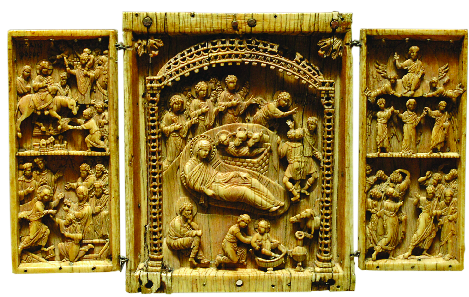
Scenes from the life of Jesus Christ, triptych, Constantinople, crimson ivory, late 10th century. In the central panel is the model used, from Giotto on, in the iconography of the nativity, both in the East and in the West
What shall we offer Thee, O Christ, who for our sake hast appeared on earth as man? Every creature made by Thee offers Thee thanks. The angels offer Thee a hymn; the heavens a star; the Magi, gifts; the shepherds, their wonder; the earth, its cave; the wilderness, the manger: and we offer Thee a Virgin Mother. O pre-eternal God, have mercy upon us
– Stichera from “Lord I have cried…”
The Feast of the Nativity of Our Lord, which we are preparing to celebrate on December 25, is a great and joyful feast for all Christians. And yet, the early Fathers of the Church remind us that the feast we are preparing to celebrate, the Feast of the Nativity of the Lord — Christmas — is inextricably bound up with the sad history of the human race: the fall of Adam, the disobedience of the children of God, and our own sinfulness.
Still, as Zechariah, the father of John the Baptist, proclaimed with a joy that we, too, can experience, “In the tender compassion of our God, the dawn from on high shall break upon us,to shine on those who dwell in darkness and the shadow of death, and to guide our feet into the way of peace.” (Lk 1:67-79) All of us at Inside the Vatican wish you and your families a holy and happy Christmas!
 St. Basil the Great (330-379)
“On the Incarnation”
“God is in the flesh”
God is on earth, He is among men, not in the fire nor amid the sound of trumpets; not in the smoking mountain, or in the darkness, or in the terrible and roaring tempest giving the Law, but manifested in the flesh, the gentle and good One dwells with those He condescends to make His equals!
God is in the flesh, not operating from a distance, as did the prophets, but through Him human nature, one with ours, He seeks to bring back all mankind to Himself.

Adoration of the Magi, Giotto, c. 1320. The kneeling king picks up the Child; Mary looks on with concern, translating the biblical account into deeply human terms. Metropolitan Museum of New York
 St. John Chrysostom (ca. 347-407)
Christmas sermon in Antioch, 386 A.D.
“The Ancient of Days has become an infant”
What shall I say to you; what shall I tell you? I behold a Mother who has brought forth; I see a Child come to this light by birth. The manner of His conception I cannot comprehend.
What shall I say! And how shall I describe this Birth to you? For this wonder fills me with astonishment. The Ancient of days has become an infant. He Who sits upon the sublime and heavenly Throne, now lies in a manger. And He Who cannot be touched, Who is simple, without complexity, and incorporeal, now lies subject to the hands of men. He Who has broken the bonds of sinners, is now bound by an infants bands. But He has decreed that ignominy shall become honor, infamy be clothed with glory, and total humiliation the measure of His Goodness.
For this He assumed my body, that I may become capable of His Word; taking my flesh, He gives me His spirit; and so He bestowing and I receiving, He prepares for me the treasure of Life. He takes my flesh, to sanctify me; He gives me His Spirit, that He may save me.
Come, then, let us observe the Feast. Truly wondrous is the whole chronicle of the Nativity. For this day the ancient slavery is ended, the devil confounded, the demons take to flight, the power of death is broken, paradise is unlocked, the curse is taken away, sin is removed from us, error driven out, truth has been brought back, the speech of kindliness diffused, and spreads on every side, a heavenly way of life has been in planted on the earth, angels communicate with men without fear, and men now hold speech with angels.

Our eye is drawn first to Mary, the Theotokos. She is the largest figure, indicating her importance in our Lord’s incarnation. Our eye is drawn next to the color black behind Jesus. Black is rarely seen in icons, therefore, it has great significance. Jesus is the light born into the darkness of the world caused by sin. He has come to conquer the darkness of sin and death. This cave also reminds us of the sacrifice Jesus will offer. It resembles the tomb in which He will be laid. But, like this cave, His tomb will bring life, not death. The baby is wrapped in strips of cloth reminiscent of the cloths that will wrap Him at his death. The crib appears as a coffin. All this foreshadows His death and reminds us He was born to die. Note the ox and donkey: they look directly at the child, recognizing Him as the Messiah. We know from the Gospels this will not be the case of many in Israel. We read in Isaiah 1:3 “The ox knows its owner and the donkey its master’s crib; but Israel does not know, my people do not understand.”
 St. Athanasius of Alexandria (ca. 296-373)
On the Incarnation, 10.14
“By His power, he restored the human race”
The Word of God did not abandon the human race, his creatures, who are hurtling to their own ruin. By the offering of his body, the Word of God destroyed death which had united itself to them; by his teaching, he corrected their negligences; and by his power, he restored the human race.
Why was it necessary for the Word of God to become incarnate and not some other? Scripture indicates the reason by these words: “It was fitting that when bringing many heirs to glory, God, for whom and through whom all things exist, should make their leader in the work of salvation perfect through suffering.” This signifies that the work of raising human beings from the ruin into which they had fallen pertained to none other than the Word of God, who had made them in the beginning.
By the sacrifice of his body, he put an end to the law which weighed upon them, and he renewed in us the principle of life by giving us the hope of the resurrection. For if it is through ourselves that death attained dominance over us, conversely, it is through the incarnation of the Word of God that death has been destroyed and that life has been resurrected, as indicated by the Apostle filled with Christ: “Death came through one person; hence the resurrection of the dead comes through another person also. Just as in Adam all die, so in Christ all will come to life again.”
It is no longer as condemned that we die. Rather, we die with the hope of rising again from the dead, awaiting the universal resurrection which God will manifest to us in his own time, since he is both the author of it and gives us the grace for it.
 St. Gregory of Nazianzus (329-390)
Oration 38, O strange conjunction!
The Self-existent comes into being; the Uncreated is created
Christ is born: glorify him. Christ comes from heaven: go out to meet him. Christ descends to earth: let us be raised on high. Let all the world sing to the Lord; let the heavens rejoice and let the earth be glad, for his sake who was first in heaven and then on earth. Christ is here in the flesh: let us exult with fear and joy — with fear, because of our sins; with joy, because of the hope that he brings us.
Once more the darkness is dispersed; once more the light is created. Let the people that sat in the darkness of ignorance now look upon the light of knowledge. The things of old have passed away; behold, all things are made new. He who has no mother in heaven is now born without father on earth. The laws of nature are overthrown, for the upper world must be filled with citizens. He who is without flesh becomes incarnate; the Word puts on a body; the Invisible is seen; he whom no hand can touch is handled; the Timeless has a beginning; the Son of God becomes Son of Man — Jesus Christ, the same yesterday, today and for ever.
Light from light, the Word of the Father comes to his own image, in the human race. For the sake of my flesh he takes flesh; for the sake of my soul he is united to a rational soul, purifying like by like. In every way he becomes human, except for sin. O strange conjunction! The Self-existent comes into being; the Uncreated is created. He shares in the poverty of my flesh, that I may share in the riches of his God-head.

Chorale from an illuminated manuscript of the King of Hungary Matthias Corvinus, dating back to 1400

Epiphany of the Lord, from around 1420-1430, surrounded by scenes showing the three wise men and King Herod
 St. Hippolytus of Rome (ca. 170- ca. 235)
On the Refutation of All Heresies
“By taking a body from the Virgin, He refashioned our fallen nature”
Our faith is not founded upon empty words; nor are we carried away by mere caprice or beguiled by specious arguments. On the contrary, we put our faith in words spoken by the power of God, spoken by the Word himself at God’s command. God wished to win us back from disobedience, not by using force to reduce us to slavery but by addressing to our free will a call to liberty.
The Word spoke first of all through the prophets, but because the message was couched in such obscure language that it could be only dimly apprehended, in the last days the Father sent the Word in person, commanding him to show himself openly so that the world could see him and be saved.
We know that by taking a body from the Virgin he refashioned our fallen nature. We know that his humanity was of the same clay as our own; if this were not so, he would hardly have been a teacher who could expect to be imitated. If he were of a different substance from me, he would surely not have ordered me to do as he did, when by my very nature I am so weak. Such a demand could not be reconciled with his goodness and justice.
No. He wanted us to consider him as no different from ourselves, and so he worked, he was hungry and thirsty, he slept. Without protest he endured his passion, he submitted to death and revealed his resurrection.
In all these ways he offered his own humanity as the first fruits of our race to keep us from losing heart when suffering comes our way, and to make us look forward to receiving the same reward as he did, since we know that we possess the same humanity.
When we have come to know the true God, both our bodies and our souls will be immortal and incorruptible.
We shall enter the kingdom of heaven, because, while we lived on earth, we acknowledged heaven’s King.
Friends of God and co-heirs with Christ, we shall be subject to no evil desires or inclinations, or to any affliction of body or soul, for we shall have become divine. It was because of our human condition that God allowed us to endure these things, but when we have been deified and made immortal, God has promised us a share in his own attributes.
 St. Gregory of Nyssa (ca. 335-ca. 394)
Homily on the Nativity of Christ
“The notable day of our feast is at hand”
“Sound the trumpet at the new moon,” says David, “even in the notable day of your feast.” The commandments of Divinely-inspired teaching are assuredly a law for those who hear them. Therefore, since the notable day of our feast is at hand, let us, too, fulfill the law and become heralds of the solemnity. The trumpet of the law, as the Apostle bids us understand, is the word. For the sound of the trumpet, he says, should not be uncertain, but its notes should be distinct so that the hearers may clearly perceive it. So let us produce a clear and audible sound, brethren, one that is no less noble than that of the trumpet.
For the Law, prefiguring the truth in the shadowy types, enjoined the sounding of the trumpet at the Feast of Tabernacles. Now, the theme of the present Feast is the mystery of the true Tabernacle. For on this day did He Who vested Himself with humanity for our sake pitch His human tabernacle; on this day our tabernacles, which had disintegrated through death, are reconstituted by Him Who constructed our habitation from the very beginning. Let us utter the words of the Psalm, joining in chorus with the loud-voiced David: “Blessed is he that cometh in the name of the Lord.” How does He come? He crosses over into human life, not by boat or by chariot, but through the incorruption of a Virgin. This is our God, this is our Lord, Who appeared to us to ordain a Feast with thick branches, even unto the horns of the altar.
We are assuredly not unaware, brethren, of the mystery contained in these words: that all of creation is a single temple of the Master of creation. But since, when sin intervened, the mouths of those overcome by evil were stopped, the voice of rejoicing fell silent and the harmony of those who keep festival was interrupted, as human creation no longer celebrated with celestial Angel-kind, for this reason there came the trumpets of the Prophets and the Apostles, whom the Law calls horns, because they are formed from the true Unicorn (Numbers 23:22).
By the power of the Spirit they made the word of truth resound with piercing clarity, so that the ears of those who had been made deaf by sin might be opened up and so that there might be one harmonious celebration, echoing in unison through the thick covering of the tabernacle of the lower creation with the sublime and preëminent Hosts that stand around the Heavenly Altar.
“In the tender compassion of our God, the dawn from on high shall break upon us,to shine on those who dwell in darkness and the shadow of death, and to guide our feet into the way of peace.”
(Lk 1:67-79)
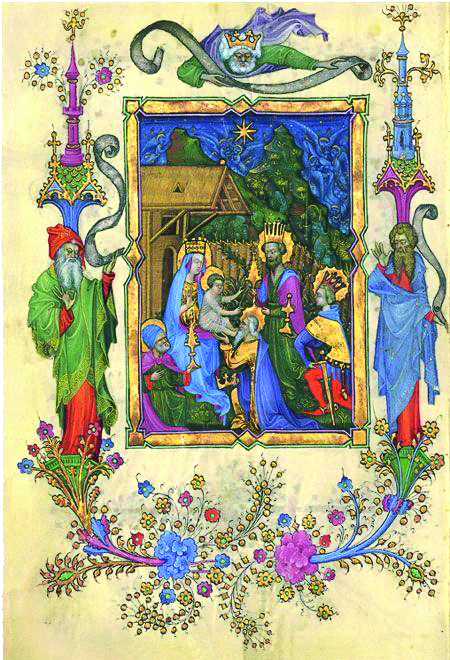
Illuminated page from The Book of Hours, commissioned by the ruler of Milan, Gian Galeazzo Visconti, in Italy, 1400.
 St. John Damascene (ca. 675-749)
Exposition of the Orthodox Faith
“We stand to Him in the relation of brothers”
He who is first begotten is called firstborn(1), whether he is only-begotten or the first of a number of brothers. If then the Son of God was called firstborn, but was not called Only-begotten, we could imagine that He was the firstborn of creatures, as being a creature(2). But since He is called both firstborn and Only-begotten, both senses must be preserved in His case. We say that He is firstborn of all creation(3) since both He Himself is of God and creation is of God, but as He Himself is born alone and timelessly of the essence of God the Father, He may with reason be called Only-begotten Son, firstborn and not first-created.
For the creation was not brought into being out of the essence of the Father, but by His will out of nothing. And He is called firstborn among many brethren, for although being Only-begotten, He was also born of a mother.
Since, indeed, He participated just as we ourselves do in blood and flesh and became man, while we too through Him became sons of God, being adopted through the baptism, He Who is by nature Son of God became firstborn amongst us who were made by adoption and grace sons of God, and stand to Him in the relation of brothers. Wherefore He said, “I ascend unto My Father and your Father.”
 St. Augustine of Hippo (354-430), Sermon 191.1
“He wished to have one day set aside for his human birth”
The Word of the Father, by Whom all time was created, was made flesh and was born in time for us.
He, without whose divine permission no day completes its course, wished to have one day set aside for His human birth.
In the bosom of His Father, He existed before all the cycles of ages; born of an earthly mother, He entered upon the course of the years on this day.
Man’s maker became Man that He, Ruler of the stars, might be nurse at His mother’s breast;
that He, the Bread, might hunger;
the Fountain, might thirst;
the Light, might sleep;
the Way, might be wearied by the journey;
the Truth, might be accused by false witnesses;
the Judge of the living and the dead, might be brought to trial by a mortal judge;
that He, Justice, might be condemned by the unjust;
that He, Discipline, might be scourged with whips;
that He, the Foundation, might be suspended upon a cross;
that Courage might be weakened;
that Healer might be wounded;
that Life might die.