The family is “one of the most precious goods of humanity,” St. John Paul II said in his Apostolic Exhortation Familiaris Consortio. And today, the family is more than ever at the center of the concern and attention of the Church. Pope Francis has decided to dedicate two Synods of Bishops to the family — the Third Extraordinary General Assembly, on the pastoral challenges facing the family in the context of evangelization from October 5 to 19 in 2014, and the Fourteenth Ordinary General Assembly, on the vocation and mission of the family in the Church and in the modern world, scheduled to be held at the Vatican from October 4 to 25.
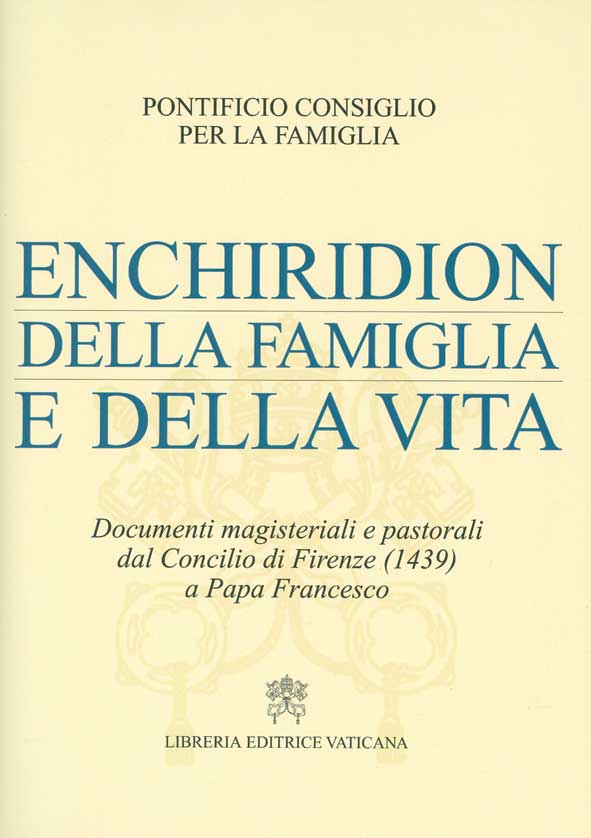 This process of reflection and of hearing the concerns of the people of God is being accompanied by a major Holy See publishing effort. The effort is the fruit of a collaboration between the Pontifical Council for the Family, the Vatican office most directly involved in the promotion of the pastoral ministry and apostolate to the family, and the Vatican Press, which has always been attentive to the theme of the family — its catalog includes dozens of publications on family-related topics such as marriage, procreation and children’s rights. The Vatican Press’s Enchiridion on the family and life issues, for example, is more than 3,500 pages long and gathers hundreds of documents of the Magisterium on family life, spanning a period of almost six centuries: encyclicals, letters, speeches, apostolic constitutions, motu proprio, homilies, radio messages, beginning with the “Decree to the Armenians” from 1439 during the Council of Florence, and including the most recent statements of Pope Francis, as well as statements from the previous 13 pontificates, from Pius VII to Benedict XVI.
Now this effort is taking the form of two series: The Family on the Way and The Family and Life, both series edited by Father Gianfranco Grieco, an official at the Pontifical Council for the Family.
The first series consists of five publications.
The first booklet is Hello, Papa! Families in Dialogue with Benedict XVI. It contains the conversations between five families from around the world and Benedict XVI in Milan on the evening of June 2, 2012, at the Seventh World Meeting of Families. (At the eighth meeting, in Philadelphia in September, Pope Francis will be present.)
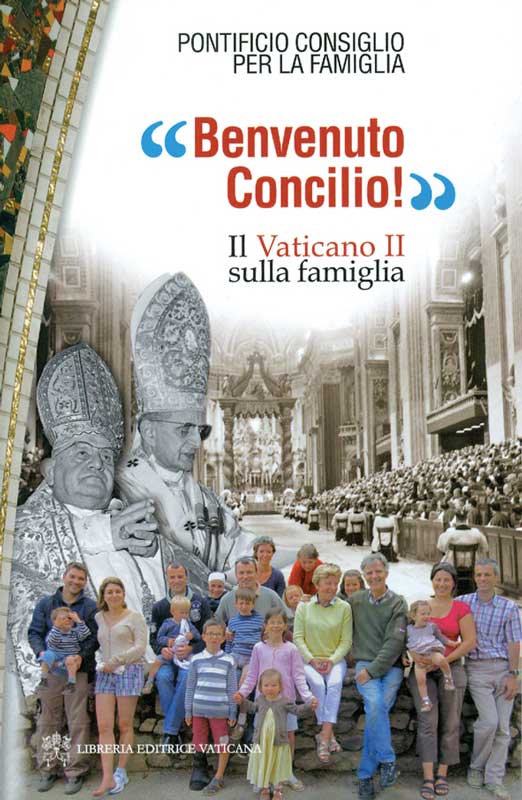 The second booklet, entitled Welcome, Council! Vatican II on the Family contains texts taken from the conciliar documents. “The Second Vatican Council has deeply influenced the life of the Church and society in the last 50 years,” Archbishop Vincenzo Paglia, president of the Pontifical Council for the Family, says in the preface. “The documents of Vatican II speak in plain and concrete language,” Paglia continues, referring to the conciliar texts published in the booklet. He notes that these texts have “accompanied the journey of the Church community, called to respond in ever more credible ways regarding the family and life.”
The work is divided into six chapters. The first is entitled “The family, a plan of God”; another focuses on the mystery of the love between a man and a woman; and a third on the “most beautiful fruit” of marriage, that is, children, and on the task of educating children.
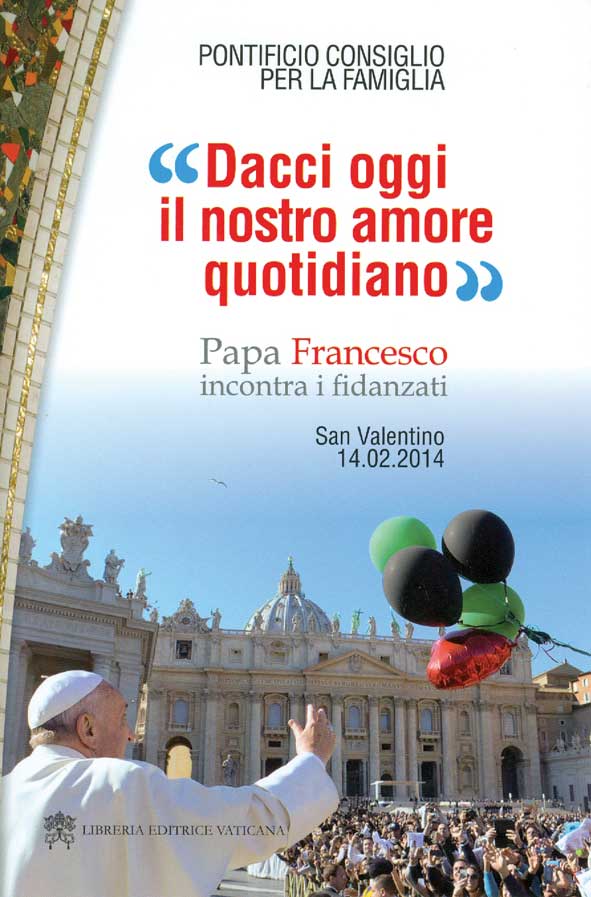 Give Us This Day Our Daily Love is based on the meeting of Pope Francis with thousands of engaged couples in St. Peter’s Square on St. Valentine’s Day, February 14, 2014. The booklet contains the questions that couples have asked the Pope, and his answers, including the exhortation, “Lord, give us this day our daily love,” and the three words that according to Francis are the basis of married life: “please, thank you and forgive me.”
“Maybe you’ve gotten angry, maybe a plate has been thrown,” observed the Pope, “but please remember this: never end the day without making peace! Never, never, never!”
In Family, Evangelize Yourself and the World! Analyses and Proposals of the Synod of 2012 are 48 texts concerning the family from the Synod Fathers of the XIII Ordinary General Assembly, which took place from October 7 to 28 in 2012 on the theme “The New Evangelization for the Transmission of the Christian Faith,” proposing a new evangelization of the family and of family life in today’s pluralistc society.
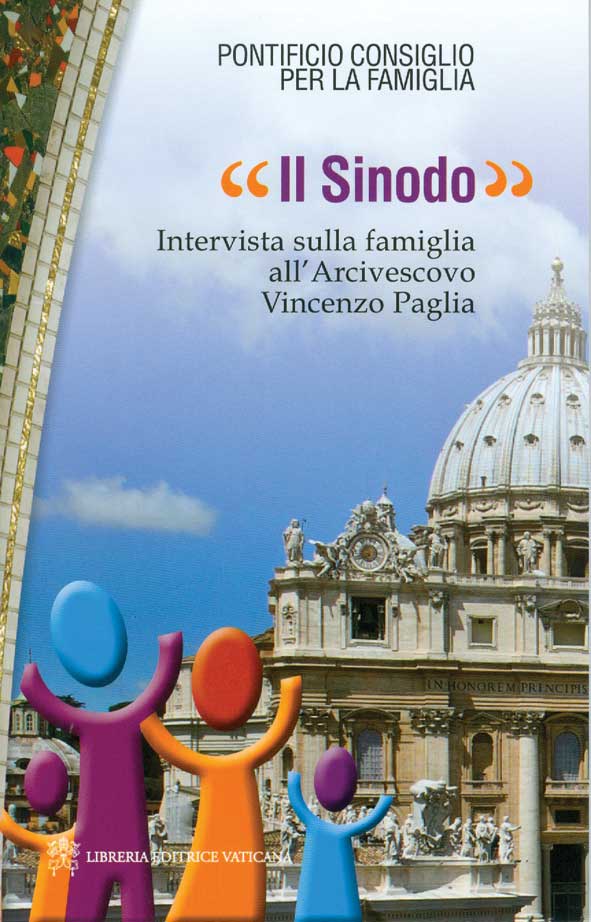 Finally, The Synod: Interview on the Family with Archbishop Vincenzo Paglia is a long dialogue between the president of the Pontifical Council for the Family and the journalist Luciano Moia of Avvenire, the daily of the Italian bishops’ conference.
Much thicker are the volumes in the series “Family and Life.” The first title in this series is The Teachings of Jorge Mario Bergoglio, Pope Francis, on Family and Life, 1999-2014. This volume brings together 35 interventions of Cardinal Bergoglio as Archbishop of Buenos Aires, and more than 130 interventions of Pope Francis, including Angelus prayers, speeches, messages, homilies, Wednesday audience catecheses and morning meditations. This volume shows that family and life are two constants themes in the preaching of Pope Francis, not only today but also when he was pastor of the Argentine capital. “Today, Pope Francis speaks as Cardinal Bergoglio spoke in past years,” Father Grieco writes in the book’s preface, “using clear, immediate and direct words that strike hearts, trouble consciences and challenge intellects. This, it seems, is his pattern: to start from the heart in order to change one’s conscience while challenging the intellect and reasoning faculty.” Archbishop Paglia, in his introduction, writes: “Pope Bergoglio preaches the ‘good news’ of the family as a central part of evangelization; the family is a community of life that has its own autonomous reality and rights; the family is founded on marriage between one man and one woman; a passion for the two poles of family life, childhood and old age; the need for the family to live the joy of faith; the need for the family to find in Jesus its true joy; the truth that marriage is a journey, hand in hand, forever, for one’s whole life.”
In 2013, the Pontifical Council for the Family hosted several “days of reflection” to study the various situations in which the family finds itself today. The results of this round of “Dialogues for the Family,” which took place in Rome, are contained in the other volumes of the series.
 The family as the first “business” of society, from the economic, social, psychological and educational points of view, is the theme of the The Family, The First Business. In the family there is the present and the future of the children, uniting the two poles of the infant and the aged. Putting the family again at the center of all social projects should therefore become the goal, not only of the family, but of all government and social institutions.
Family and Imperfect Love asks the question: should the role of the father and mother in the education of children be a priority and decisive? This duty may not be delegated to others, such as babysitters, school, parish, oratory, friends. Parents have a duty to provide a sound education for their children, to spend time with them, to discuss and walk together. They must engage in this process of education, which is also education in the faith and life, which starts from childhood and continues through adolescence to maturity. The delegation of this “mission’ means to fail in this primary responsibility to build the father-mother-children relationship.
The proceedings of a conference sponsored in 2013 by the Pontifical Councils for the Family and for the Unity of Christians and the Department for External Church Relations of the Moscow Patriarchate are collected in the volume Catholics and Orthodox Together for the Family. The great treasure of the Catholic and Orthodox Churches contains theological, spiritual and cultural resources in support of a Christian witness to the values of marriage and the family. The volume stresses the common responsibility to present marriage and family as a way of holiness for Christian couples.
 Family, Protect Creation! focuses attention on the need for people to “guard” what has been given to us by God and to transmit it to future generations with respectful fidelity, with all of us active participants and not spectators in this effort.
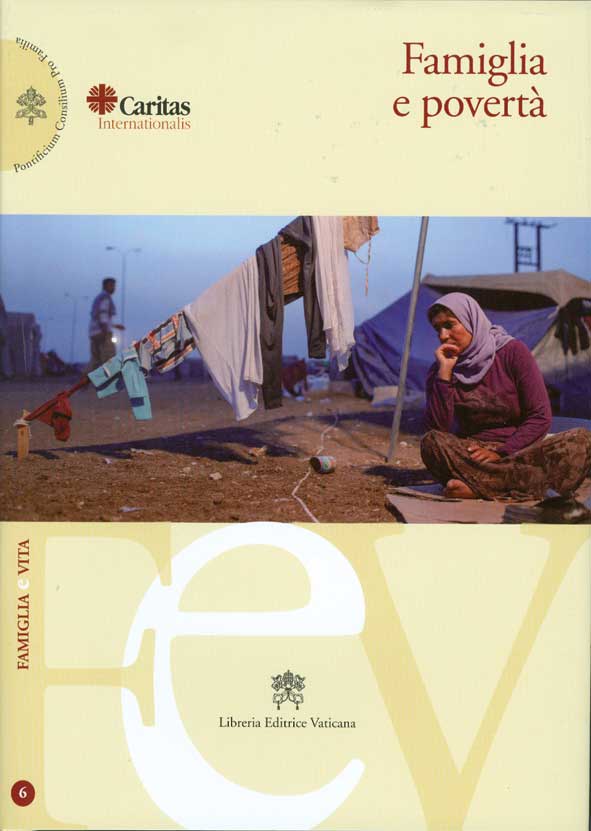
Family and Poverty is a multi-lingual volume produced in collaboration with Caritas Internationalis, which has a clear focus: to examine not the family in the abstract or the “perfect” family, but rather to examine concrete families of our time, including those going through financial, social and emotional difficulties, yet despite everything are still able to hope and plan for the future, becoming resources to overcome every crisis.
 Family and Church: An Unbreakable Bond. Interdisciplinary Contribution to the Deepening of the Synod presents the results of a study seminar on some of the most important issues concerning the pastoral care of the family. Following the Extraordinary Synod, Archbishop Paglia formed a Steering Committee to carry out a detailed interdisciplinary study to make a contribution to the Church’s discernment in view of the Ordinary Synod. At an international conference, 40 scholars met to discuss some issues mentioned in the Lineamenta for the next Synod, and to articulate possible proposals to respond to today’s cultural challenges and pastoral emergencies. In addition to the internationality of the membership, the group was distinguished by competence and “interdisciplinarity.” Three pillars of the discussion were:
 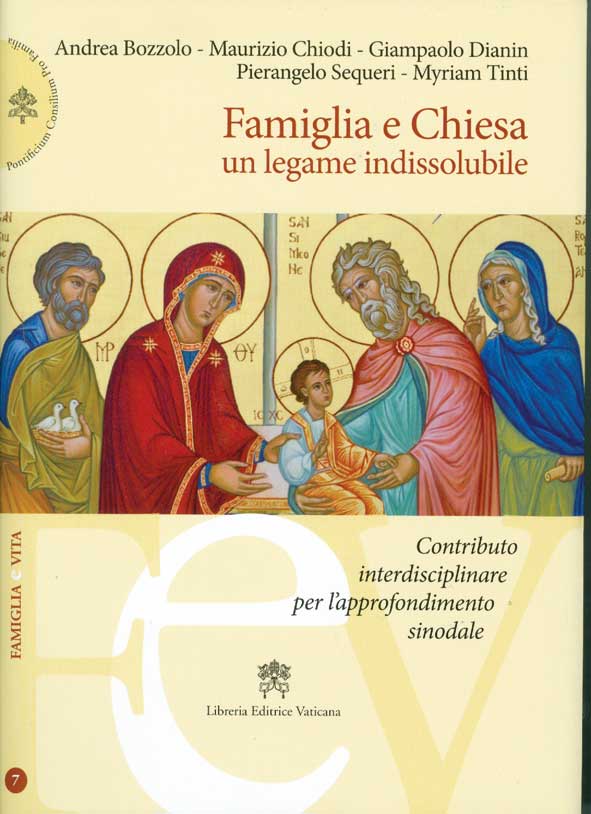 (1) marriage and the sacrament, that is, the “choice of faith” made by those who decide to get married through the sacrament of marriage, with the desire to do what the Church teaches; (2) marriage and procreation, that is, the nuptial covenant and its generous openness to procreation; and (3) marriage and divorce, that is, the pastoral attitude toward families that are wounded or broken, and toward irregular unions, addressing the hard, concrete situations that cannot be ignored or underestimated. The book, then, seeks to be a contribution to the Church, which is called to respond to the will of the Lord who asks her to take care of all whom she meets along the way, bending down with care and concern also toward those of her children who are wounded.
Finally, The Family Generates the World. The Words of Pope Francis in His Wednesday Catecheses. Between the two Synods, Pope Francis since December 2014 has been offering to the faithful attending the Wednesday general audience reflections on the family.
The Pope began with Nazareth, with that special family composed of Jesus, Mary, and Joseph, and then reflected on the figures of mother, father, children, siblings, grandparents, grandchildren, the words “male and female he created them,” marriage, the three now well-known words “please, thank you and forgive me,” the education of children, engagement, poverty, sickness, bereavement, wounds.
This cycle of catechesis will continue until the end of the Synod of 2015, enabling the Pope to teach on the beauty and truth of the family, fundamental pillar of human society.