Obedience to legitimate authority makes us more powerful
By Anthony Esolen
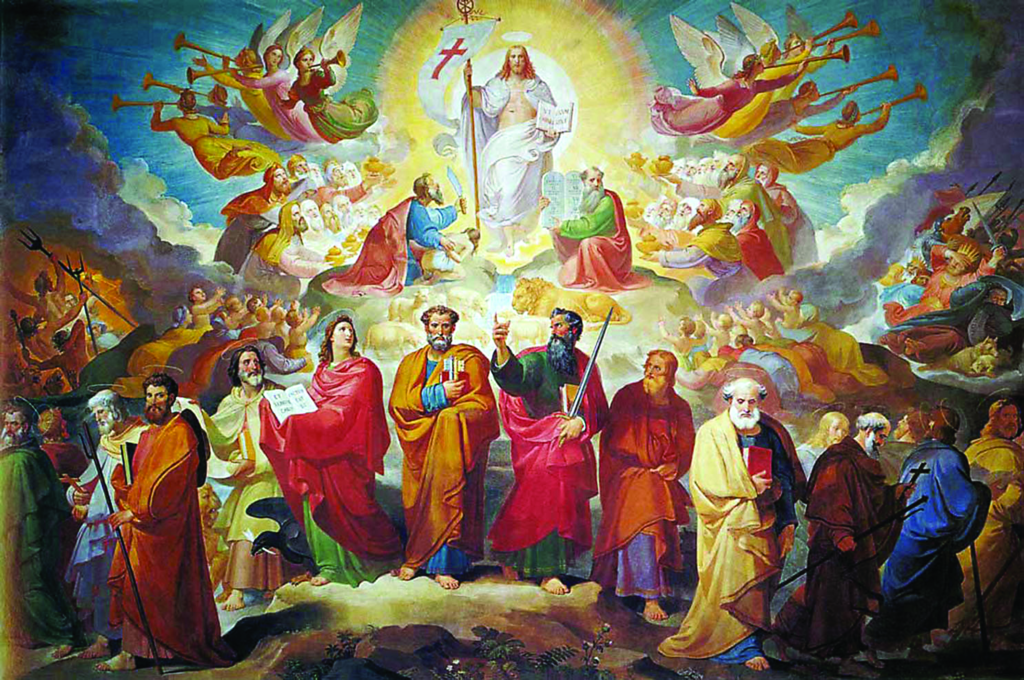
“The propagation of Christianity” by Tommaso Minardi, Quirinale Palace, Rome
“There is neither Jew nor Greek,” says Saint Paul, “ “there is neither slave nor free, there is neither male nor female; for you all are one in Christ Jesus” (Gal. 3:28). He had to say it, because the Galatians had gotten addled by preachers who persuaded them that their males must be circumcised, as if there were two orders of Christian adoption, the greater (for those who followed the law of Moses) and the lesser (for those who believed they were set free from all those laws that had been fulfilled, brought to completion, by Christ and in Christ).
Similarly, he had said to the church in Rome that the saving power of God is available to all. “Salvation comes from the Jews,” said Jesus to the Samaritan woman at the well (Jn. 4:22), but it does not end there, “for the same Lord is Lord of all and bestows his riches upon all who call upon him” (Rom. 10:12).
It is common in our time to read Paul’s words in Romans and Galatians as an expression of equality pure and simple, as a defining feature of God’s justice and his love, and as an implicit demand that we human beings commit ourselves, within the Church and without, to the same. When we meet Paul saying that our lives should be ordered by hypotaxis – by subordination one to another, as he does explicitly (e. g., Eph. 5:21), and implicitly (e. g., in his image of the Christian life as that of the members of a body, 1 Cor. 12:12-31), and in the clear vision he has of ecclesial order, so that a good bishop will be a man who has been a virtuous and capable head of his household (1 Tim. 3:4-5) – the critics hasten to suggest that Paul was not really the author of the letters with the passages in question, or that Paul or whoever else was the author did not understand the import of that absolute ideal of equality, or that he was, because of timidity or ignorance or a desire to compromise, too much beholden to the cultural norms of his place and time.
None of these dodges will work. First, Paul is just as insistent upon subordination in such letters as Romans and 1 Corinthians, whose authorship no one doubts, as he is in Ephesians and 1 Timothy. Second, it does not matter who wrote Ephesians and 1 Timothy, since the Church holds those letters also to be divinely inspired, and thus not to be smuggled into a closet as embarrassments.
Third, it is rather presumptuous of us to attribute cowardice to men like Paul, whom the Jews flogged five times within an inch of his life, who was beaten three times with rods, who was stoned, three times shipwrecked, “on frequent journeys, in danger from rivers, danger from robbers, danger from my own people, danger from Gentiles, danger in the city, danger in the wilderness, danger at sea, danger from false brethren; in toil and hardship, through many a sleepless night, in hunger and thirst, often without food, in cold and exposure” (2 Cor. 11:26-27).
Fourth, he was by no means shy about challenging everything foolish or wicked in the cultures around him. Finally, who are we to judge the intelligence of Saint Paul? Aren’t we rather the ones who, in raising up equality as a criterion for judging the veracity and consistency of the early Church’s most energetic apostle, are beholden to cultural values, and will not tiptoe beyond them?
“Holy, holy, holy,” we pray at every Mass, “Lord God of hosts!” The most obvious thing about the organization of a host – an army – is that not every soldier is the same; the organization is one of command, obedience, common devotion to the cause, and mutual help. For the true general commands for the sake of his men; and the men, in obedience, make the general’s commands the light of their eyes, the blood of their heart, and the nerves in their arms. So it is with the heavenly hosts. “At that time,” says Daniel in his apocalyptic prophecy, “shall arise Michael, the great prince who has charge of your people” (12:1). And Paul himself, describing the second coming of the Lord, says it will be accompanied with “the archangel’s call” (1 Th. 4:16), and what is an archangel if not, literally, the chief angel, the angel in command?
Jesus himself, as I have often noted and written, was not shy of establishing hierarchies among his disciples. He sent out the seventy-two on their commission of preaching and preparing the way for him (Lk. 10:1). He did not send everyone. He chose twelve men to be his apostles, and “gave them authority over all demons and to cure diseases” (Lk. 9:1). He did not choose everyone. Among those twelve, he favored Peter, James, and John, to accompany him on the Mount of Transfiguration (Lk. 9:28), to be with him when he raised the little girl from the dead (Lk. 8:51), and to be at his side, apart from the other disciples, when he prayed in the garden of Gethsemane (Mt. 26:37).
Among those three, he singled out Peter to be their chief (Mt. 16:18), and he gave Peter the commission of shepherd over the shepherds, to strengthen the faith of his brethren (Lk. 22:31). We dare not say that Jesus did so because it was merely pragmatic, or because he was making a concession to the culture. That would be like saying that Jesus was a trimmer, a coward, or a sly manipulator. We must then accept that just as such hierarchies were good for his disciples, so they are good for us also.

“Saint Paul writing his epistles” by Valentin de Boulogne, Blaffer Foundation Collection, Houston, Texas, USA
“We must obey God rather than men,” says Peter and the apostles, when the high priest and his council demand that they cease preaching about Jesus (Acts 5:29). And who is this God? “The God of our fathers,” they say, who “raised Jesus whom you killed by hanging him on a tree” (5:30). Peter is not just identifying God. He is calling into play the allegiance we owe to our fathers, our forebears, because they are the ones who passed along to us the knowledge of God’s works.
In fact, that is one of the ways God names himself to Moses, from the burning bush: “I am the God of your father, the God of Abraham, the God of Isaac, and the God of Jacob” (Ex. 3:6). Paul himself claims no originality: “For I received from the Lord what I also delivered unto you” (1 Cor. 11:23). The bearer of a tradition is a middle term in an order of fidelity and love. He submits to what he has heard, and he hands it on in service to those to whom he preaches; and in neither role does he assert any independence of thought or action. He is, like the centurion, “a man under authority” (Mt. 8:9).
I will conclude with an observation that would not have surprised our greatest and wisest poets. It is that obedience to legitimate authority makes us more powerful, more likely to contribute to remarkable enterprises. It is thus not only an occasion to practice the humility we praise more with our lips than with our deeds. It is our principal means of increase and multiplication. Let Jesus himself be our example, who said that “the Son can do nothing of his own accord, but only what he sees the Father doing” (Jn. 5:19). And look what he has done.
*Dr. Esolen is a Distinguished Professor of Humanities at Thales College, North Carolina, and a senior editor and regular writer at Touchstone magazine. He is author of more than 30 books, including a three-volume translation of Dante’s Divine Comedy (Random House), and well over 1000 articles in various journals, and publishes a web magazine dedicated to language, music, poetry, and classic films called Word and Song, with his wife, Debra.