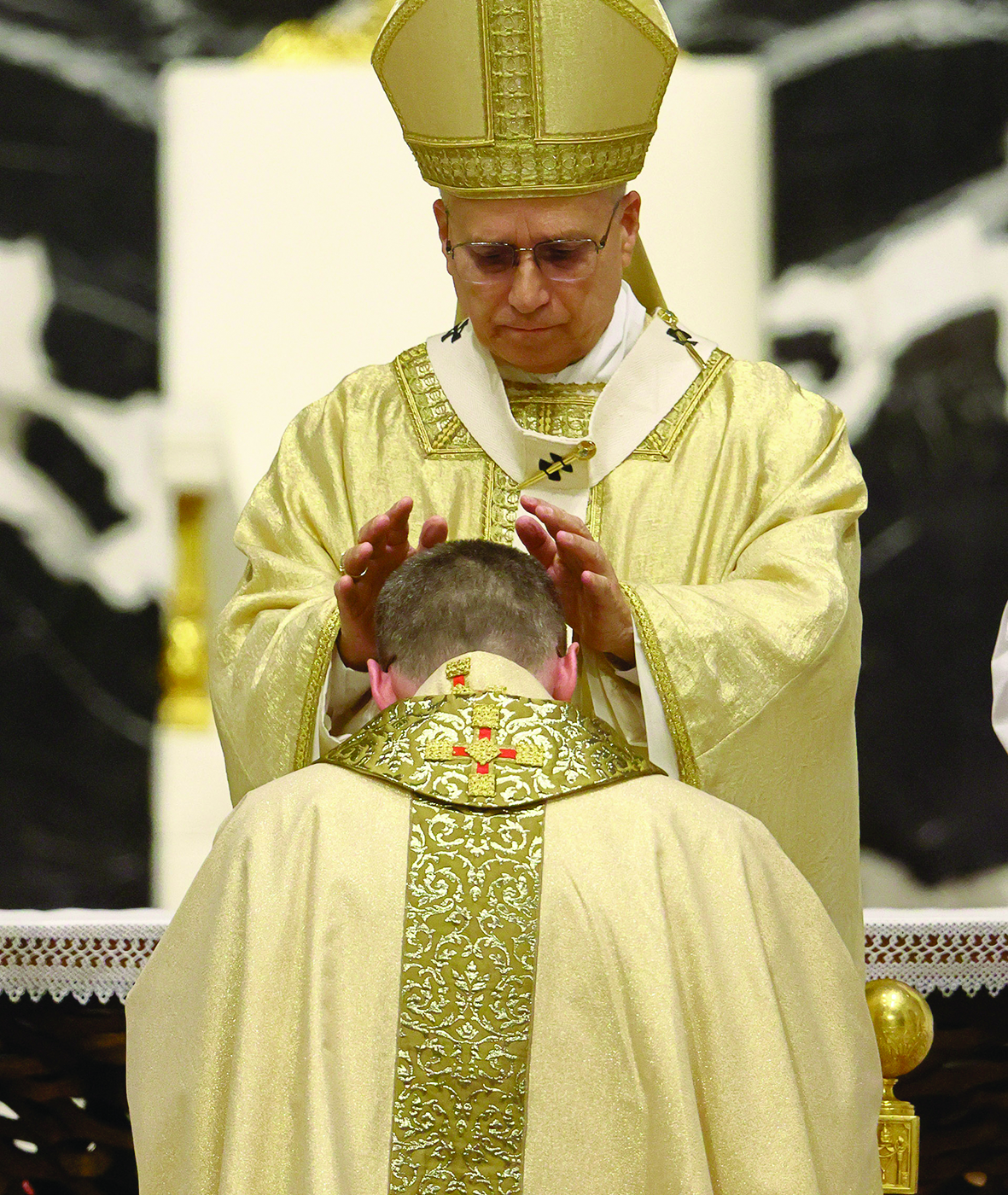
By Aurelio Porfiri

It seems that within certain circles of the Church, there is a sense of irritation whenever the topic of Gregorian chant arises. This irritation is, frankly, incomprehensible when considering that Gregorian chant is the Church’s own music, officially recognized as such. Yet, some view it as a sign of a backward-looking mentality rather than an embrace of the magnificent future that lies ahead.
This is, without a doubt, a grave error.
A scholar of traditional music, Jean Thamar (1909–1989), once said that while an orchestral Mass fills the church, Gregorian chant seems to fill the universe.
The evolution of this multifaceted yet unified repertoire and its origins have been studied extensively by many historians. In the first millennium, there were various stages of development leading to significant advancements in the 9th century. These advancements eventually made it possible to notate melodies, initially as memory aids for singers, and later, with the refinement of notation, to record intervals with relative precision.
However, we must never forget that Gregorian chant originated as an oral tradition. Many scholars have approached it from an ethnomusicological perspective, comparing it to other religious traditions. Think of figures like the Italian Pellegrino Ernetti, the Frenchman Jacques Viret, and the American Peter Jeffery. Noteworthy work in this field has also been done by the Italian Giacomo Baroffio.
Among the various systems for organizing Gregorian chant, we find the classification into eight “modes,” referred to by the Greek term octoechos (ὀκτώηχος). This medieval classification, as was realized in the last century, often imposes artificial constraints on melodies. Through the research of scholars such as Dom Jean Claire (1920–2006) and, more recently, Monsignor Alberto Turco, the understanding of Gregorian modality has deepened, revealing the presence of three “archaic modes” based on C, D, and E.
In the allegorical medieval period, it was also important to interpret the ethos of Gregorian modes. Consider, for example, the capitals of the monastery at Cluny, each representing a Gregorian mode and its “meaning.” Similarly, in the Summa de officiis ecclesiasticis by William of Auxerre (1150–1231), modes are analyzed allegorically (Don Claudio Campesato has authored a book addressing this topic).
Gregorian chant is not just a world; it is an entire universe. In this universe, the Word of God is interpreted exegetically and contemplatively, allowing us to approach the texts of the Bible and the liturgy through the lens of Gregorian chant—a true lectio divina. Yes, you have understood correctly: Gregorian chant leads us, throughout contemplation, to a more profound understanding of the word of God. It is real exegesis, a “struggle” with words that really matters for our spiritual nourishment. Today, when it is so easy to have varied translations and many other kinds of liturgical support, it is really a pity that we have to give up this magnificent musical repertoire.

On September 28, 2019, Pope Francis encouraged members of the Italian Association of Saint Cecilia with these words: “Together, you can better commit yourselves to chant as an integral part of the liturgy, drawing inspiration from the original model, Gregorian chant.”
Similarly, his predecessor John Paul II eloquently expressed this in a Chirograph dated November 22, 2003: “Among the musical expressions that best meet the qualities required by the notion of sacred music, especially liturgical music, Gregorian chant holds a special place. The Second Vatican Council recognizes it as ‘proper to the Roman liturgy,’ and under equal conditions, it should be given pride of place in sung liturgical celebrations conducted in Latin. Saint Pius X emphasized how the Church ‘inherited it from the ancient fathers,’ ‘jealously preserved it through the centuries in its liturgical codices,’ and still ‘proposes it to the faithful’ as her own, considering it ‘the supreme model of sacred music.’ Thus, Gregorian chant continues to serve today as a unifying element in the Roman liturgy.”
Why, then, are we now in a situation where Gregorian chant seems to face outright ostracism? This rejection often accompanies the decline of Latin, mysteriously absent from churches despite Vatican II’s recommendations for its use. In a General Audience on November 26, 1969, Pope Paul VI urged the faithful to embrace liturgical reform, stating: “Here, it is clear, the greatest novelty will be felt: that of the language. Latin will no longer be the principal language of the Mass, but the spoken language. For those who know the beauty, power, and sacred expressiveness of Latin, the replacement with the vernacular is certainly a great sacrifice: we lose the language of Christian centuries, becoming almost intruders and strangers within the literary confines of sacred expression, and thus we lose much of that marvelous, incomparable artistic and spiritual heritage, which is Gregorian chant. Yes, we have reason to regret it, and almost to feel lost: what shall we replace this angelic language with? It is a sacrifice of inestimable value. And for what reason? What outweighs these highest values of our Church? The answer seems banal and prosaic but is valid because it is human and apostolic: the intelligibility of prayer matters more than the ancient and splendid vestments with which it has been regally adorned; the participation of the people, of this modern people saturated with clear, comprehensible words, matters more than those ancient treasures.”
It is striking that the Pontiff, only a few years after the Council he had so tenaciously brought to completion — a Council that prescribed the use of Latin and Gregorian chant — would now speak, albeit elegantly, in such terms. We must recognize, alongside various sociologists and scholars of religion, that the sacrifice of which Saint Paul VI spoke has not borne the expected fruits, as evidenced by the dramatic decline in religious practice.
Unfortunately, Gregorian chant and Latin are often used as scapegoats, perhaps to avoid confronting the real and profound difficulties in the current liturgy. By doing so, necessary and urgent measures to address this ongoing crisis are left unimplemented, and it is the faithful who suffer the consequences.
 * Maestro Aurelio Porfiri is a composer, conductor, master organist, writer and educator in Rome. His blog on music, Cantus, is available on Substack, and his latest book, The Right Hand of the Lord Is Exalted: A History of Catholic Traditionalism from Vatican II to Traditionis Custodes, is now available from Sophia Institute Press.