His appreciation for the Church’s musical patrimony did not prevent its gradual disappearance
By Aurelio Porfiri
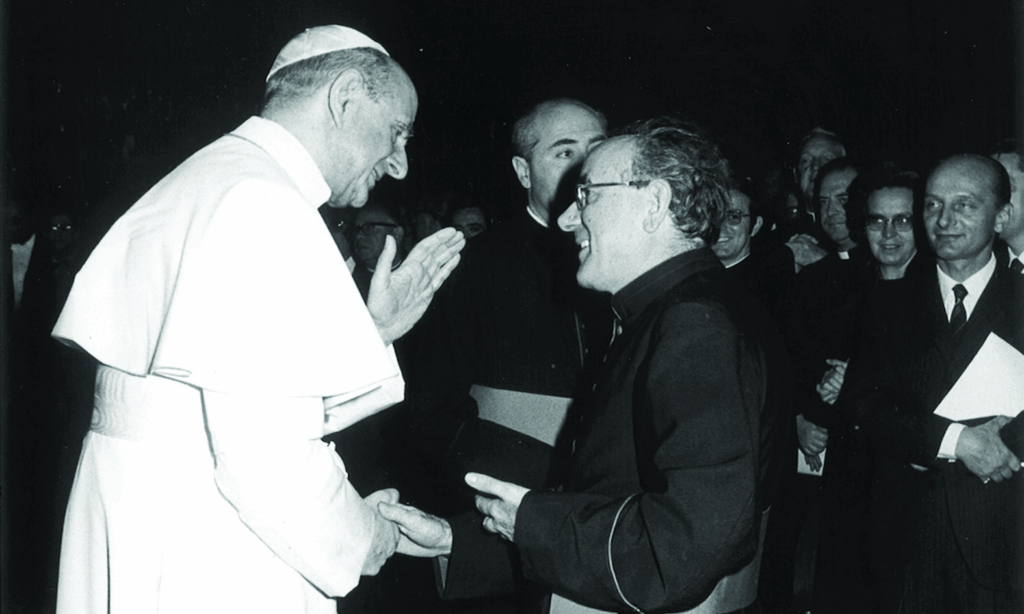
In the early years of his pontificate, Paul VI received Maestro Domenico Bartolucci in a private audience.
There is no doubt that one of the most influential figures in the Catholic Church of the 20th century was Pope Paul VI, now proclaimed a saint. He was undoubtedly a key figure in the Church’s journey through the last century (although his work, as often happens, is celebrated by some and criticized by others, with little balance between these two perspectives). Perhaps something similar can be said about his relationship with liturgical music.
I also draw on my own memories of conversations with my teacher, Cardinal Domenico Bartolucci, who was the director of the Sistine Chapel Choir during Paul VI’s papacy. If one compares the repertoire of the Sistine Chapel Choir at the opening of the Second Vatican Council (under John XXIII) with that at its conclusion (under Paul VI), one can see an evident limitation of the choir’s role. Much of its glorious polyphonic repertoire was practically excluded. For years, the choir was even barred from giving concerts.
Recalling the Council era and the subsequent years, Cardinal Bartolucci stated: “We were gradually downsized and sidelined. We became an alien body within the celebrations. During the pontificate of John Paul II, the Sistine Chapel Choir was increasingly less involved in major papal liturgies. The living beauty of Palestrinian polyphony and Gregorian chant was progressively relegated to museum artifacts.” (Paolo Mattei, “La porpora e il coro,” 30 Giorni, November, 2010. ).
In an interview with noted Catholic author Paolo Rodari, recalling the Council years, Cardinal Bartolucci commented: “We were dismissed, told that it was not the Sistine Chapel that should sing, but the people. It was a Copernican revolution. The abandonment of Latin, which the Council itself did not advocate, was in fact promoted by many liturgists, and thus the entire traditional repertoire of Gregorian chant and polyphony, and consequently the scholae cantorum, were branded as the root of all problems. The motto became ‘go to the people,’ without understanding the grave consequences of this trivialization of the rites and the liturgy.
“I always opposed this and firmly supported the necessity of great art in the Church, as nourishment and benefit for the people themselves. Participation was equated with singing or reading something, disregarding the wise pedagogy of the past. Paradoxically, even the entire repertoire of devotional hymns that the faithful knew and sang disappeared. Years ago, for instance, when people attended a Requiem Mass, they knew how to sing the Dies Irae with devotion, and I recall everyone joining in the Te Deum or the Marian antiphons. Today, it’s hard to find someone capable of doing so.

In 2011, Bartolucci, now a cardinal, during his direction of the choir of St. Peter’s Basilica
“Fortunately, many are now starting to realize what happened, though it may be a bit late. We should have thought about this before proceeding with so much presumed ‘wisdom,’ dictated by fashion. But you see, back then, everyone was renewing, everyone was pontificating. Luckily, the Holy Father is now giving very clear guidance on liturgy, and we hope time will assist the new generations.”
The Holy Father he referred to was Benedict XVI. However, Paul VI also received the Sistine Chapel Choir on March 12, 1964, and addressed them with words of appreciation, summarized on the Vatican’s official website as follows: “First of all, sing well. This is already happening, and the Holy Father acknowledges and praises the maestro, Monsignor Bartolucci, the individual group instructors, and all those who make up this excellent choir. Singing well is no simple task: it requires significant study, exercises, rehearsals, repetitions — in short, it is a meritorious effort to be regarded as a primary duty.
“It could be said to be the only duty, but a second one arises, contributing to its true primacy. This second duty obliges one to sing well not only with the voice but also with the heart.
“This may seem simple, but it is arduous, as aligning the soul’s sentiments with the words and sounds is natural, yet not always achieved, just as the spiritual unity of man is not always alive and operative. Seeking it, valuing it, sometimes involves difficulty. One can sing well, even excellently, with the voice, and be faithful to the score, yet let the heart wander elsewhere, distracted by thoughts and interests unrelated, if not contrary, to the music’s spiritual expression.”
These are admirable words, even though what was happening in the liturgy during those years seemed to move in a direction contrary to the Pope’s praise. To be impartial, we must also recall the words of the late maestro of the Milan Cathedral, Monsignor Luciano Migliavacca, who served under Archbishop Giovanni Montini (the future Paul VI) and was more open to liturgical reform, although he did not shy away from criticism when necessary.
On the occasion of Paul VI’s canonization, he remarked: “On the day — June 21, 1963 — when he was elected Pope, he was supposed to be here with us. We sent him a congratulatory telegram. Then came the encounters in Rome. In the Sistine Chapel, with the participation of the entire Choir, the Cappella performed for the first time a Mass with Italian hymns. In St. Peter’s, our Alessandro Bussadori once moved cardinals, dignitaries, and faithful to tears; he himself wept, embraced after a sublime hymn by the Pope.
“The most memorable encounter was in the Pope’s private chapel on his eightieth birthday. He wished to spend it in recollection and solitude; yet he could not say no to the children. To them, the venerable Pontiff, as if reminiscing for himself but with words comprehensible to them, recalled the reasons for his vocation, the milestones of his priesthood, the aspirations of his life, the challenges, concerns and hopes of his pontificate. It was, in the stunned silence of the children present, the most beautiful speech ever heard from him. May this dear and holy Pontiff assist us and smile upon his young choristers from heaven.”

The late maestro of the Milan Cathedral, Monsignor Luciano Migliavacca, who served under Archbishop Giovanni Montini (the future Paul VI)
Certainly, between these two illustrious maestros, who respected one another, there was a divergence of opinion on Paul VI. I remember Cardinal Bartolucci often recounting an anecdote about a meeting with Archbishop Montini, where the latter asked for more “pastoral music.” This scandalized the esteemed musician, who would add that true “pastoral music” was that of the great tradition of the Catholic Church.
In conclusion, while Paul VI seemed to appreciate those who dedicated themselves professionally to sacred music, he also appeared to favor collaborators and projects that relegated great sacred music to oblivion. It is another enigma about this Pope, now consigned to history. One thing that is clear: this debate, even decades after his death, shows no signs of subsiding.
On the contrary, the situation seems increasingly tangled. Reflecting on our past can help us gain a clearer understanding of these issues and, perhaps, discover if a way forward exists.
 * Maestro Aurelio Porfiri is a composer, conductor, master organist, writer and educator in Rome. His blog on music, Cantus, is available on Substack, and his latest book, The Right Hand of the Lord Is Exalted: A History of Catholic Traditionalism from Vatican II to Traditionis Custodes, is now available from Sophia Institute Press.