More than a century ago, Monsignor Robert Hugh Benson foresaw the rise of secular humanism, the contraction of the Catholic Church, and the coming of the Antichrist
By ITV Staff
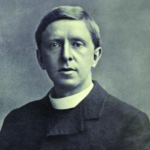 Editor’s Note: The passage below is from the novel Lord of the World, written by the English Catholic convert Monsignor Robert Hugh Benson (the son of the Anglican Archbishop of Canterbury) in 1907. He attempts a vision of the world more than a century in the future — in the early 21st century… our own time… predicting the rise of Communism, the fall of faith in many places, the advance of technology (he foresees helicopters) and so forth up until… the Second Coming of the Lord, with which his vision ends. For this reason, and also because Pope Benedict and Pope Francis have repeatedly cited the book, saying its clarification of the danger of a type of humanitarianism without God is a true danger that we do face, we print a selection from it in ITV, now and in the months ahead.
Lord of the World
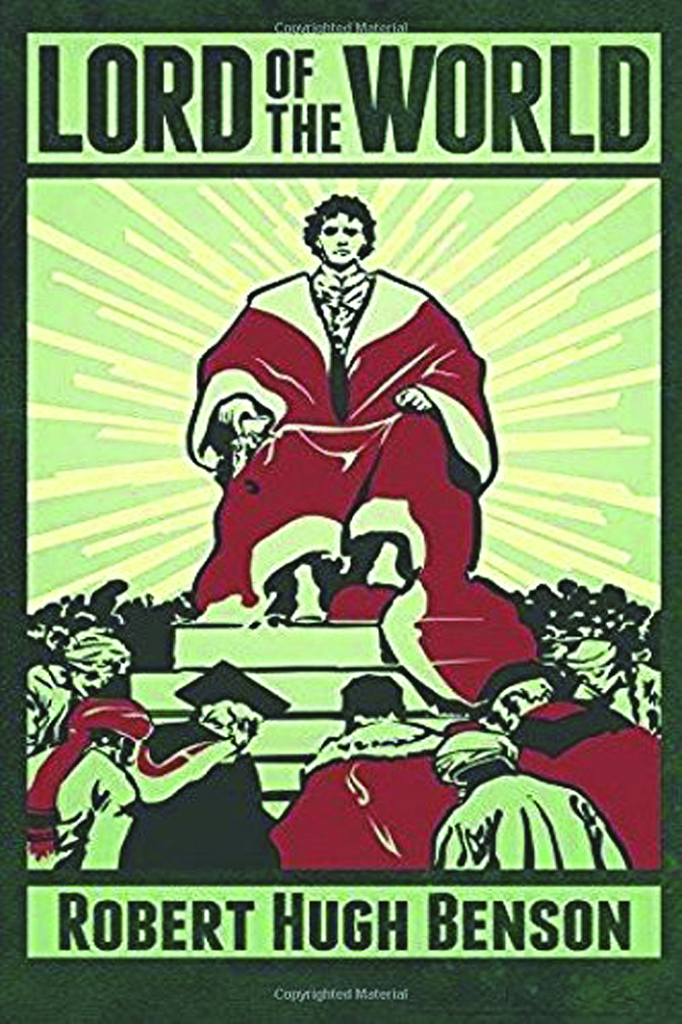
By Robert Hugh Benson (1907)
Book II, The Encounter, Chapter VIII, Section II-III
(Note: At last, the President of Europe, Julian Felsenburgh, appears to the assembled crowd in triumph after decimating his enemies and laying waste to Rome and all it symbolized. Mabel, in attendance, feels herself drawn completely into his words: “There is no repentance, but there is something better…the knowledge of what crimes man was yet capable of, and the will to use that knowledge…”)
In this again, as Mabel perceived afterwards, there was no precise or verbal record within her of what he said; there was no conscious process by which she received, tested, or approved what sheThen she saw how already the long procession was winding up beneath the screen, and by imperceptible art the light grew yet more acutely beautiful. They were coming, then, those ministers of a pure worship; grave men who knew in what they believed, and who, even if they did not at this moment thrill with feeling (for she knew that in this respect her husband for one did not), yet believed the principles of this worship and recognised their need of expression for the majority of mankind—coming slowly up in fours and pairs and units, led by robed vergers, rippling over the steps, and emerging again into the coloured sunlight in all their bravery of Masonic apron, badge and jewel. Surely here was reassurance enough.
* * * * *
The sanctuary now held a figure or two. Anxious-faced Mr. Francis, in his robes of office, came gravely down the steps and stood awaiting the procession, directing with almost imperceptible motions his satellites who hovered about the aisles ready to point this way and that to the advancing stream; and the western-most seats were already beginning to fill, when on a sudden she recognised that something had happened.
Just now the roaring of the mob outside had provided a kind of underbass to the music within, imperceptible except to sub-consciousness, but clearly discernible in its absence; and this absence was now a fact.
At first she thought that the signal of beginning worship had hushed them; and then, with an indescribable thrill, she remembered that in all her knowledge only one thing had ever availed to quiet a turbulent crowd. Yet she was not sure; it might be an illusion. Even now the mob might be roaring still, and she only deaf to it; but again with an ecstasy that was very near to agony she perceived that the murmur of voices even within the building had ceased, and that some great wave of emotion was stirring the sheets and slopes of faces before her as a wind stirs wheat. A moment later, and she was on her feet, gripping the rail, with her heart like an over-driven engine beating pulses of blood, furious and insistent, through every vein; for with great rushing surge that sounded like a sigh, heard even above the triumphant tumult overhead, the whole enormous assemblage had risen to its feet.
Confusion seemed to break out in the orderly procession. She saw Mr. Francis run forward quickly, gesticulating like a conductor, and at his signal the long line swayed forward, split, recoiled, and again slid swiftly forward, breaking as it did so into twenty streams that poured along the seats and filled them in a moment. Men ran and pushed, aprons flapped, hands beckoned, all without coherent words. There was a knocking of feet, the crash of an overturned chair, and then, as if a god had lifted his hand for quiet, the music ceased abruptly, sending a wild echo that swooned and died in a moment; a great sigh filled its place, and, in the colored sunshine that lay along the immense length of the gangway that ran open now from west to east, far down in the distant nave, a single figure was seen advancing.
III
What Mabel saw and heard and felt from eleven o’clock to half-an-hour after noon on that first morning of the New Year she could never adequately remember. For the time she lost the continuous consciousness of self, the power of reflection, for she was still weak from her struggle; there was no longer in her the process by which events are stored, labelled and recorded; she was no more than a being who observed as it were in one long act, across which considerations played at uncertain intervals. Eyes and ear seemed her sole functions, communicating directly with a burning heart.
* * * * *
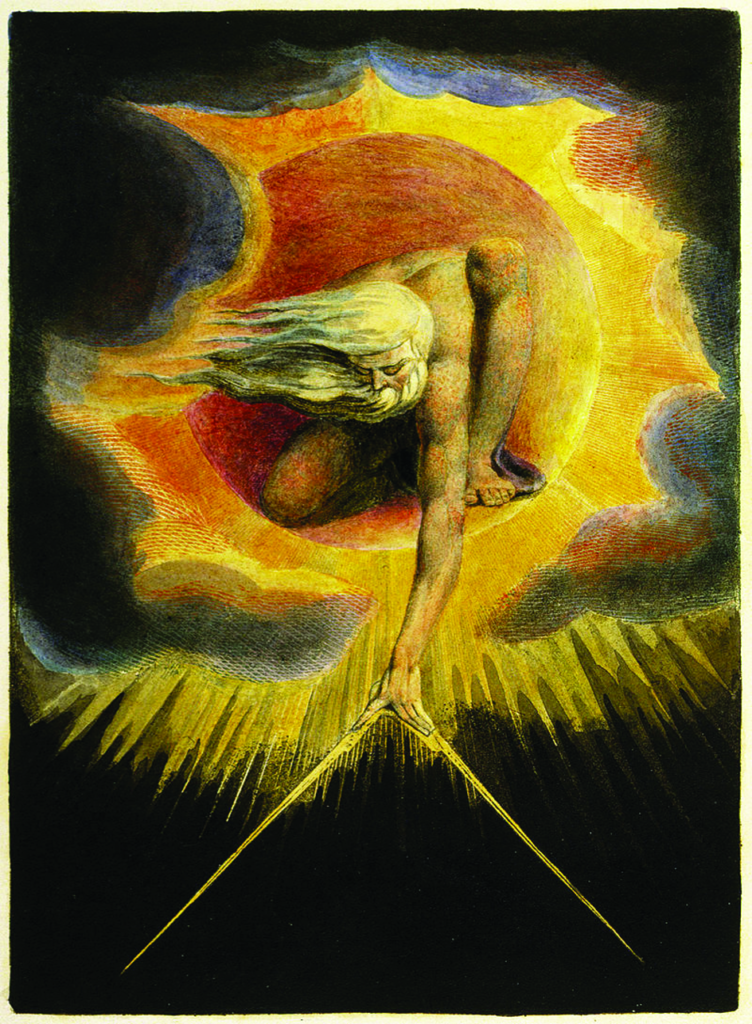
God as depicted by British poet William Blake as the “architect of creation,” the “Ancient of Days,” now in the British Museum, London
She did not even know at what point her senses told her that this was Felsenburgh. She seemed to have known it even before he entered, and she watched Him as in complete silence He came deliberately up the red carpet, superbly alone, rising a step or two at the entrance of the choir, passing on and up before her. He was in his English judicial dress of scarlet and black, but she scarcely noticed it.
For her, too, no one else existed but He; this vast assemblage was gone, poised and transfigured in one vibrating atmosphere of an immense human emotion. There was no one, anywhere, but Julian Felsenburgh. Peace and light burned like a glory about Him.
For an instant after passing he disappeared beyond the speaker’s tribune, and the instant after reappeared once more, coming up the steps. He reached his place—she could see His profile beneath her and slightly to the left, pure and keen as the blade of a knife, beneath His white hair. He lifted one white-furred sleeve, made a single motion, and with a surge and a rumble, the ten thousand were seated. He motioned again and with a roar they were on their feet.
Again there was a silence. He stood now, perfectly still, His hands laid together on the rail, and His face looking steadily before Him; it seemed as if He who had drawn all eyes and stilled all sounds were waiting until His domination were complete, and there was but one will, one desire, and that beneath His hand. Then He began to speak….
The nearest image under which she could afterwards describe her emotions to herself, was that when He spoke it was she who was speaking. Her own thoughts, her predispositions, her griefs, her disappointment, her passion, her hopes—all these interior acts of the soul known scarcely even to herself, down even, it seemed, to the minutest whorls and eddies of thought, were, by this man, lifted up, cleansed, kindled, satisfied and proclaimed.
For the first time in her life she became perfectly aware of what human nature meant; for it was her own heart that passed out upon the air, borne on that immense voice. Again, as once before for a few moments in Paul’s House, it seemed that creation, groaning so long, had spoken articulate words at last—had come to growth and coherent thought and perfect speech.
Yet then He had spoken to men; now it was Man Himself speaking. It was not one man who spoke there, it was Man—Man conscious of his origin, his destiny, and his pilgrimage between, Man sane again after a night of madness—knowing his strength, declaring his law, lamenting in a voice as eloquent as stringed instruments his own failure to correspond.
It was a soliloquy rather than an oration. Rome had fallen, English and Italian streets had run with blood, smoke and flame had gone up to heaven, because man had for an instant sunk back to the tiger. Yet it was done, cried the great voice, and there was no repentance; it was done, and ages hence man must still do penance and flush scarlet with shame to remember that once he turned his back on the risen light.
There was no appeal to the lurid, no picture of the tumbling palaces, the running figures, the coughing explosions, the shaking of the earth and the dying of the doomed. It was rather with those hot hearts shouting in the English and German streets, or aloft in the winter air of Italy, the ugly passions that warred there, as the volors rocked at their stations, generating and fulfilling revenge, paying back plot with plot, and violence with violence. For there, cried the voice, was man as he had been, fallen in an instant to the cruel old ages before he had learned what he was and why.
There was no repentance, said the voice again, but there was something better; and as the hard, stinging tones melted, the girl’s dry eyes of shame filled in an instant with tears. There was something better—the knowledge of what crimes man was yet capable of, and the will to use that knowledge.
Rome was gone, and it was a lamentable shame; Rome was gone, and the air was the sweeter for it; and then in an instant, like the soar of a bird, He was up and away—away from the horrid gulf where He had looked just now, from the fragments of charred bodies, and tumbled houses and all the signs of man’s disgrace, to the pure air and sunlight to which man must once more set his face.
Yet He bore with Him in that wonderful flight the dew of tears and the aroma of earth. He had not spared words with which to lash and whip the naked human heart, and He did not spare words to lift up the bleeding, shrinking thing, and comfort it with the divine vision of love….
Historically speaking, it was about forty minutes before He turned to the shrouded image behind the altar.
“Oh! Maternity!” he cried. “Mother of us all—-”
And then, to those who heard Him, the supreme miracle took place…. For it seemed now in an instant that it was no longer man who spoke, but One who stood upon the stage of the superhuman. The curtain ripped back, as one who stood by it tore, panting, at the strings; and there, it seemed, face to face stood the Mother above the altar, huge, white and protective, and the Child, one passionate incarnation of love, crying to her from the tribune.
“Oh! Mother of us all, and Mother of Me!”
So He praised her to her face, that sublime principle of life, declared her glories and her strength, her Immaculate Motherhood, her seven swords of anguish driven through her heart by the passion and the follies of her Son—He promised her great things, the recognition of her countless children, the love and service of the unborn, the welcome of those yet quickening within the womb.
He named her the Wisdom of the Most High, that sweetly orders all things, the Gate of Heaven, House of Ivory, Comforter of the afflicted, Queen of the World; and, to the delirious eyes of those who looked on her it seemed that the grave face smiled to hear Him….(to be continued)