Disciples of the Beatitudes

The Sermon on the Mount by Carl Bloch, 1890
The year 2025 has been a harrowing one for many around the world. Violence on a grand scale has plagued many nations, and on a smaller scale, many communities, even schools and churches.
Yet, we have just celebrated — and continue to celebrate — the nearly unimaginable humbling of the Creator of the universe. He embraced the human condition so totally that there is no tragedy or sorrow that He is not acquainted with.
More than that, He lives among us now, touching us every day with the balm of His love. And He often does it through the hands of His disciples — those who follow His counsel to be merciful, to be peacemakers, to suffer for righteousness’ sake… They are the Disciples of the Beatitudes.
 Catholic Archbishop Jacques Mourad
Homs, Hama, and al-Nabek, Syria
Syrian Archbishop Raises His Voice for Country and Christianity
Syria contains among the oldest Christian communities on earth, dating back to the first century, and rooted in the traditions of St. Peter and St. Paul. But the Syrian Church is “dying,” warns Syrian Catholic Archbishop Jacques Mourad.
And the end of Christianity in Syria would be a great loss, says the archbishop, because “the Church stands as a reminder to every one of the ethics of justice and human dignity as a supreme value.”
Archbishop Jacques Mourad of Homs, Hama, and al-Nabek said the Church in Syria faces an unbearable and unsustainable political and legal situation, with Christians leaving the country in search of better living conditions.
Archbishop Mourad, 57, is a member of a monastic community committed to promoting fraternity between Christians and Muslims, in a country where the former makes up 2.3% of the population and the latter 95%. He was in Rome in October 2025, taking part in the presentation of the Religious Freedom in the World Report 2025, organized by the pontifical foundation Aid to the Church in Need (ACN).

Around 2.1 million Christians lived in Syria in 2011, according to ACN estimates, whereas in 2024, the number was much lower, close to 540,000
Archbishop Mourad, who was abducted by the Islamic State group in 2015, avoided speaking about the trials he endured at the hands of the jihadists, preferring to mention the Muslims who helped him escape captivity. In a soft voice, but with clear words, he expressed his hope that “raising our voices at this moment may be beneficial to our country.”
Around 2.1 million Christians lived in Syria in 2011, according to ACN estimates, whereas in 2024, the number was closer to 540,000.
“None of the efforts by the Universal Church or the local Church managed to stem the tide of the exodus, because the causes are not related to the Church, but rather to the country’s disastrous political and economic situation,” the archbishop said. “You can’t stop a wave of migration without first establishing a well-defined political government model in Syria and a solid security system.”
In late 2024, Syria’s long-time Assad regime was overthrown by a band of rebels led by former jihadist Ahmed al-Sharaa. Al-Sharaa, now interim president of the country, has said he has rejected his former jihadist affiliations and has tried to reassure religious minorities in the country. But the transition has been marked by violence.
“The Syrian people continue to suffer violence, reprisals, and tragic and regrettable events that undermine all the international claims and popular demands to put an end to this bloodbath,” Archbishop Mourad said at the conference.
The bishop issued an “appeal to all people of good will… to take the necessary measures to put an end to the violence and find ways to end the past and present injustices,” explaining that “the lack of justice is a consequence of the past 60 years, which carved out a great division between the state and the people.”
He added, “The people don’t trust the local government or the international community. We only trust in God.”
Archbishop Mourad also expressed concern over a possible peace treaty with Israel that would cede the disputed Golan Heights, which he thinks would “deprive the inhabitants of Damascus of water sources and enslave them. … Where are the human rights values that should help ensure that decisions are fair for both parties?”
He proposed that “the international community adopt a clear position regarding what is happening in Syria,” and that “all local and international institutions and organizations that operate in Syria cooperate with cultural bodies, schools, universities, and institutes to overcome the fear that has taken hold in society, and organize training courses on the role of legislation in the establishment of justice and the independence of the state’s judiciary.”
Locally, the Church in Aleppo is organizing “forums to train people to carry out a political role, when the opportunity presents itself, and therefore to contribute to and ensure a transition from an authoritarian and unipolar regime to a democracy,” he explained. The archbishop stressed that the Church reserves the right to do so “in a country so rich in history, civilization, and human values,” but recognized that Catholics currently “feel like foreigners in our own country, which is intolerable.” —Xavier Bourgos, ACN
 Sonia McGarrity, Mother
Denver, Colorado, USA
Among Her 8 Children Are 3 Adoptive Children with Down Syndrome
Sonia McGarrity was three months pregnant with her third child when she lost that child to a miscarriage on the feast of St. Therese of Lisieux.
“In the midst of that sadness,” she says, “I had a conversation with my sister and I told her that if I could not have any more children, I would love to adopt a child who had Down Syndrome.”
Though Sonia did not know anyone with that particular diagnosis, she did have a relative with a disabled child, and “after spending time with their family, I saw the charity and patience that her son’s siblings displayed, and I knew I wanted that for my own children.”
Sonia became pregnant again, with her third son, Jeffery — who turned out to have Trisomy 21, the name of the medical diagnosis commonly known as Down Syndrome. Despite several ultrasounds, the diagnosis came as a surprise to Sonia.
“I remember my dad saying, ‘I am so sorry,’ but I think that my husband Jeff and I had already projected acceptance and peace with his diagnosis,” she says.
Sonia immediately began gathering information on raising children with Trisomy 21 and started therapies for her Jeffrey.
Within months, the family decided to move from Maryland to Denver, and after a few years, Sonia, a homeschooling mom, suffered another miscarriage. Sonia says it was then that an article on Denmark’s high rate of abortion of babies with prenatal diagnoses “inspired us to open our hearts and our home to any child whose parents were interested” in agreeing to release such a child for adoption.
The McGarritys contacted the National Down Syndrome Adoption Network and completed a home study with a local adoption agency, but more surprises were in store for them.
Sonia was pregnant again when she and her husband were finally contacted by a couple in Colorado Springs whose unborn daughter had a prenatal diagnosis of Trisomy 21. “We began with phone conversations with Emily, our daughter Cecilia’s birth mom, in 2010. We were encouraging her to parent,” says Sonia.
During this time, Sonia suffered her third miscarriage; shortly after, Cecilia’s birth mom called the McGarritys to meet their adoptive daughter, one hour after she was born in December of 2010.
Four months later, Sonia discovered that she was pregnant yet again, and four days after Cecilia’s first birthday, their fifth son, Augustine, was born in December of 2011.
With a homeschooling and family management routine in place, the McGarritys remained open to helping the Down Syndrome Adoption Network encourage birth moms to parent after a surprising diagnosis of Trisomy 21.

Then, one mom asked Sonia and her husband to parent her daughter Rosie, born in 2015 — and the McGarritys welcomed Rosie into their family.
Three years later, they welcomed Charlotte, who did not have a prenatal diagnosis but was born in 2018 with Trisomy 21 and a very complicated heart defect.
“Charlotte is our youngest child, and has had two open heart surgeries. She brings delight and joy to our family,” says Sonia.
The journey that began with the birth of Jeffrey 18 years ago has borne fruit not only for the four non-neurotypical children the McGarritys have welcomed into their hearts, but for their natural sons too.
“Our family is steeped in pro-life activities and as they have grown up in our Catholic, pro-life home, we feel that they have learned more patience and other-centeredness than most children,” says Sonia. “They have become strong men of good character.”
Sonia’s experience has reinforced for her the insight of faith: that it’s love — “not a nicer house or a better body” — that makes a happy life.
“Raising a child with a developmental disability is also hard, but the rewards are so much more significant than anything we can want in life … the rewards are love … loving touches, loving glances, loving trust, loving confidence … So much love.”
Sonia’s special children “don’t worry about social cues, what they look like, or judging others based upon appearance — they love everyone unconditionally… That is what we were created to do.” —Mary Cooney, Mercatornet/ITV staff
 Cardinal Lucian Murešan
Archbishop of Alba Iulia and Fagaras, Romania
“My Fight Is Over! Yours Continues!”
Cardinal Lucian Murešan, Major Archbishop of the Romanian Greek Catholic Church and Metropolitan of the Archdiocese of Alba Iulia and Făgăraş, passed away on September 25, 2025, at the age of 94.
President Nicuşor Dan of Romania stated that his memory remains “closely linked to the tumultuous history of the Church that he pastored for many years, with wisdom, balance and a generous openness to dialogue between confessions and religions, between the Church and society.”
“His courage in times of persecution,” he continued, “and his involvement in the institutional and spiritual reconstruction of the Church, made him an emblematic figure for the rebirth of the Greek Catholic Church in Romania.”
His Beatitude Lucian Mureşan, named cardinal by Pope Benedict XVI in 2012, was the only living Romanian cardinal at his death and lived in seclusion in the Metropolitan Palace of Blaj.

On February 18, 2012, Pope Benedict XVI elevated him to the dignity of cardinal
The Greek Catholic prelate was born on May 23, 1931, in the commune of Firiza as the tenth of 12 children of the family of Petru and Maria Mureşan. Young Lucian graduated from a vocational school for woodworking, completing his high school studies part-time.
In 1948 the Romanian United Church was outlawed, and Lucian had to wait for an opportunity to study theology to somehow arise. Between 1951 and 1954 he fulfilled his compulsory military service, graduating from aviation officer school. When the communist army leaders learned that Lucian was Romanian Catholic, they labeled him undesirable and moved him from aviation to a construction battalion at Bicaz Hydropower Plant in 1954.
Finally, in 1955, immediately after his return from detention, Roman Catholic Bishop Áron Márton received five young Greek Catholics (one for each Romanian diocese) into the Roman Catholic Theological Institute of Alba Iulia. In the 1958-1959 academic year (their fourth year of college), the Department of Cults learned of their existence and intervened with the Diocese to have them expelled. Bishop Márton refused, but the five students left the Theological Institute under pressure from the communist authorities.
For Lucian Murešan, this act began his persecution by the Securitate. For a year, he was refused employment, even in the mines as a wagon driver. Only after a year he was hired as an unskilled worker at a stone quarry. Mur e šan continued his theological studies and took his exams in secret with professors from the former abolished theological academies who were still at large. He took his bachelor’s exam in secret, after which he continued to work as a clerk, awaiting ordination.
This moment came on December 19, 1964, after the release from prison of the surviving Greek Catholic bishops.
Thus, the auxiliary bishop Ioan Dragomir of Maramureş, released from prison that year, ordained him a priest in the basement of a building in Cluj.
While remaining employed in road construction, after his ordination he began his clandestine pastoral ministry, focusing on youth and especially on those who wanted to become priests. After the death of Bishop Dragomir, in August 1986, Father Lucian Murešan was consecrated as Ordinary of the Diocese of Maramureş.
After the Revolution and the relegalization of the United Romanian Church, on March 3, 1990, Pope John Paul II appointed him Bishop of Maramureş. He was consecrated, together with Vasile Hossu of Oradea, in an open-air liturgy in Baia Mare (the Greek Catholic Cathedral of Baia Mare was occupied at the time by an Orthodox parish).
In 1994, Bishop Murešan was appointed as metropolitan archbishop of Făgăraş and Alba Iulia.
On December 16, 2005, the United Romanian Church was elevated by Pope Benedict XVI to the rank of major archiepiscopal church, with autonomy and rights similar to those of the Eastern Catholic patriarchates. Archbishop Murešan was one of the four major archbishops of the Catholic Church.
After presiding over the rebirth of the Catholic Church in one of the most severely persecuted nations in the communist bloc, on February 18, 2012, Pope Benedict XVI elevated him to the dignity of cardinal.
In the message sent to Pope Leo XIV at the Vatican Commemoration of Blessed Iuliu Hossu, on June 2, 2025, His Beatitude Lucian recalled the words of Cardinal Hossu spoken at his last moments, urging future generations to preserve and defend the treasure of faith: “My fight is over! Yours continues.”
 Jimmy Lai, Businessman
Hong Kong, China
Sacrificing His Freedom, and Perhaps… His Life, for Truth
International Catholic pro-life activist Reggie Littlejohn calls him a man of “heroic virtue.” Jimmy Lai, 78, has been languishing in a Hong Kong prison for five years — virtually all of it in solitary confinement — for publishing criticism of the repressive communist regime of China. And on Monday, December 15, Lai was found guilty. The decision that could keep him to prison for the rest of his life.
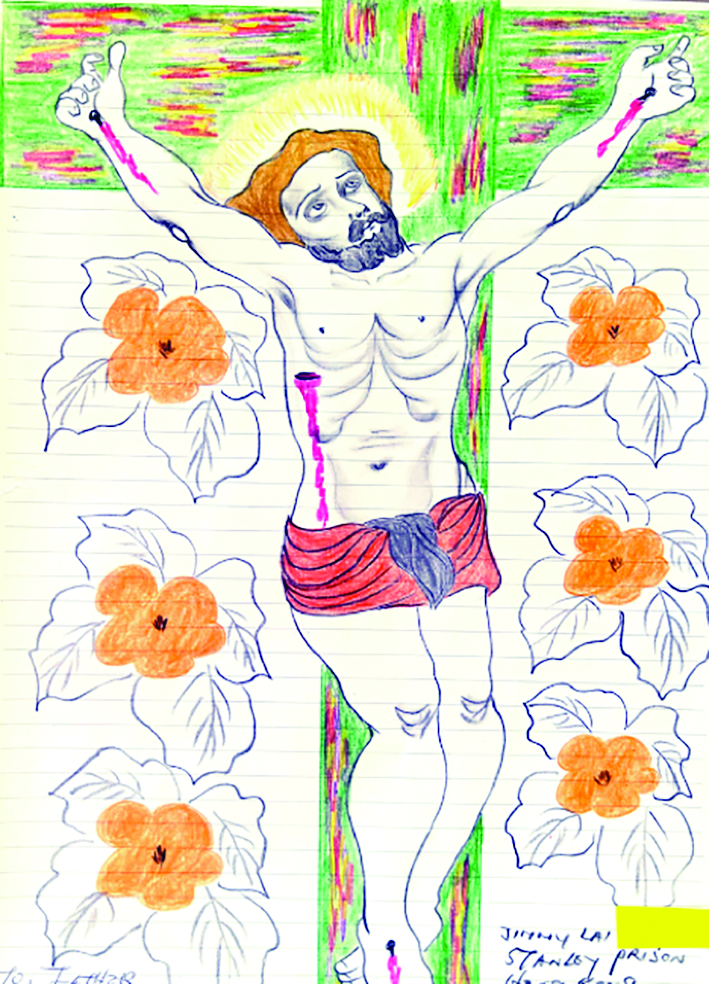
Drawing The Crucifixion by Jimmy Lai, done in prison
A man of great faith, Mr. Lai draws strength from God, say those who know him. According to Mark Simon, longtime friend and managing director of the Lai Trust, a holding company, Mr. Lai believes that as long as he is standing for truth, God will give him the strength to endure.
“He could have left Hong Kong,” said Reggie Littlejohn. “He is a British citizen. He is a wealthy man. He could have led a wonderful, peaceful, comfortable life elsewhere. But he would not leave.”
Why wouldn’t he leave? Mark Simon says it’s because “the logic of our faith as Catholics is that we must oppose these evils; some of us pray about it; others, like Lai and Cardinal Zen, are willing to sacrifice all to oppose repression.”
Mr. Lai is a close friend of Hong Kong’s Cardinal Joseph Zen, 93, who served as Bishop of Hong Kong from 2002 to 2009. Zen will turn 94 on January 13, 2026.
Cardinal Zen, a longtime, outspoken defender of human rights and religious liberty, was himself arrested in May, 2022 in Hong Kong on charges related to the 612 Humanitarian Relief Fund, which provided support to pro-democracy protesters. The cardinal was eventually convicted, and fined.
Jimmy Lai comes from an originally wealthy Chinese family in Canton. Lai was born in 1947, just before the communists came to power. Under communism, his became impoverished. Lai escaped to Hong Kong at age 12, and immediately started working in a garment factory as a child laborer for the equivalent of $8 per month.
A gifted entrepreneur, he went on to found his own clothing brands and other businesses, then branched out into publishing, eventually founding the pro-democracy newspaper Apple Daily. When mainland China imposed the National Security Law on Hong Kong in 2020, the government went after pro-democracy forces, of which Apple Daily was the most influential. He was arrested and his newspaper was shut down. During Lai’s trial, prosecutors accused him of conspiring with senior executives of Apple Daily and others to request foreign forces to impose sanctions or blockades and engage in other hostile activities against Hong Kong or China. Lai was found guilty.
Lai’s international legal team in London had filed an appeal with the U.N. Special Rapporteur on Torture and Other Cruel, Inhuman or Degrading Treatment or Punishment over the treatment of Andy Li, among a group of 12 Hong Kong protesters captured by China’s Coast Guard as they tried to flee to democratic Taiwan by speedboat.
“Credible evidence is emerging that Andy Li was tortured when in prison in China before confessing to allegedly conspiring with Jimmy Lai to collude with foreign entities to endanger national security,” Lai’s lawyers said in a statement on January 4, 2025.
Cardinal Zen has visited Jimmy Lai in prison when allowed. “Cardinal Zen says Jimmy is so advanced in his religious studies that he, Cardinal Zen, must read up to answer Jimmy’s questions,” Lai’s friend Mark Simon said. “His religious drawings from jail are simply incredible, when you consider they give him lined paper and cheap pencils to work with. They were good enough for the Hong Kong Police to ban them from being sent out.”
There is now an international campaign to free Jimmy Lai, headed by Caoilfhionn Gallagher. She travels the world addressing foreign governments, businessmen, even the UN — anyone who can potentially put pressure on the Beijing government to release him
Lai’s son, Sebastien, says Lai has no access to natural light, no heating or air conditioning, no access to Catholic Mass, and has heart problems, diabetes, and hypertension, none of which are being properly treated in prison. Jimmy Lai may never receive justice. Yet, his son Sebastien said a statement his father made is what gives him hope: Lai said: “The truth will come out in the kingdom of God, and that is good enough for me.”
 Francesco Sforza, Photographer
Rome, Vatican
“Semper Fi” (“Always Faithful”): Papal Photographer “Ran Ahead”
Countless photographs of the Popes and live broadcasting of papal events — all these we owe to the silent and difficult daily work of many lay media people. We pay tribute to Francesco Sforza, the distinguished papal photographer who, after 48 years of faithful and discreet service to six Popes, retired November 1. At Sforza’s retirement, Fr. Federico Lombardi, SJ, former Director of the Holy See Press Office, and Alberto Gasbarri, a legendary planner and coordinator of papal flight shared his reflection on Francesco Sforza:

Vatican photographer Francesco Sforza holds his camera as he rushes ahead of Pope Leo’s popemobile (photo: Vatican Facebook page)
Fr. Lombardi: The Pope’s photographer does not walk normally or rest quietly. More often than not, he runs or walks very quickly, constantly turning his head towards the Pope. He must always be ready, almost always present, arriving early to capture the arrival, running to catch up when something unexpected happens. He always carries heavy equipment with him. On the Pope’s travels, he is part of the entourage on a minibus that stays quite far behind in the papal procession. At each stop, he has to jump out and run as fast as he can to where the Pope is, and then be picked up on the fly when the procession starts again. Then, during stops or in the evening, he must immediately select with a quick and sure eye, archiving hundreds or thousands of shots, and send them to Rome. This means many more hours of work while others eat, rest, chat, or sleep… How did Francesco manage to work so hard? I didn’t understand it; I admired it.
He is always kind and smiling, always attentive to everyone, spontaneously and without even a hint of self-promotion. His gaze and heart must be in tune with those of the Pope in order to interpret and capture his gestures and attitudes, and thus bring joy to the many for whom the encounter with the Pope will remain an indelible memory and comfort throughout their lives. It’s a valuable service that prolongs and gives durability to that of the Pope.
It’s a service for history too. Those who seek to understand the past in order to understand the present go to the Vatican archives. From previous centuries, they find mainly writings. From our own era, for the last few decades, they also find and will find sounds and images. They will be able to relive these pontificates more closely. Francesco has contributed to “creating” documents of decades of history that will remain.
Finally, Francesco has a beloved wife (my highly esteemed colleague, who has also served the Holy See for decades) and a beautiful family that fully supports his service to the Pope. Francesco has not only done his “professional” job very well, but has also made a valuable contribution so that “working in the Vatican” (even to the limit of one’s strength, as he has done) can be experienced together as a beautiful service, in communion of ideals, in sincere, frank, and lasting friendship.
Gasbarri: “At the end of the long pontificate of St. John Paul II, Arturo Mari’s succession did not appear to be an easy one. A great photographer and a great personality in the Vatican world.
But Francesco Sforza, with his careful and meticulous preparation and after many years of working alongside Arturo, developed an excellent level of professionalism not only from a technical and aesthetic point of view but also in his ability to grasp, interpret, and communicate the spirituality and intense emotion that characterized the pontificates of Pope Benedict XVI, Pope Francis, and the Jubilee Year with the advent of Pope Leo XIV.
But in addition to his professional skills and kindness, he possesses a quality that is increasingly rare in today’s world, namely total identification with the institution to which he has dedicated his working life. Indeed, in a world dominated by economic goals and senseless rhythms, it is increasingly difficult to find room for ethical values in the workplace.
Francesco Sforza was therefore part of that rare “human capital” belonging to the Holy See that still exists today but whose survival does not seem to be fueled either by the algorithms of human resources agencies or by the product of artificial intelligence. — Anna Artymiak
 Brian Burch, American Ambassador
To The Holy See, Rome
“We Will Not Stand By and Watch the Slaughter of Christians”
Like Pope Leo himself, the new US Ambassador to the Holy See, Brian Burch, is a Chicago-area native. Burch is also a graduate of the Catholic University of Dallas (where he met his wife, Sarah), a husband and a father of nine.
Brian Burch came to the wider attention of President Donald Trump’s campaign during the 2024 election cycle, when he was the president and CEO of the non-profit CatholicVote.org. The nonprofit was widely credited with being partly responsible for the whopping 15% margin of Catholic voters who favored Trump over Kamala Harris, who, Burch said, “snubbed us, and she repeatedly affirmed our deepest fears about her animus and bigotry towards Catholics.”
Burch, a lifelong and orthodox Catholic, began CatholicVote.org 17 years ago, along with co-founder Joshua Mercer, to mobilize Catholic voters to make a pro-faith, pro-family, pro-life difference in the American political process.

Ambassador Brian Burch and his wife, Sara, flanking Pope Leo, brought their nine children, a daughter-in-law, and their granddaughter to meet Pope Leo XIV at the Vatican in September 2025 when Burch presented his credentials
Some of the issues CatholicVote.org has tackled with YouTube videos, television ads, media interviews and grassroots organization are same-sex marriage, abortion, cultural and government anti-Catholic bias; and they even worked to promote the printing of “Mother Teresa” postage stamp by the U.S. Postal Service.
Now, as the American Ambassador to the Holy See, Burch is using his position to deepen the cooperation between the U.S. and the world’s most influential “soft power” institution, the Vatican.
“It transcends traditional diplomacy, rooted instead in our shared commitments to religious freedom, human dignity, global peace, and justice,” he said at the time.
“The Holy See, as the governing body of the Catholic Church, plays a critical and influential role in international affairs. We can and we must continue our strong partnership, while advancing our mutual interests in addressing an array of global challenges, including working to resolve war and conflict in multiple regions around the globe, religious persecution, the exploitation of the poor and vulnerable, the scourge of human trafficking, and the defense and promotion of human dignity and prosperity.”
An example of Burch’s commitment to advance the shared struggle against human rights violations is his November 3 meeting with Sebastien Lai, son of imprisoned Catholic Hong Kong activist Jimmy Lai, and the moment of prayer they shared at San Bartolomeo Church in Rome. The basilica houses the Icon of New Martyrs and Witnesses of the Faith of the 20th Century, a tribute to those who have died for their faith.
They prayed for mercy for Jimmy Lai, whose failing health is of great concern to many around the world, including President Donald J. Trump, who has called for his release.
Also in early November, Burch told journalist Martha MacCallum that the Nigerian government “has a responsibility to protect its citizens” and that the U.S. “will not stand by and watch the slaughter of thousands of Christians.”
“This is exactly why this designation is so important,” Burch said, referring to Trump’s October 31 decision to redesignate Nigeria a Country of Particular Concern (CPC) under the International Religious Freedom Act.
“This is not an effort to try to isolate or threaten the Nigerian regime,” Burch told MacCallum. “This is an effort to call them to their responsibility that they have to their citizens, to protect people of faith, to protect religious minorities. This includes Muslims. By the way, there are peaceful Muslims in this country as well, but these Islamic extremists are weaponizing religion to justify terror, and it needs to stop right now.”
“The Vatican has sought to kind of reduce tensions here, to try to turn down the temperature,” he said. “They have pointed out that this has multiple causes. There’s economic, there’s fights over land, there’s corruption, but there is no mistaking that Christians are being targeted because of their beliefs.”
 Ashley Noronha, Professor
Co-founder of the Truth and Beauty Project, Rome
“Lives Transformed by Beauty Can Transform the World”
Ashley Noronha comes from the world of corporate lifestyle marketing for companies like Kraft Foods, JC Penney and Universal Pictures. But today she is a Catholic media personality, theologian, pontifical university professor and co-founder of the non-profit Truth and Beauty Project.
As a young professional woman in 2008, she and her new engineer husband, John Noronha, both committed Catholics, moved to Rome to pursue graduate studies in the Eternal City.
Ashley had, for several years prior, been captivated by the art and architecture – and the faith that it expresses — of her new home. After moving to Rome, she became more involved in evangelization, and in 2012 she began inviting listeners to “visit” Rome as the Rome correspondent for the Relevant Radio Network.

Ashley Noronha meeting late Pope Francis in the Vatican
“It’s a joy, “ says Ashley, “to share this amazing city, and the heart of the Church, with listeners all over the world.”
Ashley has also worked as a Vatican Official at the Pontifical Council for Social Communications in the Holy See and worked under Pope Benedict XVI and then Pope Francis — calling them “my two most interesting bosses.”
In 2010, she created a course called “Media Training for Priests” and since then have been teaching it at the Pontifical North American College, to priests on sabbatical at the Institute of Continuing Theological Education, and to other priests and seminarians all over the world.
But it is clear that one of the endeavors that is closest to her heart is the Truth and Beauty Project — something for which she and husband John were honored with the Springtime Award for Outstanding Service in the New Evangelization.
The Truth and Project was conceived and begun by Ashley and husband John in 2017. Its mission is actually simple: to lead others to Truth — and the ultimate Good, God Himself — through the medium of Beauty. It is a reflection of the famous precept, first conceived by the ancient philosophers Plato and Aristotle, that the True, the Good and the Beautiful are actually one – all facets of the same reality. It was later refined by the medieval philosopher St. Thomas Aquinas (called by the Church “the Angelic Doctor”), who named these three attributes “the Transcendentals.”
Ashley’s particular calling, she believes, is to break open the beautiful works of sacred art and architecture which overflow the Eternal City, to reveal the truths of our faith, and the presence of God, in new and enlightening ways.
“In 2017, we had a vision to use Rome — the amazing, living classroom of Rome — as a place to give strong formation in the faith. It was evident that all this art and architecture came out of their deep formation… the gifts, the legacy they left for us come out of their deep faith, out of theology and Scripture. We wanted to help people have that same formation today,” Ashley says.
But it’s more than just formation: it is to help people to live their faith with intention, and to share that faith, leading others to Christ. To that end, the Truth and Beauty Project blends art, Scripture, liturgy, philosophy, and human formation to help people fall in love with their faith.
And it is the youth that Ashley believes can benefit from immersion in beauty, first and foremost.
Every young adult who joins the week-long program is asked to write a “FIAT” — a two-pronged action plan to outline how the participant will allow themselves to be changed, and how they will help to transform the culture once they return home. The Truth and Beauty Project even offers scholarships to young people who need financial help to attend.
“Our vision is to empower every participant to make their life a masterpiece — and to offer that masterpiece in joyful service to others,” say Ashley and John.
“We believe that lives transformed by beauty can transform the world.”
 Archbishop Michael Diddi Adgum Mangoria
Bishop of Khartoum, Sudan
Embattled Shepherd Will Not Leave His Tiny Flock
The country of Sudan, the third largest in Africa, is now being tortured by its third civil war. The first war, which lasted from 1955 to 1972, was fought between the Islamist north (which had been favored by its colonial British rulers up to that time) and the Westernized, partially Christianized south. Six years after the first war ended, South Sudan became an independent country.
However, the festering injustices, both from decades of exploitative colonial rule and continuing Islamic domination, never healed, and a second civil war occurred from 1983 to 2005. This war was also fueled (and financed) by Western interests in the region — Sudan is oil-rich. This third civil war, begun in 2023, is being fought between warring generals — the president and vice-president of the country — again, largely over financial control of the country’s assets.
Sudan and South Sudan are battlegrounds that have seen some of the most vicious and horrific violence in the world, much of it against defenseless women and children. It was home to the drug-fueled, mass-scale atrocities perpetrated by abused and brainwashed “child soldiers” in the previous war. Today there are some eight million civilians displaced by the violence.

A scene of the life of the Church in South Sudan
This is the backdrop against which a courageous and faithful bishop struggles to lead his small and dwindling flock.
Archbishop Michael Diddi Adgum Mangoria has been the bishop of Khartoum, Sudan, since 2015. In the first years of his episcopate, the country was relatively at peace (though still dealing with the results of war — massive numbers of orphaned children; displaced families; and people from the south who lost their Sudanese citizenship after the split into two countries).
At that time, Archbishop Diddi spoke about the challenges of evangelization in a culture still somewhat attached to tribalism and polygamy.
“Until now,” he told Australia’s Catholic Weekly in 2017, “we have tended to look above all at the numbers…But we baptized so many heathens without there being any real conversion. Many people also misunderstand the meaning of baptism. They bring their children for baptism because they are sick, and they think that baptism will heal them… And so the Faith is not really deeply rooted, but above all it is not fully understood.
“What is more,” he continued, “our local traditions are still very strong. Take the question of polygamy. The people want to have offspring and heirs at any cost. And so they often have several wives.
“This is a catechetical challenge of the first order, which I intend to tackle with my priests. We also need to form our catechists better. But above all it is down to us bishops and priests to proclaim and bear witness to the Faith. But as I have said, we cannot play down the problems, above all in conveying the teaching of the Church on marriage.”
Asked about the positive signs in his archdiocese, the archbishop answered, “I take joy in the fact that the people are happy and proud to be Christians…And moreover the people are strongly involved in the life of the Church. As I said, what is lacking is the depth. But the people are of good will and have an open heart for Christianity.”
That was in 2017. Khartoum is in the Muslim north; only 5% of the population was Christian as of 2023, and rapidly shrinking. Most of the clergy and religious have left, and the seminary has closed; armed combatants are attacking the remaining clergy and Church property. In a city of millions, only three priests remained with Archbishop Diddi as of earlier this year.
In July of this year, Archbishop Diddi, who had for a time been forced by the violence to relocate to Port Sudan on the Red Sea coast, reported that soldiers had broken into parishes, a Catholic bookshop, and even his own residence and looted them. All the money in the possession of the archdiocese was stolen.
The deteriorating security situation, he said, has made it nearly impossible for priests to move freely, disrupting regular church services and community outreach. “The situation is difficult, but we remain steadfast in our mission to proclaim the Gospel,” said the archbishop.
 Fr. Gioele Schiavella
Retired Pastor of Vatican City’s (Only) Parish, Rome
At 103, Retired Pastor of St. Anne’s, Continues a Lifetime of Quiet Service
The comparison was once made between priests and planes: there are so many planes heading to so many destinations of which we are not aware, but when one crashes, it is in all the news. It is the same with the priests who labor, unnoticed and uncelebrated, dedicating their whole lives to serving people: when one fails, the attention is all on him.
Among the many priests who has quietly and devotedly sacrificed himself for Christ and His people is 103-year-old Fr. Gioele Schiavella, an Augustinian Father who in 2025 celebrated 80 years of priesthood.
The year 2025 also marked 35 years since he was appointed in 1990 by Pope St. John Paul II to be the pastor of the Vatican’s Santa Anna parish church (photo) — the only parish church in the Vatican City State. “Fr. Gioele,” as he is known, worked at St. Anne’s for 15 years and remained there after his retirement on March 19, 2006. Before retiring as the pastor, he welcomed to St. Anne’s the newly-elected Pope Benedict XVI. Fr. Gioele also warmly welcomed Pope Leo XIV when he came to celebrate Holy Mass there.

As a pastor, Fr. Gioele was famous for his homilies, which were even collected by some people. And, like St. John Maria Vianney, Fr. Gioiele was also a famous confessor, known for attracting souls thanks to his kindness and serenity.
His name, Gioele, derives from the Italian word gioia, which in English means “joy” and expresses perfectly the serene joy of his character, with a quiet discretion that is characteristic of the Augustinians.
Gioele Schiavella was born on September 9, 1922 in Genazzano, a little town near Rome famous for the Augustinian Shrine of Our Lady of Good Council — a shrine to which our current Holy Father Leo is devoted.
Gioele’s upbringing near this shrine marked his whole life. At the Shrine in Genazzano he completed his novitiate year in 1937/38 and there he took his simple vows on October 24, 1938.
In 1940, he was sent to College of St. Monica in Rome for a course in theology, and was ordained a priest in Rome on July 15, 1945. After the World War II he taught Latin to students in Carpineto Romano, the city where Pope Leo XIII was born in 1810.
Fr. Schiavella was elected Provincial Secretary of the Roman Province of the Augustinian Order during the 1948 Chapter and he was transferred to St. Maria del Popolo in Rome, with the duties of sacristan, ministry to young people, and provincial bursar.
He attended the Gregorian University and in April 1952 he graduated in Theology with a thesis on “The Morally Good Act in Gregory of Rimini.”
The same year he became Master of the Professed at St. Monica in Rome. At the end of October 1955, he was assigned to the convent of Viterbo, the seat of philosophical studies for the professed of the Italian Provinces, with the office of Prior. There he taught philosophy and Latin.
In January 1960, Father General Luciano Rubio called him back to St. Monica, to the office of Vice Rector. He was appointed head of the Third Order of St. Augustine (TOA) of St. Monica. He was also entrusted with teaching moral theology at the Augustinianum and Marianum for about 10 years. His students found him a clear and helpful professor — he even gave his own notes to the students to help them pass their exams.
On August 31, 1965, he was appointed secretary of the Order, and in 1971, Vicar of the Father General. Six years later, the titles of Assistant General for Italy and Malta and Legal Representative of the Augustinian General Curia were added.
In 1983, he ended his service at the General Curia and returned to the Province of St. Maria del Popolo, where he was elected Provincial in 1985, and in 1989 he was appointed parish priest of St. Maria del Popolo — the home that he has never left since.
Fr. Gioele has a special devotion to Blessed Stefano Bellesini, whose body rests in the church of the Shrine in Genazzano. The canonization of Blessed Bellesini is another one of the causes that the centenarian priest continues to hold dear to his heart.
 Jan Eperjesi, Doctor, OB-GYN
Paso Robles, California, USA
Slovakian Immigrant Builds a Chapel to Glorify God
A young obstetrician, living on a ranch near the central California town of Paso Robles, is bringing to life a sanctuary of faith for American Catholics of the 21st century.
Dr. Jan Eperjesi, a Slovak-American and husband and father of three, was inspired to build a stone chapel, dedicated to St. Stefan and the Holy Family, while returning from a trip to Italy with his wife.
The Italian countryside, filled with many small stone chapels built out of simple faith, he mused, was not unlike the terrain of his California ranch. Perhaps, he thought, we could build such a simple, rustic stone chapel on our property.
“I always felt drawn to raise my soul to God at roadside shrines and chapels,” says Dr. Eperjesi. “They reflect the faith of our forefathers with whom we share in spiritual communion. Remote chapels give glory to the God of Creation and bear witness that God is present everywhere, even at the farthest reaches of the universe.”
But the chapel was not envisioned as a lone project unto itself; it was part of a larger vision, inspired by Dr. Eperjesi’s acquaintance not only with great spiritual writers like de Montfort and von Balthasar, but also contemporary writer Rod Dreher, author of The Benedict Option.

Dr. Jan Eperjesi with his wife, Patricia, his three children, and his mother-in-law. He is building a chapel
He explains: “It was this book that made me want to go to the Benedictine Monastery in Norcia as a tangible gesture of aligning myself with a spirituality and holiness that seemed to be at the heart of Dreher’s call for families to purposefully adopt a Benedict Option domestic charism…It seemed to be an urgent bid for an intentional approach to faith and spirituality, within the family and amongst families, in solidarity, and in community with each other, over a declared desire to live out the faith in a post-secular world.”
Dr. Eperjesi’s journey from being an physician and family man to being the visionary behind building an entirely new Catholic community came, he says, through the mediation of his father, a Slovak emigré living in Canada.
“In July 2014, I moved to Paso Robles, California from Durham, North Carolina with my wife, Patricia, and two young children,” explains Dr. Eperjesi. “I had just graduated from Duke University and was about to start my first job as a newly minted OB-GYN physician. But I was grieving deeply. Just one month before my graduation, my beloved father, Stefan, died in remote Lhasa, Tibet, in his sleep — part of a tour group with other Slovak-Canadian emigré friends.
“I prayed earnestly for my father’s soul at the Adoration chapel. I also sat wordless, thoughtless, motionless in the Rays of the Sacrament, still. I prayed for so many other things too — desiring to be penetrated by His Light, permeated and enveloped by His Love.”
His prayer led to more than simply a spiritual awakening, albeit one he calls a “transformation.” It eventually led to a desire, shared by his wife, “to purchase a rural ranch property to foster a sacred and protected space ‘away from the world’ for my family. I am convinced that through the workings of the Holy Spirit, she and I found such a place. From the moment we first visited the property in April 2016, our souls were lifted to God, literally awestruck by its sheer natural beauty.”
There were twists and turns on the road to finally acquiring the property, but Dr. Eperjesi could not help but see God’s hand in all of it. “Thus, on August 19, 2016, my deceased father’s birthday, we became the official new owners of our beloved ranch, nicknamed by the previous owners “Rancho de los Vientos” (Ranch of the Winds). Hats off to the Holy Spirit (and my dad)!”
Today, a simple but beautiful wooden ranch sign hangs which memorializes the Eperjesis’ sentiments: Rancho Eperjesi-Martinez, Sláva Bohu na výsostiach (Eperjesi-Martinez Ranch — Glory to God in the Highest!). “We used the Slovak cross (a.k.a., Cross of Lorraine) as our emblem, a deeply meaningful symbol of our salvation in God and alignment with the ancestry, faith and agrarian culture of our fathers and forefathers,” Eperjesi said.