By Lucy Gordan

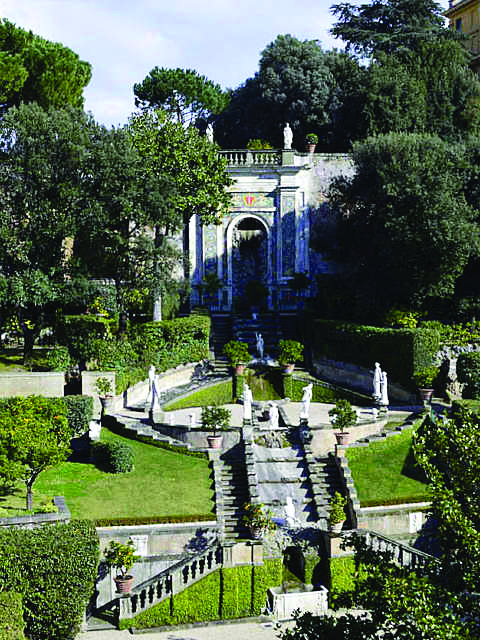
The Palazzo Colonna with its impressive entrance courtyard and (below) magnificent gardens at its back.
I’ve lived in Rome for more than 50 years and had never heard of, much less visited, Palazzo Colonna, until last November when the Culture Group of the Foreign Press Association was invited on a tour there.
The entrance to Palazzo Colonna is located near Rome’s most central square, Piazza Venezia, at Piazza Santi Apostoli 66, between Rome’s insignificant Wax Museum and the Roman headquarters of Touring Club Italiana. Farther along on the same side of the piazza is the 6th-century church of the same name, administered since the Middle Ages by the Franciscans.
The Palazzo’s short, beautifully-illustrated guide (15 euros), with editions in many different languages, recounts: “The Colonnas are a Roman family whose history began 900 years ago. The first documented member of the family was Pietro, who lived between 1078 and 1108 in the countryside south of Rome, close to the town of Colonna, from which the House derived its name.
“Up to the present day there have been no less than 32 generations of the Colonna family, the main branch of which established itself from the beginning of the 1200s here on the slopes of the Quirinal Hill.” Over the centuries, one family member was elected Pope and some 30 members became cardinals, not to omit numerous, less important prelates.
Today the Palazzo, with its impressive entrance courtyard and magnificent gardens at its back, is one of the oldest and largest (3 acres) still-private dwellings in Rome. Built in part over the ruins of an ancient Roman Serapeum, it took five centuries to complete.
Tradition holds that the Colonnas hosted Dante here during his visit to Rome in October, 1301 as part of a diplomatic mission to Boniface VIII to ask this Pope not to intervene in Florentine politics. The poet Petrarch, a family friend, stayed here in April 1341, when he came to Rome to be crowned poet laureate on the nearby Capitoline Hill.
Other contemporary documents note that Oddone Colonna, who ascended to the papacy as Pope Martin V on November 11, 1417, was born here in 1369. (By the way, his election at the Council of Constance effectively ended the Western Schism, which had begun in 1378. He was also the last Pope to take the pontifical name “Martin.”) Pope Martin V returned to Rome in 1420, appointed the Palazzo as the Pontifical Seat and lived here again until his death in 1431.
According to the Palazzo’s website: “In those ten years, within the still austere fortress-like rooms of the Palazzo, Pope Martin V designed and implemented a great plan for a cultural and urban rebirth of the city of Rome, which lay in devastating conditions…during the Western Schism.”
“A century later, during the Sack of Rome in 1527, Palazzo Colonna was one of the few buildings that was not destroyed, due to the good relations the Colonna family had with Emperor Charles V. Instead, it offered a safe haven for more than 3,000 Roman citizens,” even if they were soon arrested and had to pay a ransom to re-obtain their freedom.
The highpoint of the Palazzo’s existence was the 1600s, when, thanks to three generations of the family headed by Prince Philip I (1578-1639), Cardinal Girolamo I (1604-66) and Prince Lorenzo Onofrio (1637-1685), it was transformed by the best available architects and artists, Bernini and Carlo Fontana among them, from a fortress into the magnificent Baroque palace it still is today, although there were also later embellishments.

The jaw-dropping Great Hall, a vast, glittering 76-meter-long gallery decorated with mirrors, paintings, frescoes and priceless objects.
The Palazzo’s undisputed architectural highlight, completed in 1703, is the jaw-dropping Great Hall, a vast, glittering 76-meter-long gallery decorated with mirrors, paintings, frescoes and priceless objects that is three meters longer than the Hall of Mirrors at Versailles. It was commissioned in the 1660s by Prince Lorenzo Onofrio as a showcase for the family’s growing art collection, as well as a celebration of the achievements of his illustrious ancestor, Marcantonio II (1535-84).

The Steinhart brothers’ ebony and ivory cabinet
This heroic naval commander, in charge of the papal fleet, was responsible for leading a vast alliance into battle against the advancing Turkish forces at Lepanto in the Gulf of Patras in 1571. Colonna’s victory was considered one of the most important events in early-modern history and made an instant hero of Marcantonio.
In fact, the Great Hall’s enormously high ceilings are covered with ornate frescoes portraying several scenes of the battle and its hero. They culminate with a fresco of the victorious Marcantonio being presented to the Virgin Mary.
The Great Hall is a crystalline statement of the Colonna family’s elevated status in Roman society, now on a par with the other newly powerful Roman families, the Barberini and the Borghese, who were also busily gilding their own reputations by building sprawling new palaces in Rome and creating impressive art collections.

Pulzone’s Portrait of Marcantonio II Colonna.
Another important historical event is commemorated in the Great Hall. A cannon ball landed on the short flight of stairs leading to the Palazzo’s magnificent multi-level gardens decorated with statues and a waterfall. During the short-lived, anti-clerical Roman Republic, which lasted from February to July 1849, the French army, under the command of General Oudinot, had fired upon the Palazzo from the Janiculum Hill in June. Oudinot had entered Rome with some 9,000 troops from the nearby Porta San Pancrazio to suppress the insurgent Republicans, to restore the Holy See’s temporal power, and to guarantee the return to Rome of Pope Pius IX (r.1846-1870), who’d fled to safety in Gaeta.

The room frescoed with Gaspard Dughet’s tromphe-l’oeil frescoes.
Ironically, two of these insurgents, Mazzini and Garibaldi, went into exile, but twenty years later, together with Cavour, were the protagonists of the Risorgimento, or Unification of Italy.
Although fictional, a century later, the final scene — the press conference — of the 1953 classic film Roman Holiday, starring Audrey Hepburn and Gregory Peck, was shot in the Great Hall.
In addition to the Great Hall, the ceilings and walls of most of the Palazzo’s rooms — the Hall of the Battle Column, the Hall of the Landscapes, the Room of the Apotheosis of Martin V and the Room of the Chapel, to name a few — are decorated with frescoes, tapestries and paintings, notified and bound by the fidecommesso of 1800, a document stating that these treasures must remain the property of the Colonna family and be handed down from generation to generation.

Pisanello’s copy of a Portrait of Martin V
Their masterpieces are too many to list here. Suffice it to say that the highlights of the some 300 paintings are several by Francesco Albani, Andrea del Sarto’s Madonna Crowned by Angels with the Christ Child and Young St. John the Baptist, Pompeo Batoni’s Portrait of Isabella Colonna Salviati, Jan Frans van Bloemen (called L’Orizzonte)’s many landscapes, Brueghel the Elder’s nine fantastic miniature landscapes painted on copper, Bronzino’s Virgin with Sleeping Christ Child, St. Anne and Young St. John, Carracci’s The Beaneater and Cranach the Elder’s Madonna and Child with Angels and Strawberries.
You can also see there Gaspard Dughet’s many trompel’oeil landscapes, many works by Guercino, Pietro Da Cortona’s The Resurrection of Christ and of Some Members of the Colonna Family at the End of Time, Scipione Pulzone’s Portrait of Marcantonio II Colonna, Guido Reni’s St. Francis of Assisi and Two Angels, Perugino’s Penitent St. Jerome in the Desert, Rubens’ Reconciliation of Esau and Jacob, several paintings by Tintoretto and landscapes of Italy by Vanvitelli.

View of Naples from the sea with Castel dell’Ovo by Vanvitelli.
Also of note is the large ebony and ivory cabinet made by the German Steinhart brothers, the sandalwood cabinet decorated with precious stones and miniatures of a Roman villa, the many French tapestries, several mind-boggling frescoed ceilings and elaborate Murano glass chandeliers.
Palazzo Colonna is open to visitors every Friday and Saturday (holidays included) from 9:15 am to 2:00 pm (last admission is 1:15 pm). Guided tours in English start at 9:30 and 10:00 am. For information about the Palazzo, click on www.galleriacolonna.it. To book reservations, telephone 011-39-06-6784350 or email: [email protected] or book online via TICKETONE. Exclusive private guided tours can be arranged every day and start at 3:00 pm. Entrance fees: Guided tours cost 35 euros per person and last two hours. The unguided tour of the entire Palazzo costs 21 euros per person; for only the Great Hall, 15 euros; for visitors between 13 and 18 years old, 10 euros; and younger children enter free.