By Anna Artymiak
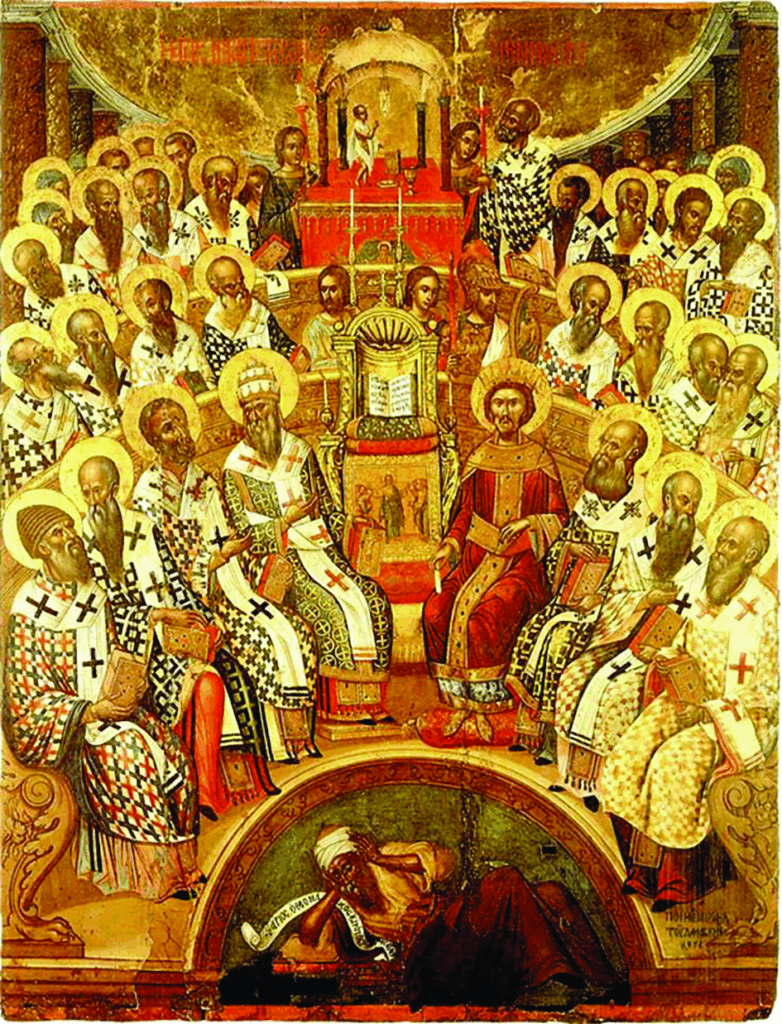
The Council of Nicaea, held in 325 AD, was attended by Emperor Constantine and ended with the defeat of the Arian heresy. Arius is represented at the feet of the assembly
May 23, 2025
In two days he would have gone to Nicaea in Turkey to celebrate the 1,700th anniversary of the first Council of Nicaea, had the Lord not called him from this life.
It was a long-awaited trip of the late Pope.
Francis already in 2014 accepted an idea of the celebration of this unique anniversary. It would have been his only trip, just a one-day trip, during the whole 2025 Jubilee Year.
Pope Francis gave a long reflection on the meaning of the Council of Nicaea during one of the last homilies before his death.
At the Vespers for the Feast of the Conversion of Saint Paul on January 25 this year in the Basilica of St. Paul’s Outside-the-Walls, the Holy Father said:
“The Jubilee Year of Hope celebrated by the Catholic Church coincides with an anniversary of great significance for all Christians: the 1,700th anniversary of the first great ecumenical council: the Council of Nicaea.
“This Council sought to preserve the unity of the Church at a very difficult time, and the Council Fathers unanimously approved the Creed that many Christians still recite each Sunday at the celebration of the Eucharist.
“This Creed is a common profession of faith that transcends all the divisions that have riven the Body of Christ over the centuries.
“The anniversary of the Council of Nicaea is therefore a year of grace, an opportunity for all Christians who recite the same Creed and believe in the same God.
“Let us rediscover the common roots of the faith; let us preserve unity! Let us always move forward! May the unity we all are searching for be found.
 “What comes to mind is something that the great Orthodox theologian Ioannis Zizioulas used to say: ‘I know the date of full communion: the day after the final judgment! In the meantime, we must walk together, work together, pray together, love together. And this is something very beautiful!’
“Dear brothers and sisters, this faith we share is a precious gift, but it is also a task. The anniversary should be celebrated not only as a ‘historical memory,’ but also as a pledge to bear witness to the growing communion between us.
“We must take care not to let it slip away, but rather to build solid bonds, cultivate mutual friendship, and be instruments of communion and fraternity.
“In this Week of Prayer for Christian Unity, we can also draw from the anniversary of the Council of Nicaea a call to persevere in the journey towards unity.
“This year, the celebration of Easter coincides in both the Gregorian and Julian calendars, a circumstance that proves providential as we commemorate the anniversary of the Ecumenical Council.
“I renew my appeal that this coincidence may serve as an appeal to all Christians to take a decisive step forward towards unity around a common date for Easter (cf. Bull Spes Non Confundit, 17). The Catholic Church is open to accepting the date that everyone wants: a date of unity.”
Everything changed when Francis was suddenly hospitalized on February 14. Immediately it was clear the Pope was so ill that he would not be able to make the trip to Nicaea.
The trip was postponed.
This is one of the legacies of Pope Francis that the newly-elected Pope Leo XIV wishes to honor and uphold.
On the second Monday after his election, May 19, early in the morning, the Holy Father Leo received in private audience the Ecumenical Patriarch, Bartholomew I of Constantinople.
The key question of their private meeting was the trip to Nicaea.
Already it was clear that there was too little time to organize a trip for the end of May.
At the same time, it was clear that a one-day trip would also not be possible, as Turkish protocol requires a head of state coming to the country for the first time to visit the country’s capital city, Ankara.
Therefore, Pope Leo XIV probably will make a three-day trip to the country.
The Ecumenical Patriarch suggested he come for the Feast of St. Andrew, November 30.
Leo XIV promised the Patriarch he would come to Nicaea this year, the year of the 1700th anniversary of the first Council, but he did not promise any dates, as the Pope confessed he still needs to understand his other obligations at that time.
Later on May 19, the Holy Father received in private audience Representatives of Other Churches and Ecclesial Communities, as well as of other religions who came for the celebration of the beginning of his Petrine ministry. At his address Leo XIV dedicated a long passage on the first Council of Nicaea, assuring he would like to continue his predecessor’s path.
The Pope said, speaking in a personal tone: “My election has taken place during the year of the 1,700th anniversary of the First Ecumenical Council of Nicaea. That Council represents a milestone in the formulation of the Creed shared by all Churches and Ecclesial Communities.
“While we are on the journey to re-establishing full communion among all Christians, we recognize that this unity can only be unity in faith. As Bishop of Rome, I consider one of my priorities to be that of seeking the re-establishment of full and visible communion among all those who profess the same faith in God the Father, the Son and the Holy Spirit.
“Indeed, unity has always been a constant concern of mine, as witnessed by the motto I chose for my episcopal ministry: In Illo uno unum, an expression of Saint Augustine of Hippo that reminds us how we too, although we are many, ‘in the One — that is, Christ — we are one’ (Enarr. in Ps., 127, 3).
“What is more, our communion is realized to the extent that we meet in the Lord Jesus. The more faithful and obedient we are to Him, the more united we are among ourselves.
“We Christians, then, are all called to pray and work together to reach this goal, step by step, which is and remains the work of the Holy Spirit.”
Bartholomew at the tomb of Francis

Greek Orthodox Ecumenical Patriarch Bartholomew (left), and the late Greek Orthodox Metropolitan Gennadios (center), during a visit of the Urbi et Orbi Foundation, led by Dr. Robert Moynihan (right) to the Phanar, the residence of the Patriarch, in Istanbul, in July 2014
Patriarch Bartholomew’s visit to Rome for the celebration of the beginning of Leo XIV’s Petrine ministry was an occasion for him to come to pray at the tomb of Pope Francis.
The Patriarch, along with Metropolitan Job and Metropolitan Polykarpos and the deacon, Evlogios, arrived at Saint Mary Major Basilica a few minutes after 3 pm.
Bartholomew placed a bouquet of flowers on the tomb of Francis and sang a psalm praying for the eternal rest of Pope Francis’ soul. He chanted these words in Greek:
“Receive, Our Lord and Savior, the soul of your servant, Francis, in that place where there is no pain or suffering, where there is true peace.”
At the exit of the basilica, the Ecumenical Patriarch was kind enough to meet a few correspondents present outside the Basilica, waiting for comment from him. He did not want to answer too many questions, but he was willing to comment on the most important issues for us: his first private meeting with Pope Leo XIV, the upcoming trip to Nicaea, and his memories of the late Pope Francis.
Bartholomew made a short statement in Italian. I was among the correspondents, representing Inside the Vatican magazine, to greet the Patriarch on behalf of our Editor-in-chief, Robert Moynihan. Somehow it seemed to me like a mission impossible. But the fact that Bartholomew stopped to talk with us was a sign of hope. In a few sentences he satisfied all our expectations. He said:
“Pope Francis and I shared the same ideals, the same visions for the future of the Church and for humanity.
“Francis honored us with his visit to us at the beginning of his pontificate in 2014. We visited Jerusalem together in the same year, in May 2014. We knelt and prayed before the tomb of Jesus for the re-establishment of the union of our Churches and for the good and peace of all humanity.
“While he was preparing to come to Turkey once again to celebrate together the 1700th anniversary of the first Council of Nicaea, the Lord called him to Heaven, from where we are certain and sure that he prays for us all.
“This morning I met His Holiness Pope Leo. I saw with great satisfaction that we can continue on the same path for our Churches, for Christianity as a whole, for peace in the world.
He assured me that he wants to come to Turkey for the anniversary of Nicaea. We have not set a concrete date, but certainly this year.
“This is our desire, also our wish, and it will be our honor to welcome His Holiness, perhaps on his first trip outside the Vatican. To visit Nicaea, but also to make an official visit to the Church of Constantinople, to the Ecumenical Patriarchate.”
A journalist asked Bartholomew to recall the time when he studied in Rome, in the 1960s, at the time of the Second Vatican Council.
“I recall many good professors. The courses were in Latin. It was the Second Vatican Council that introduced Italian into the pontifical universities, but when I studied it was Latin.
“At first it was difficult for me, but little by little I managed to understand and to pass the exams.”
It was a special day for another reason. On May 19, 1984, 41 years ago, Robert Moynihan arrived in Rome. Probably he would never imagine how this trip would change his life. Bob — as we call him in the press office — has already covered four Popes: John Paul II, Benedict XIV, Francis, and now, Leo XIV.