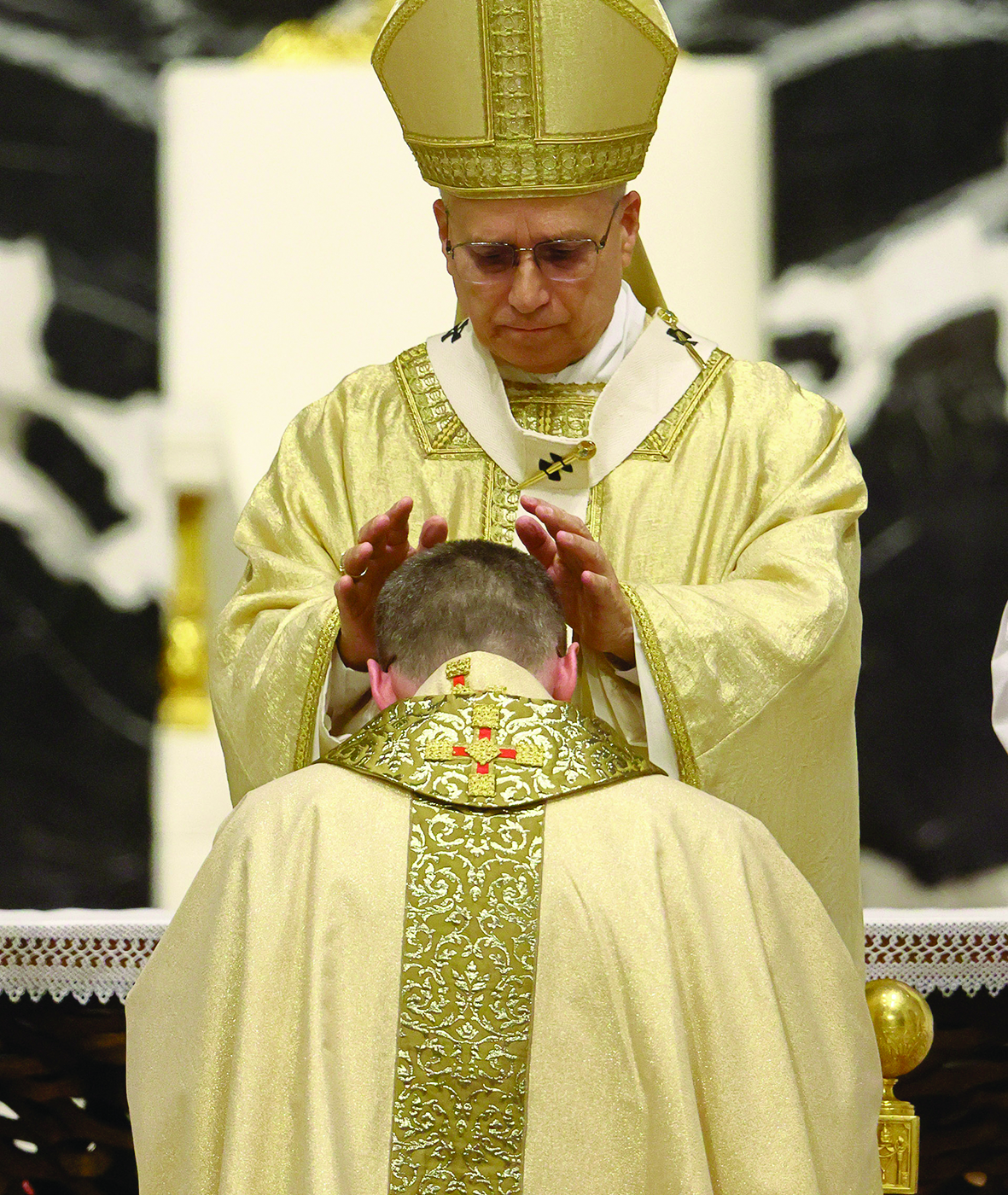
The new Pope this summer took his first steps as the Successor of Peter. Elected on May 8, his first 100 days were complete on August 18. His 70th birthday will be September 14
By Robert Moynihan
Wednesday, August 20, 2025 — Pope Leo did something this summer that Pope Francis never did: he went out to Castel Gandolfo, a village about 15 miles outside of Rome, to leave behind the scorching heat of Rome’s summer. In Castel Gandolfo there is a papal palace which stands high on the edge of a volcanic crater, looking down upon a beautiful blue crater lake, called Lago Albano, and nearby there are extensive Vatican gardens, larger than the ones in Vatican City. Here, since 1626, pontiffs have come for a summer rest. But Francis broke the tradition, staying in Rome each summer, in the Domus Santa Marta, his residence.
So Leo, in his first summer, reversed the decision of Francis, came out to Castel Gandolfo, and the local residents received him with great joy.
The Rome daily newspaper La Repubblica now reports that Leo, when he moves into the papal apartment in the Apostolic Palace in the fall, will make of this 10-room apartment a home to a “small community of three or four Augustinians” from the Pope’s religious congregation, along with himself and his secretary, the Peruvian priest Fr. Edgar Rimaycuna. These could be the three religious who make up the “papal sacristy,” responsible for preparing the Pope’s liturgical celebrations.
These Augustinians — one Italian, one Filipino and one Nigerian — currently live near the Sistine Chapel. “Sometimes the current Pope goes to lunch with these religious,” the prior general of the Order of Saint Augustine, Spanish priest Alejandro Moral Antón, told I.Media last June. Father Moral said he suggested to the new Pope “that it would be good to form a small community of brothers around him who would study, pray and live with him” in the Apostolic Palace.
So one of the things we may say about Leo is that he is doing at least some things differently from Francis. Leo knew Francis well; he met with him for an hour nearly every Saturday for the past two years. But, Leo is also himself, his own man.
This may be seen even in tiny details. Just today, August 20, there is a story by Luisa Mosello in Il Gusto, an Italian food magazine, of how Pope Leo invited a local Italian food caterer and pizza maker, Alessandro Pacetti, owner of “Pizza Country” restaurant, to make him a pizza for the evening of his departure from Castel Gandolfo, August 19.
“I approached him and asked if he liked the Tonda (round pizza), and he said, ‘Yes, let’s do it on Tuesday evening.’ I used the best ingredients, and it was a dream come true. And he loved it.
“It all started last Sunday (August 17, ed. ) when we prepared the catering for an event with Caritas in the Vatican gardens of Borgo Laudato Si’…We brought our fried foods, supplì cacio e pepe, arancini all’amatriciana and carbonara, and fried pizza Montanara. Then, when the Pope returned after the Sunday Angelus, we offered them to him too.
“My family and I were there: my wife Loredana and my son Alfonso, who is the pizza chef, plus two staff members,” Pacetti continued. “We were introduced to His Holiness by the bishop of Albano, Vincenzo Viva, and that’s when the idea came to me.”
Here Pacetti gets a little emotional remembering that moment: “I don’t even know how I said these words, ‘Your Holiness, do you like pizza?’ And he, very easy-going, replied, ‘Of course, of course…’ At which point, the bishop intervened, saying, ‘Alessandro has a pizzeria across the street and his dream is to make a pizza for the Pope.’ At that moment, I was completely lost, and I thought Pope Leo was laughing in my face. Instead, he said, ‘Let’s do it Tuesday eve ning (August 19, ed.). Do everything as you like, to your taste, you choose.’
“In the end, we decided on a Capricciosa, and a special one dedicated entirely to him, which is called Pizza Leone XIV: with mozzarella and cooked zucchini, enriched fresh from the oven with smoked Black Angus, stracciatella and truffle cream. With high-quality ingredients, excellence, the best of the best for the Pope, but everything balanced, without overdoing it… nothing American…And we ac com panied them with a dedication of thanks…The waiter who delivered the pizzas said that the Pope had enjoyed them. It was a great honor for me, the best gift.”
We all know that Pope Leo now faces the many great issues of our time: wars, AI, technocrats, moral confusion. But we also know that he is bringing a certain humility and good humor and gentle kindness to the great task that confronts him, as this story of the pizza in Castel Gandolfo shows.
Another sign that Pope Leo is a man of kindness and humility is the fact, as reported August 14 by an NBC Chicago journalist who interviewed him, that Leo’s brother, John Prevost, continues to speak every single day by phone to his brother in Rome.
But Pope Leo’s concern extends to the entire world as well, and in particular, to those troubled areas where many continue to die every day: he asked the world’s Catholics and all people of good will to join him in a day of prayer and fasting for peace on Friday, August 22 — a very traditional Catholic practice.
On Tuesday, August 19, Pope Leo, strikingly, visited the mountaintop Shrine of Our Lady of Grace at Mentorella, located in a small cave just south of Rome (see cover), where he prayed — no doubt for the peace that so eludes the world, and for his own mission. The place is perhaps the oldest Marian shrine in Italy, consecrated by Pope Sylvester in 335 A.D.
Today, back in Rome’s sizzling heat — having left Castel Gandolfo — speaking at his Wednesday Audience, Leo’s main theme was forgiveness, the forgiveness of Christ. “Even at the darkest moment,” he said, “it is never too late to love and forgive.”
Pope Leo told the faithful how Jesus’ love, despite being betrayed, did not allow evil to have the last word, and that “there is always a way to continue to love, even when everything seems irredeemably compromised.” He said: “Let us ask today for the grace to be able to forgive, even when we do not feel understood, even when we feel abandoned.” To forgive, the Pope said, does not mean to deny evil, but to prevent it from generating further evil. “It is not to say that nothing has happened, but to do everything possible to ensure that resentment does not determine the future.” This is clearly at the center of Pope Leo’s teaching.