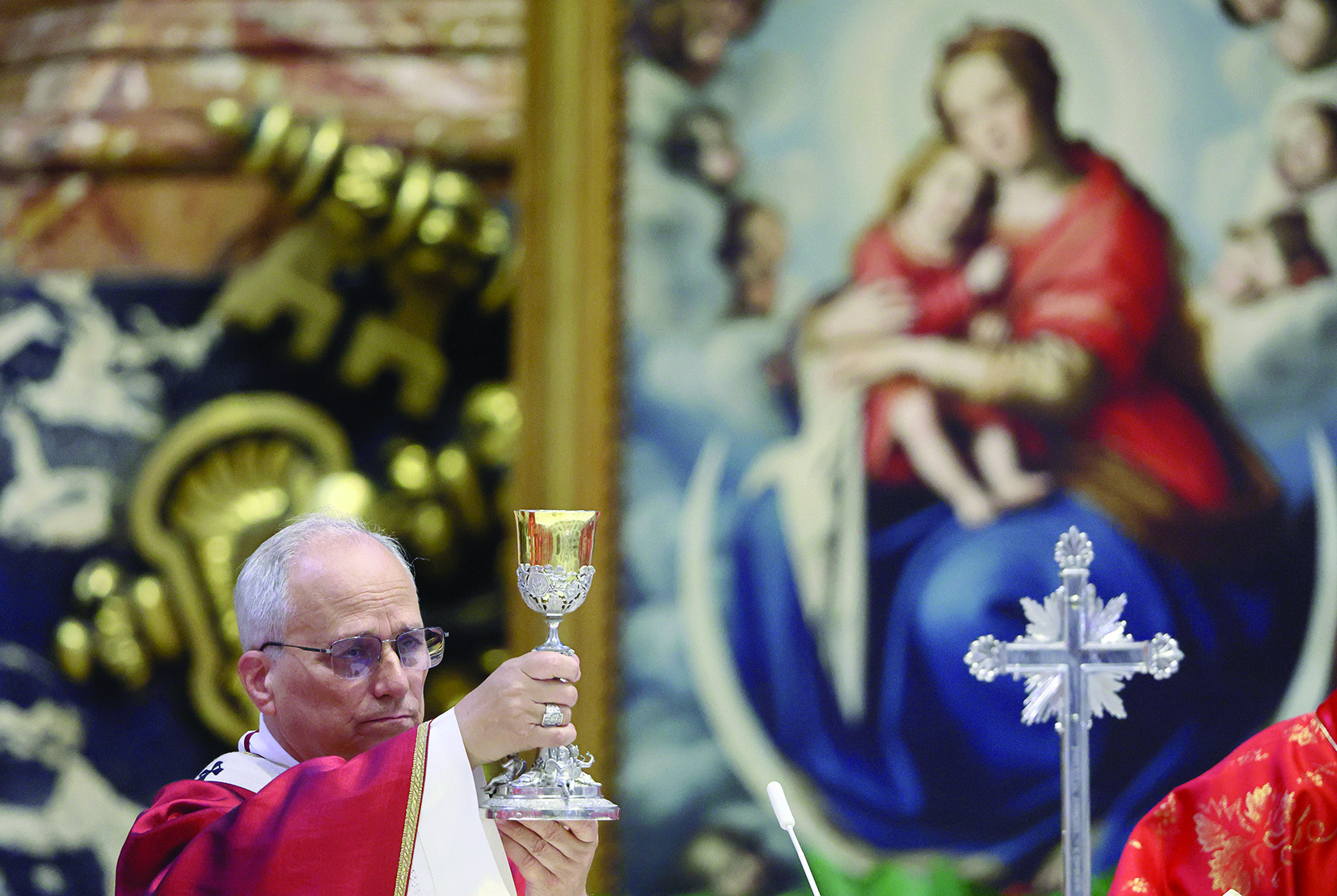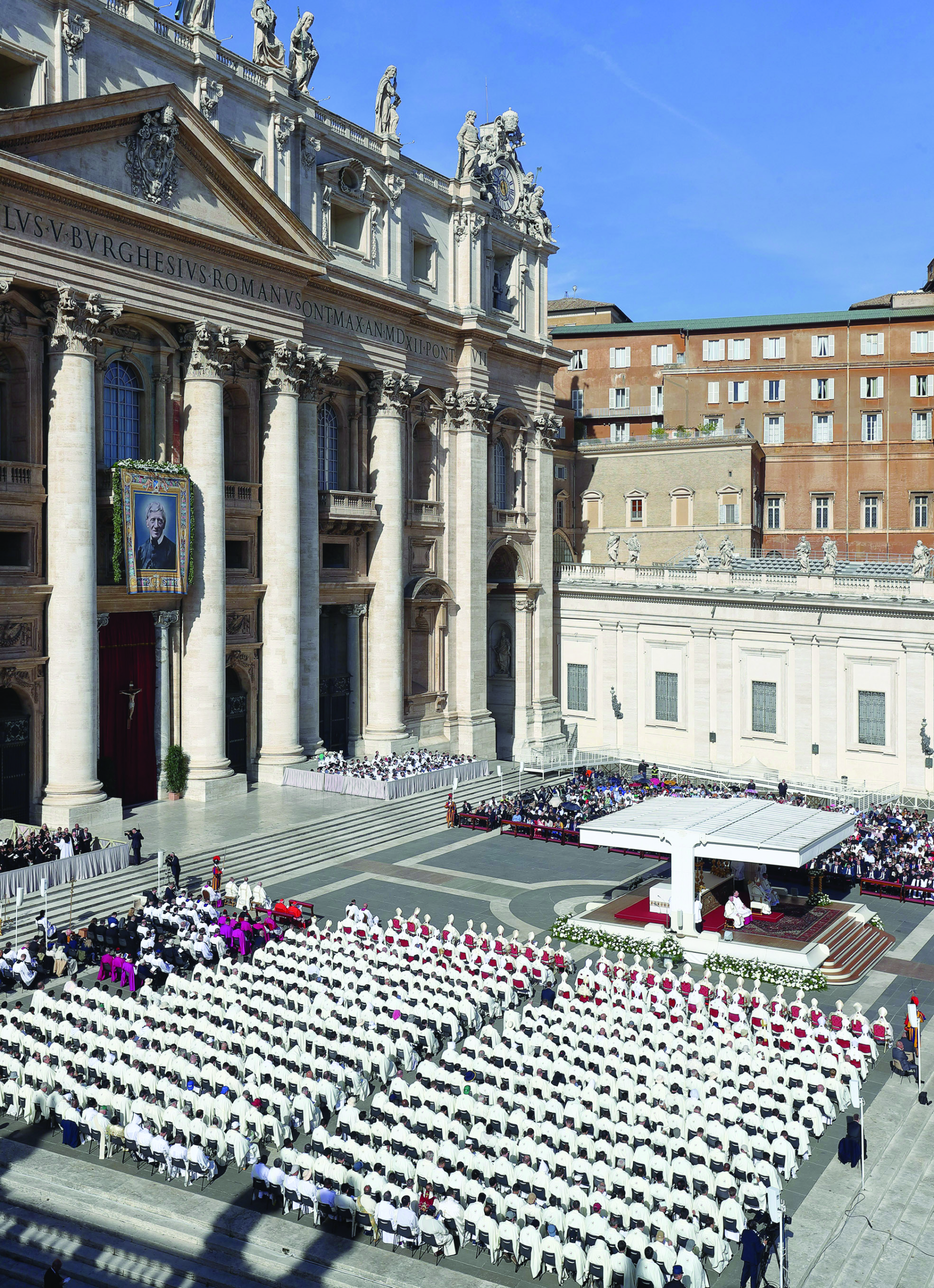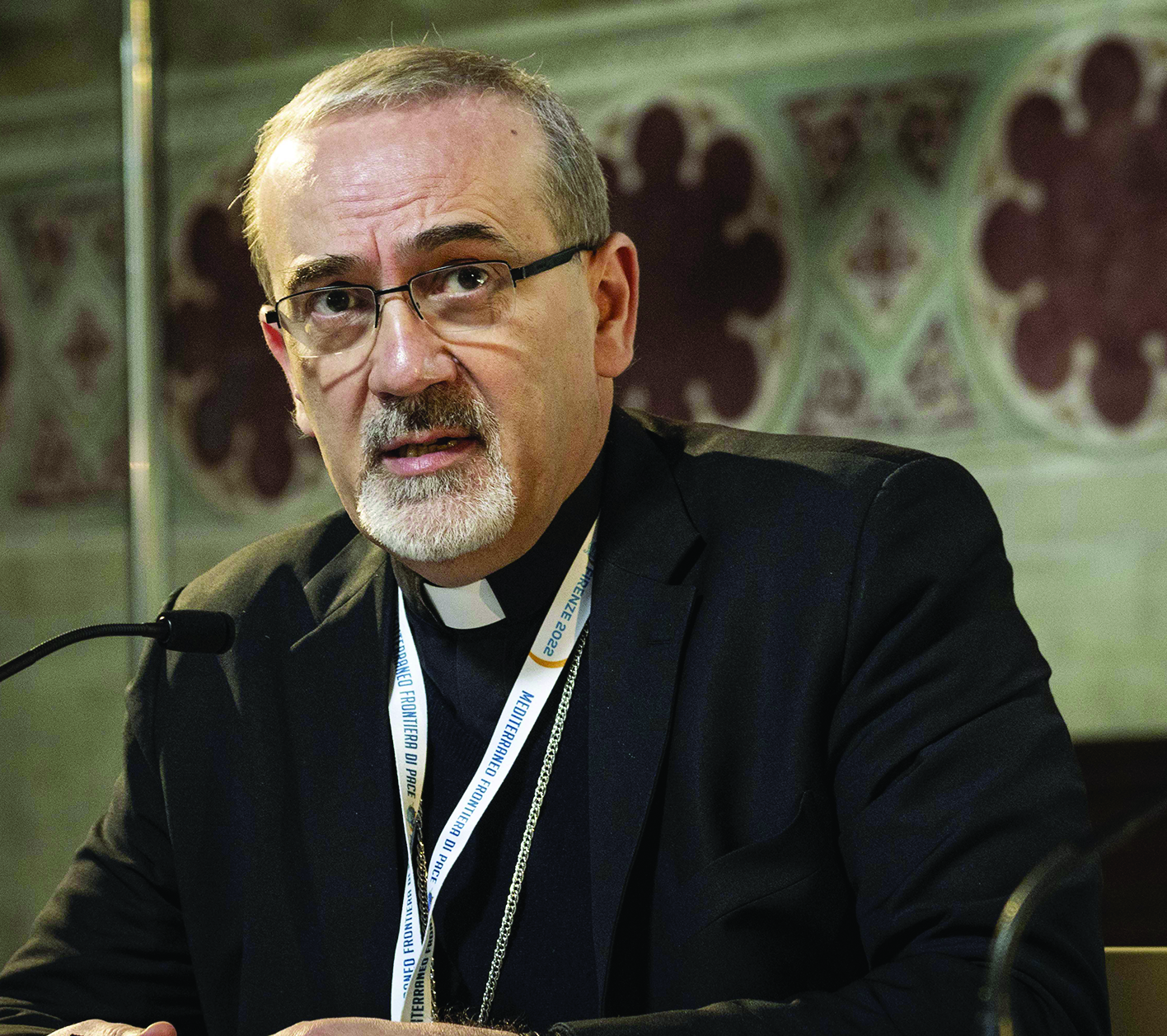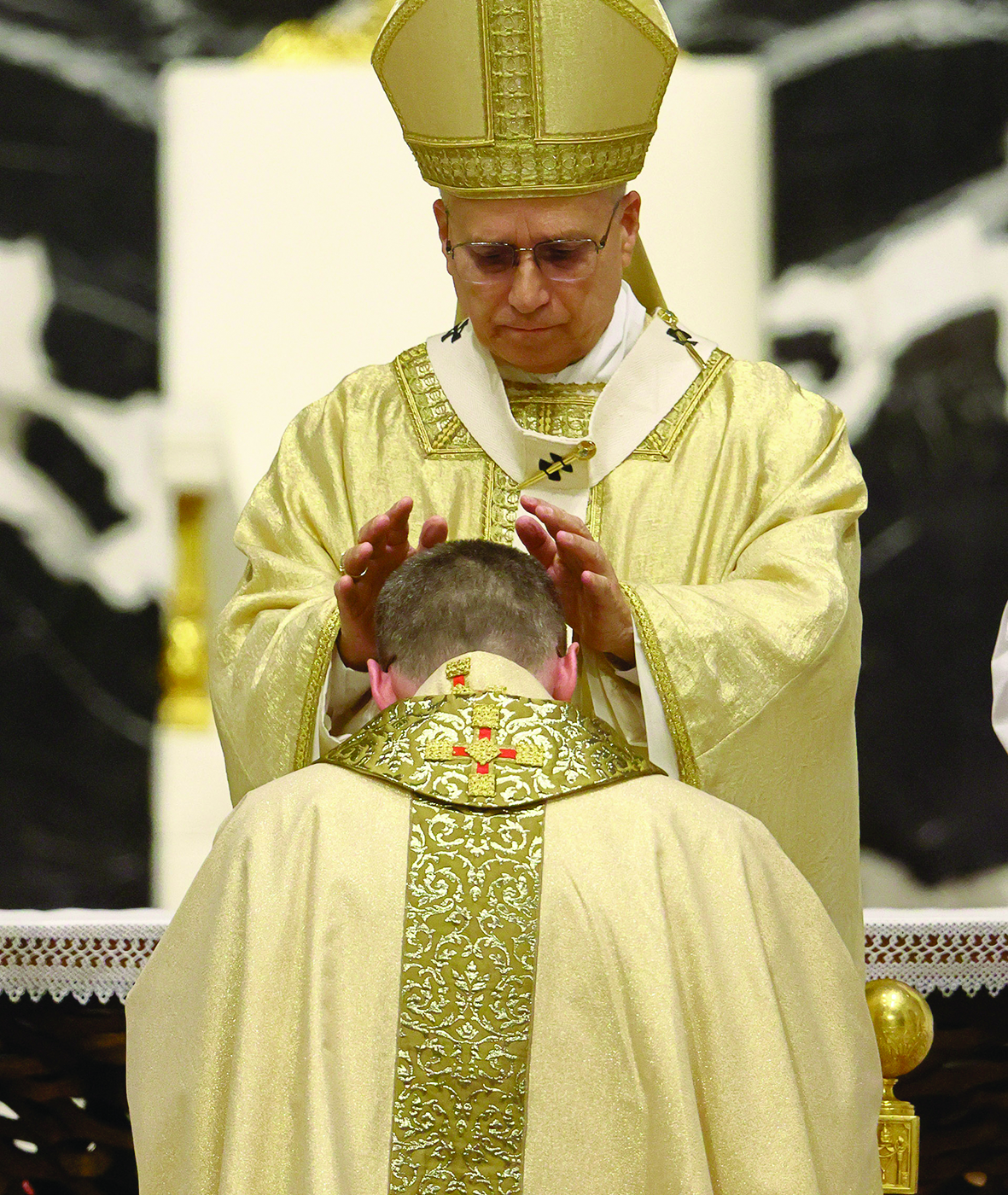
During the inauguration Mass of his pontificate in St. Peter’s Square, Pope Leo XIV received two symbols of papal power
By Vatican Media

The Eucharistic Celebration, with which the elected Pope officially begins his ministry, emphasizes in particular the “Petrine” dimension of Pastor of the Catholic Church.
The specific value assumed by the usual episcopal insignia, the Pallium and the Ring, is therefore emphasized. In addition to their reference to Christ and the Church, for the Successor of Peter they are evocative of the task entrusted to him by the Risen Lord (Jn 21:15-17).
The connection with the Apostle Peter and his martyrdom, which fertilized the nascent Church of Rome, are further emphasized by the places where the celebrations take place, first of all the Confession of Saint Peter in the Vatican Basilica.
In the solemn Eucharistic liturgy, in which the two “Petrine” episcopal insignia are imposed, the texts and signs make explicit their reference to Christ, the cornerstone of the Church (cf. Eph 2:20), and to Peter, called by him to be its “stony foundation,” the rock on which Christ the Lord builds the Church (cf. Mt 16:18).
The rite takes place in Saint Peter’s Basilica and in the square in front.
The stop at the Apostolic Confession of the Basilica underlines the close bond of the Bishop of Rome to the Apostle Peter and his martyrdom, gathering the people of God, on such a solemn day, in the same place where he confessed his faith with his blood together with many other Christians who gave the same testimony with him.
From the central gate of the Vatican Basilica hangs the tapestry of the miraculous catch of fish (John 21:1-8), which depicts the dialogue between Jesus and Peter, to which the rite makes explicit reference, in the liturgy of the Word and in the euchological texts.

0J9A3419 x
Here, the pallium is placed on Pope Leo by Cardinal Dominique Mamberti at the Pope’s inaugural Mass.

0J9A3470 x
Pope Leo receives the Fisherman’s Ring from Filipino Cardinal Luis Tagle (Galazka photo)

LEO LOOKS AT RING x
Pope Leo looks with emotion at the Fisherman’s Ring on his finger after it had been placed there by Cardinal Tagle (Galazka photo)
Introductory Rites
The new Roman Pontiff descends, with the Patriarchs of the Eastern Churches, to the tomb of Saint Peter, the “Apostolic Trophaeum,” and pauses there in prayer before incensing it.
In the meantime, two deacons take the Pastoral Pallium, the Fisherman’s Ring and the Book of the Gospels and carry them together in procession to place them on the Altar of the celebration.
The initial procession, after the pause at the Confession of Saint Peter, sets out towards the Altar, while the Laudes Regiæ [“Royal Praises” or “Royal Acclamations”] are sung, with the invocation of the intercession of the holy pontiffs, martyrs and saints of the Roman Church.
The rite for the blessing and sprinkling of holy water follows, and since it is a Sunday in the Easter season, the singing of the Gloria and the collect prayer which, recalling the Father’s plan to build his Church on Peter and inspired by Lumen Gentium, asks that the Bishop, appointed Successor of the Prince of the Apostles, show the Christian people Peter as the “visible principle and foundation of unity in faith and of communion” in the Church.
Inheriting his service, the Pope also participates in it (cf. LG 18, 23 and note 30; Vatican Council I, Const. Pastor Æternus, 1).
Liturgy of the Word
During Easter time, the page from the book of the Acts of the Apostles (4, 8-12) is read in which Peter announces that Christ is “the stone rejected by the builders.”
The assembly takes up the theme of the “stone” in the responsorial psalm (Ps 117 [118]), with the text: “The stone rejected by the builders has become the cornerstone.”
Peter’s vocation as the foundation of the Church (cf. Mt 16:18), is rooted in the rock that is the Lord (cf. Dt 32:4; Ps 117 [118], 22-23) and in the chosen, precious and solid stone that is Christ (cf. Is 28:16; Rm 9:33; 10:11).
The second reading (1 Pt 5:1-5, 10-11) further emphasizes the bond between Peter, the Church of Rome and the ministry of his Successor.
The Gospel of John (21:15-19) is one of the texts that, together with Mt 16:13-19 and Lk 22:31-34, traditionally establish the special and personal task given to Peter in the group of the Twelve.
He receives it, like the other Apostles, from the risen Christ.
Jesus’ triple question and triple answer are accompanied in crescendo by the invitation to feed “his lambs” and “his sheep.”

Pope Leo waves from his popemobile in St. Peter’s Square amid a sea of cameras before celebrating the Mass. (Galazka photo)
Imposition of the Pallium and delivery of the Ring
After the proclamation of the Gospel, in Latin and Greek, three Cardinals of the three Orders (Deacons, Presbyters and Bishops) and from different continents approach the Holy Father, to impose the Pallium and give him the Fisherman’s Ring Symeon of Thessalonica in De sacris ordinationibus writes: “The Pallium indicates the Savior who, meeting us as the lost sheep, takes it on his shoulders, and assuming our human nature in the Incarnation, has divinized it; with his death on the cross he has offered us to the Father and with the resurrection he has exalted us.”
The Pallium therefore recalls the Good Shepherd (cf. Jn 10:11), who places the lost sheep on his shoulders (cf. Lk 15:4-7), and also the threefold loving response to the request made by the risen Jesus to Peter to feed his lambs and his sheep (cf. Jn 21:15-17).
The pallium, in its present form, is a narrow band, woven in white wool, which rests on the shoulders over the chasuble, with two black flaps hanging in front and behind, so that the vestment resembles the letter “Y”.
It is decorated with six black silk crosses, one on each end that descends to the chest and back and four on the ring that rests on the shoulders, and is decorated, in front and behind, with three pins (acicula) that represent the three nails of the cross of Christ.
The Pallium is imposed by a Cardinal of the Order of Deacons, who in the formula used refers to Christ, “the great shepherd of the sheep,” whom God raised from the dead (Heb 13:20), and now He himself transmits it to the Pope.
After the Cardinal has imposed the Pallium, a Cardinal of the Order of Presbyters invokes with a special prayer the presence and assistance of the Lord on the Chosen One.
He implores from God the blessing – which is his own Son – and the greatest gift, the Holy Spirit, so that the Pope may exercise his ministry in a way that corresponds to the charism received.
The delivery of the Fisherman’s Ring follows.
Since the first millennium, the ring has also been the proper insignia of the Bishop.
The Ring that the new Pope receives, however, has the specific value of the seal ring that radically authenticates the faith, a task entrusted to Peter to confirm his brothers (cf. Lk 22:32).
It is called the “Fisherman’s” ring because Peter is the Apostle (cf. Mt 4:18-19; Mk 1:16-17) who, having had faith in the word of Jesus (cf. Lk 5:5), hauled the nets of the miraculous catch of fish from the boat ashore (cf. Jn 21:3-14).
The delivery of the Ring is made by a Cardinal of the Order of Bishops.
The delivery of the Ring ends by invoking the Holy Spirit to enrich the new Pontiff with strength and gentleness in preserving the disciples of Christ in the unity of communion.
After the rite of delivery, the Holy Father blesses the assembly with the Book of the Gospels, while proclaiming “For many years!” in Greek.

0J9A3178 x
Italy represented by the Italian President Sergio Mattarella with his daughter, and behind him the Italian Prime Minister Giorgia Meloni

0J9A3345 x
From the United States, Leo XIV's country of origin, Vice President JD Vance with his wife Usha

King Philip of Spain with his wife Letizia dressed in white, a privilege allowed in the ceremony to the royals. Behind, on the left among dignitaries and heads of state in attendance were Ursula von der Leyen, President of the EU; and Volodymyr Zelenskyy, President of Ukraine. (Galazka photo)
Concluding rites
The blessing returns again to the biblical image of the vine and the vineyard, applied to the Church (cf. LG 6), invoking that the Lord “guard” and “protect” the vine and the vineyard he has planted (cf. Ps 79 [80], 15-16), and asks that his face of salvation “shine” on all.

The coat of arms and motto of Pope Leo, which says in Latin, “In the One, we are one.”