By Lucy Gordan

The Altar of Calvary before being sent to Florence for Restoration (Courtesy of Brother Stéphane Milovitch)

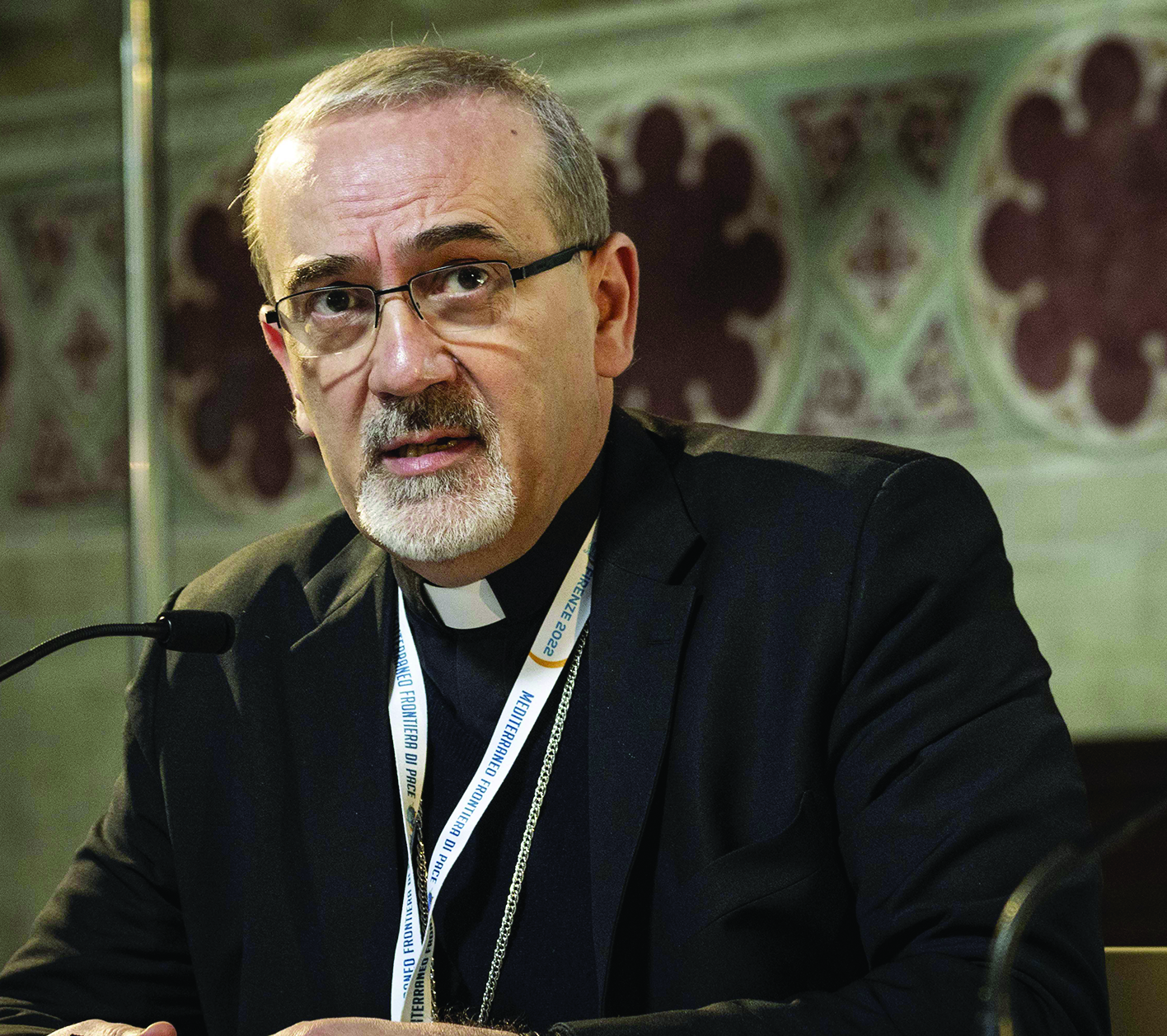
Brother Stéphane Milovitch (Courtesy of Terra Sancta Museum)
The 109 spectacular masterpieces on display until January 8, 2025 at the Marino Marini Museum in Florence chronicle more than five centuries of sacred art. They’d been commissioned by European Catholic courts — Spain, Portugal, France, and the Holy Roman Empire, as well as Genoa, Venice, the Grand Duchy of Tuscany, and the Kingdom of Naples, and mostly donated to the Basilica of the Holy Sepulcher in Jerusalem, founded in the 4th century AD and considered the holiest site of Christianity. The treasures include jewels, ornaments, chalices, tapestries, liturgical vestments and vessels, codices, icons, paintings, and canopies.
Proclaimed by two papal bulls as the custodians of Christian sacred places in the Holy Land in 1342, since 2013 the Franciscan Order of Friars Minor has been cataloging their share of what’s on display: 87 works of these sacred art treasures, several of which were made in Tuscany. After their donation, none have ever left the Holy Land before this exhibition and have ever even been exhibited in Jerusalem.
The remaining some 20 sacred artworks are on loan from Italian Museums: the Uffizi, the Palazzo Reale in Naples, Museo e Real Bosco di Capodimonte in Naples, Biblioteca Centrale di Firenze, Biblioteca Medicea Laurenziana in Florence, Biblioteca Riccardiana in Florence, Archivio di Stato di Firenze, Fondazione Banco di Napoli, and private collections.
The choice of the exhibition’s Florentine location is for a specific historical reason. From the Middle Ages to the early 19th century, it was the site of the Church of San Pancrazio behind the Palazzo Rucellai. In the mid-15th-century, the very wealthy wool merchant and close friend of the Medici family, Giovanni di Paolo Rucellai (1403-1481) commissioned the architect Leon Battista Alberti (1404-72), whom he had met during the Ecumenical Council held in Florence in 1439, to build him a tomb in the family chapel of the Church. Completed in 1467 this sepulcher was inspired by the Holy Sepulcher’s Anastasis in Jerusalem. Its exterior is decorated with green and white marble intarsia; inside, decorated with frescoes by Giovanni da Piamonte, a student of Piero della Fran cesca, are the tombs of Giovanni Rucellai and his family. Napoleon deconsecrated the Church in 1805, but not the Rucellai chapel, which today is in the Marino Marini Museum, founded in 1986 and the only museum of contemporary art in a deconsecrated church to house a still consecrated chapel, visitable since February 2013.

Tapestry showing the construction of Cosimo I de’ Medici’s hospital on Mount Zion (Courtesy of the Marino Marini Museum)
According to Leyla Bezzi, executive curator, the exhibition is intended to be a journey to Jerusalem in three parts. The first part opens with a splendid model of Jerusalem’s Basilica of The Holy Sepulcher made of wood, mother-of-pearl and camel bone in Bethlehem around 1700 and on loan from Bethlehem-born collector and researcher George Al-Ama, who recently became a member of the scientific committee of the Franciscans’ Terra Sancta Museum. It proceeds to recount the history of the Holy Sepulcher, the church which contains both the site where Jesus was crucified at Calvary and the location of his empty tomb as well as the history of the Rucellai Chapel.
The second section displays a geographic pilgrimage where visitors will retrace the itinerary followed by pilgrims to Jerusalem. Here there are engravings from Breydenbach’s “Book of Chronicles” depicting the ports of Venice, Ancona and Jaffa and ending with a panoramic view of the Holy City. The pilgrims arrived in The Holy Land at Jaffa, some 40 miles from Jerusalem. Accompanied by the Franciscan Custodian, on the way they stopped at the Ramieh Hospice before climbing the Judean mountains and entering Jerusalem through the Jaffa gate. They were received in the Convent of St. Savior, where some 300 Franciscans still live today. Here the Custodian washed their feet in a silver basin (one is on display), before they were served a meal, after which they sang the Te Deum in the cloister. They celebrated mass in the morning and visited the Holy Sepulcher in the early afternoon. The night was usually spent in the Basilica praying. Besides providing hospitality the Franciscans cared for the sick, both pilgrims and local Christians, so on display here are some of their pharmaceutical equipment.

The Cappella Rucellai (Courtesy of the Marino Marini Museum).
On display, country by country, in the third section-located in what had been the Church’s crypt-are the artworks and treasures donated by Europe’s royalty.
The star of the exhibition is the Altar of Calvary from the Holy Sepulcher in Jerusalem. This masterpiece and its massive gilded bronze Ornament, now an integral part of the Altar of Calvary, were donated by Grand Duke of Tuscany Ferdinand I de’ Medici (1549-1609) to guard the Stone of Unction, but the stone was too large. Nonetheless it shouldn’t be omitted that Ferdinand had been made cardinal at age 13, though he was never ordained, and was Protector of the Franciscans until he abandoned religious life in 1587 to succeed his brother as Grand Duke.
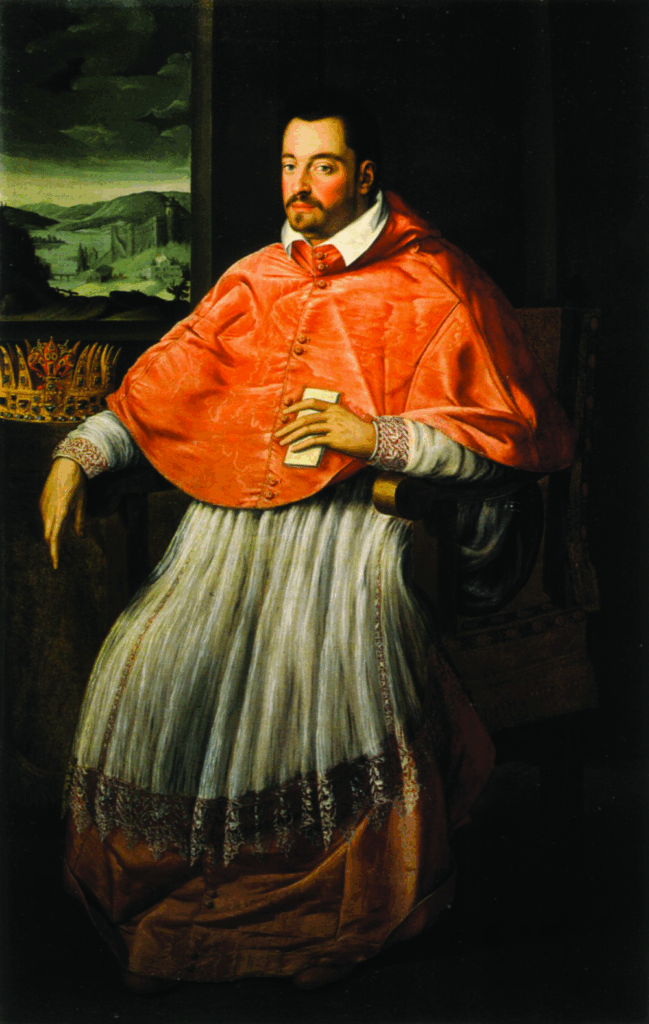
Portrait of Ferdinand I de’ Medici (Courtesy of The Uffizi Museum).
The Ornament was made in Florence between 1587 and 1588 under the direction of Father Domenico Portigiani of the Convent of St. Mark. It contains six splendid bas-reliefs attributed to Pietro Francavilla and his master the sculptor Giambologna. These six bas-reliefs each represent an episode of Christ’s passion and resurrection: The Elevation of the Cross, The Crucifixion, The Deposition from the Cross, The Anointing of Christ’s Body, The Burial and The Resurrection. (These bas-reliefs are comparable to bas-reliefs by these same artists on the bronze doors of Pisa’s Cathedral.) Now for the first time in nearly five centuries, the Ornament, like many of the artifacts made in Italy, has left Jerusalem to return to Italy for restoration and display. For a complete chronology of the altar click on www.terrasanctamuseum.org.
Another de’ Medici artifact illustrating the dynasty’s religious devotion and affinity for Jerusalem is a splendid tapestry by Jan van der Straet (1523-1605) (design and cartoon) and woven in Florence by Cosimo Squilli in c. 1571. It’s on loan from the Uffizi. Van der Straet was born in Bruges but worked in Florence as a painter, designer of tapestries, draughtsman, designer of prints and pottery decorator most of his professional life. Commissioned by Cosimo I de’ Medici (1519-1574), Ferdinand I’s father, the tapestry depicts the construction of a hospital for pilgrims on Mount Zion.

A silver bas-relief showng the Resurrection of Christ (1736), a gift of the Kingdom of Naples (Courtesy of the Terra Sancta Museum)
Other highlights are a gold and silver altar frontal, a gift of Charles of Bourbon, King of Naples, made in 1731 by the Neapolitan master goldsmith Gennaro De Blasio as well as three previously unknown canvases depicting St. Francis, St. Anthony of Padua, and St. Joseph and the infant Jesus. All three had been painted by Francesco De Mura (1696-1782), considered the greatest Neapolitan painter of the 18th century. They were commissioned in 1732 by Giovanni Antonio Yepes, Commissioner of the Holy Land in Naples, for the Church of the Annunciation in Nazareth.
Before arriving in Florence several of these sacred objects (in particular the Portuguese liturgical objects), were displayed at the Museo Calouste Gulbenkian Museum in Lisbon from November 10, 2023 to February 26, 2024 and then another selection at the Cidade da Cultura in Santiago de Compostela in Spain from March 22 to August 4, 2024, “since,” as a wall panel tells us, “until the end of the 18th century, Spain had been the main supporter of the Custody of the Holy Land, regularly sending large sums of money and precious gifts.” (It should not be forgotten that the Kingdom of Naples was under Spanish rule during the 17th century.)
“After Florence,” Brother Stéphane Milovitch, Director of Cultural Heritage of the Holy Land and Superior of the Francsican Monastery of St. Savior in Jerusalem, e-mailed me a few days ago, “the exhibition will travel to three destinations in 2025. One will be New York [I read the Frick collection on the Internet], the other two in Europe, but no venues or dates have yet been confirmed. The treasure will return to Jerusalem in 2026 to go on permanent display in a new section of the Terra Sancta Museum in St. Savior’s Convent in 2027.”