By Lucy Gordan


Andrea Palladio, the architect of this votive church on the island of Giudecca, La Chiesa de Santissimo Redentore (The Church of the Most Holy Redeemer)
Spread to human beings by fleas that had previously bitten infected rats, the bubonic plague or “black death” was a constant problem for Venice from its first outbreak in 1347, when it killed millions of people throughout Europe, until the 1830s. Venice, a city dependent on commerce, especially by sea from the East, couldn’t turn away foreign ships for fear they’d introduce disease, because otherwise it would have collapsed economically.
Over the next 60 years after 1348 there were another six outbreaks of the plague until the Senate decided in 1423 to introduce a hospice for the sick, known as a lazzaretto, in the monastery on the island of Santa Maria di Nazareth in the Venetian lagoon. It became known as Lazzaretto Vecchio. Although this isolation was better than nothing, there were two more outbreaks of the plague, in 1439 and in 1468, so a second and permanent quarantine station, known as Lazzaretto Nuovo and designed by the esteemed architect Andrea Palladio, was built in the monastery on the island of San Giorgio Maggiore.
These two lazzaretti and the permanent establishment in 1485 of the Magistrato alla Sanità (basically a Ministry of Public Health) kept Venice plague-free for nearly a century.
In 1568 the Tezon grando (a large warehouse built on the island of San Giorgio Maggiore for the cleansing of goods which arrived on infected ships) was built, but when in 1573 news of a major epidemic in Constantinople arrived, the city was caught unprepared because many cases had arrived from the mainland, not from the sea. Although it had been diagnosed by family physicians, professors of medicine in nearby Padua and the Venetian Government denied the presence of the plague until a year later, when, on July 31, they declared the first lockdown ever, lasting two weeks. When the situation didn’t improve, the Doge and the Senate promised the Lord to erect “a temple in the name of Christ” and miraculously the epidemic ended in early January 1577 — only after killing 50,726 Venetians, or one third of the city’s population.
The architect of this votive church on the large island of Giudecca, La Chiesa de Santissimo Redentore or Church of the Most Holy Redeemer, was again Palladio, who died in 1580, before the church was finished. Its façade facing “downtown” Venice across the wide Canale della Giudecca was inspired by the Pantheon in Rome and the 15 steps required to reach the church’s entrance were a direct reference to the Temple of Jerusalem.

A view of the garden from the church bell tower (Photo Carlo Soffietti)
Giovanni Trevisan, the Patriarch of Venice, laid the cornerstone on May 3, 1577. The church wasn’t consecrated until 1592, when Pope Gregory XIII entrusted it to the Order of Friars Minor Capuchin, who already, since 1539, had administered a small church called Santa Maria degli Angeli nearby, today part of the Redentore complex. Fourteen Capuchins, almost all northern Italians, still live at the Redentore.
The Giudecca had always been Venice’s garden, orchard, and farm island, so the Capuchins soon planted their own garden which they kept for themselves for over 400 years — only opening it to the public for the very first time this year, on October 31. For now, it is open until March 31, 2025 on Thursdays, Fridays and Saturdays from 10 am to 4:30 pm. The entrance fees are 12 euros for tourists, 6 euros for residents of Venice and children from 6 to 12 years old, and members of FAI (Fondo per l’ambiente italiano or Italian National Trust Fund). Otherwise, residents of Venice can choose to pay 30 euros a year for an unlimited entrance card. It’s free for clergy, members of ICOM (International Councils for Museums), children under 5 years old, the disabled plus their helpers, and donors of between 500 and 1,000 euros to the Friends of Venice Gardens Foundation. The best way to reach Il Redentore by public transportation is via the vaporetto 2, which stops just in front.
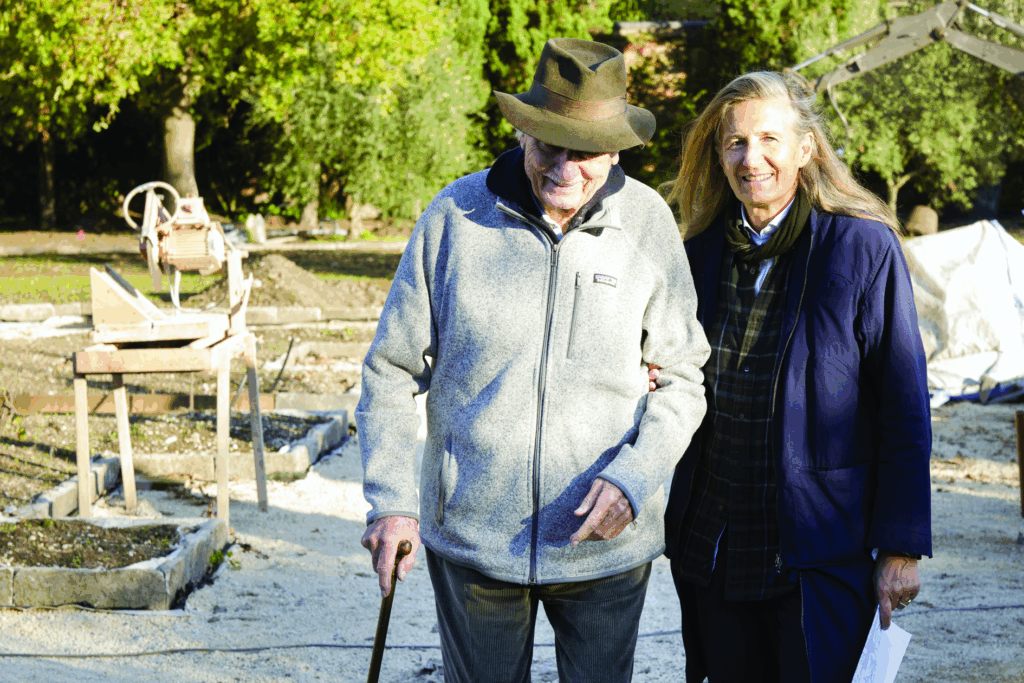
The Turin lawyer Adele Re Rebaudengo, creator and curator of the restoration project, and the famous landscape architect Paolo Pejrone. (Photo – Cynthia Giard Préfontaine)

The 1-hectare garden runs from the back of the church’s apse to the south lagoon. Over the centuries its several buildings, including meditation chapels, workshops, a greenhouse, and an apiary, had gradually fallen into disrepair, but the garden suffered serious damage from the “acqua alta,” the record 187 cm. (6 feet, 2 inches) high tide on November 12, 2019, which submerged and devastated the whole city of Venice.
To remedy the damage to this important record of Venetian landscape, culture, and religion, and exemplar for the Capuchin Franciscans of “Paradise on Earth,” on May 19, 2021 the Friars, with the authorization of the Holy See (Congregatio pro Institutis Vitae Consecratae et Societatibus Vitae Apostolicae) and of the Superintendency of Archeology, Fine Arts and Landscape for the City of Venice and its Lagoon, entrusted the garden’s restoration to the Venice Gardens Foundation Project. Created in 2014 by the Turin-born lawyer Adele Re Rebaudengo “to restore and conserve parks, gardens, and places of historic and cultural interest,” the Foundation restored the Giardini Reali (Royal Gardens) in Piazza San Marco as its first project, finishing on December 17, 2019.
“Almost immediately afterwards — in fact, not even two weeks after the completion of the Royal Gardens project,” Re Rebaudengo told a group of invited journalists, including me, at supper the night before the press preview on October 26, “I’d rung the doorbell of the Redentore’s monastery to propose this second project. I was sure they would think I was crazy, but instead, after long discussions, and bureaucratic and legal negotiations, the Holy See gave the Foundation a 22-year Concession.
“The aim of the project was to carry out the restoration, care, cultivation, and the opening of the compound to visitors, while maintaining the spirit and harmony of the place. In this historical moment, when collaboration, compassion and dialog seldom exist,” continued Re Rebaudengo, “the Foundation believes that this was a project not only of restoration, and of affinity and respect for nature, but also a return to how we human beings used to treat each other with respect. We live in fast-moving times, but here we have to respect the cycles of nature and its fruits Franciscan-style.”

The Venetian church Santa Maria della Salute, built to celebrate the end of an outbreak of the plague in 1630
Although open to the public, this garden is not your usual park with playgrounds. Rather it’s a place to meditate and find inner peace, so it is not appropriate for children unless specific activities, like art, gardening and cooking lessons with the products from the garden, have been set up for them. Other planned activities include concerts, poetry readings, book presentations, art and photographic exhibitions, and a café with dishes prepared from the garden’s seasonal produce. For example, the menu at the press preview was soft polenta with melted cheese by the spoon and crispy black kale, polenta chips with garden herb ricotta, lightly seared mixed garden vegetables, Chantilly cream with grappa, baked plums and mint.
With the objective of restoring and safeguarding the site’s beauty, religious and cultural tradition and vision for the future, the Foundation first conducted in-depth archival research predominantly in the Redentore’s archive and Venice’s library La Marciana, founded in 1468 by the humanist Cardinal Bessarion, where documentation and drawings of the original garden were discovered. The project was then entrusted to the world-famous landscape architect Paolo Pejrone, also Turin-born, who had, for example, restored the gardens of the Roman Church Santa Croce in Gerusalemme and the Giardini Reali, and to architect Alessandra Raso for the buildings’ reconstruction.
The project took three years to complete and cost approximately 5,500,000 euro, or 6 million dollars. Europe’s PNRR (National Recovery and Resilience Plan), part of the Next Generation EU economic recovery project, provided 2,200,000 euro; the remaining funds were donated by cultural foundations, businesses, and generous private benefactors as well as by many individuals who adopted trees and benches.
Speaking of trees and plants, the garden is home to 2,504 plants: 52 trees (30 of which are cypresses brought here from Tuscany); 240 shrubs; and 684 herbaceous, 1,520 flowering, and 8 aquatic plants. The garden includes an olive grove, an orchard of fruit trees, a fountain with water lilies in homage to the Orient’s connection to Venice, seasonal vegetable plots, an arbor made of chestnut wood, a traditional herb garden with medicinal plants which were once the source of the Redentore’s pharmacy, and a pittosporum garden essential for the garden’s honey production and the perfect setting for romantic views of the sunset over the lagoon. The garden is self-sufficient for water, thanks to a well and a rainwater storage. The Foundation will cover the maintenance cost of 250,000 euro (c. $270,000) a year.
P.S.: Since 2021 the Venetian church Santa Maria della Salute, built to celebrate the end of an outbreak of the plague in 1630 which killed 80,000 Venetians, had been covered in scaffolding and closed to the public.
Every year since 1631, on November 21, the Venetians have crossed the Grand Canal from St. Mark’s Square on a bridge made of connected boats to give thanks at this church and enjoy a plate of castradina, a mutton-based dish. This year the celebration was especially joyous because the scaffolding had been dismantled and the church reopened just a few days before.