His past remarks as a priest and bishop reveal a few insights into the thought of our new Augustinian Pope
By ITV staff

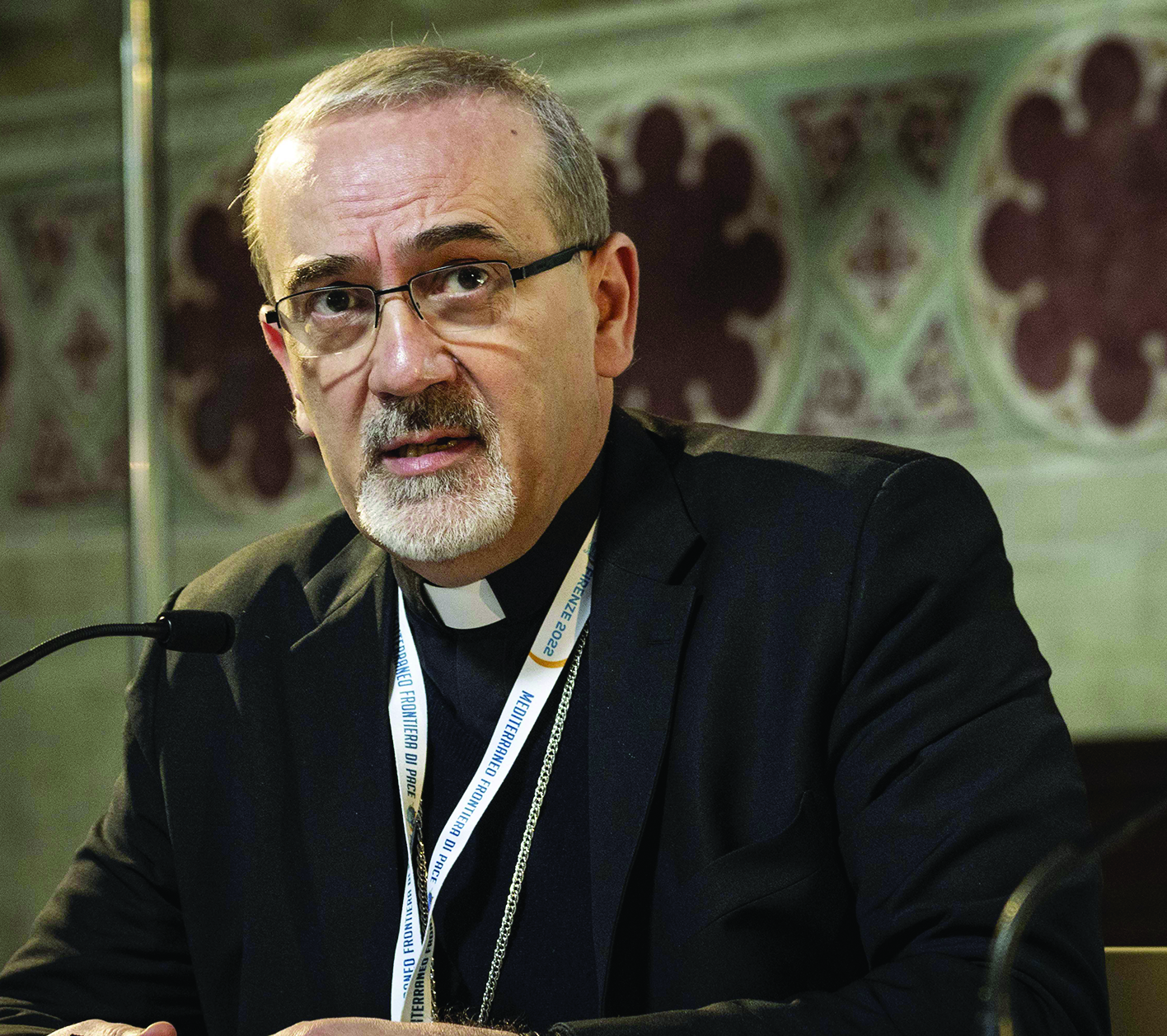
Cardinal Robert Prevost, now Pope Leo XIV, made a rather rare appearance before the media last year during the 2024 Synod on Synodality (photo: Vatican News)
Pope Leo XIV does not have a particularly long or voluminous “paper trail” of speeches, articles and other public deliveries of opinion; his positions on many issues remain inscrutable.
But he has been in prominent enough positions prior to his election as Pope to have left some indications of his general thought in the talks and interviews he did give.
For example, in 2012, as then-Father Prevost, Prior General of the Augustinian Order, Pope Leo delivered an intervention, titled “Mystery as an Antidote to Spectacle,” at the October 2012 Synod of Bishops in Rome (excerpt follows), in which he discussed some of the challenges of evangelization in the modern world.
We must redirect attention away from “spectacle,” into “mystery”
At least in the contemporary Western world—if not throughout the entire world—the human imagination concerning both religious faith and ethics is largely shaped by mass media, especially television and cinema. Western mass media is extraordinarily effective in fostering within the general public enormous sympathy for beliefs and practices that are at odds with the Gospel; for example, abortion, the homosexual lifestyle, euthanasia.
Religion is at best tolerated by mass media as “tame” and “quaint” when it does not actively oppose positions on ethical issues that the media have embraced as their own.
However, when religious voices are raised in opposition to these positions, mass media can target religion, labeling it as ideological and insensitive in regard to the so-called vital needs of people in the contemporary world.
In a world dominated by mass media, magisterial Church teaching can be helpful. Yet there is a great need for further development in this area. Noteworthy for its perception of the mass media context for evangelization is the post-conciliar document Aetatis Novae (1992). This document observed that modern media not only distorts reality by telling us what to think—it tells us what to think about.
The Fathers of the Church can provide eminent guidance for the Church in this aspect of the new evangelization, precisely because they were masters of the art of rhetoric. With their rhetorical formation—which, for many of them, constituted the best training available in the late ancient world—the Church Fathers offered a formidable response to those non-Christian and anti-Christian literary and rhetorical forces at work throughout the Roman Empire in shaping the religious and ethical imaginations of the day. They understood with enormous precision the techniques through which popular religious and ethical imaginations of their day were manipulated by the centers of secular power in that world.
Moreover, overt opposition to Christianity by mass media is only part of the problem. The sympathy for anti-Christian lifestyle choices that mass media fosters is so brilliantly and artfully engrained in the viewing public that, when people hear the Christian message, it often inevitably seems ideological and emotionally cruel by contrast to the ostensible humaneness of the anti-Christian perspective.
It is not sufficient for the Church to own its own television media or to sponsor religious films. The secular media will always be stronger in this field. And while it is vital that the Church be actively engaged in and with the media, we cannot successfully compete with the secular media.
In his City of God, Augustine teaches that mystery focuses the imagination on the darkness surrounding death—specifically, on the darkness of Christ’s crucifixion, which St. Augustine saw echoed in the deaths of the Christian martyrs. Spectacle, on the other hand—with its companion features: celebrity and heroism—offers people a false comfort by distracting the mind from its instinctive fear of death. Augustine saw this false comfort present in Roman theater, sports events, secular festivals, and military honors.
[…]
The Church should resist the temptation to believe that it can compete with modern mass media by turning the sacred liturgy into spectacle…
Church fathers remind us today that spectacle is the domain of the saeculum [world], and that our proper mission is to introduce people to the nature of mystery, as an antidote to spectacle. As a consequence, evangelization in the modern world must find the appropriate means for redirecting public attention away from special and into mystery.
“Consecrated life – poverty, chastity, obedience – is a sign of the Kingdom”
 Catholic News Service interviewed then-Fr. Prevost (pictured right) when he was in Rome for the 2012 Synod of Bishops. In his wide-ranging answers, he spoke of evangelization by example, the value of consecrated life and the role of personal experience in growing closer to God.
Here are a few excerpts:
There are thousands of young people who are looking for some kind of experience that will help them live their faith. And I think that has to come first anyway. Our priority needs to be living the Gospel…if we learn how to live our faith better, and invite others to live it.
Lay people have a very great role in the Church – as Pope Francis said, not to take over the clergy, but to live their baptism vocation with greater clarity.
I think we have to be open to change… but also be respectful of many wonderful traditionals that have grown up in the Church throughout the years.
[…]
I would say very broadly, first of all, consecrated life, if I can use that expression, is not primarily about the work that religious do, but rather about the total consecration of one’s life to God…I think quite clearly that the special gift that consecrated life is to the church is precisely who we are as religious in professing our lives through the evangelical councils — poverty, chastity and obedience — as a sign of the Kingdom, as a sign of the world to come.
[…]
I would say that Augustine is one of the church fathers who very clearly spoke about experience.
Human experience, he says, is precisely where you can find God, and the humanity of Augustine is not something which leads into a kind of a personalized, egoistic, “it’s all about me and only me” world, but quite the opposite.
Because of Augustine’s understanding of humanity, that human experience is actually the door that leads one into discovering who God is, and then a movement that Augustine speaks of in different areas about how going into God also leads you into solidarity with other people. And that second part of living in solidarity with others is perhaps a piece of the experience that is missing nowadays.