Maronite Christians in Lebanon are caught in the crossfire between Israel and Muslim Hezbollah forces
By Christopher Hart-Moynihan

Here below, the August 4, 2020 Beirut port explosion, a tragedy from which Lebanon still has not recovered.
“There is a big danger all around, and we never know when will be the next strike.” That was how Georges Assaf, a long-time collaborator of Urbi et Orbi Communications and a leader within Lebanon’s Maronite Christian community, summed up Leb anon’s situation on a podcast October 3 about the current status of Christians amid the ongoing, intensifying war between Hezbollah and the Israeli Defense Forces (IDF).
Following a summer during which many international observers thought a “wider war” involving Israel, Hezbollah, and Hezbollah’s ally and backer Iran might still be avoided, the events of recent weeks have answered such questions in the negative.

Hezbollah commander Fuad Shukr
While Hezbollah had been engaged in cross-border missile strikes with the IDF since the beginning of the Israel-Gaza war on October 7, 2023, the Israeli killing of Hezbollah commander Fuad Shukr in a targeted strike on a Beirut high-rise July 30 was a sign that the crisis was sliding toward full-scale war, and subsequent events of September and October 2024 have marked a significant escalation — and a concomitant escalation in the suffering of Lebanon’s civilian population.
Two particular events in recent weeks bear mentioning. First: the pager and walkie-talkie explosions of September 17 and 18, during which the IDF targeted Hezbollah communications devices.
The compromised devices had been acquired by Hezbollah through a shell company and used for several months before the mass detonations on the 17th and 18th, which killed more than 42 people and injured more than 3,500. While the pager and walkie-talkie detonation was ostensibly targeting Hezbollah’s operations, the indiscriminate nature of the attack, including the increased probability of non-combatant casualties, drew intense criticism from Lebanon’s government. Lebanon’s health minister, Firas Abiad, claimed the scale of the attack and the casualties was “far greater” than that of the August, 2020 Beirut port explosion, itself a catastrophic blow from which Lebanon still has not recovered.
Horrific injuries, many of them to the eyes and face as a result of users holding the devices near their heads just prior to the explosion, left thousands instantly — and permanently — disabled and overwhelmed Lebanon’s collapsing medical system.
While President of Israel Isaac Herzog denied Israeli involvement in the attack, Prime Minister Benjamin Netanyahu stated, “If Hezbollah has not understood the message, I promise you, it will understand the message,” and Israeli Defense Minister Yoav Gallant subsequently announced that Israel would be pursuing a “new phase” of the ongoing conflict.

Hassan Nasrallah, Supreme Leader of the Lebanese Shiites
The second crucial event in the recent escalation was the killing of long-time Hezbollah leader Hassan Nasrallah, in a targeted airstrike on his southern Beirut compound on September 27, 2024.
The implications of Nasrallah’s death from the Israeli perspective were summarized by former Director General of the Israeli Foreign Ministry Alon Liel in an October 25 interview with news outlet Al Jazeera, where Liel stated, “a few weeks ago, when Nasrallah was killed, the feeling in Israel was that this is all over, they don’t have a leader, and all the assistants around him, all the commanders around him, were killed and Hezbollah will collapse, but as you [can] see, it didn’t happen. Fighting is still going on… Israel lost 10 soldiers in the last 24 hours; so reality is hitting us again, maybe, in the face, and I think that this euphoric mood after Nasrallah’s and [Yahya] Sinwar’s killings is changing now to a more realistic mood, that the fighting will still go on for a while.”

Ismail Haniyeh, leader of Hamas
Christians in Lebanon have largely been caught in the crossfire in the latest deadly flare-up of the decades-long conflict between Hezbollah and Israel, Lebanon’s southern neighbor. Hezbollah, a Shia Muslim paramilitary organization backed financially and politically by Iran, has made no secret of its intention to take the fight to Israel and the IDF in the spirit of “permanent resistance” since its founding in the early 1990s.
Because Hezbollah uses southern Lebanon as its base of operations and controls many branches of government and society within Lebanon as a whole, acting in many ways as a “state within a state,” the IDF recently took the decision to invade southern Lebanon, an operation that is now resulting in the displacement of Christian families and communities in the area that are not affiliated with Hezbollah.
Similarly, the IDF bombardment of Beirut and surrounding areas has negatively impacted the civilian population there, many of whom are Christians.
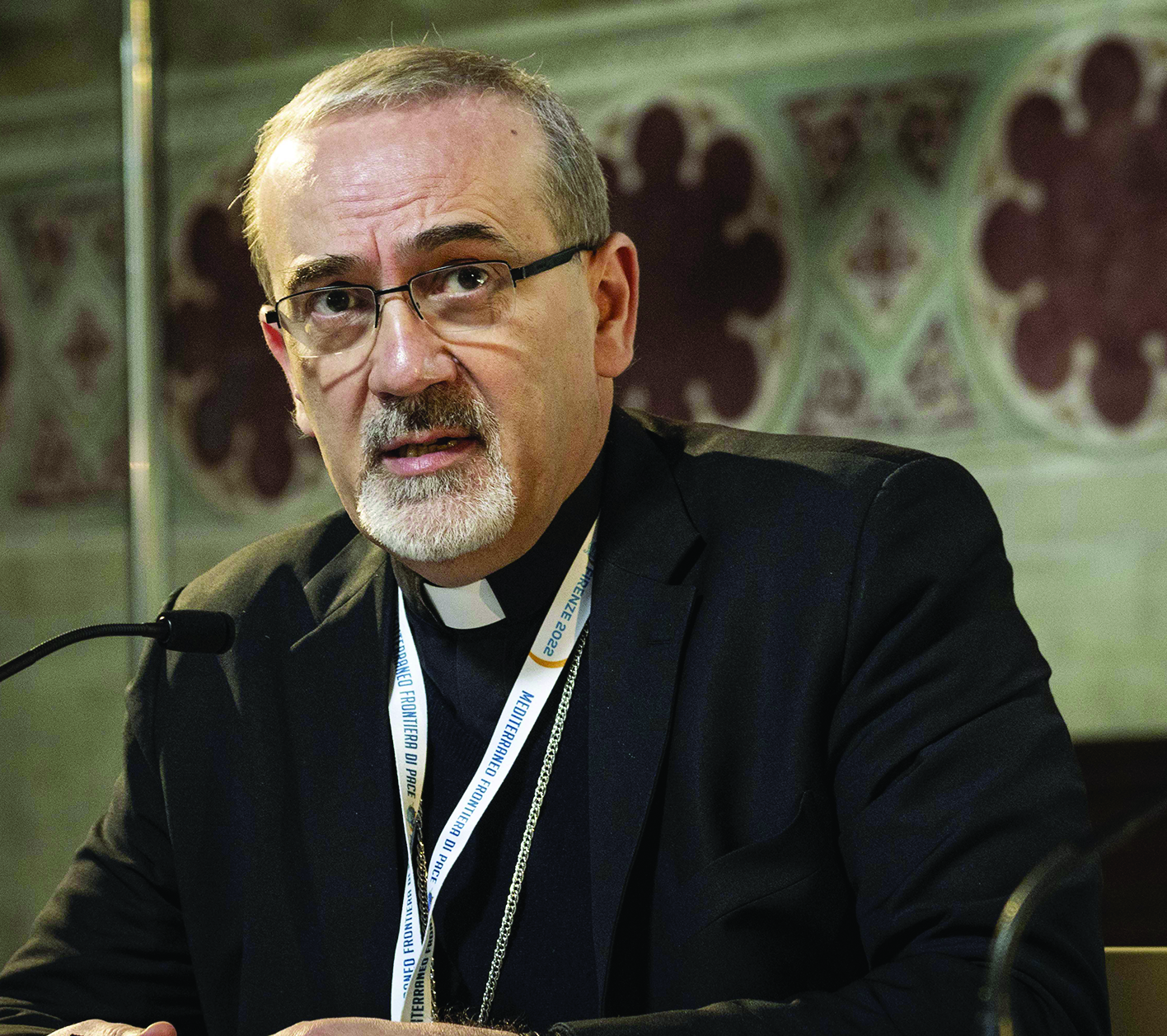
Many conversations on the sidelines of the recent Synod in Rome touched on the catastrophic situation the Christian community, and Lebanon as a whole, is currently undergoing. Bishop Mounir Khairallah (photo), the Maronite Catholic Bishop of Batrun, spoke eloquently at the Synod press briefing on October 5, sharing his own personal story of loss and hardship.
Bishop Khairallah’s story is remarkable. Growing up during the period of Lebanon’s Civil War, from 1975 to 1990, he lost several members of his family to the violence. In his statement at the press briefing, he noted, “I have personally experienced forgiveness. When I was five years old, someone came to our house and brutally murdered my parents. I have an aunt who is a nun in the Lebanese Maronite order. She came to our house to take us four children — the eldest was six years old, the youngest two — and took us to her monastery. In the church, she invited us to kneel and pray — to pray to God for mercy, for love. She told us: ‘Let us not pray so much for your parents; they are martyrs before God. Let us instead pray for those who killed them and seek to forgive throughout your lives. Thus you will be the children of your Father, who is in Heaven.’”

Yahya Sinwar, the planner of the October 7 attack
Khairallah also noted that the current war in Lebanon is “not entirely a war of confession or religion. It is a war that has been imposed on us.” He continued, “Leb anon is a message of peace and should remain a message of peace. It is the only country in the Middle East where Christians, Muslims, and Jews can live together, respecting their diversities, in a nation that is a ‘model nation,’ as Pope Benedict XVI said. Coming here, in this situation, to speak at the Synod might seem strange. Speaking also about forgiveness, which Pope Francis has taken as a sign for this Second Session, would be even more complex. Yes, I come here to speak about forgiveness and reconciliation, while my country and my people suffer and experience the consequences of wars, conflicts, violence, vengeance, and hatred. We Lebanese always want to condemn hatred, vengeance, and violence. We want to build peace. We are capable of doing so. If Pope Francis has chosen forgiveness, for us and for me, it is a great message to give.”
The reality of the ongoing hostilities, which since the beginning of September has expanded to become the most significant Israel-Hezbollah conflict since 2006, does not seem conducive to building peace. The towns and villages in southern Lebanon, now caught between entrenched Hezbollah forces and an incipient Israeli ground invasion, are primarily Shia, but there is a patchwork of Maronite and Orthodox Christian enclaves as well. In late September, Fr. Gregory Salloum of the Greek Orthodox Patriarchate of Antioch was hospitalized after suffering serious injuries in an Israeli airstrike on Ibl al-Saqi, Lebanon. Other leaders within the Christian community, like Fr. Najib al-Amil, are working tirelessly to ensure that the Christian villages are not used as staging grounds for Hezbollah’s attacks. In a September interview with The Guardian, Fr. al-Amil stated, “We don’t know what will happen. We are isolated, tired and scared.”
On September 29, when asked to comment on the killing of Nasrallah while en route from Belgium to Rome, Pope Francis called for a return to rules that, even in the midst of the general immorality of war, “indicate some morality.”
“When there is something disproportionate, there is a dominating tendency that goes beyond morality,” Francis said. “A country that does these things — and I’m talking about any country — in a superlative way, these are immoral actions.”

July 7, 2018. The meeting for peace in the Middle East called by Pope Francis with the heads of the Churches and Christian communities. Above, Bishop Mounir Khairallah, the Maronite Catholic Bishop of Batrun